The lesser spotted eagle is a majestic bird of prey, but it's also a species that's facing some significant challenges.
This eagle is found in Europe, Asia, and Africa, with a range that spans across many countries.
In the wild, lesser spotted eagles typically nest in mature forests, often at heights of 10-30 meters above the ground.
They're skilled hunters, and their diet consists mainly of small mammals, birds, and reptiles.
Additional reading: Lesser Egyptian Jerboa
Physical Description
The lesser spotted eagle is a medium-sized bird, measuring between 54 to 65 cm in length. Its wingspan ranges from 145 to 165 cm, which is narrower compared to other closely related species.
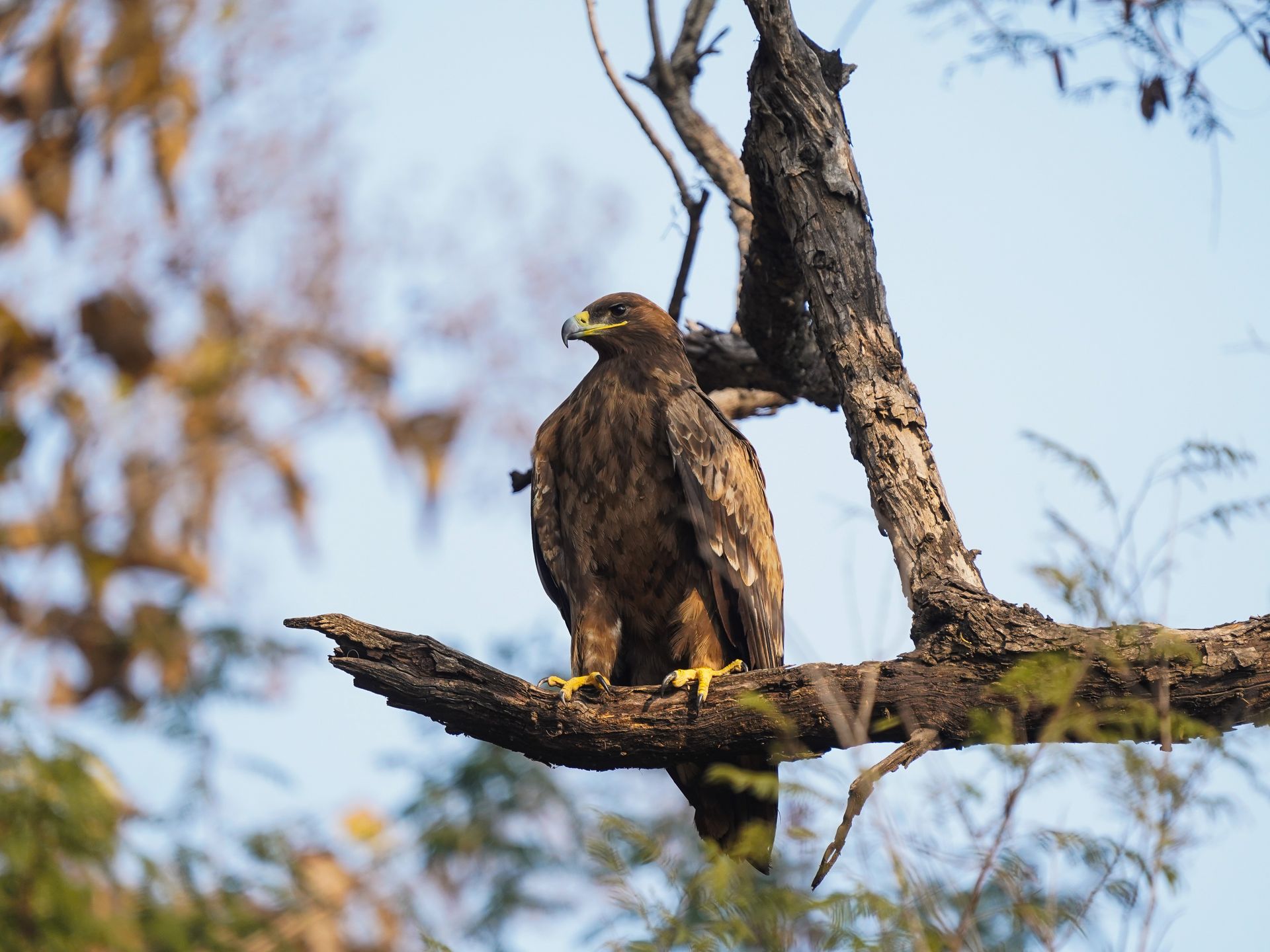
One of the distinctive features of the lesser spotted eagle is its yellow eyes, which are a lighter shade than the brown eyes found in adult steppe eagles and greater spotted eagles. Juveniles of all three species have brown eyes.
The lesser spotted eagle's head and wings are a lighter shade of brown compared to the rest of its body, making it easily distinguishable from other eagle species. Its body is predominantly brown, with a white V mark on its rump.
Discover more: Lesser Hedgehog Tenrec
Here are some key physical characteristics of the lesser spotted eagle:
- Range mass: 1.2 to 2.2 kg
- Average mass: 1.6 kg
- Range length: 54 to 65 cm
- Range wingspan: 145 to 165 cm
The lesser spotted eagle's beak is small, which is typical for an eagle. Its beak and talons are deadly sharp, making it a formidable hunter.
Distribution and Habitat
The lesser spotted eagle is a bird of varied habitats, found in different parts of the world. It breeds in Central and Eastern Europe, southeastward to Turkey and Armenia, and winters in Africa.
This eagle is a wary species, preferring open or lightly wooded country where it can hunt small mammals, such as voles, ground squirrels, and rats, as well as small birds, amphibians, reptiles, and occasionally insects.
Its habitat consists of patchy woodland areas, meadows, fields, and natural grasslands, often in moist environments. The eagle has been found in African dry mountain and grassland savanna habitats during its winter migration.
The lesser spotted eagle generally hunts by walking along the ground, but it typically nests and perches in the branches of forest trees, often using branches closer to the ground.
Here's a breakdown of the eagle's habitat regions:
- Habitat Regions
- temperate
- tropical
- terrestrial
- Terrestrial Biomes
- savanna or grassland
- forest
- scrub forest
- mountains
Behavior and Ecology
The lesser spotted eagle is a fascinating bird with some unique behaviors. It uses regularly spaced territories consistently between years in the north-western part of its distribution.
The distances between territories vary across the region, but this doesn't seem to affect breeding success. Instead, the eagles are influenced by large-scale factors such as fluctuations in climate or prey availability.
In fact, synchronous variation in breeding success across the region indicates that the eagles are indeed affected by these larger factors. This is why you might see a decline in breeding success in certain areas.
The lesser spotted eagle lays one to three white, buff-spotted eggs in a tree nest. The female starts incubating when the first egg has been laid, which can lead to the first young to hatch outgrowing its clutch mate(s) and eventually killing them.
Here's a quick rundown of some key facts about the lesser spotted eagle's behavior and ecology:
- IUCN Red List least concern species
- Clanga (genus)
- Birds of prey of Europe
- Birds of West Asia
- Birds of the Himalayas
- Birds of Africa
- Birds of East Africa
- Birds described in 1831
- Eagles
- Taxa named by Christian Ludwig Brehm
Behaviour and Ecology
The lesser spotted eagle is a fascinating bird species with some unique behavior and ecological characteristics. They use regularly spaced territories consistently between years in the north-western part of their distribution.
The distances between territories vary across the region, but this isn't related to breeding success. Instead, the eagles are influenced by large-scale factors such as fluctuations in climate or prey availability.
Synchronous variation in breeding success across the region suggests that the eagles are indeed influenced by these external factors. This is evident in the fact that breeding success can vary significantly from year to year.
The lesser spotted eagle lays one to three white, buff-spotted eggs in a tree nest. Only in breeding seasons with very abundant prey does more than one young fledge.
Here's a breakdown of the lesser spotted eagle's breeding habits:
- Female starts incubating when the first egg has been laid
- First young to hatch usually outgrows its clutch mate(s)
- First young may kill and eat its fellow siblings
The lesser spotted eagle's home range is typically 1800 km^2, but can range from 1200 to 2500 km^2.
You might enjoy: American Bald Eagle Range
Predation
Lesser spotted eagles have no natural predators and don't have any anti-predation adaptations. This lack of protection leaves them vulnerable to human threats.
Humans are a major danger to lesser spotted eagles, primarily due to chemical usage like Azodrin, an organophosphorous insecticide. This insecticide can poison animals that feed on crops, and lesser spotted eagles often die after eating these poisoned animals.
Lesser spotted eagles are also hunted by humans, particularly as they migrate to their wintering grounds. Habitat loss and fragmentation due to increased agriculture have been reported in Germany and other areas.
Siblicide is another cause of mortality in lesser spotted eagles. When there are multiple eggs in a nest, the first-hatched chick often kills its siblings by knocking them out of the nest or attacking them.
Here are some known predators and potential threats to lesser spotted eagles:
- American minks (Neovison vison) have been known to eat greater spotted eagle eggs, and may also prey on lesser spotted eagle eggs.
- Snakes (Order Squamata) have been suggested as potential egg-eaters, although this has not been clearly documented.
Conservation and Classification
The lesser spotted eagle is a species that's not too concerning in terms of conservation status. It's currently classified as Least Concern by the IUCN Red List.
One of the reasons for this classification is the large range that lesser spotted eagles occupy. They can be found living in sub-Saharan Africa and Madagascar.
Their habitat is diverse, and they can be found in various biomes, including forest biomes, which are dominated by trees. They also make seasonal movements between breeding and wintering grounds.
Here's a breakdown of their classification:
Their main threat is deforestation and destruction of habitats, but they're adaptable and widespread, so their conservation status isn't too concerning.
Conservation Status
The lesser spotted eagle is classified as Least Concern by the IUCN Red List, indicating a stable population status.
Declines in lesser spotted eagle populations have been documented, but these declines are occurring relatively slowly.
Humans are a threat to lesser spotted eagles by hunting them during migration periods, and loss of breeding habitat also contributes to population declines.
The lesser spotted eagle's large range, which covers sub-Saharan Africa and Madagascar, helps to mitigate the impact of these threats.
As an animal that mainly eats meat, the lesser spotted eagle relies on its hunting skills to survive, making conservation efforts crucial to protect its population.
For more insights, see: Lesser Canada Goose
Classification
Classification is a crucial step in understanding and conserving species like the lesser spotted eagle. It helps us categorize them based on their evolutionary relationships and characteristics.
The kingdom Animalia is the broadest category, encompassing all animals, including the lesser spotted eagle. There are 22,861 pictures of animals available online.
Within the kingdom Animalia, the phylum Chordata is a significant category, comprising animals with a notochord, a dorsal nerve cord, and a post-anal tail. There are 15,213 pictures of chordates available online.
The class Aves is a more specific category, including all birds, including the lesser spotted eagle. There are 7,311 pictures of birds available online.
Here's a breakdown of the classification hierarchy:
The lesser spotted eagle's scientific name, Aquila pomarina, indicates its classification within the genus Aquila, which includes golden eagles. There is only 1 picture of Aquila pomarina available online.
Breeding and Reproduction
The breeding and reproduction habits of the lesser spotted eagle are quite fascinating.
In the breeding season, the female lays one to three white, buff-spotted eggs in a tree nest. The first chick to hatch often outcompetes its siblings due to the female's early incubation.
The lesser spotted eagle is mostly a solitary animal, except for when it comes to breeding season, when they travel around in pairs.
They tend to breed in Europe before moving to Africa to spend the cold winter months there. This migration pattern is quite unique.
The incubation period lasts between 43-45 days, with the female and male alternating the role of incubating, while the other will hunt for food. This is a great example of shared parenting.
Unfortunately, it's fairly common for the female lesser spotted eagle to begin incubating when only the first egg has been laid, which causes the first eaglet to outgrow its siblings. This results in the hatchling killing and eating its fellow siblings.
Both the male and female will build their nests in tall trees, made out of sticks and lined with leaves for comfort.
Take a look at this: Female American Bald Eagle
Identification and Similar Species
The lesser spotted eagle is a bird that's relatively easy to identify thanks to its distinctive features.
The white patch on the upper wings is a key identifying characteristic, and it's retained even in adulthood. This patch is a great way to tell the lesser spotted eagle apart from other birds.
A pronounced white "V" on the rump is another feature to look out for - it's a trait that's unique to the lesser spotted eagle and can be seen in birds of all ages. This "V" shape is a great visual marker to keep in mind when trying to spot the bird.
Juveniles have a cream-colored neck patch that's a distinguishing feature, but it's worth noting that their wings display less contrast than those of adults. This can make them a bit trickier to identify, but the neck patch is still a great clue.
The greater spotted eagle can be confused with the lesser spotted eagle, but the former lacks the wing covert spotting and the well-defined white "V" on the rump seen in the latter.
Broaden your view: Great Crested Grebes
Featured Images: pexels.com