The Indian Spotted Eagle is a majestic bird of prey that calls the Indian subcontinent home. They are primarily found in the tropical forests and grasslands of India, Nepal, and Bhutan.
Their habitat is a mix of deciduous and evergreen forests, with a preference for areas with dense tree cover and a mix of open grasslands. This unique habitat allows them to hunt and nest with ease.
In the wild, Indian Spotted Eagles are known to be solitary birds, only coming together during mating season. They are also known to be fiercely protective of their territory, which they mark with their strong talons and sharp beaks.
Unfortunately, the Indian Spotted Eagle is listed as Near Threatened on the IUCN Red List, due to habitat loss and fragmentation, as well as hunting and poaching.
Physical Characteristics
The Indian spotted eagle is a large bird of prey, measuring 23 inches in length with a wingspan of 1.5 meters.
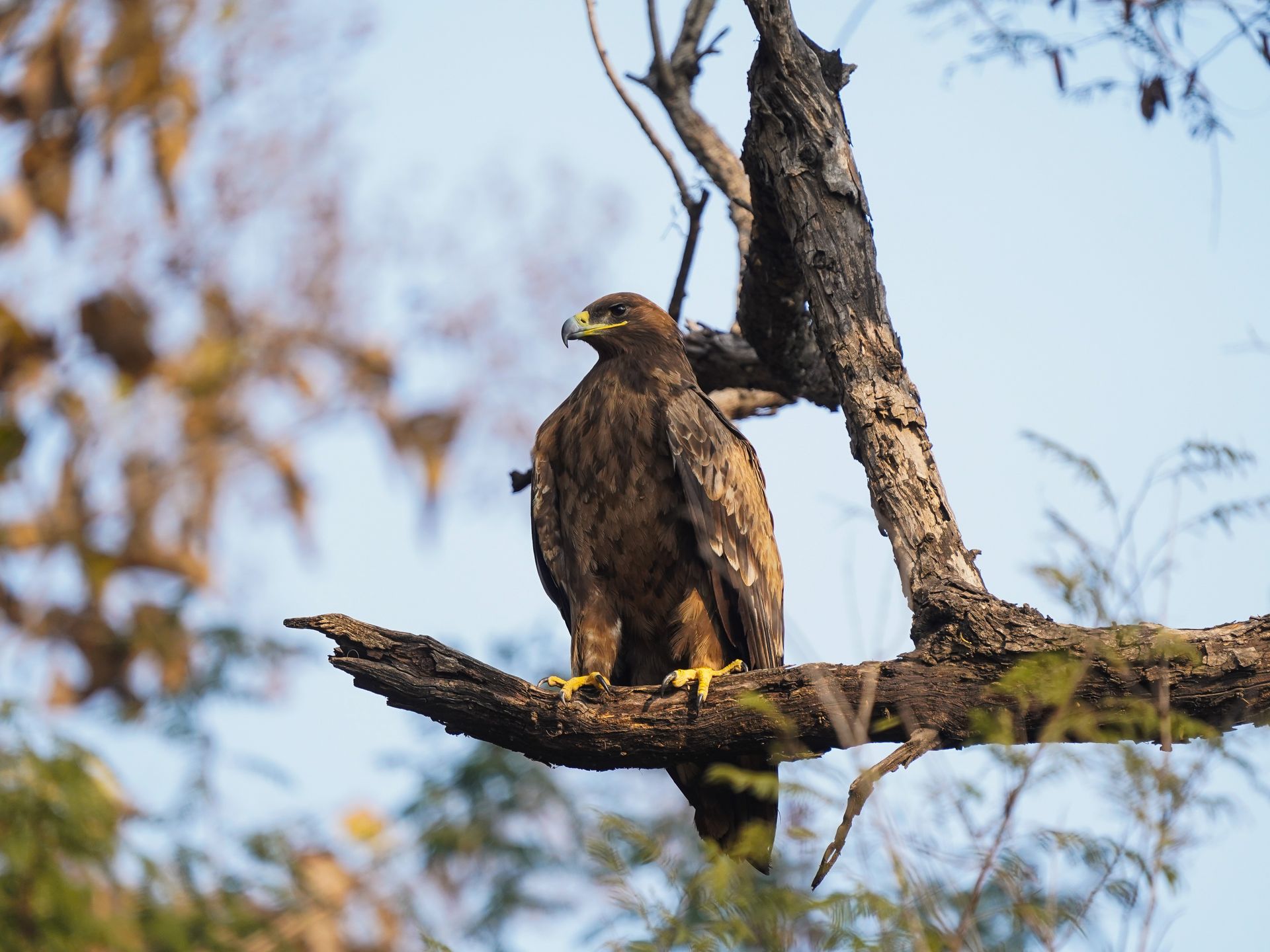
Its broad head shape and piercing eyes give it a distinctive appearance. The Indian spotted eagle has a predominantly earthy brown coloring all over, with dark brown irises that make their eyes stand out from their plumage.
Some Indian spotted eagles have white spots dotted irregularly over the outer parts of their wings, although this isn't prevalent in all the eagles. Each eagle is unique due to its inconsistent feather patterns.
The feathers of an Indian spotted eagle are varying shades of earthy-toned browns, with some eagles possessing pale and white spots over their plumage. In flight, the feathers on the wings are uniformed and darker than the feathers on the body of the eagle.
Their tail feathers are surprisingly short compared to the tails of other eagle species. The Indian spotted eagle has a sharp beak and yellow legs, complete with black talons.
For more insights, see: Haliaeetus Leucogaster
Habitat and Distribution
The Indian spotted eagle is native to Bangladesh, Cambodia, India, Myanmar, Nepal, and (marginally) in Pakistan. It occurs in agricultural landscapes and tropical dry forests.
This bird thrives in agricultural landscapes and tropical dry forests of its native range. Its unique evolutionary history, having diverged from its common ancestor with the lesser and greater spotted eagles around 3.6 million years ago, is likely linked to the separation of northern and southern lineages in the region of present-day Afghanistan.
The Indian spotted eagle prefers subtropical and tropical dry forests to plantations and arable land. It's vagrant in Pakistan, but resident and breeding in Chitwan and Bardia National Parks, in Sukla Phanta and Koshi Tappu Wildlife Reserves, and in some unprotected areas in the Terai of Nepal.
This species can often be approached quite closely for a large raptor, and it doesn't show any special affinity for wetland habitats like the greater spotted eagle. It's distributed sparingly over the Gangetic plains, in the east up to Manipur, in Madhya Pradesh and southern Orissa, but in the south limited to Kotagiri and Mudumalai, Nilgiris district, Tamil Nadu and Tumakuru, Karnataka.
The Indian spotted eagle is a South Asian bird native to India, Bangladesh, Nepal, and Myanmar. It often drifts over to Pakistan.
Suggestion: Greater Spotted Eagle
Behavior and Reproduction
The Indian spotted eagle is a monogamous bird, meaning it will only mate for life with one partner.
The breeding season for these eagles is from March to May, a relatively short period of time.
During this time, the male performs a series of aerial displays above the female, including "wing-winnowing" and "heart dives", which involve unique wing positions and calls.
The female will generally lay 1-2 eggs, and both parents take turns incubating them for 31 days, with the female doing most of the incubating during the day.
The male will hunt for food during this time, and once the eggs hatch, the nestling period can take up to 71 days before the eaglets reach the fledgling stage.
You might like: Blue Spotted Salamander Eggs
Reproduction Behavior
The Indian spotted eagle's reproductive behavior is quite fascinating. The male performs a series of aerial displays above the female, which includes "wing-winnowing" and "heart dives".
These displays are a crucial part of the mating ritual. The male and female make their distinctive calls to each other during this time.
Recommended read: Female American Bald Eagle
The female generally lays 1-2 eggs, and the male and female take turns incubating them for 31 days. The female mostly incubates during the day, while the male hunts for food.
The nestling period can take up to 71 days before the eaglets reach the fledgling stage. The female stays with her eaglets until the seventh week.
The breeding season for the Indian spotted eagle is from March to May. This is a relatively short window for reproduction.
What Adaptations Do They Have?
The Indian spotted eagle's adaptations are quite impressive. Its talons are hooked, black, and incredibly sharp, making them a formidable tool for catching prey.
These sharp talons are complemented by a strong, hooked beak, also black in color. Both the talons and beak help the eagle to be the ultimate predator.
The earthy-toned feathers of the Indian spotted eagle are a clever adaptation, helping the bird to blend into its surroundings. This makes it far more elusive to unsuspecting prey below.
Curious to learn more? Check out: Black Solitary Eagle
Are They Aggressive?
The Indian spotted eagle isn't likely to reside near human settlements, though some are often found in urban parks. They tend to keep themselves to themselves, and it's rare for them to get into a fight with a fellow eagle.
This species isn't a threat to humans in terms of aggression, but it's rare for a human to get close enough to this eagle to see how aggressive it is.
Conservation and Lifespan
The Indian spotted eagle's lifespan is a remarkable thing. In the wild, they can live between 12-15 years, although in captivity, they can live up to 20 years.
It's worth noting that adult Indian spotted eagles are at the top of their food chain, and as such, they have very few natural predators. This is a testament to their impressive hunting skills.
Their young, on the other hand, face threats from reptiles like snakes and lizards that might try to sneak into their nest, and from eagles and other birds of prey that might steal their eggs or chicks.
Curious to learn more? Check out: Where Does the American Bald Eagle Live
Conservation Status
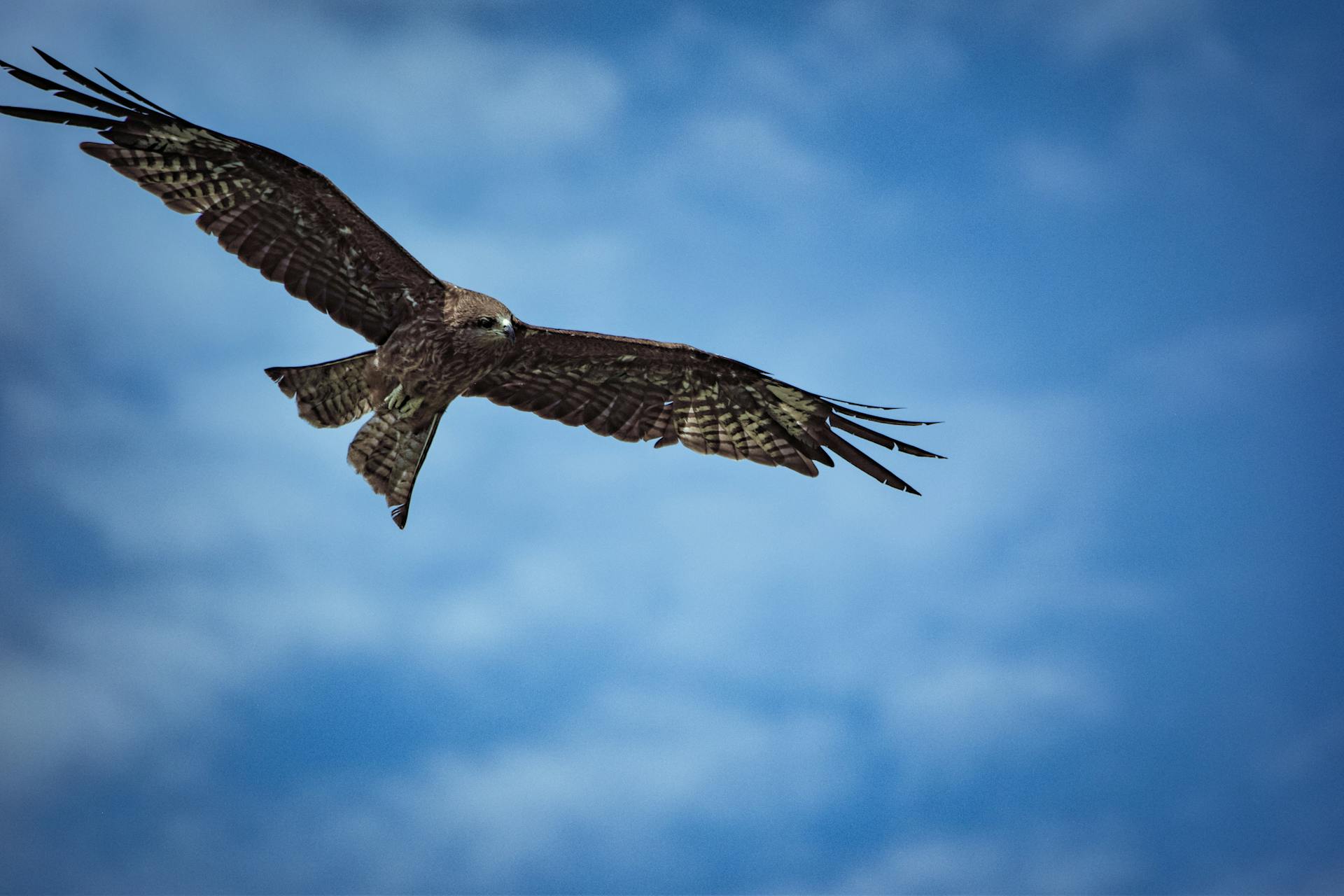
The Indian spotted eagle is classified as Vulnerable on the IUCN Red List of Threatened Species.
Deforestation is the primary reason for their vulnerable status, contributing to the destruction of their habitats through agriculture, human settlements, and general disturbance.
Their non-migratory nature means they won't leave their area, leading to a decline in population.
Conservation efforts are essential to ensure the survival of this remarkable bird.
Lifespan
The Indian spotted eagle's lifespan is a fascinating topic.
In the wild, they can live between 12-15 years.
Their lifespan can stretch to 20 years in captivity.
As adults, these birds are at the top of their food chain, so it's very rare for them to have an animal predator.
However, as juveniles and eaglets, they have a few predators, including reptiles like snakes and lizards that might try to sneak up to the nest.
If an eaglet falls from the nest, the height of the tree can be a huge threat to their lives.
For more insights, see: Atlantic Spotted Dolphin Lifespan
Nesting and Calls
The Indian spotted eagle is a skilled builder, constructing its nest on the fork of a tall tree. These nests are sturdy and made of sticks, twigs, and leaves.
The female Indian spotted eagle does most of the nest-building, with the male occasionally bringing up sticks. The male's role during this time is to focus on hunting for food.
The circular nest is a testament to the eagle's engineering skills, and it's a safe haven for the female to lay her eggs.
Related reading: American Bald Eagles Nest
What Are Their Nesting Habits?
The Indian spotted eagle is a skilled nest builder, constructing its home on the fork of a tall tree. These nests are typically circular and sturdy.
They use sticks, twigs, and leaves to build their nests, which are mostly constructed by the female. The male eagle occasionally brings up sticks to help with the building process.
The male eagle spends most of his time hunting for food while the female is busy building the nest.
Calls/Sounds
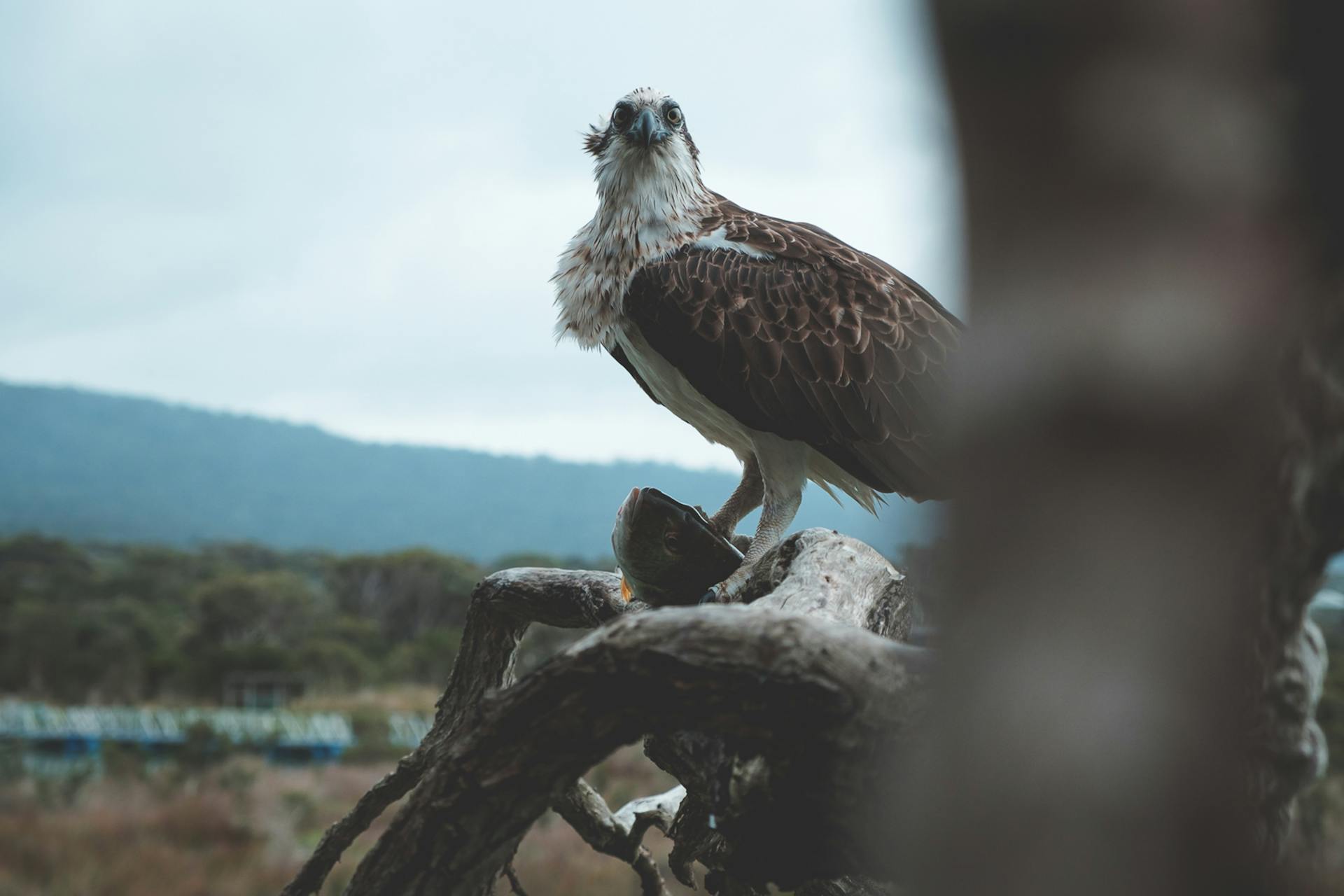
The Indian spotted eagle's call is a high-pitched, shrill cackle, similar to other eagle species.
You might be surprised to hear that the call of the Indian spotted eagle is quite distinctive and easy to identify.
Systematics and Evolution
The Indian spotted eagle has a unique evolutionary history, distinct from other eagles.
Its lineage diverged around 3.6 million years ago from the common ancestor of the lesser and greater spotted eagles.
The "proto-spotted eagle" likely lived in the general region of Afghanistan, splitting into a northern and southern lineage when glaciers and deserts advanced in Central Asia.
The Indian spotted eagle was previously grouped with the lesser spotted eagle, but is now recognized as a distinct species due to its morphological, behavioral, ecological, and DNA sequence data.
It's worth noting that the spotted eagles as a group are quite distinct from the typical members of the genus Aquila, and are now placed in their own genus, Clanga.
Suggestion: Lesser Spotted Eagle
Frequently Asked Questions
What is the Indian eagle called?
The Indian eagle is known as the Indian spotted eagle (Clanga hastata). This majestic bird of prey is a sight to behold with its distinctive features.
What do spotted eagles eat?
Spotted eagles are opportunistic feeders that eat a diverse diet of small mammals, birds, reptiles, insects, and carrion. Their varied diet includes rodents, frogs, water birds, and other small animals.
Featured Images: pexels.com