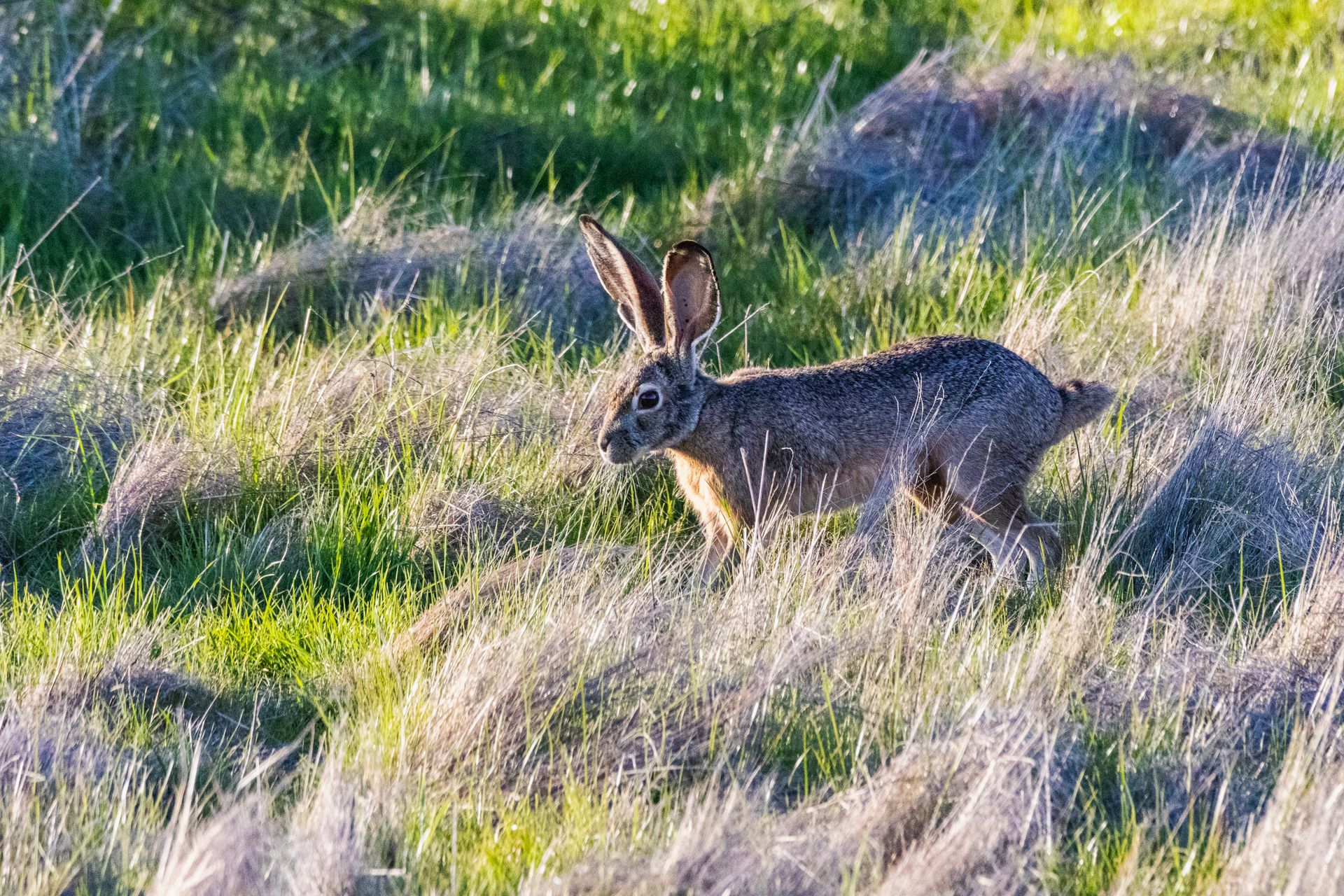
The lesser Egyptian jerboa is a remarkable creature that calls the deserts of North Africa and the Middle East home. They inhabit a vast range of habitats, from sandy dunes to rocky outcrops.
Their burrowing behavior is a key adaptation to survive in these harsh environments, allowing them to dig complex networks of tunnels and dens.
The lesser Egyptian jerboa is a solitary animal, only coming together with others of its kind during the breeding season.
Related reading: Lesser Canada Goose
Physical Characteristics
The lesser Egyptian jerboa's physical characteristics are quite unique. It has incredibly large hind legs, which are similar to those of a tiny kangaroo.
These large hind legs allow the jerboa to hop around with ease. It uses its powerful legs to jump long distances.
The jerboa has three toes on each of its hind feet, which provide excellent balance and traction. Its long tail also helps with balance when jumping.
Its big eyes and ears are perfectly suited for its desert habitat, where it needs to be alert for predators. Its short snout is a distinctive feature of the jerboa's face.
The jerboa's coat can be a pale or dark sandy color, and its belly is usually a lighter shade. This coloration helps the jerboa blend in with its surroundings.
For more insights, see: Greater Egyptian Jerboa
Biology and Behavior
The lesser Egyptian jerboa is a nocturnal species that thrives in the arid desert conditions. It feeds on seeds, insects, succulent parts of desert grasses, and fungi, using its acute sense of smell to detect food.
Its diet provides all the water it needs, allowing it to survive without drinking water. The jerboa can travel long distances, up to ten kilometers a day, thanks to its large feet and hopping stride.
One leap can cover up to three meters in a single bound, making it an impressive sight to behold. Its burrows are complex systems with multiple entrances and exits, storage chambers, hibernation chambers, and a nesting chamber at the bottom.
The burrows are well-hidden and sealed with a plug of sand in late spring and summer to keep the heat out and moisture in. The jerboa will also aestivate in its burrow during hot or dry spells.
Jerboas are solitary and nocturnal, making them difficult to study. However, breeding is known to occur at least twice a year, between June and July and from October to December.
Related reading: European Water Vole
A successful mating usually produces a litter of four to five young that become independent at around eight to ten weeks. The jerboa is generally silent, but can emit grunting noises or shrill shrieks when disturbed or handled.
Here are some key behaviors of the lesser Egyptian jerboa:
- fossorial
- saltatorial
- nocturnal
- motile
- sedentary
- hibernation
- aestivation
- solitary
Its range territory size is 10 to 14 km^2.
Habitat and Distribution
The lesser Egyptian jerboa is a desert-dwelling creature, found in areas with sandy or rocky terrain. These areas can be quite vast, covering parts of the Sahara Desert and the Sahel region.
You can find them in scattered areas of the Middle East, including parts of Egypt, Sudan, Israel, and Morocco. They're also common in Egypt, where they get their common name, the Lesser Egyptian Jerboa.
Jerboas live in burrows, which they dig using their front paws and teeth. These burrows are often complex, with many entrances and exits, and special rooms for storage, sleeping, and nesting.
Here are some key characteristics of their habitat:
- Habitat Regions: temperate, terrestrial
- Terrestrial Biomes: desert or dune
In the desert, jerboas can be found in rocky valleys and meadows, although in less numbers. They prefer places where they can easily dig their burrows.
Reproduction and Life Cycle
The lesser Egyptian jerboa's reproductive habits are quite fascinating. They are solitary and nocturnal, making it difficult to study their mating system, but it appears that males will mate with multiple females, while females will only mate with one male.
Males attract a mate by standing on their hind legs and slapping the female with their short front limbs. This unique courtship behavior is a key part of their reproductive process.
Lesser Egyptian jerboas breed at least twice a year in the wild, and even more frequently in captivity, every three months. This means they have a relatively short breeding interval.
Their breeding season occurs from June to July and from October to December, which is a relatively short period of time. During this time, females give birth to an average of three young per litter.
The young jerboas are born after a short gestation period of around 25 days, and are hairless and tiny, with a head and body around 25 mm in length. They weigh about 2 g and have very short hind feet.
Expand your knowledge: Lesser Hedgehog Tenrec
The mother jerboa does not provide much care for her young, and in some cases, has even been known to kick them out of the nest. However, in the wild, the babies and mother are brought into close contact in the burrow.
Here's a breakdown of the key reproductive features of lesser Egyptian jerboas:
The young jerboas are able to crawl around using their front limbs, but their eyes are closed over at birth. They develop quickly, and are able to leave the burrow and become self-sufficient at around 8 weeks of age.
Predation and Threats
The lesser Egyptian jerboa has a few natural predators that it needs to watch out for. Desert carnivores like pallid foxes, Nile foxes, and striped weasels are all on the lookout for a tasty jerboa meal.
These predators are fast and can catch jerboas off guard, which is why the jerboas' best defense is to run for cover - often into their burrows. They're also not very good at defending themselves when caught.
Saw-scaled vipers and moila snakes are other predators that jerboas need to be careful about. And, unfortunately, some humans eat jerboas too, which is another threat to their survival.
If this caught your attention, see: Baluchistan Pygmy Jerboa
Economic and Conservation Importance
The lesser Egyptian jerboa has some interesting economic and conservation implications. Some humans eat jerboas for food, which is a positive aspect of their economic importance.
Their popularity as pets is also worth noting. Jerboas are easily tameable and do not commonly bite, making them a great option for those looking for a low-maintenance pet.
Conservation Status
The Mediterranean assessment of the species shows that it is not currently considered threatened. This is reflected in its conservation status.
The IUCN Red List has designated the species as Least Concern, which means it is not considered to be at risk of extinction. This classification is based on the current available data and is subject to change as new information becomes available.
The species is also not listed on the US Federal List or CITES, which means it does not have any special conservation status in the United States or under international law.
- IUCN Red List: Least Concern
- US Federal List: No special status
- CITES: No special status
It's worth noting that the species' conservation status can change over time as new information becomes available.
Economic Benefits to Humans
Some humans eat jerboas for food, which is a positive economic impact on humans. Jerboas are becoming popular pets because they are easily tameable and do not commonly bite.
These small mammals are low-maintenance pets, making them a great option for people who want a unique and easy-to-care-for companion.
Classification and Habitat
The lesser Egyptian jerboa is a fascinating creature that can be found in various desert environments. These areas can be either sandy or rocky, providing the jerboa with the perfect terrain for digging its burrows.
The jerboa's habitat preferences are quite specific, and it tends to thrive in areas where it can easily dig its burrows.
The lesser Egyptian jerboa can be found in desert and semi-desert areas, which can be sandy or stony. They can also be found in less numbers in rocky valleys and meadows.
Here are some key habitat characteristics of the lesser Egyptian jerboa:
- Terrestrial Biomes: desert or dune
The jerboa's ability to adapt to different environments is impressive, but it's clear that it has a strong preference for desert and semi-desert areas.
Conclusion
The lesser Egyptian jerboa has proven to be a fascinating creature, and it's essential to take a step back and appreciate its unique characteristics.
Its ability to survive in harsh desert environments is a testament to its remarkable adaptability, with the ability to go without water for long periods of time.
In the wild, these jerboas can be found in a variety of habitats, from sandy dunes to rocky outcrops, making them a resilient and resourceful species.
Their impressive jumping ability, reaching speeds of up to 15 miles per hour, allows them to quickly escape predators and traverse their desert landscapes.
Despite their impressive abilities, the lesser Egyptian jerboa is still considered a vulnerable species due to habitat loss and fragmentation, making conservation efforts crucial for their survival.
Their unique appearance, with a stocky body and long hind legs, is a distinguishing feature that sets them apart from other jerboa species.
Overall, the lesser Egyptian jerboa is a remarkable creature that continues to capture the imagination of scientists and animal enthusiasts alike.
Suggestion: Lesser Spotted Eagle
Frequently Asked Questions
Can lesser Egyptian jerboas be kept as pets?
Yes, lesser Egyptian jerboas can be kept as pets, as they can be successfully tamed and domesticated. However, breeding them in captivity has been challenging due to their specific needs.
Featured Images: pexels.com