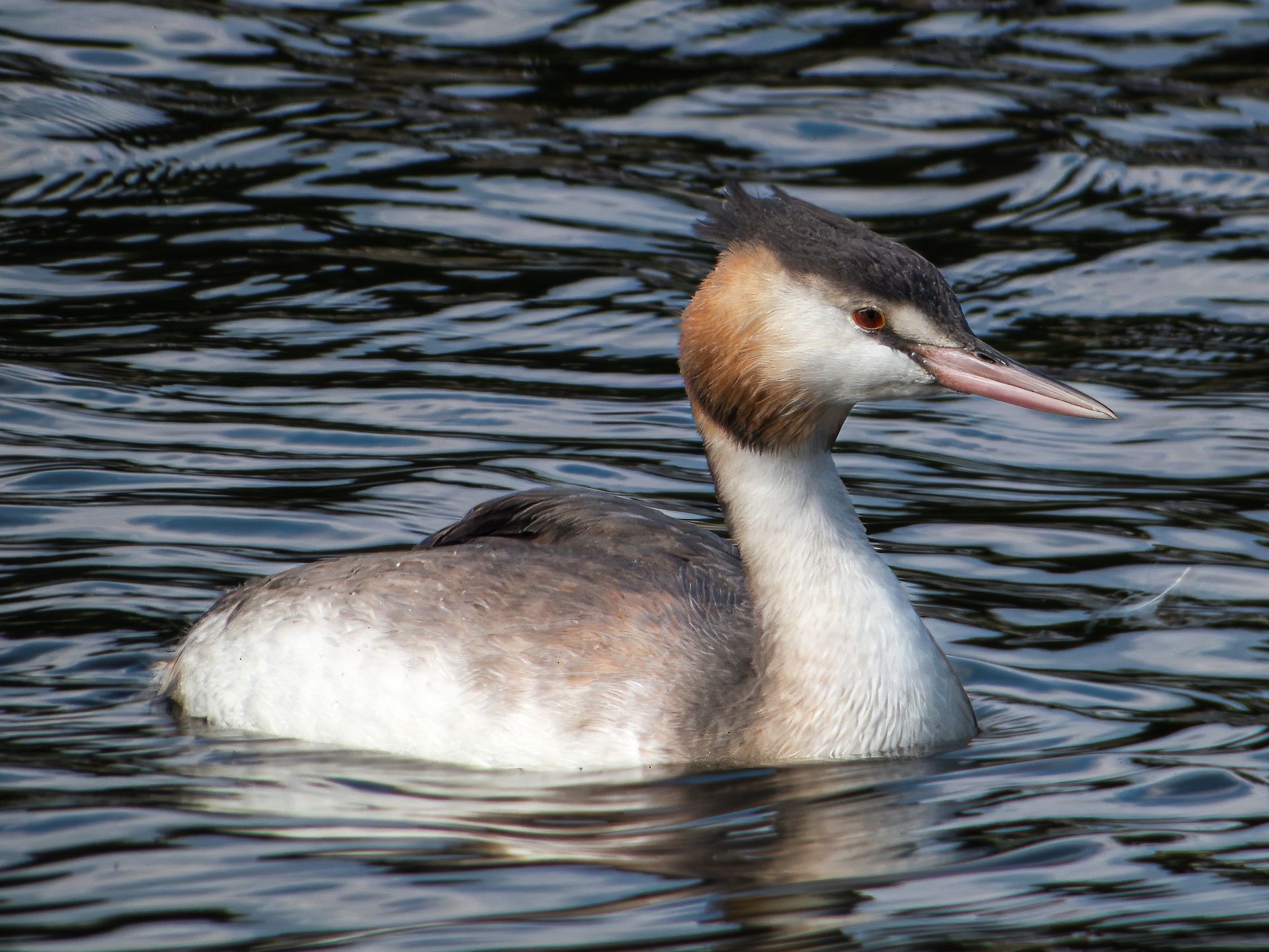
The Great Crested Grebe is a stunning waterbird with a distinctive crest on its head. They can be found in freshwater lakes, rivers, and wetlands across Europe, Asia, and North Africa.
These birds are known for their impressive diving skills, with some individuals reaching depths of up to 5 meters in search of food. They primarily feed on fish, crustaceans, and aquatic insects.
One of the most recognizable features of the Great Crested Grebe is its unique mating ritual, where the pair will sit together on the water, with their heads held high and their crests raised, to show off their courtship display.
You might enjoy: Crested Butte Dog Sledding
Classification
The great crested grebe's classification is a fascinating topic. It belongs to the kingdom Animalia.
Its phylum is Chordata, which includes all animals with a backbone. In fact, the phylum Chordata is made up of over 100,000 species.
The great crested grebe is a vertebrate, meaning it has a backbone. This classification is part of the subphylum Vertebrata.
In the class Aves, you'll find all birds, including the great crested grebe. It's a member of the order Podicipediformes, which includes all grebes.
Here's a breakdown of the great crested grebe's classification:
The great crested grebe's scientific name is Podiceps cristatus, which means "crested" in Latin.
See what others are reading: Chinese Crested Dog
Physical Characteristics
The great crested grebe is a stunning bird with some remarkable physical characteristics. They are the largest grebes in Europe, with a range of masses from 800 to 1490 grams.
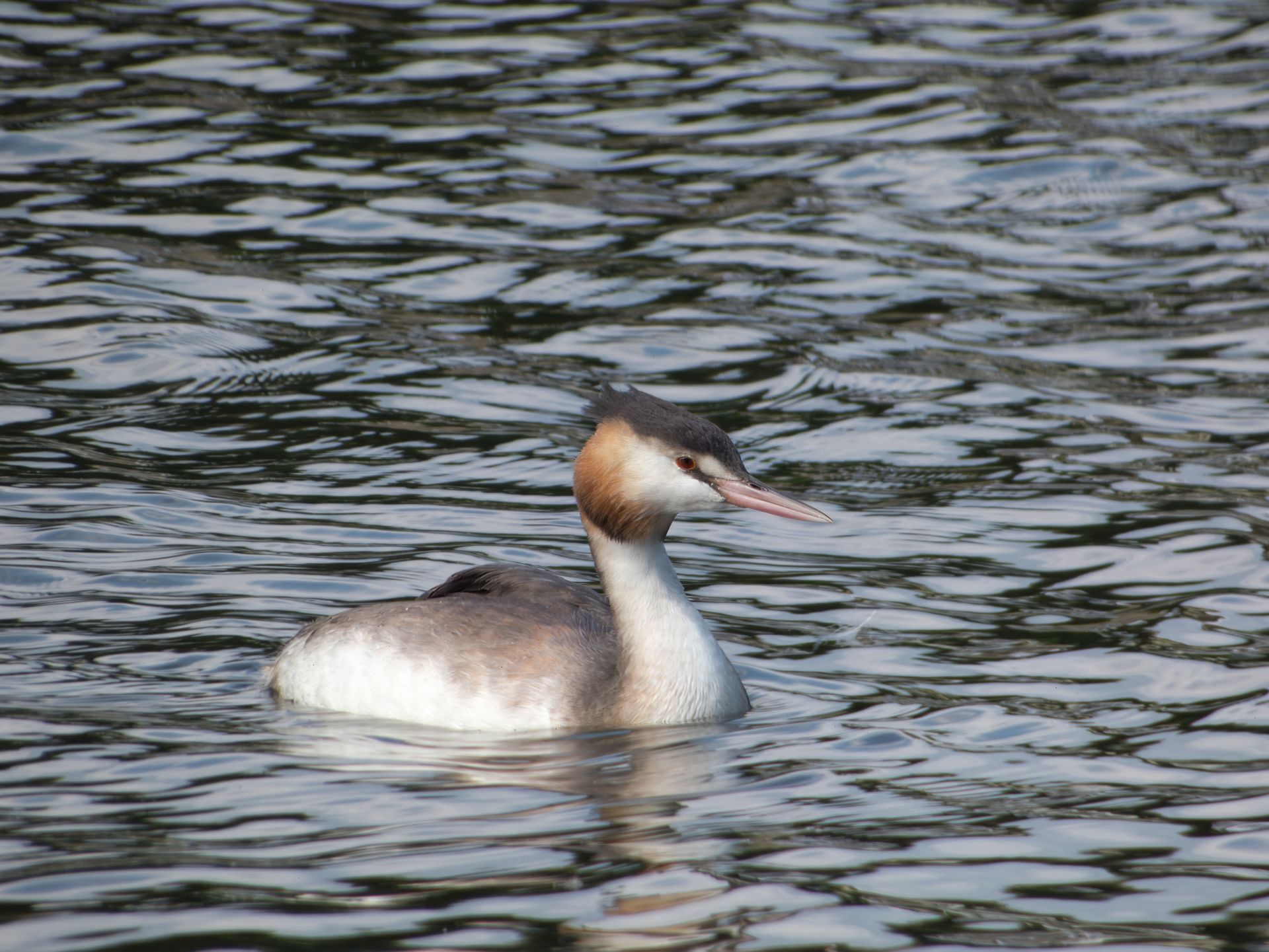
Their plumage is quite striking, with a mottled brown back and sides, and a white underside. The back of the neck is dark brown, while the front of the neck is white. They have long necks, which are perfect for their aquatic lifestyle.
One of the most distinctive features of the great crested grebe is their head plumes, which are reddish-orange with black tips. These plumes are only present during the breeding season, and start to develop in the winter. They are fully developed by spring.
The birds also have erectile black crests on the crown of their head, which are present year round. Their legs and tails are short, but set far back for efficient swimming and diving.
Here are some key physical characteristics of the great crested grebe:
- Range mass: 800 to 1490 g (28.19 to 52.51 oz)
- Range length: 46 to 61 cm (18.11 to 24.02 in)
- Range wingspan: 59 to 73 cm (23.23 to 28.74 in)
They have a long, pointed beak, and relatively long neck, which helps them to forage for food in the water. Their eyes are dark red, and their body is mostly brown to black, with a lighter rump and neck.
Habitat and Distribution
The great crested grebe can be found in a variety of aquatic habitats, including lakes, slow flowing rivers, swamps, and bays. These birds thrive in shallow open bodies of fresh or brackish water with vegetation on the banks and in the water.
They prefer waters with a rich fish population and can be found near reed-free shores during winter. In fact, many great crested grebes spend a large part of the winter in the middle of the lake.
Some key habitat regions include temperate, saltwater or marine, and freshwater areas. They can also be found in specific aquatic biomes like lakes and ponds, coastal areas, and brackish water.
Here are some key biogeographic regions where great crested grebes can be found:
- Palearctic
- Oriental
- Ethiopian
- Australian
Geographic Range
The Great Crested Grebe is a bird species with a wide geographic range. It's found in various parts of the world, including Western Europe, Britain, and Ireland, as well as in southern and eastern Africa, Australia, and New Zealand.
Breeding populations can be found in Eastern Europe, Southern Russia, and even as far as Mongolia. This suggests that the grebe is well adapted to a variety of habitats and can thrive in different environments.
The species can be found in coastal waters during the winter months, with populations present in Europe, southern Africa, and Australia. This indicates that the grebe is a migratory species, traveling to different areas in search of food and suitable breeding grounds.
The global population of the Great Crested Grebe is estimated to be between 920,000 to 1,400,000 individuals. This is a significant population, and it's likely that the species is well established in its various habitats.
Here are the biogeographic regions where the Great Crested Grebe can be found:
- Palearctic
- Oriental
- Ethiopian
- Australian
These regions correspond to the northern part of the Old World, which includes Europe, Asia, and northern Africa.
Habitat and Distribution
Great Crested Grebes can be found in a variety of aquatic habitats, including lakes, artificial bodies of water, and slow flowing rivers.
They prefer waters with a rich fish population, and can be found breeding in shallow open bodies of fresh or brackish water with vegetation on the banks and in the water.
In the winter, some populations migrate to bodies of water located in mild climates, while others can be found near reed-free shores.
Great Crested Grebes breed on large, shallow eutrophic loughs, and along canals and slow flowing rivers, often selecting wetlands with emergent vegetation bordered by open water.
Their nests are a large mound of aquatic vegetation, usually well concealed within reeds.
Here are some of the specific habitats where Great Crested Grebes can be found:
- Habitat Regions: temperate, saltwater or marine, freshwater
- Aquatic Biomes: lakes and ponds, coastal, brackish water
Behavior and Communication
Great crested grebes are mostly solitary birds, but they do form pairs during the breeding season. These pairs are fiercely protective of their nest sites and will defend them against other grebes.
Territorial behavior is highly variable among pairs and populations, but males and females will both defend their mates, nests, and young from potential threats. In fact, frequent fights have been observed over territorial boundaries during the breeding season in Britain.
Great crested grebes are also known to exhibit an interesting behavior where they ingest their feathers, especially when their diet is low in indigestible matter. This helps them create pellets that can be ejected to decrease the occurrence of parasites in their gastric system.
Here are some key behaviors exhibited by great crested grebes:
- flies
- natatorial
- diurnal
- motile
- migratory
- sedentary
- solitary
- territorial
In terms of communication, great crested grebes rely heavily on visual and acoustic cues. They use these to detect prey in the water and to communicate with potential mates during the breeding season.
Behavior
Great Crested Grebes are primarily solitary birds, but they do form pairs during the breeding season. They are highly territorial and will fiercely defend their nest sites against other pairs.
In the winter months, Great Crested Grebes are not territorial and can be found in loose colonies if there is a shortage of suitable nesting habitat. These colonies are often formed in coastal marshes and estuaries with salty water.
During the breeding season, both males and females defend their mates, nests, and young against other pairs. This territorial behavior is a key aspect of Great Crested Grebe behavior.
Here are some key behaviors exhibited by Great Crested Grebes:
- flies
- natatorial
- diurnal
- motile
- migratory
- sedentary
- solitary
- territorial
Great Crested Grebes are also known to exhibit an interesting feather-eating behavior, where they ingest their feathers to create pellets that can be ejected to decrease the occurrence of parasites in their gastric system. This behavior is more frequent when their diet is low in indigestible matter.
You might like: Great Pyrenees Temperament
Communication and Perception
Great crested grebes primarily communicate using visual and acoustic cues. They're quite skilled at detecting prey in the water thanks to their sharp eyesight.
Their mating pairs use calls to communicate, often producing them during their advertising behavior. These calls are a crucial part of their mating rituals.
In addition to calls, great crested grebes also perform elaborate courtship displays, which are mainly visual cues. It's a wonder to watch them in action!

Other than communication between pairs, great crested grebes are generally solitary animals. They don't seem to rely on scent to communicate, but other species of grebes have relatively large olfactory bulbs, suggesting they might use scent to find prey.
Interestingly, great crested grebes have a sense of taste. They've been known to reject fish that are infected, and video recordings have shown that they use the front of their beak to do so, which contains taste buds.
Here are the different perception channels used by great crested grebes:
- Visual
- Tactile
- Acoustic
- Chemical
Weekly Pattern
In the UK, the weekly pattern of occurrence is a crucial aspect of understanding the behavior and communication of certain species. The graph shows that taller bars indicate a higher likelihood of encountering the species in appropriate regions and habitats.
The species is present in the UK for most of the year, with some fluctuations in its likelihood of being encountered.
Conservation Status
The great crested grebe has made a remarkable recovery from its troubled past. It was once hunted for food and plumage, but conservation efforts have helped it thrive.
Conservation status-wise, the great crested grebe is currently listed as "least concern" on the IUCN Red List. This is a positive step towards its conservation.
The species has a stable population, with numbers remaining consistent since at least 1994, according to BBS results. This stability is a testament to the conservation efforts in place.
However, the great crested grebe still faces threats such as human impacts, including modification of lakes, urban development, and introduced competitors. These factors can have a significant impact on its population.
Here are the conservation status details for the great crested grebe:
- IUCN Red List: Least Concern
- US Federal List: No special status
- CITES: No special status
Breeding and Nesting
The great crested grebe's breeding and nesting habits are quite fascinating. They have an elaborate mating display, which is a sight to behold.
Both males and females build the nest together, using aquatic vegetation to create a large mound. The nest is usually well concealed within reeds.
The clutch averages four chalky-white eggs, measuring 54 mm × 37 mm in size and weighing 42 g each. These eggs are incubated by both parents, with the process beginning as soon as the first egg is laid.
Incubation lasts around 27 to 29 days, during which time the eggs hatch asynchronously. This means that the chicks will hatch at different times, which can be a bit challenging for the parents.
The precocial young are capable of swimming and diving almost immediately after hatching. This is quite impressive, considering they're still young and vulnerable.
To teach their young these skills, adult grebes will carry them on their back and dive, leaving the chicks to float on the surface. This allows the chicks to learn how to swim back onto their parents.
As the young grebes grow, they become more independent and start to leave the protective backs of their parents. However, they still rely on their parents for food, which is usually in the form of fish.
After about 7 weeks, the young grebes are able to fly, and they've also learned to dive themselves. From this point on, they're no longer dependent on their parents and will leave their territory to start their own lives.
Here's a rough breakdown of the young grebes' development:
The age of first breeding for great crested grebes is around 2 years.
Photography and Observation
Great crested grebes can be observed on all major waters in Switzerland, making them easily accessible for photographers.
In the period between spring and mid-summer, they are in their breeding plumage and show their unique courtship behaviour, making it a great time for photography.
Colonies are slightly better suited for photographing great crested grebes, as the chances of territorial fights and courtship are much higher there.
In the centre Champ-Pittet, great crested grebes can be photographed very easily, but you'll need to take photos from a slightly elevated wooden path, which means you won't be able to get eye-level shots.
Predation and Threats
Great crested grebes have developed clever strategies to protect themselves from predators. They cover their eggs with nest material to shield them from Eurasian coots, their main predators.
Parents also dive into the water and resurface in a safe location, leaving the nest behind to avoid attracting more predators. This behavior is crucial in protecting the eggs from terrestrial predators.
Their nest-building habits also play a significant role in predator avoidance, as they often build nests that are fully or partially suspended in water. This clever design makes it difficult for terrestrial predators to access the eggs.
Adult great crested grebes take extra precautions to protect their young, carrying chicks on their backs for up to 3 weeks after hatching. This unique behavior helps to safeguard the chicks from predators like fish species that prey on western grebe chicks.
General Information
The Great Crested Grebe is a unique waterbird with a distinctive appearance. Its legs are placed far back on its body, making it clumsy on land.
In the summer, you can find them in reed-bordered lakes, where they feed on fish and aquatic invertebrates. This is their preferred habitat, and they can be quite abundant during this time.
Historically, their population was severely reduced due to persecution for their beautiful feathers, but conservation efforts have helped increase their numbers over time.
Introduction

The Great Crested Grebe is a beautiful bird with a unique appearance, featuring ornate head plumage and a distinctive dance-like courtship display.
One of its most notable features is its adaptation to life on the water, with legs placed far back on its body, making it clumsy on land.
In the summer months, these birds can be found inhabiting reed-bordered lakes, where they primarily feed on fish and aquatic invertebrates.
Their diet consists mainly of fish and aquatic invertebrates, which they catch while swimming in the lakes.
Historically, the Great Crested Grebe population was drastically reduced due to persecution for its beautiful feathers, leaving only as few as 32 known pairs in England.
Fortunately, conservation efforts led to a significant increase in population numbers from the mid-19th century up until 1996.
Profile
The Great Crested Grebe is a remarkable bird species. Its scientific name is Podiceps cristatus.
Its wingspan is quite impressive, measuring between 85-90cm.
Wintering
During the winter months, Great Crested Grebes can be found in a wide range of locations, with the highest concentrations in the north midlands and northeast.
Their winter distribution is quite widespread, which is likely due to the fact that birds from the continent join the resident population.
In the winter, Great Crested Grebes are often solitary, and some birds may move to the coast for a change of scenery.
Large congregations of Great Crested Grebes can occasionally form for short periods, which is always a treat for birdwatchers.
Birds start returning to their breeding areas from mid-February, marking the end of their wintering period.
As a resident waterbird, Great Crested Grebes can be found in lowland areas during the winter months.
Frequently Asked Questions
What are some interesting facts about the great crested grebe?
The great crested grebe has distinctive beak colors (beak brown, black, red) and a varied feather palette, while its diet consists mainly of fish. This adaptable bird can be found in urban, suburban, marine, and wetland habitats across the UK.
What is another name for the great crested grebe?
The great crested grebe is also known as the Australasian crested grebe or pūteketeke. This bird is recognized by its distinctive crest and unique characteristics.
Featured Images: pexels.com