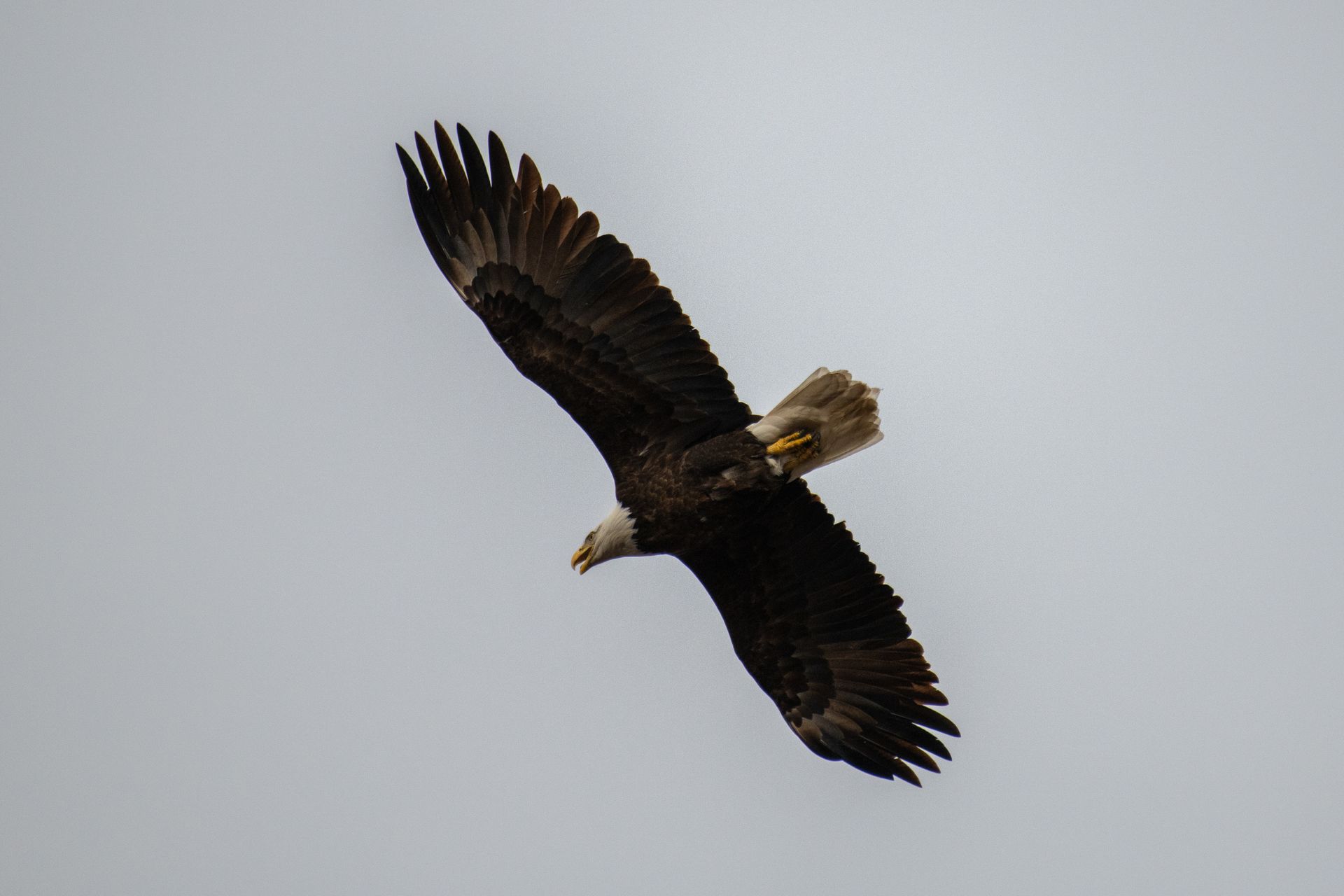
The American Bald Eagle is a majestic bird of prey that can be found throughout much of North America. Its range spans across Canada, the United States, and northern Mexico.
The Bald Eagle's habitat preferences include coastal areas, large lakes, and rivers, where it can hunt for fish and other aquatic prey. It's a bird of adaptability, thriving in a variety of environments.
From the Pacific Northwest to the Gulf of Mexico, the Bald Eagle's range is vast and diverse. Its adaptability has allowed it to flourish in many different ecosystems.
A different take: Northern Mocking Bird
American Bald Eagle Range
The American Bald Eagle is a majestic bird with a wide range across North America. They can be found in the lower 48 states, Alaska, and Canada.
Their range has expanded over the years, and they can now be found in every state except Hawaii. This is a remarkable recovery from the 1960s, when they were listed as an endangered species.
In fact, the American Bald Eagle has made a remarkable comeback, with their population increasing from just over 400 breeding pairs in 1963 to more than 70,000 in 2020.
Explore further: American Paddlefish Range
Habitat Locations and Conditions
Bald Eagles prefer large rivers and lakes or wetlands bordered with mature stands of trees, or a single large tree, such as cottonwood.
Their breeding habitat often includes some type of edge and relatively open canopy.
These birds are opportunistic and feed on a variety of fish, mammals, birds, and carrion.
In North Dakota, key nesting areas include the Missouri River system, including Lake Sakakawea, the Heart River, Cannonball River, Sheyenne River, Red River, Souris River, and the Devils Lake basin.
Bald Eagles are also initiating nests in areas not considered traditional nesting habitat, such as small stands of large cottonwood trees completely surrounded by cropland or grassland.
Nests are usually built within the top quarter of tall, living trees, with fewer nests in dead trees.
Suggestion: Northern River Otter Mustelidae Family
Research and Surveys
The North Dakota Game and Fish Department (NDGF) maintains a statewide database of known Bald Eagle nests in cooperation with the USFWS.
The NDGF conducts a rotational aerial survey of potential nesting habitat in late April or early May, but not on a yearly basis.
The majority of nests in non-traditional habitat are reported by the public.
The NDGF previously participated in the Midwinter Bald Eagle Survey from 1986 to 2013, but discontinued it in 2014 due to stable and increasing numbers of Bald Eagles wintering across the state.
Numerous published reports and gray literature have been written about the Bald Eagle species.
There are no urgent research needs or additional surveys planned due to the increasing Bald Eagle population in North Dakota.
However, demographic information such as nest success, food habits, or an analysis of non-traditional nesting habitat is unknown.
Here are some key statistics about the Bald Eagle population in North Dakota:
- Global Population Estimate: 300,000
- North Dakota Population Estimate: unknown (total number of adults, sub-adults, and juveniles)
- North Dakota Number of Occupied Nests: ~165
Conservation Status
The American Bald Eagle's conservation status is a complex issue. Habitat loss due to development along the Missouri River and other wooded areas threatens the species' survival.
Development along the river and removal of shelterbelts for agricultural expansion can result in the loss of nesting, roosting, and associated aquatic foraging habitat.
For more insights, see: Northern River Otter
The use of the pesticide DDT was detrimental to Bald Eagles, causing the thinning of eggshells. Since the ban of DDT, Bald Eagles and many other raptors have rebounded.
Intentional or accidental poisoning, lead poisoning, and collisions with vehicles, power lines, and wind turbines are substantial sources of mortality for the species.
Human activity, such as recreational viewing, research activities, and the mere presence of humans, can agitate nesting eagles if the disturbance is close and/or persistent.
Featured Images: pexels.com