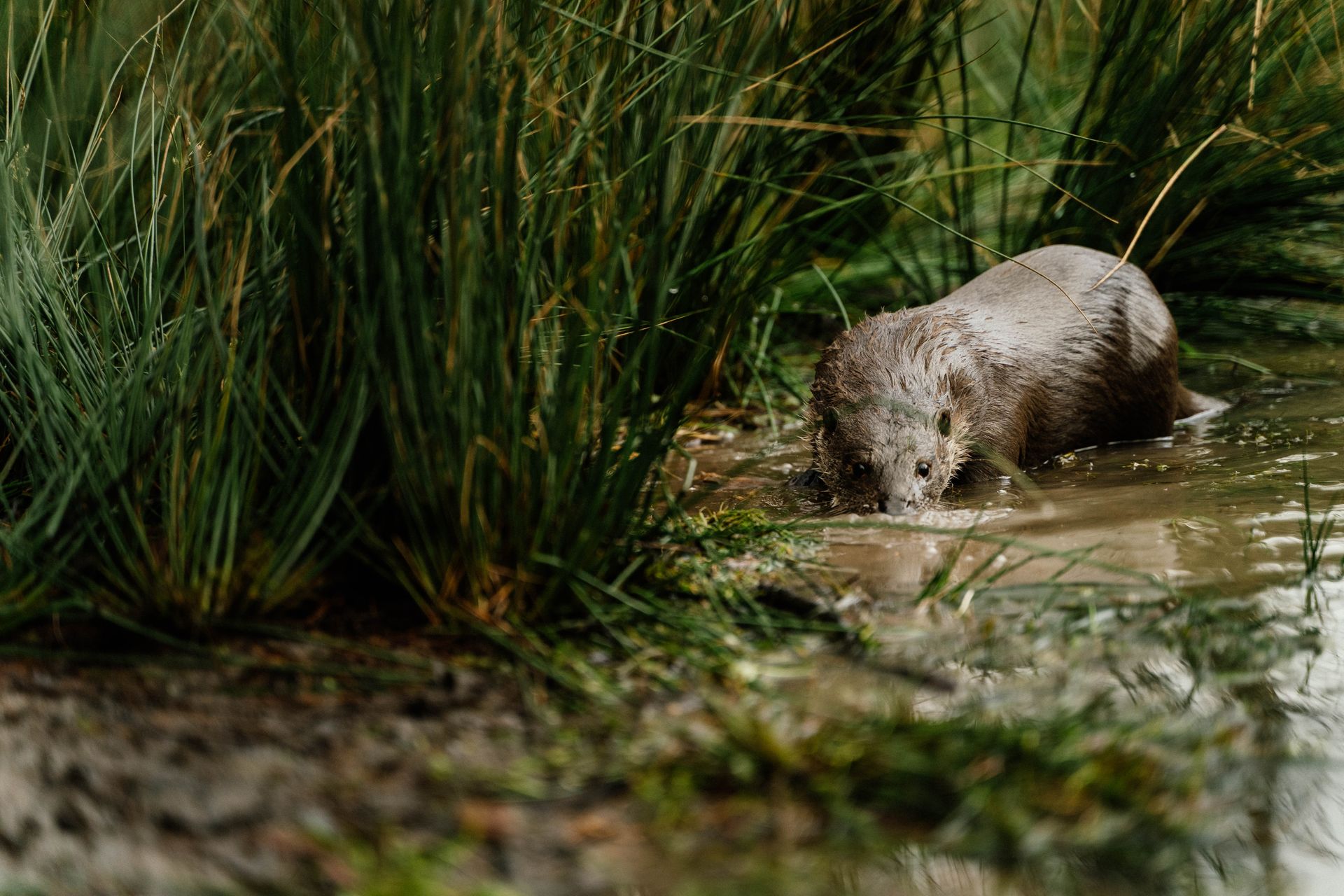
The northern river otter is a remarkable creature, and understanding its ecology and conservation status is crucial for its survival.
They are semi-aquatic mammals that primarily inhabit freshwater habitats, such as rivers, streams, and lakes, in the northern parts of North America.
Their diet consists mainly of fish, crustaceans, and other aquatic animals, which they catch using their powerful jaws and sharp teeth.
Northern river otters are also skilled swimmers, with webbed feet that help them navigate through the water with ease.
They are generally solitary animals, only coming together during mating season or to care for their young.
Suggestion: Familial Renal Disease in Animals
Physical Characteristics
The North American river otter's physical characteristics are quite impressive. They have a stout body, short legs, and a noticeably tapered tail.
Their fur is dense, short, and glossy, which helps them swim and forage more efficiently. Fur color can range from light brown to black.
Their eyes, ears, and nose are located on the top of their head, allowing them to see, hear, and smell while most of their body remains in the water. This unique adaptation is a testament to their aquatic lifestyle.
Males are generally larger than females, measuring 44 inches in total length compared to 38 inches for females. Body weight ranges from 10 to 30 pounds.
Their fully webbed feet and broad, flattened head also contribute to their streamlined body, making them well-suited for swimming and foraging in the water.
Habitat and Behavior
River otters are highly dependent on permanent watersheds, and can be found in rivers, lakes, ponds, small streams, marshes, and other inland wetlands.
Suitable habitat for river otters exhibits a high percentage of emergent vegetation, or expansive riparian corridors in natural waterways.
In fact, a close relationship between beaver and river otter populations has been observed, with a positive relationship between annual trapper harvests of the two species.
River otters often inhabit beaver ponds, and have even been known to share lodges with beavers without any negative encounters.
They don't excavate their own dwellings, but rather rely on beaver and other mammal burrows for their den sites.
In rivers, log jams with abundant woody material are used extensively for denning and latrine sites.
During dry seasons, river otters will move from their inland wetland habitats to more permanent bodies of water to adapt to drought conditions and find food.
Distribution and Habitat
River otters have been found in all watersheds of New York, but their population declined due to unregulated harvest, habitat destruction, and water pollution.
Historically, river otters were only found in the eastern half of New York State, with the western regions being devoid of otter populations except for occasional individuals passing through.
The New York River Otter Project aimed to restore river otter populations to the watersheds of western New York, releasing 279 otters at 16 different sites across the western part of the state between 1995 and 2000.
River otters are dependent on permanent watersheds and can be found in rivers, lakes, ponds, small streams, marshes, and other inland wetlands.
Suitable habitat for river otters exhibits a high percentage of emergent vegetation or expansive riparian corridors.
Beaver ponds are often home to both otter and beaver, with reports of them inhabiting the same lodges with little in the way of negative encounters.
Additional reading: Actinemys Marmorata
River otters do not excavate their own dwellings, but rely on beaver and other mammal burrows for their den sites.
In rivers, log jams with abundant woody material may be used extensively for denning and latrine sites.
During dry seasons, otter will move from their inland wetland habitats to more permanent bodies of water to adapt to drought conditions and for ease in finding food.
Key Considerations
When observing otter habitats, it's essential to consider their size and appearance. Otters are typically 3-4' long, including their tail, which is about one third of their total length, and have dark shiny brown fur.
If you're tracking otters, look for 3' wide and round tracks. In the winter, their tracks can be identified by 6" wide troughs formed when they slide through the snow into the water.
Otters are meticulous about their hygiene and use a specific "toilet" spot, often a rock or peninsula of land, which they use repeatedly. This is where you'll find large collections of scat.
Here's a summary of key otter characteristics to look out for:
- Size: 3-4' long, including tail (1/3 of total length)
- Appearance: Dark shiny brown fur
- Tracks: 3' wide and round in winter: 6" wide troughs through snow
- Scat: Large collections in prominent locations (rocks, peninsulas)
Survival and Diet
River otters are skilled hunters that can catch a wide variety of prey, from fish to small mammals and birds. Their primary source of food is fish, but they'll also eat amphibians, crustaceans, and other aquatic invertebrates when available.
Their diet is quite diverse, and they've even been known to consume small reptiles and fruit. However, their diet can sometimes have a negative impact on local populations, such as when they eat hibernating turtles.
River otters are at the top of their food chain, which means they're more likely to be exposed to environmental contaminants like PCBs, DDT, and heavy metals.
Curious to learn more? Check out: Family Owned Dog Food Brands
Food and Feeding
River otters are visual predators, with eyes shaped to facilitate underwater vision and acuity.
Their diet consists mainly of fish, but they also eat amphibians, crustaceans, and other aquatic invertebrates when available.
River otters are known to consume small mammals and birds, reptiles, and even fruit.
They've been observed eating vast amounts of hibernating wood frogs and snapping turtles, which can have detrimental effects on local turtle populations.
River otters are at the top of the food chain, making them more susceptible to bio-magnification of environmental contaminants like PCBs, DDT, and heavy metals.
These contaminants accumulate in the food chain, resulting in elevated levels of pollutants in river otters, which can have negative impacts on their health.
Predators, Parasites, Disease
Predators, parasites, and disease are a few things to watch out for in the wild. Otter are vulnerable to attack by animals like bobcat, coyote, and domestic dogs when traveling over land.
River otter are susceptible to a variety of internal parasites, including intestinal nematodes, trematodes, acanthocephalans, and cestodes. These parasites can be found in the viscera or internal organs of otter.
Ticks, fleas, and lice can also be found on river otter externally. It's not uncommon to see these pests on animals in the wild.
Rabies and distemper are two diseases that can affect river otter. There have been three documented cases of rabies in New York State otter since 1998.
Conservation and Viewing
Northern river otters are primarily solitary animals, only coming together for mating or to raise their young. They have a large home range, which they mark with scent to keep other otters away.
Their aquatic lifestyle means they spend most of their time in the water, where they are well adapted to hunting and swimming. They can dive to depths of up to 20 feet in search of prey.
River otters are carnivores, feeding on a variety of fish, crustaceans, and other aquatic animals. They have a highly specialized diet that is tailored to their environment.
In the wild, northern river otters can live up to 10 years, although their average lifespan is around 5-6 years due to various threats such as habitat loss and hunting.
Classification and Family
The northern river otter belongs to the Mustelidae family, which is a diverse group of carnivorous mammals. This family includes otters, badgers, weasels, ferrets, and wolverines.
The Mustelidae family is characterized by elongated bodies, short legs, and sharp teeth, adaptations that aid in their predatory lifestyle. They have powerful jaws with sharp teeth for capturing and consuming prey.
The Mustelidae family is further classified into the following taxonomic hierarchy:
- Kingdom: Animalia
- Phylum: Chordata
- Class: Mammalia
- Order: Carnivora
- Family: Mustelidae
- Genus: Lontra
- Species: Lontra canadensis
The northern river otter is a member of the Lontra genus, which also includes other otter species.
Featured Images: pexels.com