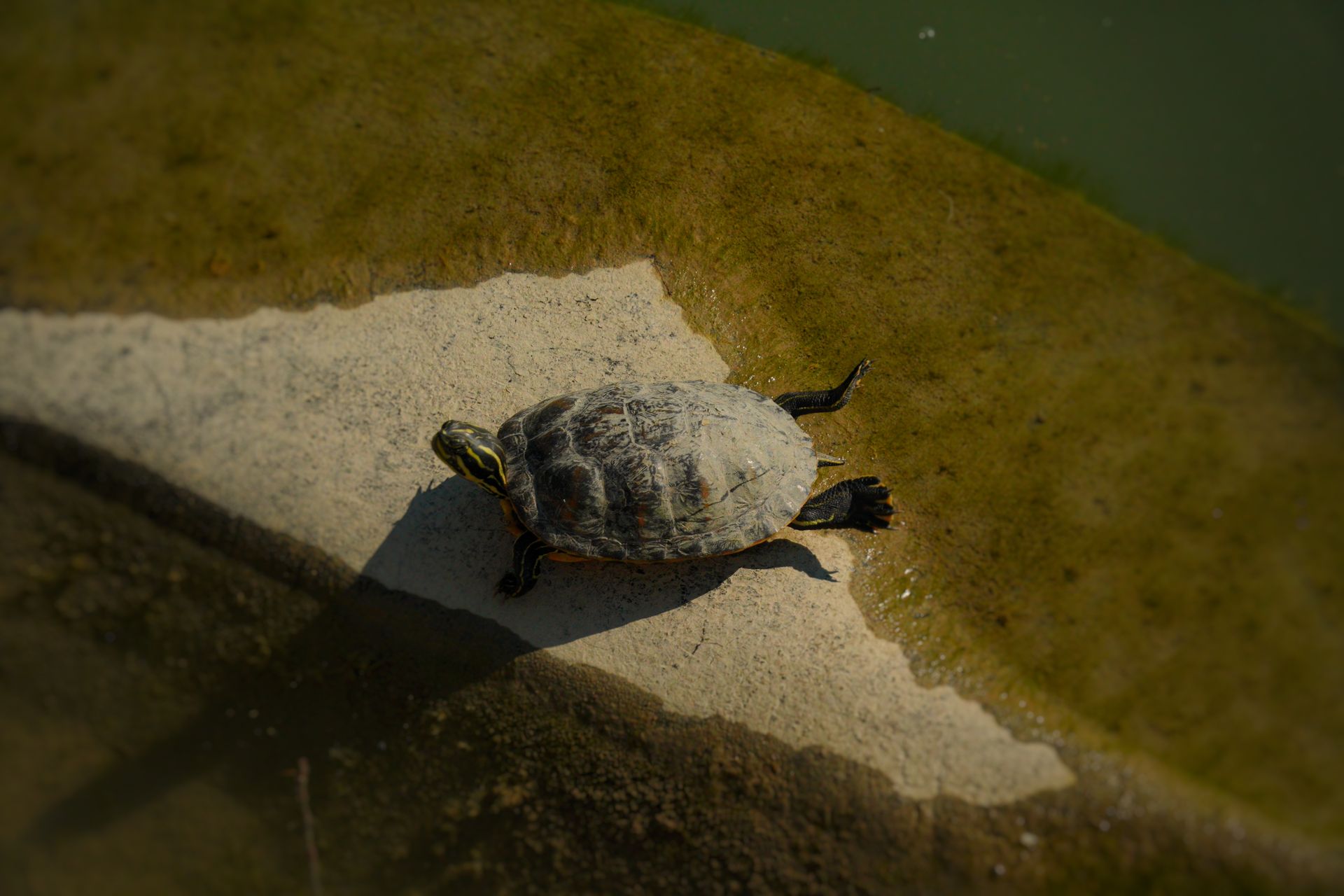
The western pond turtle is a remarkable creature with a unique life cycle. They can live up to 40 years in the wild, which is impressive for a turtle of its size.
Western pond turtles typically lay 2-13 eggs per clutch, which is relatively small compared to other turtle species. These eggs incubate for about 70-80 days.
As they grow, western pond turtles start to venture out of the nest and make their way to the water's edge. They're semi-aquatic, meaning they spend most of their time in or near water, but also come onto land to bask in the sun and nest.
In the wild, western pond turtles play a crucial role in their ecosystem, serving as both predators and prey.
Curious to learn more? Check out: Eastern Wild Turkey Hen
Physical Characteristics
Western pond turtles have a unique appearance, and it's worth taking a closer look. They are generally yellowish with dark blotches in the center of the plastron, and have marbled patterning throughout the body.
Their dorsal area is typically dark brown to olive, and the shell is low, wide, and smooth. Adult males have a larger head, pointier snout, thicker tail base, and a wider neck characterized by white and yellow on the chin and throat.
Adult females, on the other hand, tend to have a blunt snout, thinner tail base, and darker markings on the chin and throat. Hatchlings are a lighter brown and have a longer tail, soft shell, and weigh around 5g at birth.
Here are some key physical characteristics of western pond turtles:
- Webbed feet
- Low, wide, and smooth shell
- Marbled patterning throughout the body
- Dark blotches in the center of the plastron
- Yellowish plastron
They also exhibit some interesting physical features, including being ectothermic, heterothermic, and having bilateral symmetry.
Habitat and Distribution
The western pond turtle's habitat and distribution are quite fascinating. They can be found in a variety of fresh water sources, including lakes, ponds, rivers, streams, creeks, reservoirs, marshes, and irrigation ditches.
Their range used to extend from northern Baja California, Mexico, north to the southern regions of British Columbia, Canada. However, their geographical distribution has shrunk considerably over the years, and they're now only found in southern Washington, Oregon, California, and Nevada, where they've been introduced.
Check this out: Southern Fox Squirrel
Western pond turtles prefer areas that provide cover from predators, such as vegetation and algae, as well as basking sites for thermoregulation. They're observed in aquatic habitats ranging from 1 to 40 degrees Celsius, with juveniles found in areas between 12 and 33 degrees Celsius, and adults in areas between 10 and 17 degrees Celsius.
Adults tend to favor deeper, slow-moving water, whereas hatchlings search for slow and shallow water that is slightly warmer. Terrestrial habitats are used for wintering and consist usually of burrows in leaves and soil.
Here's a breakdown of the western pond turtle's habitat regions:
- Temperate
- Terrestrial
- Freshwater
They can also be found in aquatic biomes such as lakes and ponds, rivers and streams, brackish water, as well as wetlands like marshes and swamps.
It's worth noting that western pond turtles are rarely found at altitudes above 1500m, and their range elevation is typically between 0 to 1980m.
Ecology and Behavior
The western pond turtle is a fascinating creature, and understanding its ecology and behavior is crucial for conservation and observation.
This species can be found in a variety of aquatic habitats, including marshes, streams, rivers, ponds, and lakes. They also inhabit terrestrial habitats, which are just as important for their survival.
In fact, western pond turtles can spend up to 200 days out of water, especially during times of drought. Many turtles overwinter outside of the water, often creating their nests for the year.
To observe these turtles in the wild, it's essential to move slowly and hide behind shrubs and trees. They tend to aggregate in areas with large numbers of emergent logs or boulders, where they can bask.
One way to encourage western pond turtles to use artificial basking substrate, or rafts, which can make it easier to detect them in complex habitats.
Here are some key behaviors of the western pond turtle:
- Terriculous: They spend time on land.
- Natatorial: They are well adapted to swimming.
- Diurnal: They are active during the day.
- Motile: They are capable of moving between habitats.
- Sedentary: They tend to stay in one area.
- Hibernation: They can hibernate during the winter months.
- Solitary: They often live alone.
Male western pond turtles have home ranges that average 1 hectare, while females have home ranges that average 0.3 hectares.
Diet and Predation
The western pond turtle's diet is quite varied, consisting mainly of insects, crayfish, and other aquatic invertebrates. They also eat fish, tadpoles, and frogs occasionally, and will eat carrion when available.
Their diet changes as they grow, with juveniles primarily eating insects and carrion. Around age three, they start to include plant matter in their diet, such as filamentous algae, lily pads, tule, and cattail roots.
In terms of predation, the western pond turtle has a thick carapace and is generally wary, which helps protect it from predators. Young turtles, however, are vulnerable to predation due to their small size and soft shells.
Here are some known predators of the western pond turtle:
- Raccoons
- Otters
- Ospreys
- Coyotes
- Weasels
- Large fish
- Bullfrogs
- Crayfish
- Opossums
Diet
The western pond turtle's diet is quite varied.
They're primarily omnivorous, which means they eat both plants and animals.
Insects, crayfish, and other aquatic invertebrates make up most of their animal diet.
Fish, tadpoles, and frogs are eaten occasionally, and carrion is eaten when available.
Plant foods include filamentous algae, lily pads, tule and cattail roots.
Juveniles are primarily carnivorous, and eat insects and carrion.
Related reading: Common Snapping Turtle Food
Predation
Predation is a significant threat to western pond turtles. Their main defense against predators is their thick carapace and wariness.
These turtles have a hard time as hatchlings, as they're small and soft, making them easy prey. Achieving adult size is crucial for their survival.
Some of their known predators include raccoons, otters, ospreys, coyotes, weasels, large fish, bullfrogs, crayfish, and opossums. Non-native predators like the red-eared slider are also a threat.
Their thick carapace provides excellent protection, but it's not foolproof. Young turtles still need to be careful to avoid predators.
Here are some of their known predators:
- Raccoons
- Otters
- Ospreys
- Coyotes
- Weasels
- Large fish
- Bullfrogs
- Crayfish
- Opossums
Unfortunately, human activities like habitat destruction and modification have put western pond turtles in a vulnerable position.
Reproduction and Lifespan
Western pond turtles have a unique reproductive cycle. Females can lay 5-13 eggs per clutch, which they deposit either once or twice a year. They may travel up to 0.8 km away from water to find a suitable nesting site.
The mating process is also fascinating. Males court females by scratching their carapace with their forelimbs, and mating occurs after the female raises her posterior end. This process takes place from May through August.
Here are some key reproductive features of western pond turtles:
- Iteroparous (they breed multiple times in their lifetime)
- Seasonal breeding (breeding occurs from May through August)
- Gonochoric/dioecious (sexes are separate)
- Oviparous (eggs are laid outside the mother's body)
Adult western pond turtles can live up to 70 years or even longer in the wild.
Reproduction
Western pond turtles have a unique reproductive process. Females typically produce 5-13 eggs per clutch, which they deposit either once or twice a year. They may travel a significant distance from water to lay their eggs, often selecting a nest site in an open area of sand or hardpan that faces southwards.
The nest is flask-shaped with an opening of about 5 cm, and females spend considerable time covering it with soil and adjacent low vegetation. This makes it difficult for predators to detect, but also means that nests can be hard to find unless they've been disturbed.
Broaden your view: Common Snapping Turtle Eggs
Mating occurs from May through August, with most females laying eggs in alternating years. Western pond turtles have a polygynandrous mating system, meaning that males and females mate with multiple partners. The average age of maturity is between 8 and 14 years, although females in the southern subspecies may reach maturity at an earlier age.
Here are some key reproductive features of western pond turtles:
- Iteroparous (females breed multiple times)
- Seasonal breeding (breeding occurs from May to August)
- Gonochoric (sexes separate)
- Oviparous (eggs are laid outside the body)
After the eggs are laid, there is no evidence of parental care. Females do not provide any care or protection to their hatchlings, and the young are left to fend for themselves. This is likely due to the fact that western pond turtles are adapted to a environment with many predators, and any parental care would put the female at risk of injury or death.
For your interest: Mississippi Map Turtle Care
Lifespan/Longevity
Western pond turtles have a remarkable lifespan, especially when compared to other species. Adults can live up to 70 years or even longer.
In the wild, the typical lifespan of a western pond turtle is 40 to 70 years. This is a significant range, and it's likely influenced by various factors such as diet, habitat, and exposure to predators.
The average lifespan of a western pond turtle in the wild is around 50 years. This gives us a better idea of what to expect from these amazing creatures.
Here are some key statistics on the lifespan of western pond turtles:
- Range lifespan: up to 80 years (in the wild)
- Typical lifespan: 40 to 70 years (in the wild)
- Average lifespan: 50 years (in the wild)
Conservation Status
Western pond turtles are currently listed as vulnerable on the IUCN Red List, but they don't have any special status on the US Federal List, CITES, or the State of Michigan List.
Habitat destruction is a major threat to western pond turtles, primarily due to urbanization and the alteration of their natural habitats through dam construction and wetland management. This has led to the destruction of their homes, including the loss of at least 3 million turtles in the Great Valley.
A unique perspective: Florida Snakes List
In California, western pond turtles are designated as a state "species of special concern" due to their declining populations, which have decreased by as much as 80% in some regions. Nonnative species, such as the Red-eared Slider and the Painted Turtle, also pose a threat to western pond turtles by competing with them for resources and habitat.
Western pond turtles are also vulnerable to predators like the American Bullfrog, which preys on them, and human activities like off-road vehicles, chemical spills, and incidental catch by fishermen. The lack of genetic variation in western pond turtles is another concern, as it reduces their ability to adapt to changing environments.
Here are some conservation statuses of western pond turtles in different regions:
- California: State "species of special concern"
- Washington: Endangered
- Oregon: Sensitive-critical species
- British Columbia: Extirpated (nearly 20 years ago)
The conservation status of western pond turtles varies across different regions, highlighting the need for targeted conservation efforts to protect this species.
Interesting Facts
Turtles are incredibly adaptable creatures, and the western pond turtle is no exception. They can stack on top of each other to stay warm when basking spots are scarce.
The western pond turtle is a remarkable species, with a rich history dating back 215 million years. This makes them one of the oldest living reptiles on the planet.
Baby western pond turtles are incredibly small, measuring only about the size of a quarter. This tiny size is a testament to their rapid growth and development.
Turtles have some unique characteristics that set them apart from other animals. One of these is their inability to swallow air, which means all their food must be consumed underwater.
Life Cycle and Journey
As a Western Pond Turtle, my journey to adulthood begins with a perilous adventure to the pond, where I emerge from my nest on wobbly little legs and follow my mother to find food and water.
The journey is exhausting, but I'm driven by hunger and curiosity. I've been in a state of brumation for the frosty season, relying on stored fat reserves for energy during the winter.
After a week of effort, I finally reach the pond and experience the delight of dipping my toe into the calm water and feeling the warm sunshine on my shell.
My diet as a hatchling consists of nekton, aquatic organisms that can propel themselves through water, larvae of small aquatic insects, and other small invertebrates. I need the pressure of the water to swallow my food, so I can only eat underwater.
As I grow, my diet will expand to include small aquatic invertebrates, aquatic plants, carrion, and even sometimes frogs and their eggs and fish.
Classification and Ecosystem
The Western Pond Turtle's classification is quite specific. It belongs to the Kingdom Animalia, which includes all animals.
The Western Pond Turtle is a chordate, a group of animals that have a notochord, a dorsal nerve cord, and a post-anal tail. Chordates are a diverse group, but the Western Pond Turtle is part of a more specific subgroup, the vertebrates.
Here's a breakdown of the Western Pond Turtle's classification:
The Western Pond Turtle's classification helps us understand its place in the natural world and its relationships with other animals.
Classification
Classification is a fundamental concept in understanding the diversity of life on our planet. It's a way to group living organisms based on their shared characteristics and evolutionary relationships.
The Animal Diversity Web is a great resource for learning about classification, and it's structured in a way that makes sense. Let's start with the broadest categories and work our way down.
Here's a breakdown of the classification hierarchy for a specific species, the Western Pond Turtle (Emys marmorata):
- Kingdom: Animalia - This is the broadest category, encompassing all animals. According to the Animal Diversity Web, there are 22861 pictures of animals in this kingdom!
- Phylum: Chordata - This group includes animals with a notochord, a flexible rod-like structure that provides support. There are 15213 pictures of chordates in this phylum.
- Subphylum: Vertebrata - This category includes animals with a backbone or spinal column. There are 15168 pictures of vertebrates in this subphylum.
- Class: Reptilia - This group includes reptiles, such as turtles, snakes, and lizards. There are 8809 pictures of reptiles in this class.
- Order: Testudines - This category includes turtles and tortoises. There are 338 pictures of turtles in this order.
- Family: Emydidae - This group includes pond turtles, such as the Western Pond Turtle. There are 145 pictures of Emydidae in this family.
- Genus: Emys - This category includes the genus Emys, which includes the Western Pond Turtle. There are 6 pictures of Emys in this genus.
- Species: Emys marmorata - This is the specific species of the Western Pond Turtle. There are 4 pictures of this species.
Ecosystem Roles
Western pond turtles play a crucial role in their ecosystem as both prey and hosts for various species. They're an important food source for numerous predators.
These turtles act as hosts for several parasitic organisms, including trematodes, nematodes, and telorchis trematodes. These parasites can have a significant impact on the turtles' health and well-being.
Leeches are another type of organism that can be found on western pond turtles. They attach themselves to the turtles' skin and feed on their blood.
Here are some examples of the parasitic organisms that western pond turtles can host:
- trematodes (Trematoda)
- nematodes (Nematoda)
- telorchis trematodes (Telorchis)
- leeches (Hirudinea)
Stanford
At Stanford, Western Pond Turtles have a stable population, but it's a good thing they're not as plentiful as they could be, or they might not be as interesting to monitor.
The biggest threats to their population at Stanford are small population size and isolation, which can make it difficult for them to find suitable mates and establish a strong colony.
Non-native species are also a problem at Stanford, as they can compete with Western Pond Turtles for resources and habitat.
Road mortality is another significant threat, as turtles can easily get hit by cars while trying to cross the road to get to their next meal or breeding spot.
Climate change is also affecting Western Pond Turtles at Stanford, making it harder for them to adapt to their environment and find the food and shelter they need to survive.
For more insights, see: Burmese Python Population in Florida
Frequently Asked Questions
What to do if you find a western pond turtle?
If you find a western pond turtle, leave it undisturbed and walk away with loud voices and heavy footsteps to avoid stressing it. This will help prevent females from abandoning their nesting attempts.
Are Western Pond Turtles invasive?
No, Western Pond Turtles are native to California and not considered invasive species. However, they face threats from invasive species that compete with them for resources.
Featured Images: pexels.com