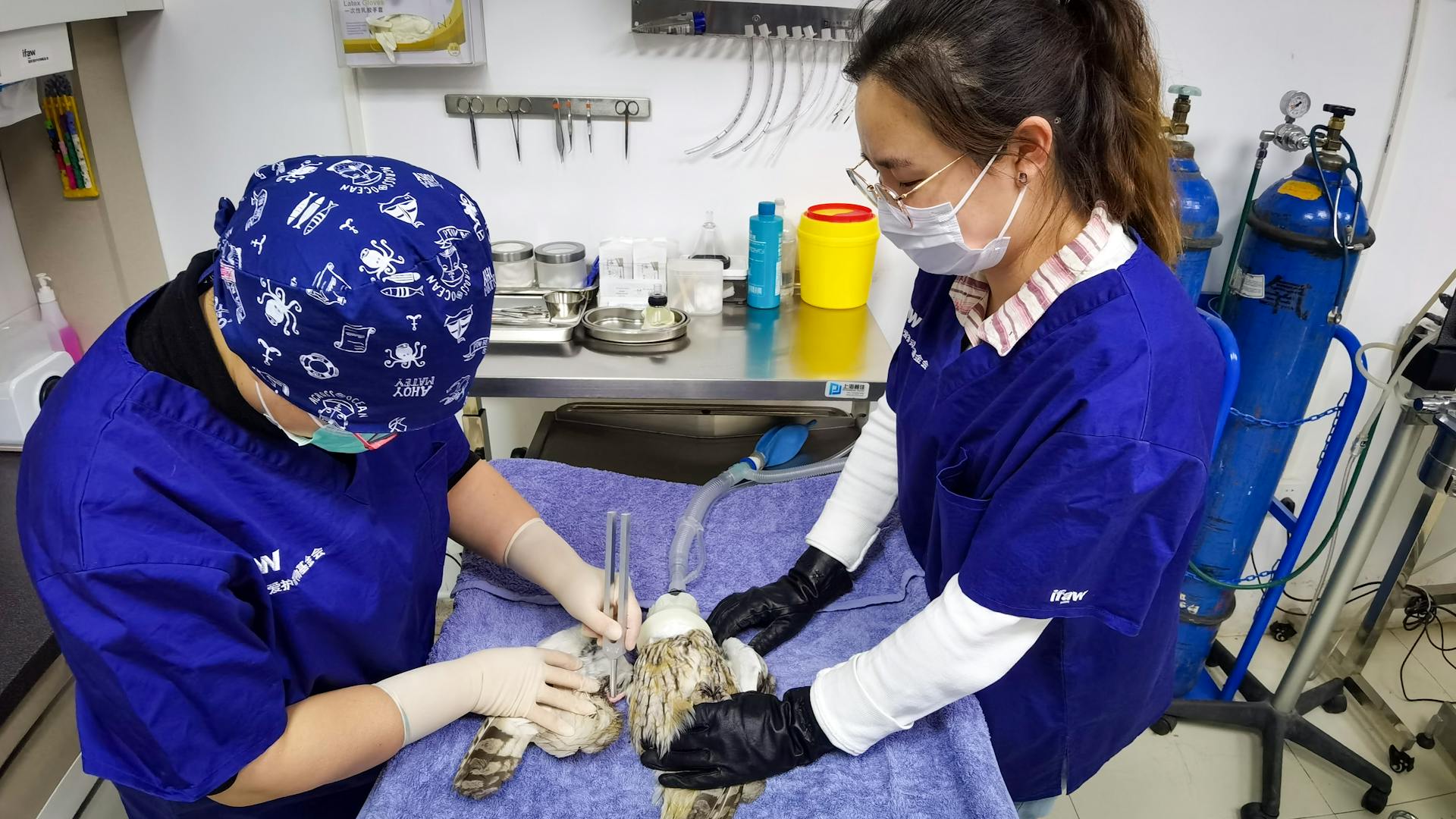
To become a veterinary technician in California, you'll need to earn an associate's degree or a certificate in veterinary technology from a program accredited by the American Veterinary Medical Association (AVMA).
The program should include both classroom and clinical training, where you'll study subjects like anatomy, pharmacology, and laboratory procedures.
You'll also need to gain hands-on experience by volunteering or interning at a veterinary clinic or hospital.
In California, you'll need to pass the Veterinary Technician National Examination (VTNE) to become certified as a registered veterinary technician (RVT).
Check this out: Pima Veterinary Technician Program
Becoming a Veterinary Technician in California
To become a veterinary technician in California, you'll need to follow these steps. First, you must graduate from an AVMA-accredited veterinary technician program, which can take two to four years. These programs are available in California, with 22 fully accredited programs to choose from.
You'll need to pass the Veterinary Technician National Exam (VTNE) offered by the American Association of Veterinary State Boards (AAVSB). This computer-based exam is offered during three one-month testing windows annually. You'll also need to pass the California Registered Veterinary Technician Exam, which must be completed within 60 months of passing the VTNE.
A unique perspective: Veterinary Assistant Test
To become licensed, you'll need to apply for licensure as an RVT and renew every two years with 20 hours of continued education (CE) credits. You can choose from various accredited programs, including Central Coast College, Pima Medical Institute, and Platt College.
Here are some specific requirements to keep in mind:
- You must be at least 18 years old to apply for licensure.
- You'll need to have Livescan fingerprints submitted to the CVMB.
- You must pass the VTNE by applying directly to the AAVSB.
- You can choose from three qualifying educational or experience criteria:
+ Graduate from an AVMA-accredited RVT program.
+ Complete a combination of 20 semester units or 30 quarter units of specific education and 4,416 hours of directed clinical practice experience.
+ Be licensed, certified, or registered as an RVT in another state and have 4,416 hours of directed clinical experience.
After completing these steps, you'll be eligible to take the CaRVT exam, which is administered by the California Veterinary Medical Board. You'll need to sit for and pass the CaRVT exam within 60 months of passing the VTNE exam.
Additional reading: Veterinary Technician National Exam Vtne
Education and Training
To become a veterinary technician in California, you'll need to complete an education and training program that meets the state's requirements. These programs can be found at institutions such as Modesto Junior College and Santa Rosa Junior College, which offer associate degree programs in veterinary technology.
The education and training program should include coursework in subjects such as veterinary anatomy and terminology, small animal disease recognition and transmission control, and veterinary surgical and dental assistance. You'll also need to complete practical experience hours, which can be done under the supervision of a licensed veterinarian.
Some notable programs for aspiring veterinary technicians in California include State Polytechnic University, College of the Redwoods, and Los Angeles Pierce College. These programs can be completed in two years and include coursework in subjects such as veterinary medical terminologies, comparative anatomy, physiology, and small animal nursing.
To become a registered veterinary technician (RVT) in California, you'll need to pass the Veterinary Technician National Examination (VTNE) and the California Veterinary Technician Examination (CVTE). You'll also need to submit a live scan of your fingerprints and a copy of your diploma.
Here are some notable programs for aspiring veterinary technicians in California:
- State Polytechnic University (Pomona, CA)
- College of the Redwoods (Eureka, CA)
- Los Angeles Pierce College (Woodland Hills, CA)
- Modesto Junior College (Modesto, CA)
- Santa Rosa Junior College (Santa Rosa, CA)
- San Diego Mesa College (San Diego, CA)
- San Joaquin Valley College (Fresno, CA)
- Yuba College (Marysville, CA)
- Pima Medical Institute (Sacramento, CA)
Other Schools
If you're looking for alternative schools to pursue a career as a veterinary technician in California, there are several options to consider. Modesto Junior College, for instance, offers a veterinary technician program as an AS degree or certificate, which consists of 30 units and includes courses such as veterinary laboratory procedures and veterinary anatomy, physiology, and terminology.

Santa Rosa Junior College is another option, offering a two-year veterinary technician program that may lead to students becoming registered veterinary technicians in the state of California. The program is offered through SRJC's Agriculture and Natural Resources Department and covers courses such as veterinary anatomy and terminology, small animal disease recognition and transmission control, and veterinary surgical and dental assistance.
If you're interested in exploring other schools, you can check out the list of California Veterinary Medical Board-approved programs, which includes San Diego Mesa College, Modesto Junior College, and Santa Rosa Junior College. However, please note that the list may not be up-to-date, so it's essential to contact the Board before enrolling.
Here's a summary of the programs mentioned:
Keep in mind that these programs may have specific requirements and prerequisites, so it's crucial to research and verify the information before applying.
Cost
Cost can be a significant factor to consider when pursuing a career as a veterinary technician.
Veterinary technician training programs at vocational colleges may cost $8,000 for the entire program duration.
You'll need to budget for the entire program cost upfront, as some colleges may not offer payment plans or financial aid.
The cost can range between $1,599 and $1,999 per semester, depending on the institution and course type.
It's essential to research and compare costs among different colleges and programs to find the best fit for your budget and career goals.
Explore further: Tcc Veterinary Technician Program
Clinical Externships
At Pima Medical Institute, students get hands-on experience in their field through clinical externships, where they're mentored by full-time professionals.
These externships provide real-world experience, which is invaluable for future careers.
Students have the chance to interface with real patients, giving them a deeper understanding of their field.
Clinical externships also offer students resume-worthy opportunities, such as letters of recommendation from supervisors.
Sometimes, students even get job placement directly after graduation, thanks to the connections they make during their externships.
Career and Salary
As a veterinary technician in California, you can expect a competitive salary. The average annual salary for vet techs in California is around $55,740, which is significantly higher than the national average of $44,040.
You can find work in a variety of settings, including clinics, hospitals, laboratories, and even zoos. According to the article, some of the top-paying cities for vet techs in California include San Francisco, San Jose, and Los Angeles.
Here's a breakdown of the average salaries for vet techs in different cities in California, based on data from indeed.com:
Keep in mind that these figures are just averages, and your actual salary may vary depending on your experience, location, and employer.
Average Salary
The average salary for vet techs in California is a whopping $45,000 annually, or approximately $25 per hour, according to indeed.com. This is nearly 23% higher than the national average income for veterinary technicians.
Vet techs in California can earn up to $62,000 a year, or $34.04 per hour, making it a highly competitive salary. Senior veterinary technicians can earn significantly higher wages than the national average for the job.
Consider reading: How Much Do Veterinary Technicians Make an Hour
The cost of living in California is notoriously high, but vet techs in the state can still enjoy a higher salary than their national counterparts. For example, in Los Angeles, vet techs can earn $25.44 per hour or $46,262 per year.
Here's a breakdown of average salaries for vet techs in different cities in California:
- Los Angeles: $25.44/hr or $46,262/year
- San Diego: $24.25/hr, $44,117/year
- San Jose: $26.64/hr, $48,452/year
- San Fransisco: $31.31/hr, $56,945/year
- Fresno: $19.05/hr, $34,642/year
Keep in mind that while the salary in California is higher, it's essential to consider the cost of living in the state.
Job Outlook
The job outlook for veterinary technicians is incredibly promising. According to the Bureau of Labor Statistics, the profession is expected to grow by 20% over the next decade.
This growth rate is nearly quadruple the growth rate of most jobs, making it an excellent investment for those looking to start a career in this field. The state of California offers flexible educational and training requirement options for prospective students, making it an ideal place to pursue a career as a vet tech.
Curious to learn more? Check out: Is Veterinary Technician a Good Career
In California, vet techs earn competitive salaries compared to the rest of the country. The state also has a number of resources and organizations for veterinary technicians, including the California Registered Veterinary Technicians Association (CaRVTA), which offers an online career center, mentor program, and job board.
The predicted growth rate for vet tech jobs in California is 19 percent, with approximately 24,300 new jobs expected between 2023 and 2033. This growth rate is several times the anticipated growth rate for all occupations during that time period.
The availability of advanced veterinary services, such as preventive dental care and surgical procedures, may provide opportunities for veterinary professionals specializing in those areas.
Programs and Courses
To become a veterinary technician in California, you'll need to complete a certified training program that's accredited by the American Veterinary Medical Association (AVMA) or the California Veterinary Medical Board (VMB). This is a requirement for getting employment in the field.
Worth a look: Pima Medical Institute Veterinary Technician
California has plenty of CVTEA-accredited programs to choose from, including State Polytechnic University's 4-year program in Pomona, which emphasizes real-world experience and consists of 120 credits that can be completed in 48 months.
You can also consider online programs, which offer flexibility for students with busy schedules. For example, the program at College of the Central Coast can be completed within two years and comprises 96.8 credits.
Foothill College's program is another great option, lasting two years and containing 90 units that cover essential topics like veterinary medical terminologies and small animal nursing.
Here are some notable programs for aspiring veterinary technicians in California:
Completing a certified training program will not only satisfy the state's educational requirement but also prepare you for the Veterinary Technician National Exam (VTNE), which is another requirement for prospective vet techs.
Careers
As a veterinary technician, you'll have the opportunity to work in a variety of settings, including clinics, hospitals, laboratories, and zoos.
You can expect to find job opportunities in clinics, hospitals, laboratories, ranches, zoos, biomedical facilities, wildlife facilities, humane societies, animal control facilities, and other professional veterinary settings.
In California, the job outlook for veterinary technicians is strong, with a predicted growth rate of 19 percent between 2023 and 2033, according to the Bureau of Labor Statistics. This is several times the anticipated growth rate for all occupations during that time period.
The California Registered Veterinary Technicians Association (CaRVTA) offers an online career center, a mentor program, continued education opportunities, and informative articles to support veterinary technicians in their careers.
The CaRVTA also hosts a job board with opportunities at places like VCA Community Companion Animal Hospital, Sacramento Zoo, and San Diego Humane Society.
Here are some of the specific job settings you can expect to find as a veterinary technician in California:
- Clinics
- Hospitals
- Laboratories
- Ranches
- Zoos
- Biomedical facilities
- Wildlife facilities
- Humane societies
- Animal control facilities
- Other professional veterinary settings
Employment of veterinary technologists and technicians is projected to grow much faster than the average for all occupations, according to the U.S. Bureau of Labor Statistics.
Interested in Starting
If you're interested in starting your journey to become a veterinary technician in California, you'll need to meet the basic requirements.
To be eligible for a veterinary technician program, you must have a high school diploma or equivalent.
You can choose from a variety of programs that offer an Associate's degree or a certificate in veterinary technology.
In California, veterinary technician programs are accredited by the American Veterinary Medical Association (AVMA).
To get started, research accredited programs in your area and find one that fits your schedule and budget.
Frequently Asked Questions
Can you be a vet tech without being certified?
In most states, certification is required to work as a vet tech, but some states may have limited exceptions. Certification is typically necessary to work in this role, so check your state's laws for specific requirements.
Featured Images: pexels.com