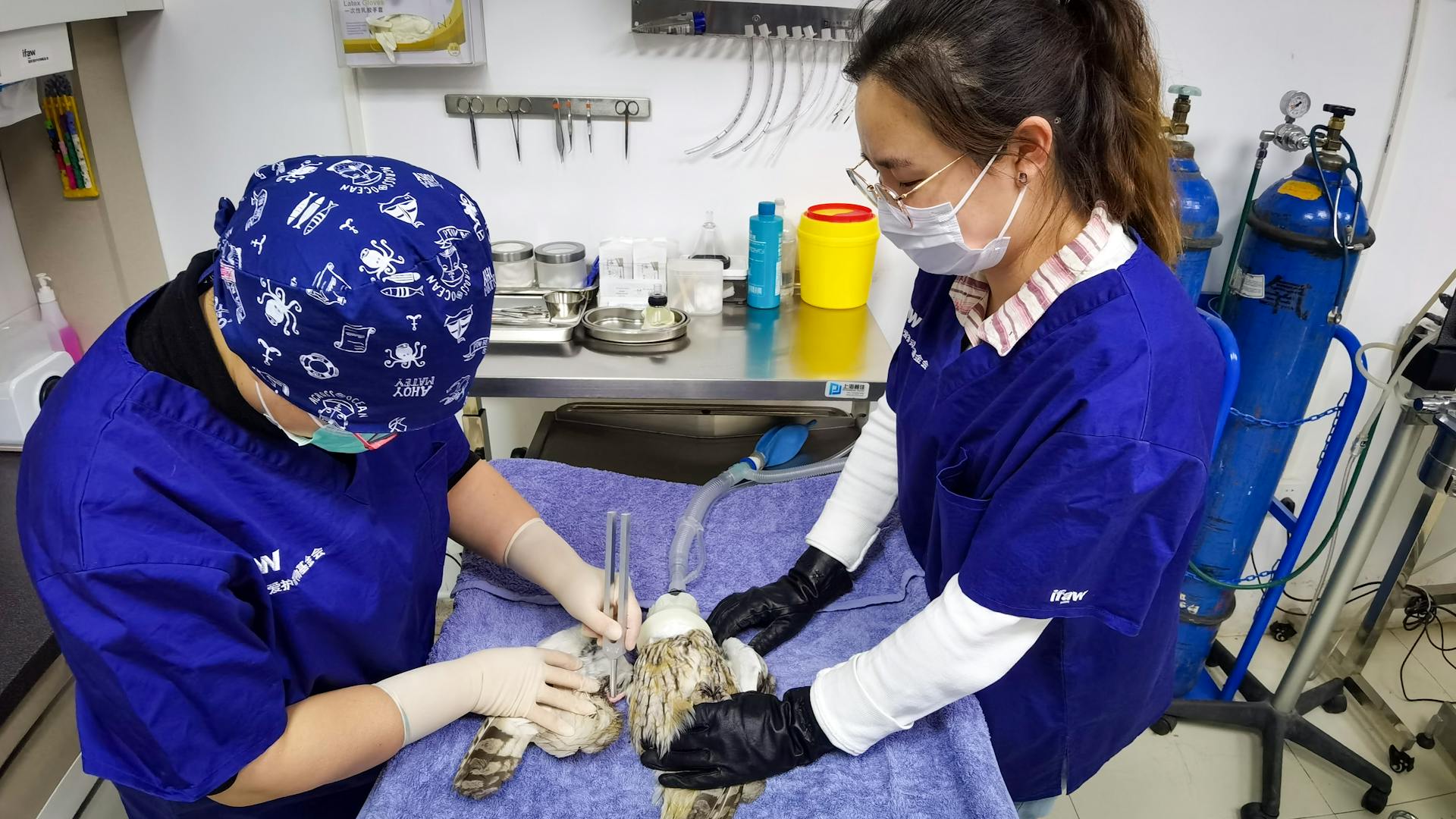
Veterinary technicians and veterinarians are two distinct professionals in the animal care industry, each with their own unique roles and responsibilities.
Veterinary technicians are trained to perform medical procedures, take X-rays, and administer medication under the supervision of a veterinarian.
The main difference between veterinary technicians and veterinarians lies in their level of education and training.
Veterinary technicians typically hold an associate's degree and complete a training program in veterinary technology, while veterinarians earn a Doctor of Veterinary Medicine (DVM) degree after completing four years of college and four years of veterinary school.
Veterinary technicians often work under the supervision of a veterinarian, assisting with exams, surgeries, and other medical procedures.
In contrast, veterinarians are licensed to diagnose and treat medical conditions in animals, prescribe medication, and perform surgeries independently.
See what others are reading: Veterinary Technician Training Program
Education and Training
To become a veterinarian, you'll need to complete a four-year Doctor of Veterinary Medicine (DVM) program after earning a bachelor's degree. This program covers topics like anatomy, pharmacology, and surgery.
Consider reading: Pima Veterinary Technician Program
A veterinarian's education is significantly longer than a veterinary technician's. The difference is stark: four years of professional study versus two years of associate's degree.
Here are the typical education paths for both professions:
- Veterinary Technician: 2-year associate's degree
- Veterinarian: 4-year bachelor's degree + 4-year DVM program
After completing their education, both veterinary technicians and veterinarians must pass a licensing exam to practice.
Schooling vs. Education
Veterinarians require significantly more schooling than veterinary technicians. On average, veterinarians must attend school for eight years, including four years of undergraduate study and four years of study in a college of veterinary medicine.
The education required for veterinary technicians is much shorter, typically two years for an associate degree in veterinary technology. Some vet techs may choose to obtain a bachelor's degree, but this is not a necessity.
The cost of education for veterinarians is approximately ten times more than that of veterinary technicians. This is due to the longer duration and intensity of their education programs.
Curious to learn more? Check out: Veterinary Education

Veterinary technicians must also meet state-specific licensing and continuing education requirements, including passing the Veterinary Technician National Exam (VTNE).
Here's a comparison of the education requirements for veterinarians and veterinary technicians:
The salary difference between veterinarians and veterinary technicians is also significant, with veterinarians earning about three times more than vet techs.
A different take: Spanish for Veterinarians
Education and Training
To become a veterinary technician, you'll need to complete a two-year associate degree program in veterinary technology. These programs are accredited by the American Veterinary Medical Association (AVMA) and include both classroom instruction and practical experience.
After graduation, aspiring vet techs must pass the Veterinary Technician National Exam (VTNE) to become licensed or certified, depending on state requirements. This exam is a crucial step in starting your career as a vet tech.
Some vet techs may choose to specialize in areas such as anesthesia, dental care, or emergency and critical care, which can enhance their career prospects and earning potential.
Take a look at this: Veterinary Assistant Exam

To become a veterinarian, you'll need to earn a bachelor's degree and then complete a four-year Doctor of Veterinary Medicine (DVM) program. These programs cover topics such as anatomy, pharmacology, surgery, and diagnostic techniques.
After earning their DVM, veterinarians must pass the North American Veterinary Licensing Examination (NAVLE) to become licensed. This exam is a requirement for practicing as a veterinarian.
A vet tech typically requires a two-year associate's degree, whereas a vet requires a four-year professional program after completing three to four years of pre-professional studies.
Vet techs can opt to take an exam to get certification and license to practice, but they can also choose to pursue a four-year bachelor's degree to become a certified veterinarian technologist. This can lead to more responsibilities and higher income.
You might enjoy: How to Become a Zoo Veterinary Technician
Education Requirements
To become a veterinary technician, you'll typically need to complete a two-year associate degree program in veterinary technology, which is accredited by the American Veterinary Medical Association (AVMA). This program will provide you with both classroom instruction and practical experience.
Related reading: Mcc Veterinary Technician Program

To become a veterinarian, you'll need to earn a bachelor's degree, followed by a four-year Doctor of Veterinary Medicine (DVM) program. You'll also need to pass the North American Veterinary Licensing Examination (NAVLE) to become licensed.
The cost of education for veterinarians is significantly higher than for veterinary technicians, with an estimated cost that's around ten times higher. This is due to the longer duration of veterinary programs.
Here's a comparison of the education requirements for veterinary technicians and veterinarians:
After completing their education, veterinary technicians must pass the Veterinary Technician National Exam (VTNE) to become licensed or certified, while veterinarians must also pass the NAVLE to become licensed.
Readers also liked: Licensed Veterinary Technician Texas
Job Responsibilities and Obligations
Veterinarians have a wide range of job responsibilities, including examining animals, diagnosing health problems, and performing surgery. They also prescribe medications, test for and vaccinate against diseases, and advise animal owners on their pets' care.
Veterinary technicians, on the other hand, play a supporting role to veterinarians. Their duties include observing animal behavior, providing nursing care, and restraining animals during medical exams or procedures. They also administer anesthesia, take x-rays, and collect and record case histories.
Consider reading: Animal Health Technician

Here are some key job responsibilities for both veterinarians and veterinary technicians:
It's worth noting that while veterinary technicians have a more limited scope of practice, they can still make a significant impact on animal health and welfare.
Job Duties vs Responsibilities
Job duties and responsibilities can be a bit confusing, especially when it comes to careers in the animal health care industry.
Veterinarians have a wide range of job duties, including examining animals to assess their physical health and performing surgery on animals.
One of the key differences between veterinarians and veterinary technicians is the level of responsibility and required education. Veterinarians must complete longer years of schooling, but they earn greater salaries for their work.
Veterinary technicians, on the other hand, have job duties that are in support of the veterinarian, including observing behavior and physical condition of animals and providing nursing care or emergency first aid to injured or recovering animals.
Related reading: Veterinary Technologist Job Description

Here are some examples of job duties for veterinarians and veterinary technicians:
Both veterinarians and veterinary technicians have important roles to play in the animal health care industry, and understanding their job duties and responsibilities can help you make informed decisions about your career.
Responsibilities and Obligations Between Technicians and Healthcare Professionals
Veterinarians and veterinary technicians have distinct responsibilities and obligations. Veterinarians are the primary decision-makers and are responsible for diagnosing illnesses, performing surgeries, and prescribing medications. They also guide pet owners on animal behavior and preventative care.
Veterinary technicians, on the other hand, play a supportive role. Their responsibilities include drawing blood, administering vaccines, assisting in surgeries, performing x-rays, and conducting laboratory tests. They may also provide first aid to injured animals and offer nursing care in critical situations.
Here are some key differences in responsibilities between veterinarians and veterinary technicians:
- Veterinarians: diagnose illnesses, perform surgeries, prescribe medications, and guide pet owners on animal behavior and preventative care.
- Veterinary technicians: draw blood, administer vaccines, assist in surgeries, perform x-rays, conduct laboratory tests, provide first aid, and offer nursing care.
Veterinarians have a deeper knowledge of veterinary medicine, which is critical in treating and preventing diseases. Veterinary technicians, while not able to diagnose or provide treatment plans, can learn a lot by observing veterinarians and asking questions, making the path to veterinary school easier for those who wish to pursue it.
Licensing and Certification
To become a licensed veterinarian, you must pass the North American Veterinary Licensing Examination (NAVLE), which consists of 360 multiple-choice questions and costs $690.
Veterinarians must also fulfill continuing education (CE) requirements to maintain their license, but rules vary from state to state.
The NAVLE is administered by the International Council for Veterinary Assessment (ICVA) in November/December and April.
You should check your state's veterinary rules and regulations to see if you need to pass state-specific exams prior to becoming licensed.
Veterinary technicians must pass the Veterinary Technician National Exam (VTNE) prior to licensure, which consists of 200 multiple-choice questions.
Some states also require passing a state licensure exam for veterinary technicians.
To maintain licensure, both veterinarians and veterinary technicians must fulfill CE requirements, but the specific requirements vary from state to state.
Curious to learn more? Check out: Certified Veterinary Technician Programs
Salaries and Job Prospects
Veterinarians earn significantly higher salaries than veterinary technicians. As of May 2019, the average veterinarian salary in the U.S. is $104,820.
The average salary range for veterinarians is quite broad, with the lowest being $60,690 and the highest being $164,490, as per the U.S. Bureau of Labor Statistics in May 2020.
Veterinary technicians, on the other hand, have a much narrower salary range, with the lowest being $25,520 and the highest being $52,410, according to the same source.
Interestingly, salaries for both veterinarians and veterinary technicians vary significantly by state. For example, New Jersey pays veterinarians an average of $128,430 per year, while the District of Columbia pays veterinary technicians an average of $66,850 per year.
Here's a list of the top five paying states for veterinarians and veterinary technicians:
Job prospects for both veterinarians and veterinary technicians are expected to increase between 2019 and 2029, with 18,300 new vet tech jobs and 14,200 new jobs for veterinarians becoming available.
Expand your knowledge: New York Veterinary Technician License
Technicians Collaborate
Veterinary technicians and veterinarians work together to provide the best possible care for animals. They have a collaborative dynamic that enhances efficiency.
Vet techs handle many technical tasks, allowing veterinarians to focus on diagnosis, treatment, and surgery. This allows veterinarians to perform procedures like surgery while vet techs monitor the patient's vitals and manage anesthesia.
During a surgery, a veterinary technician might prepare surgical tools, while the veterinarian performs the procedure. This seamless collaboration ensures that each patient receives the best possible care.
Worth a look: Veterinary Surgery Technician
Choosing a Career Path
Choosing a Career Path can be overwhelming, but breaking it down into key factors can help. Consider your education and time commitment: if you prefer a shorter path, becoming a vet tech may be the right choice.
Education and time commitment play a significant role in this decision. If you're willing to invest in a longer academic journey, a veterinary career offers broader opportunities.
When weighing your options, think about the responsibilities and skills required for each role. Vet techs focus on hands-on tasks and patient care, while veterinarians take on diagnostic and leadership roles.
Earning potential is also a consideration, with veterinarians having higher earning potential, but this comes with more extensive education and responsibility.
Consider reading: Is Veterinary Technician a Good Career
Which Career Path Fits You?

As you consider your career options, it's essential to think about your education and time commitment. If you prefer a shorter educational path, a career in veterinary technology may be the way to go.
Education and time commitment can have a significant impact on your career choices. For example, becoming a veterinary technician typically requires a shorter educational journey compared to becoming a veterinarian.
Your responsibilities and skills also play a crucial role in determining which career path is right for you. Veterinary technicians focus on hands-on tasks and patient care, while veterinarians take on diagnostic and leadership roles.
Consider the earning potential of each career path as well. Veterinarians have higher earning potential, but this comes with more extensive education and responsibility.
Here's a quick comparison of the two careers:
Ultimately, the decision comes down to your strengths, preferences, and long-term career goals.
Should I Choose a Career in Animal Care?
If you're considering a career in animal care, you're probably weighing the pros and cons of becoming a Veterinarian or a Veterinary Technician.
Becoming a Veterinarian requires many years of study, often extending beyond graduation.
As a Veterinarian, you'll be constantly learning and improving as new technologies and treatments arise.
You'll also bear the burden of responsibility for making medical decisions and providing treatment plans for patients.
On the other hand, becoming a Veterinary Technician is a path that's open to those who truly have a heart for serving and helping others.
As a Veterinary Technician, you'll perform service tasks and provide customer care.
The salary difference between the two careers is also a consideration, with some seeing it as a stepping stone rather than a long-term path.
After gaining experience and knowledge as a Veterinary Technician, many find it frustrating to go back to a position where they don't get to provide medical treatment plans.
However, this experience can be a stepping stone to becoming a great Veterinarian one day.
For your interest: Equine Veterinarian
Transitioning and Reverting
Transitioning from one role to another can be a bit of a challenge, but it's definitely possible.
Veterinary technicians can transition into veterinary assistant roles, but this often requires additional training and certification.
In some cases, veterinary technicians may choose to revert back to a veterinary assistant role, especially if they're not interested in performing certain procedures.
Veterinarians can transition into research or academia, but this often requires a significant amount of additional education and training.
Veterinarians who decide to leave the profession altogether may struggle to find relevant work outside of the veterinary field.
Veterinary technicians can transition into veterinary practice management roles, which can be a great way to use their skills and experience in a different way.
Related reading: Veterinary Dental Technician Training
General Information
Veterinary technicians and veterinarians are both crucial members of an animal care team, but they have distinct roles and responsibilities.
Veterinary technicians are educated and trained professionals who assist veterinarians with medical procedures, take vital signs, and perform laboratory tests. They typically have an associate's degree in veterinary technology and must pass a certification exam to become a licensed veterinary technician.
Veterinary technicians often work behind the scenes, but their contributions are vital to the care and treatment of animals.
Frequently Asked Questions
Can a veterinary technician become a veterinarian?
While it's possible for vet techs to become veterinarians, it's not a common or efficient route. Most DVM programs require additional education and coursework beyond a vet tech degree.
Featured Images: pexels.com