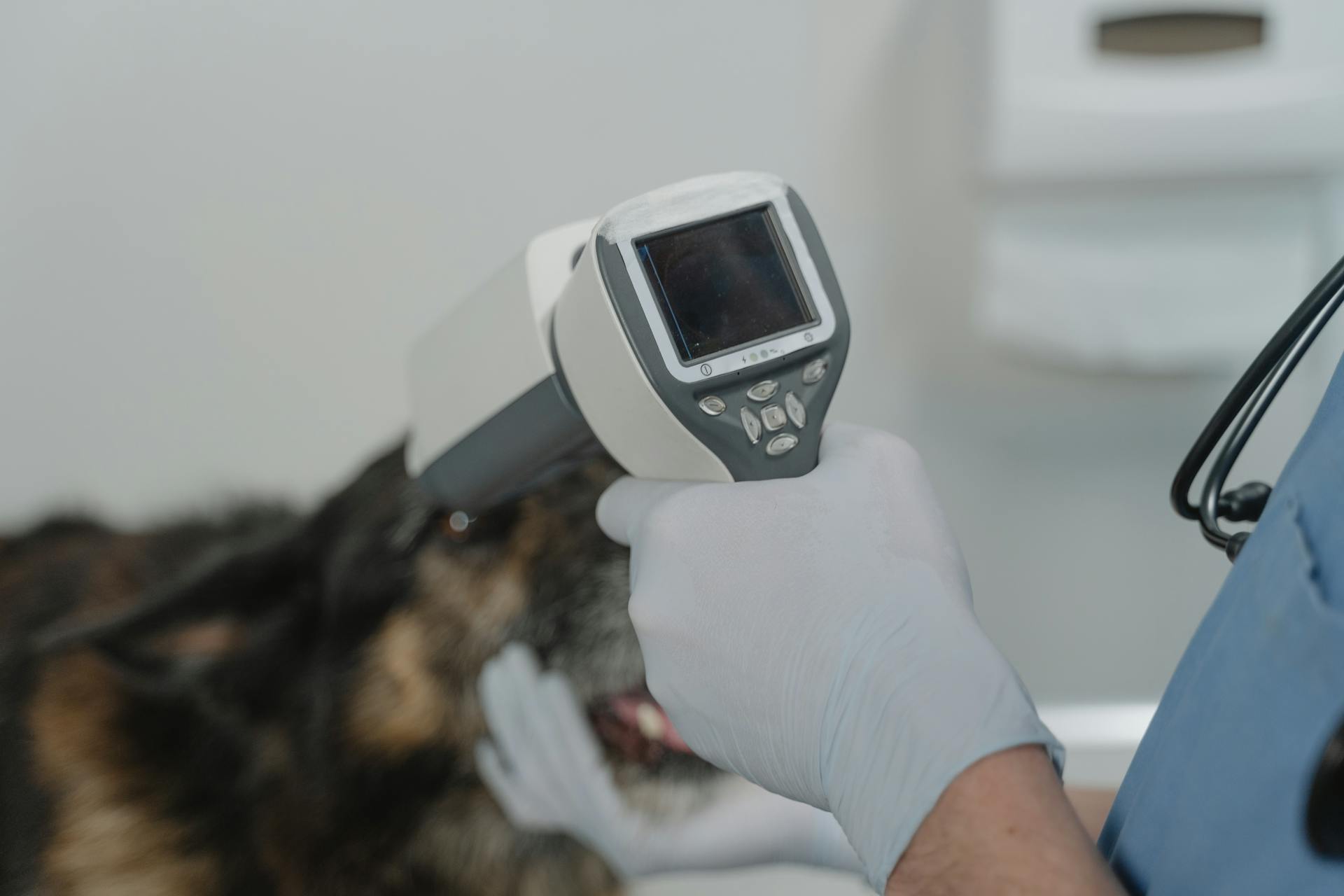
To become a veterinary technician, you'll need to meet the certification requirements. In the United States, the American Association of Veterinary State Boards (AAVSB) sets the standards for veterinary technician certification.
You'll need to complete a post-secondary program in veterinary technology, which typically takes two years to complete. These programs are offered at community colleges and universities.
To be eligible for the Veterinary Technician National Examination (VTNE), you'll need to graduate from an accredited program. The program must be accredited by the American Veterinary Medical Association (AVMA).
The VTNE is a comprehensive exam that tests your knowledge and skills in areas such as anatomy, pharmacology, and laboratory procedures.
A different take: Tcc Veterinary Technician Program
Certification Requirements
To be eligible to become a Registered Veterinary Technician in California, you must meet certain requirements. You must be at least 18 years old and have Livescan fingerprints submitted to the CVMB.
You'll also need to pass the Veterinary Technician National Exam (VTNE) by applying directly to the American Association of Veterinary State Boards.
To meet the educational or experience criteria, you can choose one of three options. Option one is to graduate from an American Veterinary Medical Association (AVMA) accredited RVT program or a California Veterinary Medical Board (CVMB) approved RVT program.
Alternatively, you can complete a combination of education and experience, which includes 20 semester units or 30 quarter units of specific education, and 4,416 hours of directed clinical practice experience in no less than 24 months under the direct supervision of a California licensed veterinarian.
This route, known as the Alternate Route, is designed for individuals already working in a veterinary setting who don't meet the other eligibility categories. The coursework must be completed within five years prior to taking the examination and documented by transcripts or certificates of attendance.
The directed clinical experience must also be completed in no less than 24 months and no more than 5 years prior to taking the examination. Practical experience must be documented by a signed Task List showing competence in all the listed tasks.
If you're already licensed, certified, or registered as an RVT in another state, you can also meet the requirements by providing proof of current certification and a signed Task List documenting completion of the required 4,416 hours of directed clinical practice experience.
Intriguing read: Veterinary Equipment List
Preparation and Education
To become a certified veterinary technician, you'll need to prepare for the VTNE, a comprehensive exam covering seven major areas of knowledge. These areas include pharmacology, surgical preparation and assisting, dentistry, laboratory procedures, animal nursing, diagnostic imaging, and emergency medicine.
Enrolling in an AVMA-accredited veterinary technician program is a crucial step in your education. These programs usually take two years and grant an associate degree in veterinary technology.
You can also supplement your education by purchasing study materials and practice exams from the AAVSB, the organization that administers the VTNE.
You might enjoy: Continuing Education for Veterinary Technicians
Understanding the Role
Becoming a vet tech is a great career choice if you have a passion for animals and want to work in the veterinary field.
You'll be working in a variety of settings, such as animal hospitals, clinics, zoos, farms, and research facilities.
As a vet tech, you'll be an integral part of the animal care team, working alongside veterinarians to provide medical care and treatment for animals.
Being a vet tech is a rewarding and fulfilling career that allows you to make a difference in the lives of animals and their owners.
Intriguing read: Animal Health Technician
Enroll in AVMA-accredited Program
Enrolling in an AVMA-accredited program is a crucial step in preparing for a career as a veterinary technician. These programs provide the necessary education and training to prepare you for the VTNE.
You'll need to join an American Veterinary Medical Association (AVMA)-accredited veterinary technician program to get started. These programs usually take two years and grant you an associate degree in veterinary technology.
You'll learn everything from animal anatomy to surgical prep in an AVMA-accredited program. Think of it as boot camp for future vet techs.
To find an AVMA-accredited program, look for one that meets the requirements for the VTNE. This will ensure you're getting the education and training you need to succeed.
Explore further: Pima Veterinary Technician Program
Instructions
To get started on your path to becoming a licensed veterinary technician in Maryland, you'll need to gather some essential documents. You'll need to provide a final transcript from your AVMA-accredited veterinary technology program, which should be sent directly from the college to the Board office.
Consider reading: Do Veterinary Assistants Need a Degree

The transcript should be submitted in an envelope with an unbroken seal from the college, or emailed from the institution to [email protected]. This ensures that the document is authentic and comes directly from the source.
You'll also need to provide a headshot, about 2" x 3", taken within the past 6 months, which must be uploaded.
If you have any pending or past disciplinary action with another state Board or if you have any criminal convictions (other than minor traffic violations), you must provide all related documentation.
Here's a list of the documents you'll need to gather:
- Final transcript from your AVMA-accredited veterinary technology program
- Headshot (2" x 3", taken within the past 6 months)
- Letters of Good Standing (if applicable)
- Miscellaneous Documentation (if applicable)
The State Board of Veterinary Medical Examiners of Maryland works Monday to Friday, 8:30 a.m. to 5:00 p.m., so be sure to plan your application submission accordingly.
Certification Process
To become certified as a veterinary technician, you'll need to pass the Veterinary Technician National Exam (VTNE). This exam tests your knowledge across nine domains, including anesthesia, pharmacology, and emergency care, and consists of 170 multiple-choice questions.
A different take: Veterinary Assistant Test
The cost of taking the VTNE is $300, and you can register for the exam through the American Association of Veterinary State Boards (AAVSB) website or by calling them at (816) 931-1504.
You'll also need to obtain a license to work as a vet tech in most states. The cost of a vet tech license varies depending on the state, but you can expect to pay a fee in addition to the cost of certification.
To sit for the VTNE, you'll need to meet the eligibility requirements for your state. In Maryland, for example, you can become a licensed Registered Veterinary Technician (RVT) by graduating from an AVMA-accredited Veterinary Technology Program or by acquiring significant education and experience.
Here's a breakdown of the steps to become a licensed RVT in Maryland:
- Graduate from an AVMA-accredited Veterinary Technology Program
- Take and pass the VTNE
- Submit your final transcript from your AVMA-accredited program to the Maryland State Board
- Provide any required documentation, such as letters of good standing or disciplinary action records
Note that if you haven't graduated from an accredited program, you'll need to submit additional documentation and meet the state's eligibility requirements before sitting for the VTNE.
Application
To apply for certification as a Registered Veterinary Technician (RVT) in Maryland, you'll need to submit the required documents.
First, you'll need to pass the Veterinary Technician National Exam (VTNE), which tests your knowledge across nine domains.
There are two ways to become licensed as an RVT in Maryland: graduating from an AVMA-accredited Veterinary Technology Program or acquiring significant education and experience.
If you've already taken and passed the VTNE, your scores will be transferred to the State Board automatically if you sat for the exam in Maryland.
If you've passed the VTNE but didn't sit for the exam in Maryland, you'll need to have your score transferred to the State Board by the Veterinary Technician Information Verifying Agency (TIVA).
You'll also need to provide a final transcript from your AVMA-accredited veterinary technology program. This document should be sent directly from the college to the Board office.
If you're not a graduate of an AVMA-accredited Veterinary Technology Program, you'll need to submit all required documentation before you can sit for the VTNE.
Intriguing read: Mcc Veterinary Technician Program
Here's a list of the required documentation:
- Test Scores: You'll need to take and pass the VTNE.
- Transcripts: A final transcript from your AVMA-accredited veterinary technology program.
- Letters of Good Standing: If applicable, these letters may be emailed from an official state office.
- Documentation: If you have any pending or past disciplinary action with another state Board or any criminal convictions, you'll need to provide all related documentation.
Once you've submitted all the required documentation, the State Board will review it and determine your eligibility to sit for the VTNE.
Rehabilitation
If you're interested in specializing in rehabilitation, there are a few certification options available to veterinary technicians and nurses.
The University of Tennessee offers three different certifications: the Certified Canine Rehabilitation Practitioner (CCRP), the Certified Equine Rehabilitation Program (CERP), and the Certified Canine Fitness Trainer (CCFT).
Another option specific to canines is the Certified Canine Rehabilitation Veterinary Technician or Nurse (CCRVT or CCRVN) offered through the Canine Rehabilitation Institute.
Certification Types and Fees
The cost of certification for vet techs can vary, but the National Veterinary Technician Exam (NVTE) is a commonly accepted exam with a fee of $300.
To work as a vet tech, you'll also need a license, but the cost of a vet tech license varies by state.
The NVTE certification exam is a crucial step towards becoming a licensed vet tech, and passing it will open doors to a successful career.
Consider reading: Georgia Veterinary Technician License
Certification and Licensure Fees

Certification and licensure fees can add up quickly. The National Veterinary Technician Exam (NVTE) is the most commonly accepted certification exam for vet techs in the United States, and it costs $300.
Obtaining a license to work as a vet tech in most states requires additional fees. The cost of a vet tech license can vary depending on the state.
A fresh viewpoint: New York Veterinary Technician License
CVT vs LVT vs RVT
If you're researching certification types, you might come across different letters attached to the title of a veterinary technician. Certification might come with different letters depending on where you live, with some states using voluntary certification, while others require licensing or registration.
In states with voluntary certification, you might see Certified Veterinary Technician (CVT) listed. This certification doesn't require a specific set of criteria to meet.
Licensing, on the other hand, requires meeting state licensing criteria, and is often denoted as Licensed Veterinary Technician (LVT).
Registration with state boards after passing the VTNE is what leads to the title of Registered Veterinary Technician (RVT).
Here's a quick rundown of the three:
- Certified Veterinary Technician (CVT): Commonly used in states with voluntary certification.
- Licensed Veterinary Technician (LVT): Requires meeting state licensing criteria.
- Registered Veterinary Technician (RVT): Involves registration with state boards after passing the VTNE.
Don't worry too much about the differences – they all mean you're qualified to work as a vet tech.
Veterinary Specialist
Veterinary Specialist certifications are offered by the National Association of Veterinary Technicians in America (NAVTA) and are available in 15 different specialties.
NAVTA offers Veterinary Technician Specialist (VTS) certifications in various areas, including Anesthesia & Analgesia, Behavior, and Clinical Pathology.
To become certified in a VTS specialty, you typically need a set amount of work experience in the specialty area.
Each VTS specialty has its own specific requirements, which may include completion of a skills list, case logs or case reports, and passing a specialty examination.
Here's a list of the 15 VTS specialty areas offered by NAVTA:
- Anesthesia & Analgesia
- Behavior
- Clinical Pathology
- Clinical Practice
- Dentistry
- Dermatology
- Diagnostic Imaging
- Emergency and Critical Care
- Equine Nursing
- Internal Medicine
- Laboratory Animal Medicine
- Nutrition
- Ophthalmology
- Physical Rehabilitation
- Surgery
- Zoological Medicine
State Requirements and Licensure
To become a veterinary technician, you'll need to meet the certification requirements set by your state. In California, for example, you must be at least 18 years old and have Livescan fingerprints submitted to the CVMB. You'll also need to pass the Veterinary Technician National Exam (VTNE) and meet one of the three qualifying educational or experience criteria.
To be eligible for the VTNE, you'll need to have a high school diploma or equivalent and complete a two-year veterinary technology program accredited by the CVTEA. This is the case in states like Texas and Florida, where you'll also need to pass the VTNE. In Texas, the length of time it takes to complete the program can vary depending on the school and program's requirements.
Each state has its own licensing requirements, which may include additional exams, background checks, and continuing education. In Florida, for instance, you'll need to complete a minimum of 15 hours of continuing education every two years to maintain your license. The cost of certification and licensure can vary depending on the state and organization providing the certification, with the National Veterinary Technician Exam (NVTE) costing $300.
For your interest: Texas Licensed Veterinary Technician
Featured Images: pexels.com