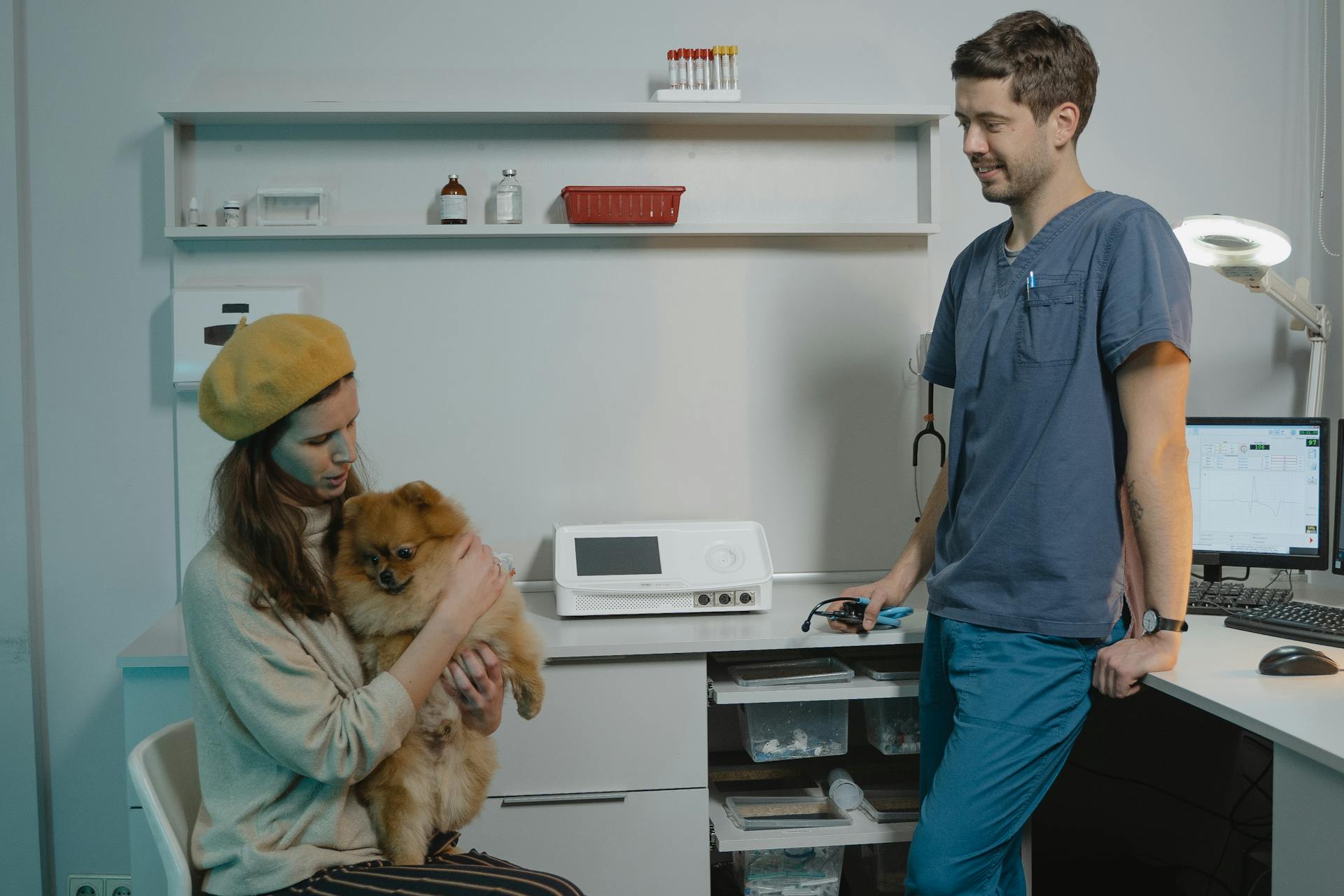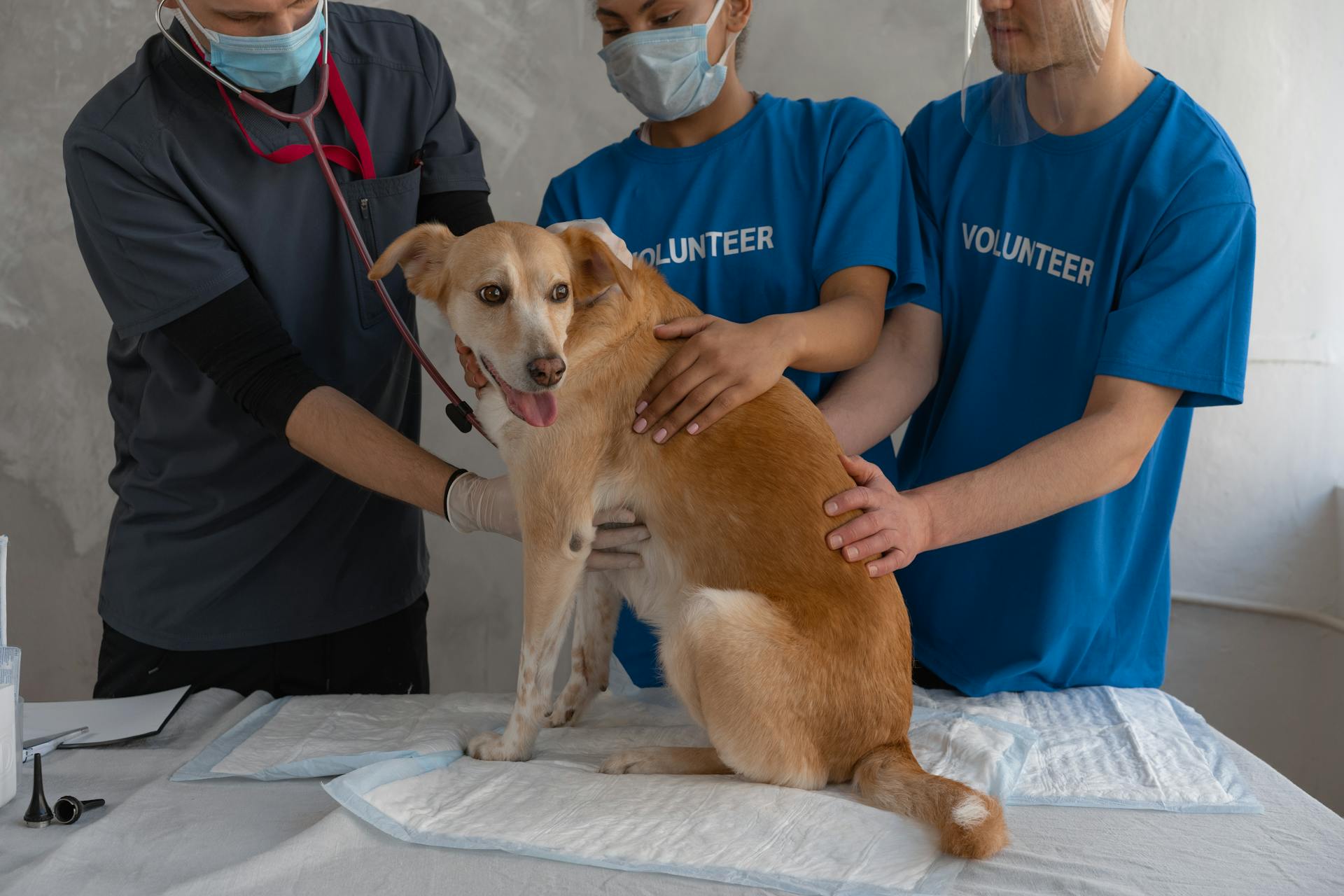
Veterinary technicians play a vital role in animal healthcare, working closely with veterinarians to provide medical care to animals. They are trained professionals who assist with medical procedures, take X-rays, and perform laboratory tests.
Veterinary technicians can specialize in various areas, such as dentistry, surgery, or anesthesia. They may also work in research or education settings, conducting studies or teaching students.
In a typical day, a veterinary technician might assist with vaccinations, take blood samples, or monitor anesthesia levels during surgery. Their tasks are essential to ensuring the well-being of animals and providing accurate diagnoses.
Veterinary technicians often work in hospitals, clinics, or laboratories, and may work irregular hours, including evenings and weekends.
Additional reading: Veterinary Technician Relief Work
What a Veterinary Technician Does
As a veterinary technician, your day is filled with a variety of tasks that require a unique blend of technical skills, compassion, and communication.
You'll work closely with veterinarians, office staff, and pet owners, so people and animal skills are a must, including compassion and empathy. This means being able to comfort anxious pets and explain treatment plans to worried owners.
Worth a look: Skills of a Veterinary Technician
From assisting in surgeries to drawing blood and administering medications, vet techs are the multitasking superheroes of veterinary medicine. They're always there, juggling multiple responsibilities to ensure every pet gets the best care possible.
Your tasks may vary based on the type of practice, specialty, or location, but you'll always be working with animals and performing a range of medical tasks. These can include:
- Medical tasks: Drawing blood, administering medications, and assisting with X-rays.
- Surgical assistance: Prepping animals for surgery and monitoring anesthesia.
- Client communication: Explaining treatment plans and post-op care to pet parents.
- Laboratory work: Running diagnostic tests like urinalysis or fecal exams.
- Animal comfort: Providing TLC to pets before and after procedures.
You'll also be responsible for conducting medical laboratory tests, setting up and maintaining medical laboratory equipment, and collecting and preparing specimens for testing. This requires attention to detail and the ability to follow procedures.
Curious to learn more? Check out: Pima Medical Institute Veterinary Technician
Skills and Education
To become a successful veterinary technician, you'll need to develop certain skills and meet specific education requirements. Being a successful vet tech isn't just about loving animals, though that helps! You'll need to have attention to detail, which is critical for tasks like calculating medication dosages or monitoring anesthesia levels during surgery.
Explore further: Do Veterinary Assistants Need a Degree
To communicate effectively with pet parents, you'll need strong communication skills, explaining complex medical terms in ways they can understand without overwhelming them. Physical stamina is also essential, as you'll be lifting large dogs and standing for hours during surgeries. Emotional resilience is crucial, as you'll encounter tough cases like euthanasia or emergencies.
To register with the British Columbia Veterinary Technologists Association (BCVTA) in B.C., you'll need to complete a two- or three-year veterinary or animal health technology diploma or a related program. You'll also need to pass the Veterinary Technician National Examination (VTNE).
Education and Skills
To become a successful vet tech, you'll need to have a solid foundation in education and skills. A two- or three-year veterinary or animal health technology diploma or a related program is required for this role.
In order to succeed, you'll need to master a range of skills, including attention to detail, communication skills, physical stamina, emotional resilience, and technical expertise.
On a similar theme: Veterinary Assistant Skills
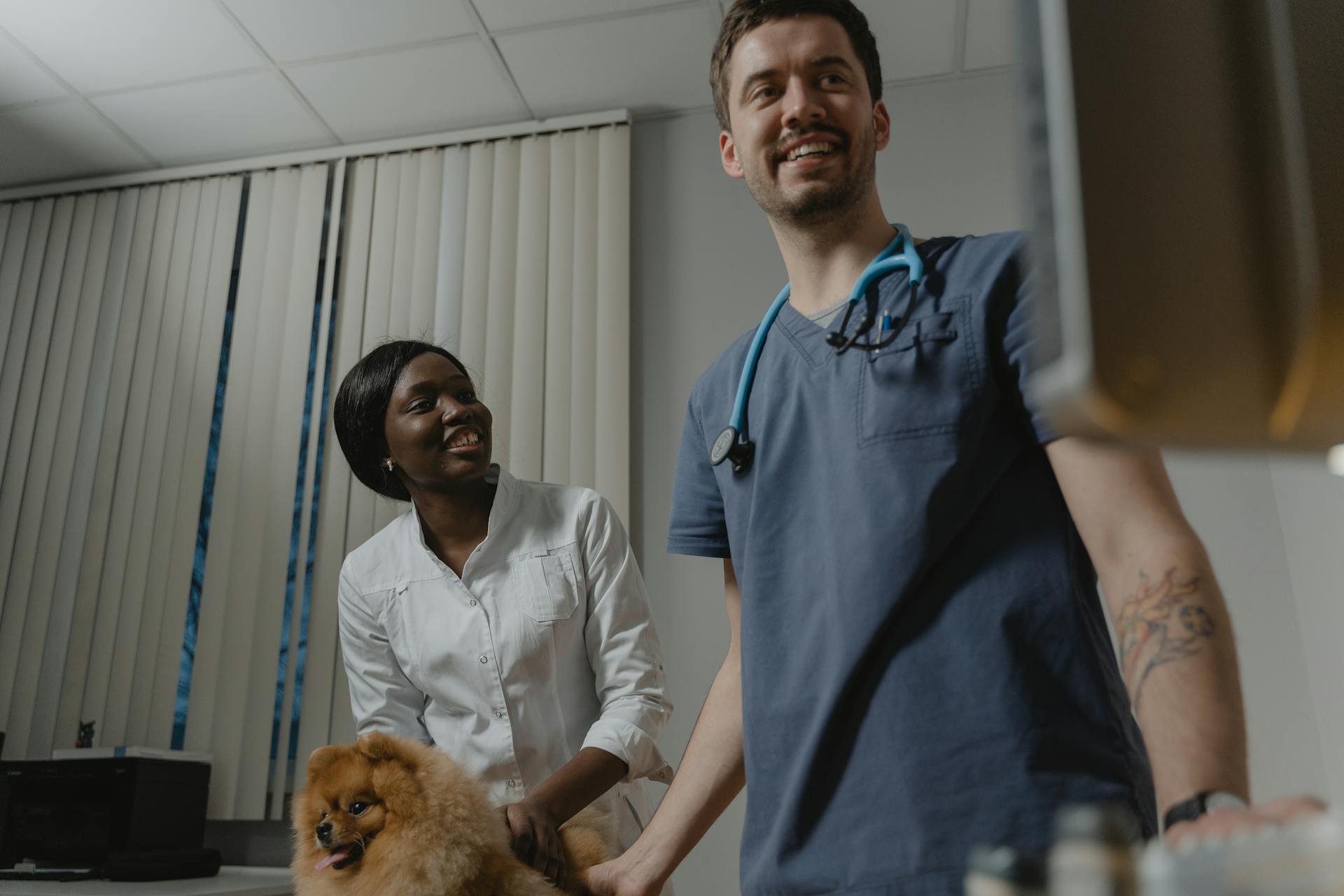
Being able to communicate effectively in writing is also crucial, especially when explaining complex medical terms to pet parents.
Here are the key skills you'll need to excel in your role:
- Attention to detail: precision is critical in calculating medication dosages and monitoring anesthesia levels.
- Communication skills: explaining complex medical terms in a way that's easy to understand is essential.
- Physical stamina: lifting large dogs and standing for hours during surgeries can be physically demanding.
- Emotional resilience: staying compassionate yet professional in tough situations is crucial.
- Technical expertise: mastering tools like IV catheters or diagnostic machines is part of your daily routine.
In B.C., registration with the British Columbia Veterinary Technologists Association (BCVTA) is available to veterinary and animal health technologists who have completed an accredited training program and passed the Veterinary Technician National Examination (VTNE).
Specialization
Specialization is a key part of a vet tech's career, allowing them to focus on a specific area of interest and develop advanced skills. By gaining initial qualifications and work experience, vet techs can pursue various specializations.
One way to specialize is to become a veterinary technologist, which often involves working in different areas such as wildlife facilities, biomedical facilities, diagnostic labs, food safety inspection facilities, and animal food and drug manufacturing facilities. This role can be quite diverse.
Some vet techs choose to specialize in areas like veterinary nutrition, assisting with animal diets and nutrition. Others may focus on veterinary dental care, performing procedures and cleanings under the supervision of a veterinarian.
Additional reading: Animal Health Technician
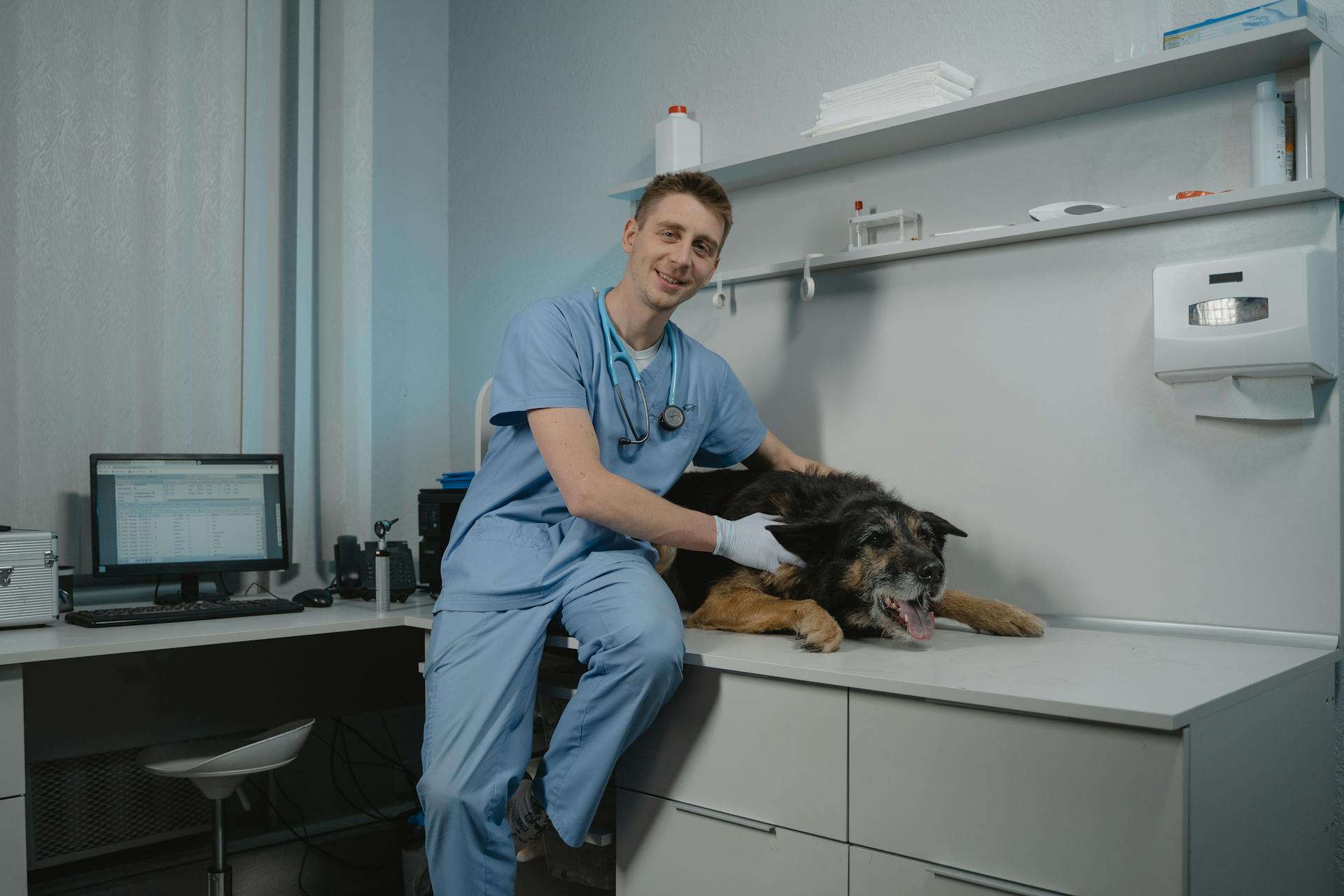
Veterinary surgical techs assist veterinarians with surgery and provide pre- and post-op care, working closely with medical professionals. In contrast, veterinary behavior techs observe animal behavior and work to correct undesirable behavioral problems.
Emergency and critical care vet techs play a critical role in providing care to critically ill and injured animals. Equine vet techs, on the other hand, work specifically with equine veterinarians, often traveling to ranches to provide care to horses.
Here are some examples of vet tech specializations:
- Veterinary nutrition techs
- Veterinary dental techs
- Veterinary surgical techs
- Veterinary behavior techs
- Clinical pathology vet techs
- Emergency and critical care vet techs
- Equine vet techs
Assisting the Veterinarian
As a veterinary technician, one of the most important roles you'll play is assisting the veterinarian during procedures. This can range from restraining an animal during an exam to assisting in surgery, as veterinarians often need trained hands to help them during various procedures.
Vet techs play a crucial role in keeping veterinary practices running smoothly, and their work ensures that veterinarians can focus on diagnosing and treating patients while knowing that everything else is under control.
If this caught your attention, see: Laboratory Procedures for Veterinary Technicians
Some of the specific tasks vet techs perform to assist the veterinarian include prepping animals for surgery, monitoring anesthesia, and gathering the instruments needed for the procedure. During the surgery, vet techs may hand the veterinarian surgical instruments, suction, or retract tissue as needed.
Here are some examples of tasks vet techs perform to assist the veterinarian:
- Prepping animals for surgery
- Monitoring anesthesia
- Gathering instruments needed for the procedure
- Handing the veterinarian surgical instruments, suction, or retracting tissue as needed
- Notifying the veterinarian if any complications develop after the procedure
The Workplace
As a veterinary technician, you'll have the opportunity to work in a variety of settings, each with its unique challenges and opportunities.
Veterinary technicians can be found working in veterinary clinics, animal hospitals, and animal care facilities, where they assist veterinarians with medical procedures and ensure the overall comfort of patients.
In these clinical settings, you'll work closely with animals and their owners, providing compassionate care and valuable education about proper animal health management.
Veterinary technicians can also find employment in zoos, aquariums, and wildlife rehabilitation centers, where they care for a diverse range of animals and contribute to conservation efforts.
Emergency and specialty clinics offer another dynamic workplace for veterinary technicians, where they respond to urgent medical cases and provide immediate medical attention to animals in distress.
Related reading: How Is a Veterinary Technician Work Environment
End-of-Day Tasks
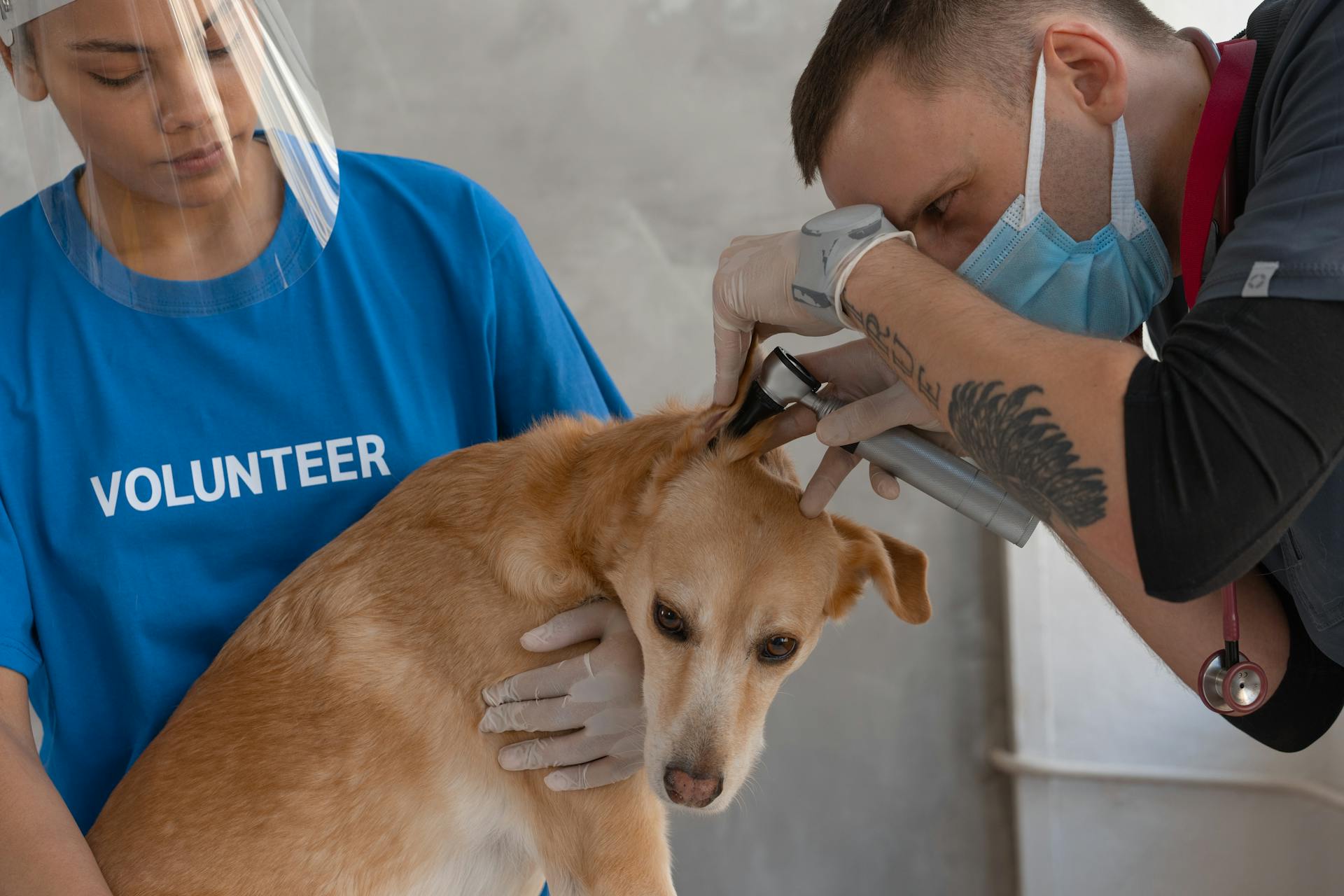
As you're wrapping up your day at the office, it's essential to tidy up before clocking out. Vet techs clean exam rooms, for instance, to keep things organized for the next day.
Before leaving, make sure to restock supplies to avoid any last-minute scrambles in the morning. This simple task can save you time and stress in the long run.
Double-checking patient records for accuracy is crucial to ensure smooth operations the following day. This habit helps prevent mistakes and keeps patient care top-notch.
You might enjoy: Veterinary Technician Day
The Workplace
Veterinary technicians can work in a variety of settings, each with its unique challenges and opportunities.
Veterinary clinics, animal hospitals, and animal care facilities are the most common workplaces for veterinary technicians, where they assist veterinarians with medical procedures and care for patients.
In these clinical settings, veterinary technicians work closely with animals and their owners, providing compassionate care and valuable education about proper animal health management.
On a similar theme: How to Become an Exotic Animal Veterinarian
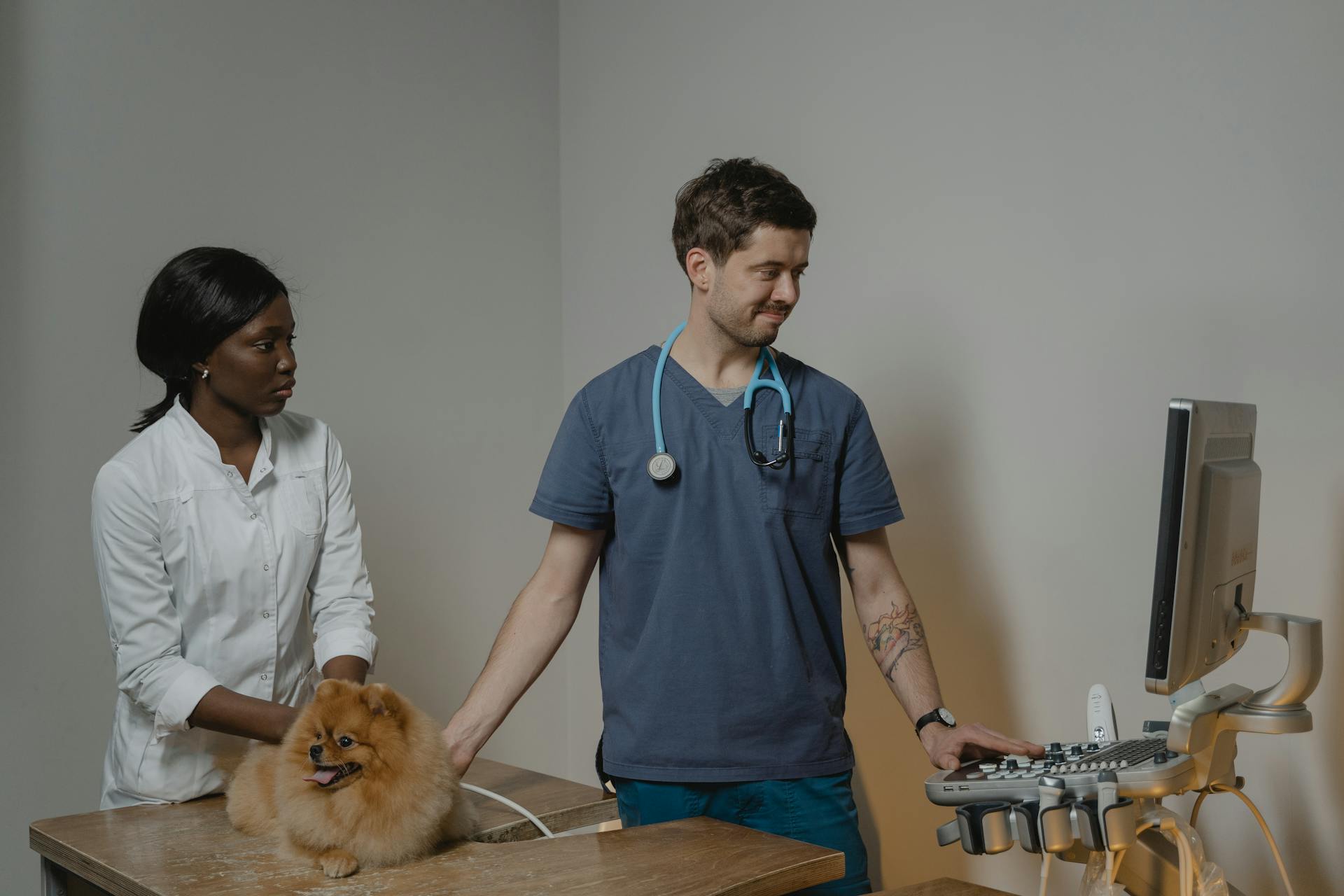
Veterinary technicians can also find employment in zoos, aquariums, and wildlife rehabilitation centers, where they care for a diverse range of animals and participate in health assessments, habitat enrichment, and conservation efforts.
Emergency and specialty clinics offer a fast-paced environment where veterinary technicians respond to urgent medical cases and provide critical care and lifesaving interventions.
Laboratories and research institutions also employ veterinary technicians to assist in experiments, studies, and clinical trials, where they conduct diagnostic tests, analyze samples, and collaborate with researchers to advance our understanding of animal health.
Veterinary technicians work in a variety of roles, including assisting veterinarians, caring for animals, and communicating with clients and colleagues.
Their tasks can range from hands-on animal care and technical procedures to client communication and recordkeeping, and they often work in a team environment with other veterinary professionals.
Veterinary technicians can also specialize in specific areas, such as working with family pets in a small private practice or collecting samples for testing in a research laboratory.
Becoming a Veterinary Technician
To become a veterinary technician, you need to start by selecting an accredited trade school that has the right credentials. Look for programs with accreditations from the Accreditation Bureau of Health Education Schools (ABHES) or the Committee on Veterinary Technician Education and Activities (CVTEA).
Upon completion of an accredited program, most states allow you to take the Veterinary Technician National Exam. This exam is a common test used by many states to determine your proficiency in the field.
Vet tech training programs typically involve general coursework in areas such as animal nursing care, animal anatomy and physiology, and surgical nursing care for animals. You'll also learn about animal diseases, animal pathophysiology, and animal pharmaceutical training.
Here are some of the general course work you can expect to find in a vet tech training program:
- Introductions to animal nursing care
- Training in animal anesthesia
- Biochemistry
- Animal anatomy and physiology
- Surgical nursing care for animals
- Animal diseases
- Animal pathophysiology
- Animal pharmaceutical training
How to Become
To become a veterinary technician, you'll need to select an accredited trade school that's recognized by the Accreditation Bureau of Health Education Schools (ABHES) or the Committee on Veterinary Technician Education and Activities (CVTEA).
A unique perspective: Free Online Continuing Education for Veterinary Technicians
The first step is to choose a program that fits your needs. Look for programs with these accreditations to ensure you're getting a high-quality education.
You'll want to take a look at the curriculum, which typically includes courses like introductions to animal nursing care, training in animal anesthesia, biochemistry, and animal anatomy and physiology.
Some courses might seem intimidating at first, but don't worry – you're not alone, and your instructors are there to help you through any challenging topics.
Here are some common courses you can expect to find in a vet tech training program:
- Introductions to animal nursing care
- Training in animal anesthesia
- Biochemistry
- Animal anatomy and physiology
- Surgical nursing care for animals
- Animal diseases
- Animal pathophysiology
- Animal pharmaceutical training
After completing your program, you'll be eligible to take the Veterinary Technician National Exam (VTNE) in most states. This exam is a common test used by many states to determine your proficiency in areas like pharmacy and pharmacology, preparing and assisting with surgery, and radiography, ultrasound, and other diagnostic tests.
You might enjoy: Veterinary Assistant Test
Obtaining Test Samples
As a veterinary technician, you'll often be responsible for obtaining test samples from animals. Routine vet checkups involve testing of the blood and stool, which you'll collect.
Collecting a urine sample is also a common task, especially if a urinary tract issue is suspected. You'll need to obtain these samples in a way that's comfortable and safe for the animal.
Serial testing is useful for determining treatment response, so you may need to obtain tests on a scheduled basis to assist with treatment plans. This helps veterinarians evaluate the effectiveness of treatment and make adjustments as needed.
Why Study?
If you're considering a career as a veterinary technician, you're likely wondering why study veterinary technology in the first place. A veterinary technician can best be thought of as an animal nurse.
You'll have the opportunity to work in a variety of settings, including small animal hospitals and large animal hospitals. Veterinary technicians can also be found in research, education, pharmaceuticals, and the military.
As a veterinary technician, you'll be responsible for providing nursing care to animals, which requires excellent communication skills. This means being able to educate clients and work effectively with veterinarians and other staff members.
The veterinary technology profession is very diverse, with opportunities for technicians to work in different areas. You'll have the chance to specialize in laboratory work, radiology, pharmacy, surgery, and anesthesia.
Duties and Responsibilities
As a veterinary technician, your duties are varied and demanding, but also incredibly rewarding. You'll spend a lot of time caring for animals, providing nursing care and rehabilitation therapy to help them recover from illnesses or injuries.
Veterinary technicians handle and restrain animals, making sure they're safe and comfortable during treatment and surgery. This requires a gentle touch and a calm demeanor, as well as a strong understanding of animal behavior.
In addition to hands-on care, veterinary technicians also perform laboratory tests, such as producing radiographs and collecting samples, to help diagnose animal health problems. They may also assist veterinarians with surgery, preparing equipment and giving anesthetics as needed.
Veterinary technicians are responsible for preparing and giving medications and vaccines under the direction of a veterinarian, as well as giving treatments as prescribed. They may also provide wound and bandage care, and do specialized procedures like animal identification and hoof trimming.
Curious to learn more? Check out: Veterinary Surgical Technician
In addition to these technical duties, veterinary technicians also interact with clients, providing advice on animal health care, nutrition, and home care. They may also help with routine tasks like scheduling appointments and managing office supplies.
Here are some of the key duties of a veterinary technician:
- Provide nursing care and rehabilitation therapy for animals
- Handle, restrain and care for animals undergoing treatment and surgery
- Produce radiographs, collect samples and perform other laboratory tests
- Assist veterinarian with animals before, during and following surgery
- Prepare surgical equipment, give and monitor anesthetics, and clean up after surgery
- Prepare and give medications and vaccines under direction of veterinarian
- Give treatments as prescribed by a veterinarian
- Provide wound and bandage care
- Do specialized procedures such as animal identification and hoof trimming
- Talk to clients about animal health care including nutrition and home care
Frequently Asked Questions
How much do most vet techs make?
Vet techs typically earn between $14 and $25 per hour, with pay varying by location, experience, and certifications. Hourly wages can fluctuate significantly depending on individual circumstances.
Is a career as a vet tech worth it?
A career as a vet tech can be emotionally rewarding and make a real difference in the lives of animals and their owners. If you're passionate about animal care and want a fulfilling job, a career as a vet tech may be worth considering.
Featured Images: pexels.com