South America is home to an incredible array of turtle species, each with its unique characteristics and habits. The continent's diverse geography, ranging from the Amazon rainforest to the Galapagos Islands, supports a wide variety of turtle habitats.
In the Amazon, the giant Amazon river turtle is a common sight. These gentle giants can grow up to 30 inches in length and weigh over 100 pounds. Their shells are a beautiful brown color with yellow stripes.
The Galapagos Islands, on the other hand, are home to the Galapagos giant tortoise, one of the largest tortoises in the world. These slow-moving giants can live up to 100 years in the wild and weigh over 900 pounds.
A fresh viewpoint: Are Galapagos Turtles Extinct
Where to Find Turtles
If you're looking to catch a glimpse of these incredible creatures in South America, you're in luck because there are a few hotspots to explore.
You can find leatherback sea turtles in French Guiana, where half of the world's females come to lay their eggs. In fact, during high season (May-June), it's not uncommon to spot dozens of them in one night.
French Guiana has two easy-accessible beaches to watch sea turtles: the beach of Remire-Montjoly outside Cayenne, and another beach under the supervision of KWATA, a French organization that protects not only sea turtles but also other endangered species like the tapir and giant otter.
Beaches in Suriname
Suriname is a turtle lover's paradise, and one of the best places to see these incredible creatures is on its beautiful beaches. Four species of sea turtles can be found nesting on Suriname's shores.
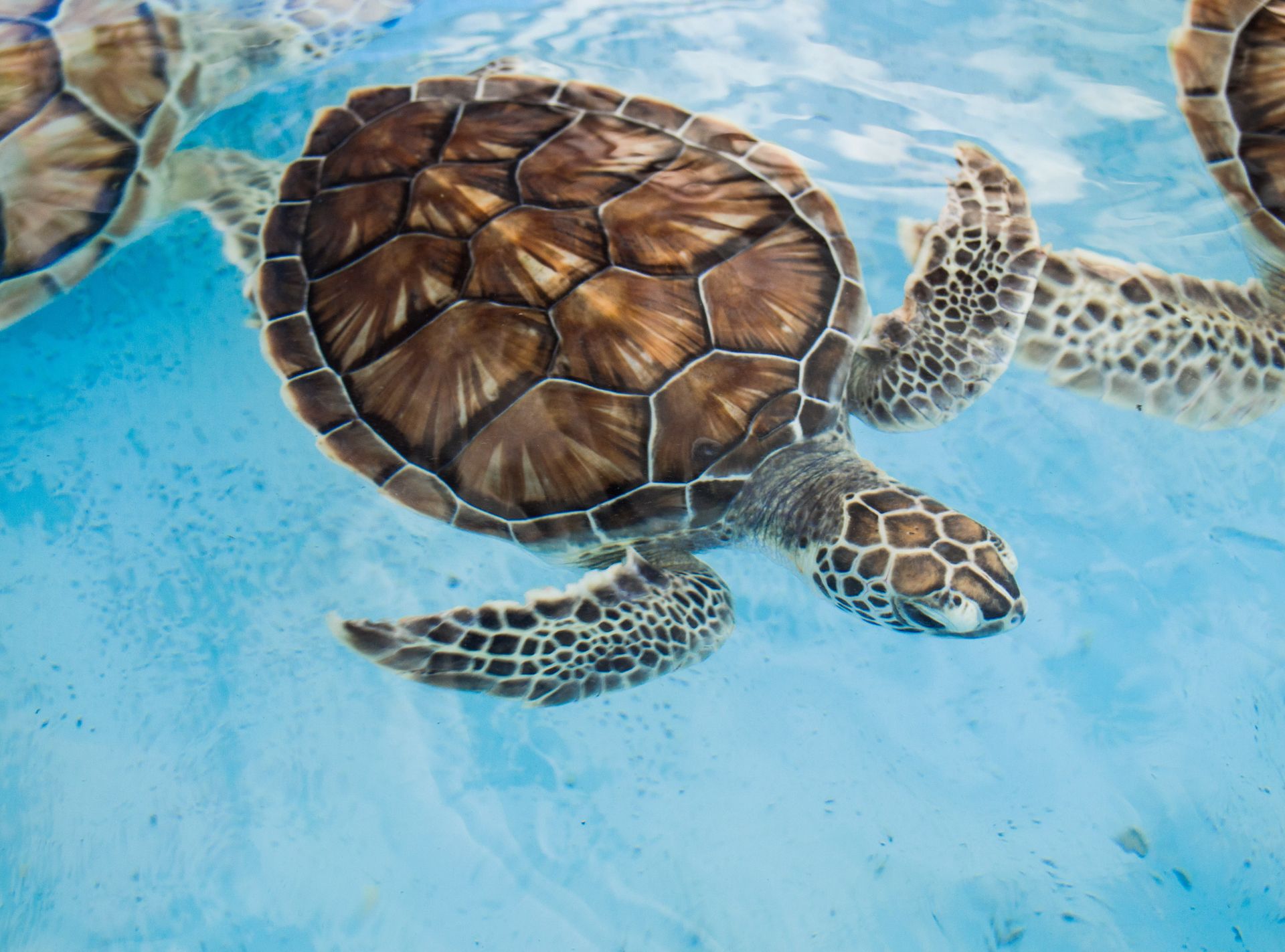
The green sea turtle is one of the most common species found in Suriname, and it's known locally as the krape.
Olive ridley turtles, or warana in Sranan tongo, can also be spotted on Suriname's beaches.
Hawksbill turtles, or karet in Sranan tongo, are another species that can be found nesting on Suriname's shores.
Leatherback turtles, or aitkanti in Sranan tongo, are the largest turtles in the world and can be found in Suriname, making it a unique and exciting experience for turtle enthusiasts.
Here are the four sea turtle species found in Suriname:
- Green sea turtle (krape)
- Olive ridley turtle (warana)
- Hawksbill turtle (karet)
- Leatherback (aitkanti)
Sea Turtles in French Guiana
French Guiana is a great destination for spotting sea turtles, with three species frequenting its beaches: the leatherback, olive ridley, and green turtle.
These turtles can be found nesting on the beaches of French Guiana from May to June, with hatching occurring mainly in July and August.
The leatherback sea turtle is particularly abundant, with half of the world's females coming to lay their eggs on the coast of French Guiana and Suriname.
You can find two easy-accessible beaches to watch sea turtles in French Guiana: the beach of Remire-Montjoly outside Cayenne, and another beach under the supervision of KWATA, a French organization that protects sea turtles and other endangered species.
KWATA staff do an important job preventing turtles from being hassled by visitors, but the beach of Remire-Montjoly is frequented by too many day visitors who don't care about the turtles.
Here are the three species of sea turtles you can find in French Guiana:
- Leatherback sea turtle (in French: la luth / in Kali’na: kawa na)
- Olive ridley turtle (in French: la tortue olivâtre / in Kali’na: Kula lasi)
- Green turtle (in French: la tortue verte / in Kali’na: kada lu)
Turtles in South America
In Brazil, you can find 22 marine turtle stations along 1000 kilometers of beach, stretching from Ceará in the north to Santa Catarina in the south.
The beaches of Anchieta, Regência, and Pontal do Iparanga in Espírito Santo are home to leatherbacks, while Bahia's Arembepe, Praia do Forte, and Costa do Sauípe host hawksbills and loggerheads.
Sergipe has the largest concentration of olive ridley turtles in Brazil, and the island of Fernando de Noronha is a haven for green turtles and hawksbills.
Unfortunately, many nests are destroyed and sea turtles get injured or killed due to human activities like driving on the beach, climate change, and artificial light.
At Pirambu, TAMAR staff collects eggs from nests in potentially dangerous spots and takes them to a fenced-in hatchery, where we were lucky enough to witness a hatchling release.
In French Guiana, you can see dozens of leatherback females laying eggs on the beach during high season (May-June).
Three species frequent French Guiana's beaches: leatherbacks, olive ridleys, and green turtles.
French Guiana has two easy-accessible beaches to watch sea turtles: the beach of Remire-Montjoly outside Cayenne, and the beach of Cayenne itself.
However, the beach of Cayenne is often frequented by day visitors who don't respect the turtles, but the presence of KWATA staff helps protect them.
Related reading: Green Haired Turtle
If you're interested in watching sea turtles in South America, here are some key locations to consider:
- Brazil: Espírito Santo, Bahia, Sergipe, and Fernando de Noronha
- French Guiana: Remire-Montjoly and Cayenne
- Bolivia/Brazil: Guaporé River (Itenez River) for giant South American river turtles
Remember to respect these incredible creatures and their habitats, and consider supporting conservation efforts like KWATA's sea-turtle volunteer program.
Turtle Behavior and Habitat
The South American River Turtle is quite the adventurer, roaming the blackwater and whitewater rivers and tributaries in the Amazon, Orinoco, and Esequibo river basins.
They inhabit a vast area, including Amazonian Brazil, Bolivia, Colombia, Ecuador, and Peru, as well as Guyana and Venezuela, and even Trinidad and Tobago after floods in the Orinoco River.
In the high-water season, they move into flooded forests, adjacent lagoons, and ponds, retreating to rivers during the low-water season.
These incredible creatures congregate in massive numbers, with tens of thousands gathering to nest on sand banks of a river along the Bolivia-Brazil border.
Wonder of Nature
The giant South American river turtles are a wonder of nature, gathering by the tens of thousands to nest on sand banks of a river along the Bolivia-Brazil border.
This massive gathering is possibly the largest of any freshwater turtle species globally. It's also essential to the ecology of the river, with hundreds of thousands of hatchlings producing food and biomass for other aquatic and terrestrial species while contributing to the river's food chain.
The giant South American river turtle is one of the most threatened species in the Amazon, with populations drastically reduced due to historical over-harvest for oil, meat, and trade. They once numbered in the millions.
Conservation efforts are underway to protect this key population of the species, with a multi-national push led by WCS (Wildlife Conservation Society) and local partners including Ecovale, the Versalles community, and environmental agencies from both countries.
Take a look at this: Common Snapping Turtle Species
South American Forest
South American Forests are home to many species of turtles, including the giant South American side-necked turtle. These turtles can live up to 80 years in the wild.
The dense vegetation of South American Forests provides a perfect hiding spot for turtles, allowing them to ambush prey and avoid predators. This forest habitat is also crucial for the reproduction of some turtle species.
Turtles in South American Forests often bask in the sun on logs or rocks, regulating their body temperature. They can be seen doing this behavior early in the morning.
Readers also liked: South American Dogs
Habitat
The South American River Turtle is found in the Amazon, Orinoco, and Esequibo river basins. They inhabit blackwater and whitewater rivers and tributaries in these regions.
In the high-water season, they move into flooded forests, adjacent lagoons and ponds. During the low-water season, they retreat to rivers.
These turtles are distributed across Amazonian Brazil, Bolivia, Colombia, Ecuador, and Peru. They also occur in Guyana and Venezuela.
After floods in the Orinoco River, they can be found in Trinidad and Tobago.
Description
The South American River Turtle is a large species, measuring up to 107 cm in length.
Its adult carapace is quite distinctive, being flattened and broad, with a smooth posterior rim and posterior marginal scutes flared over the limbs.
In terms of color, the underside of the turtle is yellow, including the plastron, marginals, and bridge.
The head of the South American River Turtle is broad and has a protruding snout, a squared-off upper jaw that's not notched in front.
Discover more: South American Tapir
Two barbels are usually found on the chin near the front of the lower jaw, and there are no subocular scales.
The neck of the turtle is grey with yellow on the ventral surface.
The carapace itself is olive to dark grey or brown, with younger individuals often having dark spots and a light border.
Males and females of this species can be distinguished by their physical characteristics, with males having a longer, thicker tail and a more rounded head with yellow markings.
Threats and Conservation
The South American River Turtle has faced an onslaught of threats that have drastically decreased their numbers. Adult turtles were hunted in enormous quantities for meat and eggs, with hunters in Peru taking up to 1,000 turtles in one night.
Hunting remains a significant threat to this species, despite conservation efforts starting in the 1960s. The South American River Turtle is listed in CITES Appendix II, but hunting continues to be intensive.
Intriguing read: South American Lungfish
Water releases from hydroelectric dams have flooded nesting sites, making it difficult for turtles to breed successfully. Dredging by mining companies and noise pollution from mining and motorised watercraft have also interfered with turtle communication.
Climate change has altered rainfall patterns and water levels, preventing nesting beaches from being exposed and flooding nests before eggs hatch.
Quick Facts and Data
The Podocnemis expansa, also known as the South American side-necked turtle, is a species found in the region.
Its scientific name is Podocnemis expansa, and it's listed as Lower Risk/Conservation Dependent on the IUCN Red List.
Quick Facts
Giant South American river turtles are mostly aquatic, only leaving water to lay eggs.
These turtles live in the Orinoco and Amazon river systems, but their nesting range has been significantly reduced due to overharvesting.
In their natural habitat, they can be found in calm waters of large rivers during the dry season, and move to swamps, lagoons, and flooded forests during the high-water season for food.
Their diet consists mainly of fallen fruits and seeds, with other items including vegetation, aquatic invertebrates, and insects.
At the Aquarium, they are fed a diet of sliced fruits, sweet potatoes, nuts, fresh greens, and commercial turtle food.
Females can grow shells longer than 30 inches and weigh up to 200 pounds, while males are much smaller.
Hatchlings are about 2 inches long.
This species was once abundant, but has declined dramatically due to poaching and habitat loss.
Humans are primarily responsible for the decline of this species, with an estimated 48 million eggs taken each year in the past.
Adults are protected from most predators due to their massive size, but hatchlings are preyed upon by black vultures and other animals.
This species is listed as threatened in some parts of its range and as endangered by the U.S. Fish and Wildlife Service.
Worth a look: Florida Softshell Turtle Diet
Species Data
The Podocnemis expansa, also known as the South American side-necked turtle, is a fascinating creature. The scientific name for this species is Podocnemis expansa.
This turtle is listed as Lower Risk/Conservation Dependent on the IUCN Red List.
Turtle Nesting and Conservation Efforts
Turtle nesting beaches in Brazil stretch for 1000 kilometers, with 22 marine turtle stations along the way. These stations are managed by TAMAR and IBAMA/ICMBio, with some doing research and others combining research with tourism.
In Espírito Santo, you can find leatherbacks on the beaches of Anchieta, Regência, and Pontal do Iparanga. In Bahia, hawksbills and loggerheads frequent the beaches of Arembepe, Praia do Forte, and Costa do Sauípe.
The beach in Pirambu is a hotspot for turtle nesting, but it's also a danger zone due to people driving on the beach, climate change, and other human activities. Unfortunately, only 2 out of 1000 hatchlings will survive to adulthood, which is why protecting these turtles has become a necessity.
Here are some of the most threatened turtle species and their habitats in Brazil:
- Leatherbacks: Anchieta, Regência, Pontal do Iparanga beaches in Espírito Santo
- Hawksbills and loggerheads: Arembepe, Praia do Forte, Costa do Sauípe beaches in Bahia
- Olive ridley turtles: Oceanário de Aracaju and Picambu beaches in Sergipe
Sea Turtle Nests
Sea turtle nests are a crucial part of these amazing creatures' life cycle. Along 1000 kilometers of Brazilian beach, stretching from Ceará in the north to Santa Catarina in the south, there are 22 marine turtle stations.
The beaches of Anchieta, Regência, and Pontal do Iparanga in Espírito Santo are home to leatherbacks. Hawksbills and loggerheads frequent the beaches of Arembepe, Praia do Forte, and Costa do Sauípe in Bahia.
In Sergipe, the largest concentration of olive ridley turtles in Brazil can be found on the beaches of Oceanário de Aracaju and Picambu. On the island of Fernando de Noronha, you'll see green turtles and hawksbills nesting on the beaches.
Unfortunately, many nests are destroyed and sea turtles get injured or killed due to human activities like driving on the beach in buggies or 4WDs, and building suburban or industrial areas on the beach.
Turtles Start Nesting
Turtles have begun nesting in one of the most magnificent events in the world, along the Guaporé River in Brazil and the Itenez River in Bolivia.
This annual nesting event is a crucial time for conservation efforts, as it exposes the turtles to poaching for meat, oil, and trade.
Conservationists are working hard to protect the turtles and their eggs, and are also conducting research to inform policies that will help preserve these incredible creatures for future generations.
The turtles are gathering in their thousands along the river, making it a truly awe-inspiring sight.
Conservationists are working with partners on the ground to protect the turtles and their eggs, and are also conducting field science to gather data that will inform policies to protect these turtles.
The turtles are an important part of the ecology of the river and basin, and are also significant to the natural cultural heritage of both Brazil and Bolivia.
This annual nesting event is a critical time for conservation efforts, and it's heartening to see conservationists working hard to protect these incredible creatures.
Check this out: Common Snapping Turtle Eggs
Frequently Asked Questions
What is the best month to see turtles in Costa Rica?
Best time to spot turtles in Costa Rica: May to October. Visit during these months for the highest chances of witnessing this natural wonder
Featured Images: pexels.com