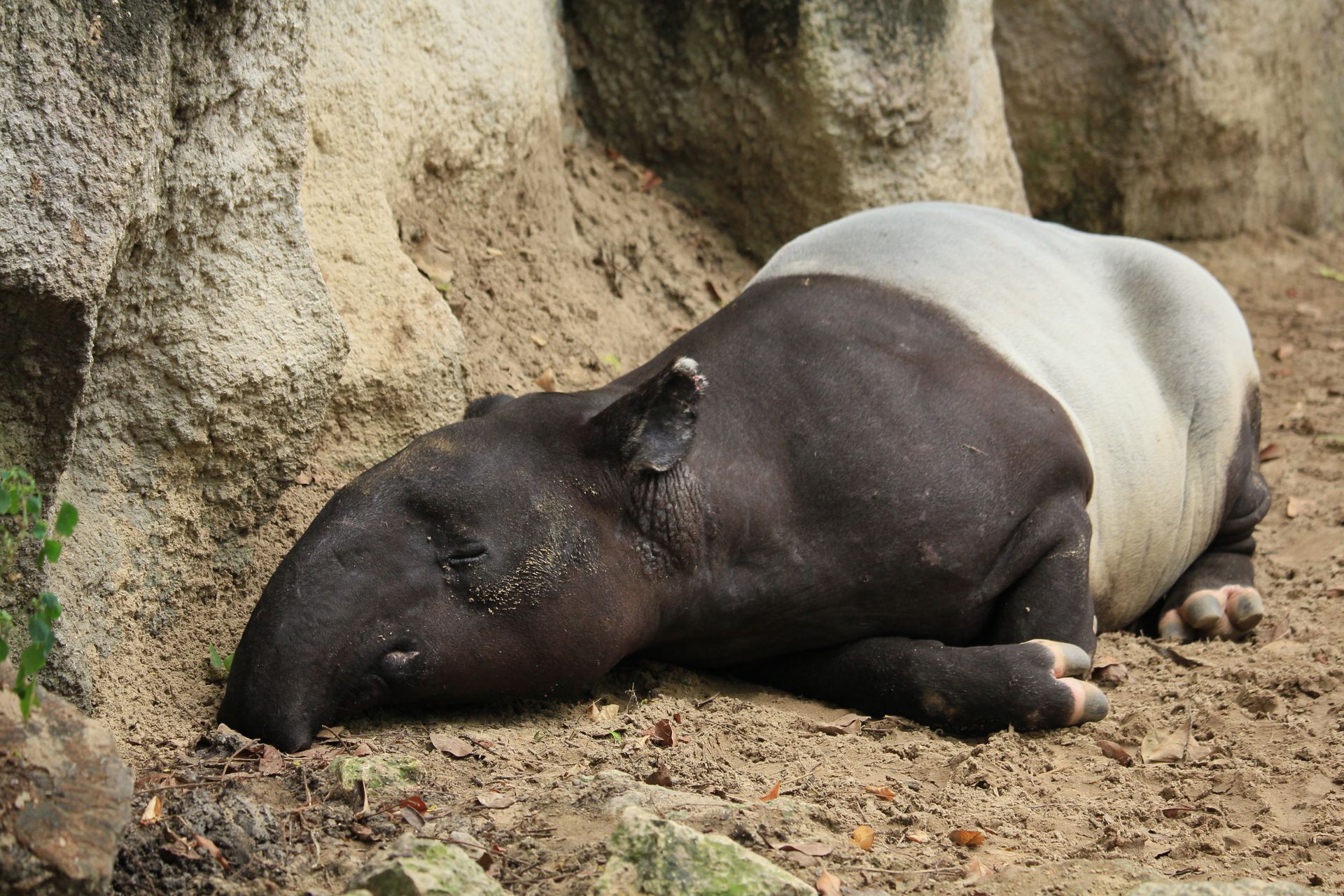
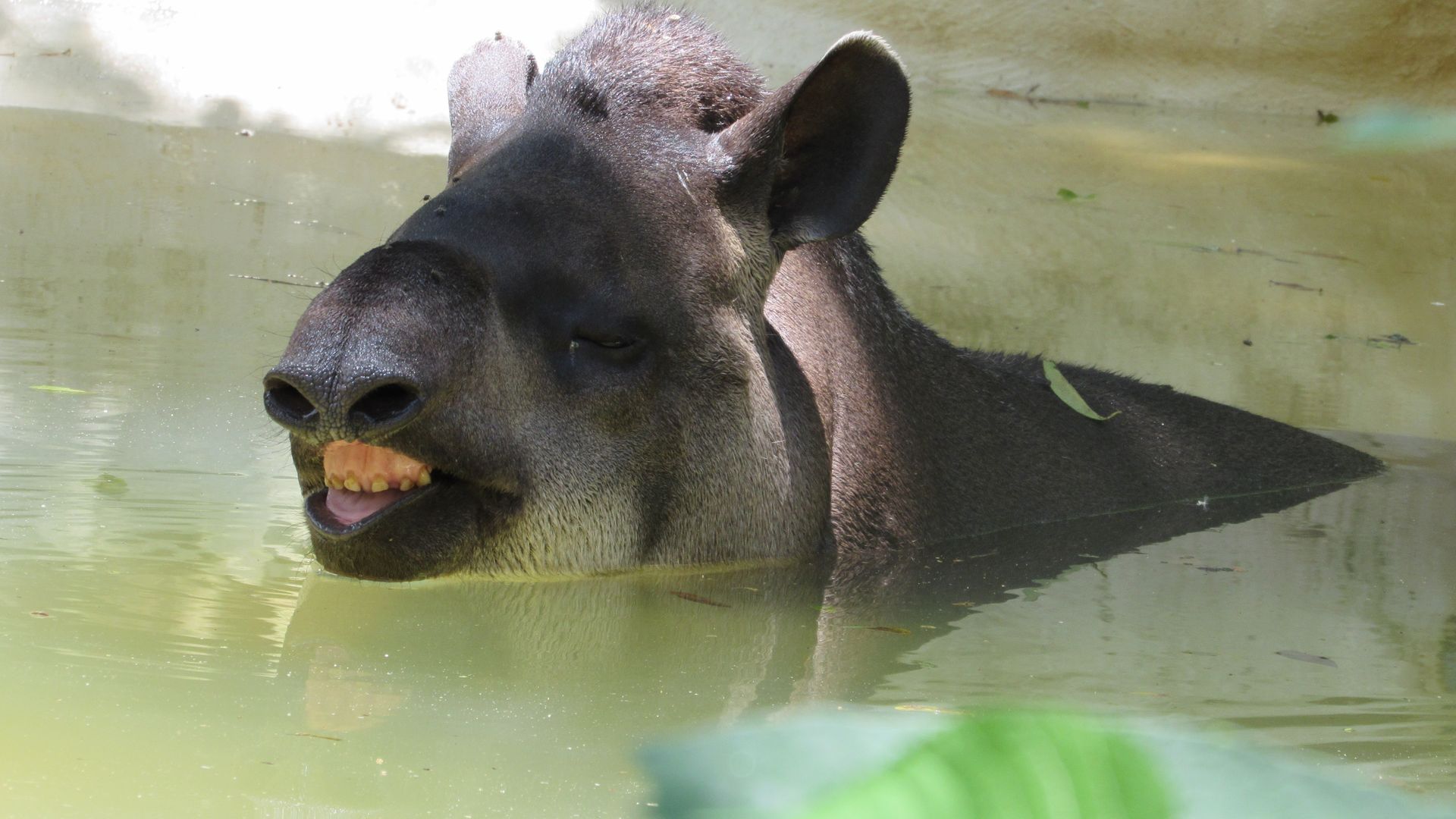
The South American tapir is a unique and fascinating creature. It has a distinctive snout that resembles a pig's and a coat that can range in color from brown to black.
These animals are herbivores and their diet consists mainly of leaves, fruits, and aquatic plants. They have a specialized digestive system that allows them to break down cellulose in plant cell walls.
The South American tapir is found in the tropical rainforests of South America, including countries such as Brazil, Colombia, and Peru. It is a solitary animal and has a large home range that it marks with its scent.
In the wild, South American tapirs can live up to 25 years, although their average lifespan is around 15-20 years.
Physical Characteristics
The South American tapir has a distinctive dark brown coat, with a lighter face and a short, stiff mane running from its head down its neck.
Its ears are round and dark, with clear white edges that make them quite striking.
Newborn tapirs have a dark brown coat with small white spots and stripes all over their bodies, making them look like adorable little bundles of joy.
Adult South American tapirs can grow up to 2.5 meters (about 8 feet) in length, with a short, stubby tail that's only about 5 to 10 centimeters (2 to 4 inches) long.
On average, an adult tapir weighs around 225 kilograms (about 496 pounds), although their weight can range from 150 to 320 kg (330 to 710 lb).
Geographic Distribution
The South American tapir can be found near water in the Amazon Rainforest and River Basin in South America, east of the Andes.
Its geographic range stretches from Venezuela, Colombia, and the Guianas in the north to Brazil, Argentina, and Paraguay in the south, to Bolivia, Peru, and Ecuador in the west.
On rare occasions, tapirs have crossed the narrow sea channel from Venezuela to the southern coast of the island of Trinidad, but no breeding population exists there.
The South American tapir was observed in the state of Rio de Janeiro for the first time since 1914 in 2024, indicating that the state's forests are once again capable of sustaining populations of large mammals.
Geographic Range
The South American tapir is found near water in the Amazon Rainforest and River Basin in South America, east of the Andes. Its geographic range stretches from Venezuela, Colombia, and the Guianas in the north to Brazil, Argentina, and Paraguay in the south, to Bolivia, Peru, and Ecuador in the west.
The tapir's range extends from the northern coast to the southern coast, with rare instances of individuals crossing the narrow sea channel from Venezuela to Trinidad. However, no breeding population exists on the island.
The Brazilian tapir is found in the rain forests of South America, living near water and capable of swimming and diving. They inhabit a mosaic of forest and savannah habitats.
In 2024, the South American tapir was spotted in the state of Rio de Janeiro for the first time since 1914, indicating that the state's forests are once again capable of sustaining populations of large mammals.
A unique perspective: Australian Water Rat
Ecuador
Ecuador is home to a unique cultural perspective on food, particularly when it comes to the consumption of mammals. The Achuar people, living in the Ecuadorian Amazon, consider almost all mammals edible, except for a few exceptions.
The tapir, also known as sachavaca, is one of the mammals the Achuar people have a specific prohibition against eating.
Habitat and Behavior
South American tapirs live near water in the Amazon Rainforest and River Basin, stretching from Venezuela in the north to Brazil, Argentina, and Paraguay in the south.
Their home range is quite extensive, covering countries like Colombia, the Guianas, Bolivia, Peru, and Ecuador to the west. They can even swim across the sea channel from Venezuela to the island of Trinidad.
These tapirs are excellent swimmers and divers, and can move quickly on land, even on rough, hilly ground. They usually live for about 25 to 30 years.
Large predators like big crocodiles, jaguars, and cougars hunt tapirs in the wild. They often attack at night when the tapirs leave the water to sleep on the riverbank.
Splayed toes help Brazilian tapirs navigate through soggy ground, making them well-suited to live near water. They generally feed only at night, hiding in the cool forest during the day.
To escape predators, Brazilian tapirs will sometimes run to the water, where they can hide and be safe.
Additional reading: European Water Vole
Diet and Nutrition
The South American tapir is an herbivore, which means it only eats plants. It uses its flexible nose to find food.
Tapirs have a simple stomach, but a very voluminous cecum in the intestine that houses bacteria to facilitate the digestion of cellulose. This allows them to feed on small amounts of food several times a day.
In the wild, tapirs feed on a variety of plants, including leaves, buds, shoots, fruits, and grasses. They also eat many of the seeds found in the rainforest.
Here's a breakdown of the tapir's diet:
In captivity, adult tapirs consume around 4 kg of alfalfa, 10 kg of balanced feed, and 5-12 kg of fruits and vegetables every day.
Diet
The South American tapir is an herbivore, which means it only eats plants. Its diet is largely vegetarian, consisting of leaves, buds, new shoots, and small branches that it pulls from trees.
Tapirs use their flexible nose to find food, which includes fruits, grasses, and plants that grow in water. They also eat many of the seeds found in the rainforest.
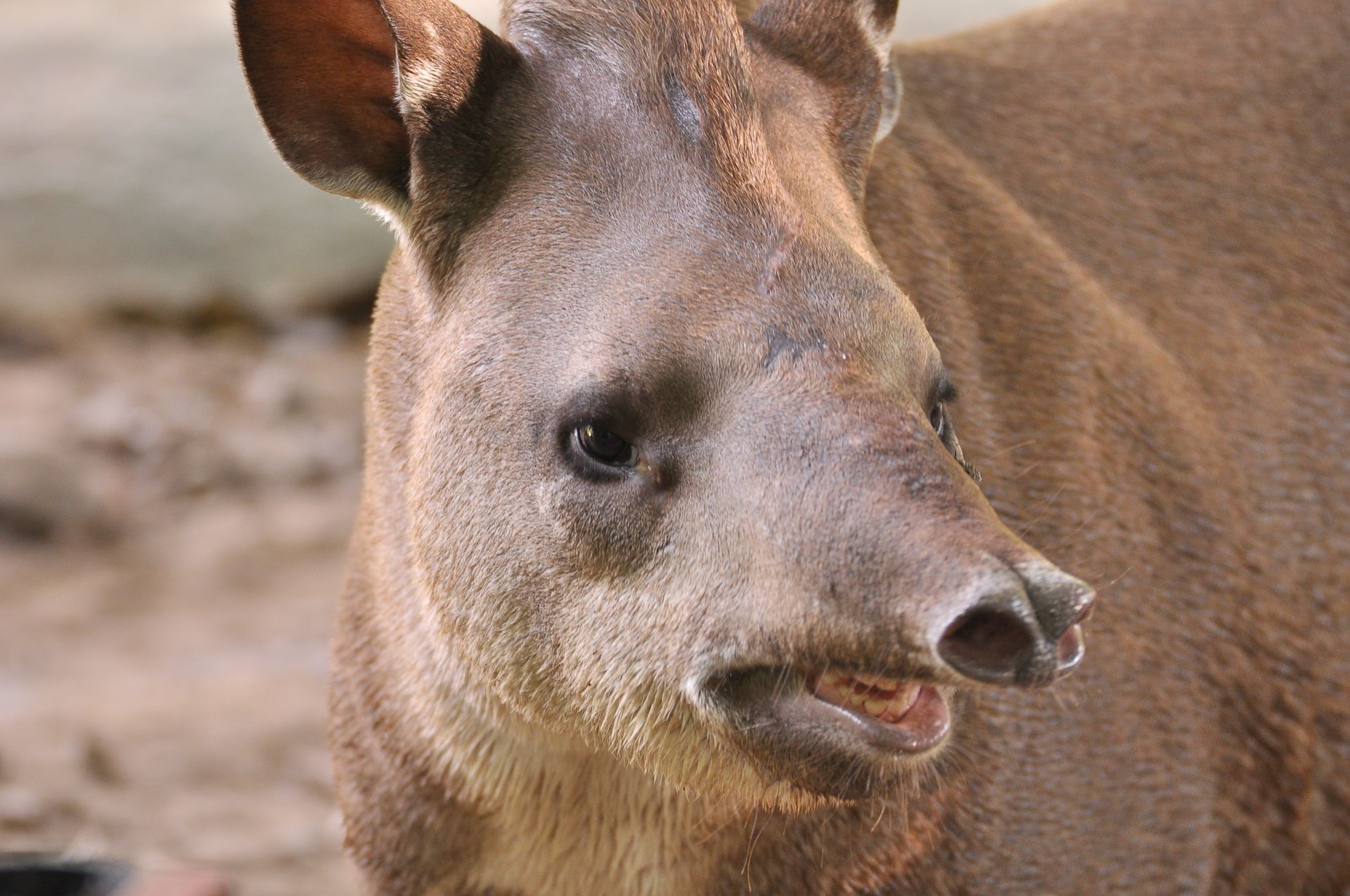
In the wild, tapirs feed on a variety of plants, including 122 species, belonging to 68 genera and 32 families. This is evident from studies on tapir feces.
Tapirs have a unique digestive system that allows them to feed on small amounts of food several times a day. Their diet is composed of 84% fibers and leaves, and 16% fruits.
In captivity, adult tapirs consume around 4 kg of alfalfa, 10 kg of balanced feed, 5 to 12 kg of fruits and vegetables every day. In freedom, they consume about 9 to 10 kg of food per day.
Here's a breakdown of the tapir's diet:
Their diet plays a crucial role in the conservation of ecosystems in South American humid forests.
Is Meat Eaten?
In many Amazonian indigenous groups, tapir meat is prohibited due to its symbolic role in their cultures. The Mayoruna, Campa, and Achuar ethnic groups are among those that do not consume tapir meat.
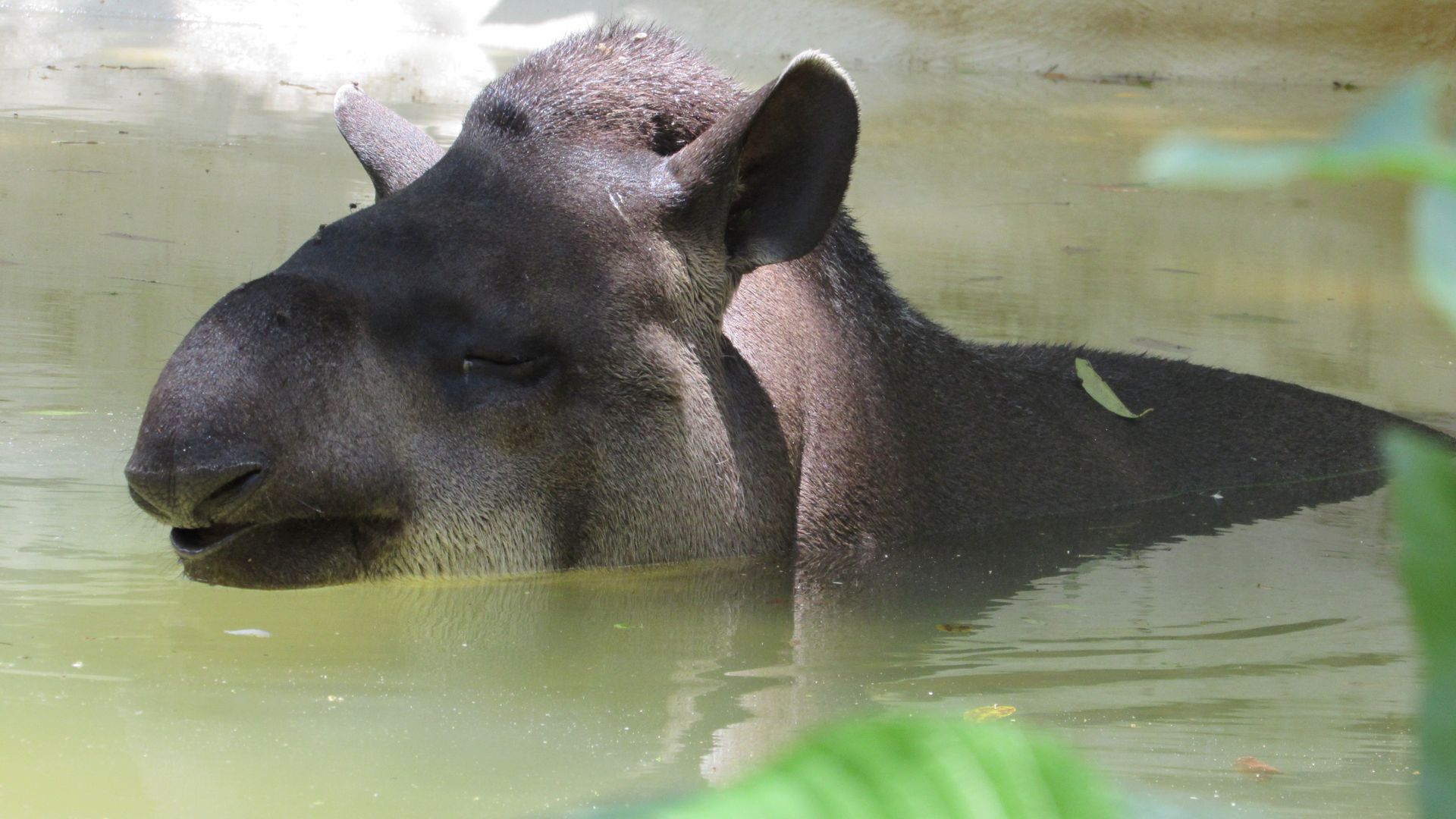
Food taboos are a common strategy among Amazonian indigenous groups to ensure their survival. These taboos are often related to food and are incorporated into the group's rites and performances.
For an omnivorous being, deciding what to eat can be a daunting task. This is why some indigenous groups establish prohibitions to avoid consuming foods that may be toxic or pose a risk to their health.
In the case of food taboos, prohibitions are often established to protect certain animals that hold special significance for the group.
Conservation Status
The Brazilian tapir is considered vulnerable of extinction by the IUCN Red List, but it's more abundant than other tapir species.
Deforestation and agricultural development are major threats to the Brazilian tapir's habitat, leading to a decrease in population.
Hunting for meat and hide is another significant reason for the decline in Brazilian tapir numbers.
The Amazonian tapir is considered vulnerable, whereas all other subspecies are classified as endangered by the IUCN.
Related reading: Brazilian Porcupine
The South American tapir is officially listed as endangered by the United States Fish and Wildlife Service, dating back to June 2, 1970.
Human activities, such as hunting and habitat destruction, have put pressure on the tapir population, making it difficult for them to recover.
The tapir's sensitive reproductive behavior, with a single offspring born after a 13-14 month gestation, makes it even harder for the population to bounce back.
The Karitiana tribe in the Amazon region regularly hunts tapirs, which further threatens their population.
Habitat destruction and infrastructure development, such as roads and dams, also pose significant threats to the tapir's survival in the region.
Reproduction and Life Cycle
Female South American tapirs are pregnant for about 13 months, carrying their babies for nearly a year before giving birth.
A newborn South American tapir weighs around 6.8 kilograms, or about 15 pounds.
The female tapir chooses a warm and quiet place to give birth, making sure her baby is safe and comfortable.
The baby tapir is born after a few hours it's already standing, which is quite impressive considering it's just a newborn.
The calf weighs between 3 to 6 kg at birth and is about 60 cm long, reaching a height of 33 cm.
The baby tapir will drink its mother's milk for about six months, getting all the nutrients it needs to grow strong and healthy.
The calf is suckled by the mother for a year or a little less, but begins to incorporate solid foods into its diet from seven days after birth.
Threats and Predation
The south American tapir is facing numerous threats in its native habitat. The tapir is an animal at risk, vulnerable for some and endangered for others.
One major threat is poaching, which is one of the main factors that marks the habitat of tapirs. Poaching is a significant concern, especially in areas where the tapir is considered a symbol, such as in Argentina.
The tapir's large size makes it a visible target for poachers, who often hunt them for their meat, leather, and other body parts. The probability of detecting tapirs increases in relation to the distance from the closest points for poachers.
Indirect enemies, such as deforestation and habitat destruction, are also major threats to the tapir's survival. The advanced deforestation exposes tapirs and reduces their survival area, especially for a species that has a low density of animal population per km2.
Tapirs are also preyed upon by native indigenous communities, who kill them to appropriate their leather and consume their meat. The Guarani Indians grind the meat to prepare one of their typical dishes.
Jungle predators like the jaguar, the puma, the anaconda, and the alligators also pose a threat to the tapir's survival. Due to improvisation, overhunting, and disobedience of the species' protection regulations, the tapir has disappeared, or its population has decreased, in many Amazonian regions.
For another approach, see: Common Snapping Turtle Species
Gallery and Facts
The South American tapir is a fascinating creature, and a visit to the Dortmund Zoo can be a great way to see one up close. You can spot a young South American tapir there, learning and growing in its naturalistic habitat.
These amazing animals can be found in northern Peru, where they roam free in their natural environment. Their unique appearance and behavior make them a joy to observe.
In terms of their physical characteristics, the South American tapir has a distinctive heart shape, which is visible in the image of a tapir heart (Tapirus terrestris). This is just one of the many interesting facts about these animals.
Here are some key facts about the South American tapir's appearance:
- Male South American tapirs are a sight to behold, with their impressive size and strength.
Gallery
The South American tapir is a fascinating creature, and its images are just as captivating.
You can spot them in zoos like the Dortmund Zoo, where they're cared for and protected.
One of the most interesting aspects of the South American tapir is its unique heart, which is a vital part of its circulatory system.
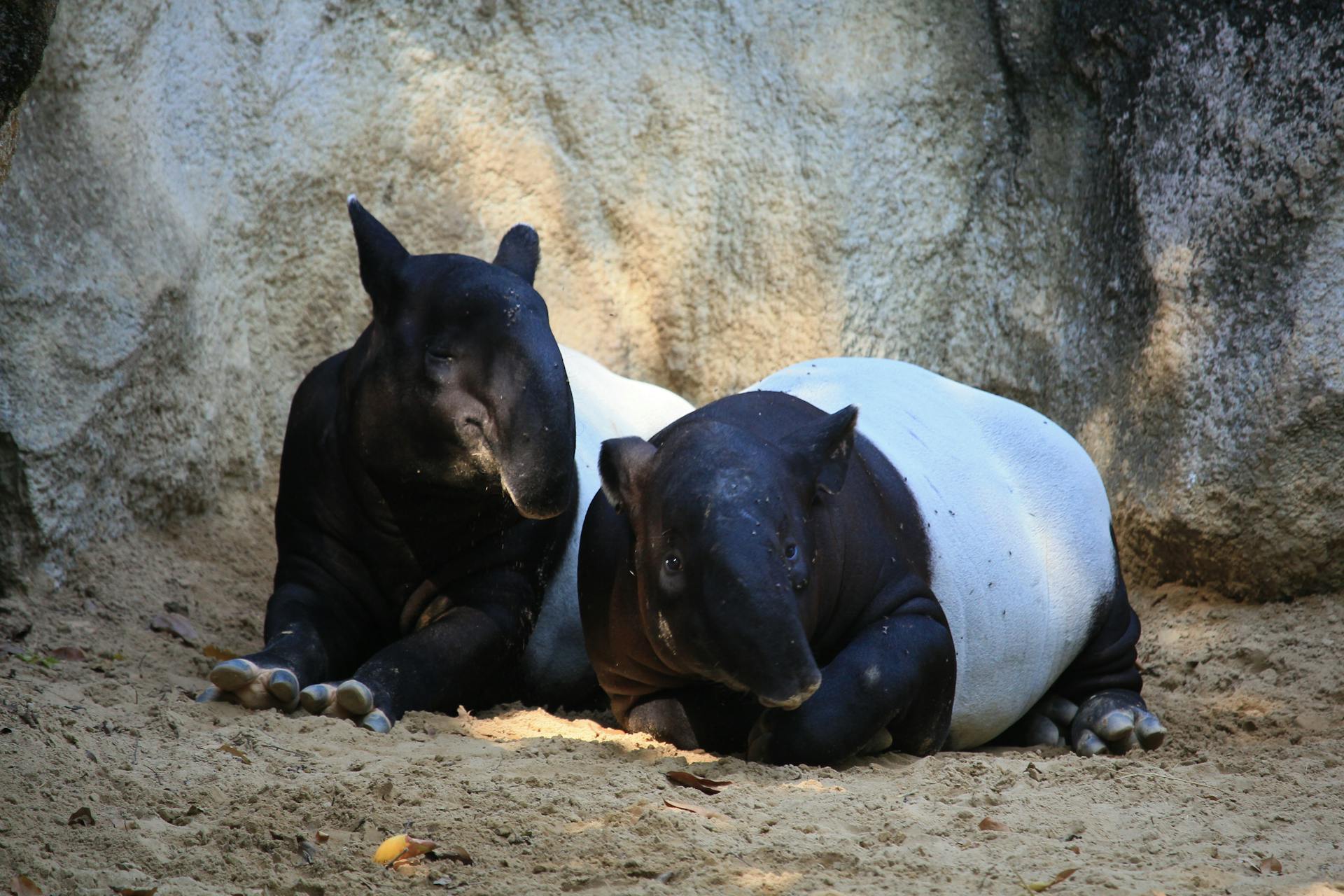
The South American tapir's heart is a remarkable organ that pumps blood throughout its body.
If you're lucky, you might catch a South American tapir performing the Flehmen response, a unique behavior where it curls up its lip to detect scents.
This behavior is a key part of how they navigate their environment and find food.
Here are some images of the South American tapir in its natural habitat and in zoos:
- Young South American tapir at the Dortmund Zoo
- South American tapir in northern Peru
- South American tapir heart (Tapirus terrestris)
- South American tapir performing the Flehmen response
- Male
Facts About Tambopata
The Tambopata region is home to some incredible creatures, and the tapir is one of the most fascinating animals you'll find there.
The tapir is an excellent swimmer and diver, but it can also move quickly on land, even over rugged, mountainous terrain.
Tapirs are herbivores, which means they only eat plants. They use their mobile nose to feed on leaves, buds, shoots, and small branches, as well as fruit, grasses, and aquatic plants.
In the wild, tapirs have to be careful to avoid predators like the black caiman, Orinoco crocodile, jaguar, cougar, and green anaconda.
Tapirs typically mate in April, May, or June, and females give birth to a single offspring after a gestation period of 13 months.
Origin and Subspecies
The South American tapir has a rich and ancient history. It's one of the surviving mammalian species of the neotropical megafauna, existing for about 40 million years.
The tapir's kinship with equids and rhinoceroses comes from their shared membership in the order Perissodactyla, which includes mammals with extremities having an odd number of fingers or hooves.
The tapir is a fairly primitive animal, belonging to the Tapiridae family, of the Perissodactyla order. This order also includes horses, donkeys, and zebras.
The genus Tapirus inhabited Eurasia during the Eocene, about 55 million years ago, and later spread throughout Eurasia and North America.
Origin of the
The tapir has a rich history that spans over 40 million years. It's one of the surviving mammalian species of the neotropical megafauna.
The tapir is related to equids and rhinoceroses, and it's all because they belong to the same order, Perissodactyla. This order is made up of mammals with extremities that have an odd number of fingers or hooves.
The tapir is a fairly primitive animal, belonging to the Tapiridae family and the Perissodactyla order. Its genus, Tapirus, inhabited Eurasia during the Eocene, about 55 million years ago.
The tapir's ancestors spread throughout Eurasia and North America during the Miocene, but they eventually disappeared from Europe and much of Asia due to the ice ages. Only one species, the Asian or Malayan tapir, survived in Asia.
The ancestors of the South American tapirs migrated to South America from North America during the Miocene, about 23 million years ago. This was a significant event in the tapir's history, paving the way for its current subspecies.
The neotropical tapir species had diverged about 21 to 25 million years ago. This divergence led to the formation of the tapir lineages that we know today.
You might enjoy: Feral Horses in North America
Subspecies
Researchers have identified two subspecies of Tapirusterrestris in Colombia.
One of these subspecies, Tt aenigmaticus, is found in the southeastern part of the country.
The other subspecies, Tt colombianus, is located in the lowlands of northern Colombia.
These subspecies were mentioned by Arias-Alzate, Palacio-Vieira and Muñoz-Durán in their 2009 study.
Indigenous Significance
The tapir holds a special place in the hearts of many indigenous communities in South America.
The Guarani Indians have a rich symbology associated with the tapir, with names like mboré and mborebi.
For the Guarani, the Milky Way is called Rape or Tapi ‘i Rapé, which translates to "path of the tapir" – a celestial path believed to be the tapir's path as it waters and tends to the harvest in heaven.
The Kaingang indigenous people have a similar origin story for the tapir, tracing its beginnings back to the great flood or universal deluge that covered the Earth.
As the waters receded, the survivors drew the new animals with charcoal, including the tapir.
Featured Images: pexels.com