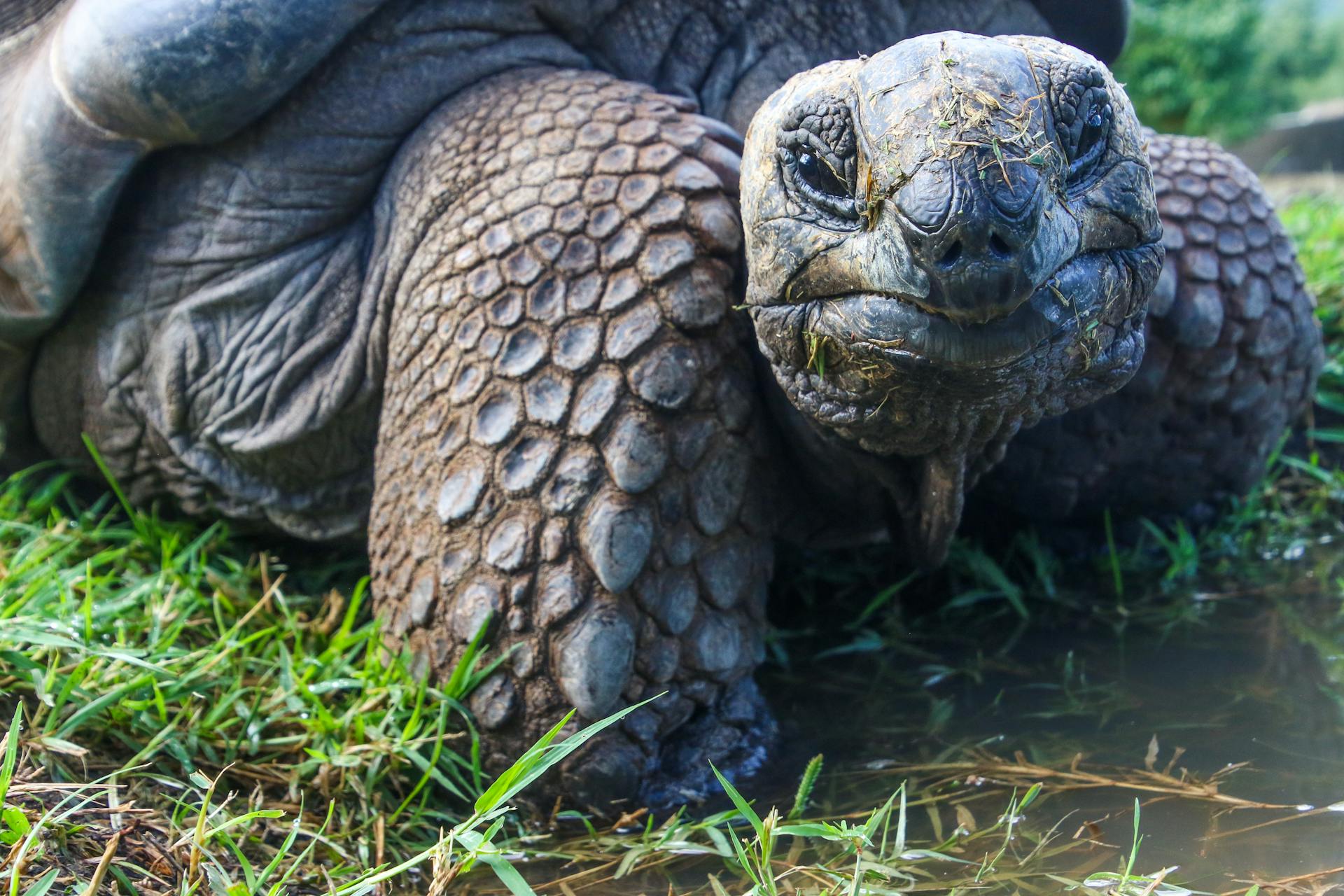
Galapagos turtles are a vital part of the Galapagos Islands' ecosystem, but they've faced numerous threats to their survival.
Some species of Galapagos turtles are indeed extinct, but conservation efforts have helped save others.
The Galapagos giant tortoise, for example, was once on the brink of extinction, with only 14 individuals remaining in the wild.
However, thanks to conservation efforts, the population has been restored to over 20,000 individuals.
Galapagos Tortoise Status
The Galapagos tortoise has a complex conservation status.
All 14 species of Galapagos tortoises are listed on the IUCN Red List, with some classified as vulnerable, endangered, critically endangered, or extinct.
Decades of overhunting by European seafarers severely depleted tortoise populations. The reptiles were hunted for food, and many species were severely overhunted.
Fernandina Island, home to the Fernandina Giant Tortoise (Chelonoidis phantasticus), was thought to be extinct for 112 years due to volcanic eruptions.
However, in 2019, a female tortoise was discovered on Fernandina Island, and genetic analysis confirmed she was the same species.
Broaden your view: World Wildlife Foundation Endangered Species List
Fernanda, the discovered tortoise, is estimated to be over 50 years old and is small due to limited vegetation on the island.
The discovery of Fernanda has sparked a renewed search for other tortoises on the island, with conservationists hoping to find a male to breed with her and save the species from extinction.
Lonesome George, the last of the Pinta Island tortoise species, died in 2012, highlighting the importance of conservation efforts to avoid similar outcomes.
Recent expeditions have found evidence of other tortoises on the island, including tracks and scat, giving hope for the species' survival.
The Galapagos National Park Directorate and the Galapagos Conservancy are planning expeditions to search for more tortoises and potentially breed them in captivity to increase the population.
By studying the Galapagos tortoise, scientists can gain insights into rare species that may persist in isolated places for a long time, informing conservation efforts.
For your interest: Common Snapping Turtle Species
Recent Discoveries
A female Galapagos tortoise, nicknamed Fernanda, was discovered on the island of Fernandina in 2019, after being thought extinct for over 100 years.
This stunning discovery has left scientists excited and hopeful for the species' survival. The tortoise was found to be a member of the Chelonoidis phantasticus species, which was previously thought to be extinct.
Fernanda's shell is quite different from the male tortoise found on the same island in 1906, leading scientists to question if they were the same species. However, genetic analysis confirmed that they are indeed closely related.
The Fernandina Island Giant Tortoise is a species native to the island, but eruptions of the Fernandina Volcano may have contributed to its decline. The island's active volcano has erupted about 25 times in the past two centuries, reducing the small pockets of vegetation where the tortoises could live and feed.
Researchers are now planning a series of expeditions to search for additional tortoises on the island, with the goal of finding a male tortoise to mate with Fernanda. This would help to increase the population and reduce the risk of extinction.
If they find a male, the team will attempt to unite him with Fernanda at the Galapagos National Park's Giant Tortoise Breeding Center in Santa Cruz, where they will encourage their breeding. The young tortoises will be raised in captivity and then brought back to Fernandina to release into the wild.
Additional reading: Conservation-reliant Species
The discovery of Fernanda has also sparked hopes of reviving other extinct species, such as the Pinta Island tortoise, whose last member, Lonesome George, died in 2012. Scientists are using genetic analysis to identify tortoises with Pinta Island DNA on other islands, with the goal of breeding them to create a new population.
This project is a remarkable example of how genetics can be used to save species from extinction. By studying the DNA of tortoises on Isabela Island, researchers have identified hybrid tortoises with Pinta Island DNA, which they hope to breed to create a new population of purebred Pinta Island tortoises.
Galapagos Tortoise Rescued
A giant tortoise thought to have gone extinct over a century ago was rediscovered on Galapagos' Fernandina Island in 2019.
Researchers discovered the female tortoise, nicknamed Fernanda, and sent blood samples to geneticists at Yale University to confirm her species.
Fernanda is the first confirmed sighting of the Fernandina Giant Tortoise (Chelonoidis phantasticus) since 1906.
On a similar theme: Galápagos Giant Tortoise
This species was thought to be extinct due to eruptions of the Fernandina Volcano.
The team at Yale compared Fernanda's genes to those of the only other tortoise found on Fernandina Island, a male Chelonoidis phantasticus discovered in 1906.
Fernanda's genetic makeup confirmed that she is indeed the same species as the male tortoise.
The discovery of Fernanda may have occurred just in time to save her species, according to Dr. James Gibbs.
Researchers are now planning a series of expeditions to search for additional tortoises on Fernandina Island.
If they find a male giant tortoise of the same species, the team will attempt to unite him with Fernanda at the Galápagos National Park's Giant Tortoise Breeding Center.
Conservationists hope to raise the young in captivity and then bring them back to Fernandina to help repopulate the island.
The Galapagos Islands have a unique place in the history of science, where Charles Darwin gathered the clues that led to his theory of evolution.
Today, researchers continue to study the Galapagos' unique wildlife, including the giant tortoises.
Expand your knowledge: Giant Tortoise in the Galapagos Islands
By studying these tortoises, scientists may shed light on the mysteries of human behavior and lead to better models for ecosystem conservation.
The Galapagos National Park Tortoise Center is a rescue and breeding facility where experts are working to keep Fernanda's species alive.
The center is a crucial step in the conservation efforts to save the Fernandina Giant Tortoise from extinction.
Frequently Asked Questions
Did the last Galápagos tortoise die?
Yes, Lonesome George, the last known Pinta Island tortoise, passed away in 2012. His death marked the end of an era for this iconic species.
Featured Images: pexels.com