The giant tortoise on the Galapagos Islands has a remarkable story of survival.
These gentle creatures were once on the brink of extinction due to overhunting and habitat destruction.
The islands' unique ecosystem and lack of natural predators allowed the tortoises to thrive for centuries.
However, by the 1970s, only 2,000 tortoises remained on the islands.
Species and Conservation
The Galapagos giant tortoise is a flagship species for conservation efforts throughout the Galapagos. It's a great example of how conservation can make a real difference.
There are several subspecies of giant tortoises, but unfortunately, one subspecies, C. n. abingdonii, became extinct in 2012 with the death of the last remaining specimen, a male named Lonesome George. The world's "rarest living creature" was a sad reminder of the importance of conservation.
The remaining subspecies are listed as at least "vulnerable" in conservation status, and their slow growth rate, late sexual maturity, and island endemism make them particularly prone to extinction without help from conservationists.
Current Species and Genus Names
The current species and genus names of the Galápagos tortoise have undergone significant changes over the years. The specific designation of niger, originally spelled nigra, was resurrected as a valid species name in 1984.
Quoy and Gaimard's Latin description of nigra, "Testudo toto corpore nigro", means "tortoise with completely black body." This description was made from a living specimen, although the accurate provenance within the Galápagos was not known at the time.
The genus of the Galápagos tortoise is currently Chelonoidis, which was elevated from a subgenus in the 1980s. This change was later supported by phylogenetic evidence that grouped the South American members of Geochelone into an independent clade.
The names of several species names in the genus Chelonoidis have often been misspelled, starting in the 1980s when the genus was elevated and mistakenly treated as feminine rather than masculine. This error was recognized and fixed in 2017.
The subspecies C. n. duncanensis and C. n. hoodensis are two examples of the many subspecies within the Chelonoidis genus.
Suggestion: Common Snapping Turtle Species
Subspecies
There were once 13 different subspecies of giant tortoise on the islands. They evolved in isolation on different islands over thousands of years.
Some tortoises are larger than others and capable of eating different foods. The most visible difference is in the shape of their shells.
These saddle-shaped shells in fact gave the islands their name: "galápago" is Spanish for a type of saddle.
Conservation
Conservation efforts have brought Galapagos giant tortoise numbers up to 19,317 (estimate for 1995-2009), a significant recovery from a low of 3,060 individuals in a 1974 census.
The remaining subspecies of tortoise range in IUCN classification from extinct in the wild to vulnerable, making conservation a pressing concern.
In 1936, the Ecuadorian government listed the giant tortoise as a protected subspecies, and in 1959, it declared all uninhabited areas in the Galapagos to be a national park.
The Galapagos giant tortoise is now strictly protected and is listed on Appendix I of the Convention on International Trade in Endangered subspecies of Wild Fauna and Flora (CITES), prohibiting international trade for primarily commercial purposes.
Capturing or removing many subspecies from the islands was banned in 1970, and it became illegal to export the tortoises from Ecuador in 1971, resulting in automatic prohibition of importation to the United States.
The banning of their exportation has been crucial in protecting these incredible creatures, and conservationists continue to work tirelessly to ensure their survival.
Some subspecies, like C. n. abingdonii, have become extinct due to human exploitation, but conservation efforts are still underway to protect the remaining subspecies.
Galapagos Islands
The Galapagos Islands are home to an incredible array of wildlife, including the iconic giant tortoise. These gentle giants have been living on the islands for centuries, and have even inspired a Jurassic-Park-like project to bring back a lost species.
The islands have a unique geography, with highlands and lowlands that support different types of tortoises. The lowland tortoises, which live in drier environments, have longer necks that they stretch to feed, and the characteristic saddleback-shaped shell.
Some islands, like Santa Fe, have been uninhabited by humans, but whalers and pirates still managed to decimate the tortoise populations. The island has never been inhabited by man, but reports have been made of whalers hauling tortoises off the island.
Santa Fe Island
Santa Fe Island is a unique place in the Galapagos, where the extinct Santa Fe subspecies of tortoise was once found. This subspecies was identified from bone fragments of 14 individuals, old eggs, and old dung discovered on the island in 1905-06.
The island has never been inhabited by humans, which is why the tortoise population remained intact for so long. However, whalers did haul tortoises off the island, although there's no record of it in historical logs.
Genetic studies later confirmed that the Santa Fe subspecies was distinct and closely related to the C. n. hoodensis tortoise. To fill the ecological gap left by the extinct subspecies, a population of C. n. hoodensis was reintroduced to the island and has since established itself.
The island's isolation has helped preserve its natural state, making it a fascinating place to study the Galapagos ecosystem.
For your interest: Are Galapagos Turtles Extinct
Galapagos Wildlife Viewing
The Galapagos Islands are a wildlife lover's paradise, and for good reason - the islands are home to an incredible array of endemic species that can be found nowhere else on the planet.
One of the most iconic creatures to spot is the giant tortoise, which can live up to 100 years in the wild and weigh over 900 pounds.
The Galapagos marine iguana is the only lizard in the world that can live and forage in the sea, and they're often seen basking in the sun on rocky shores.
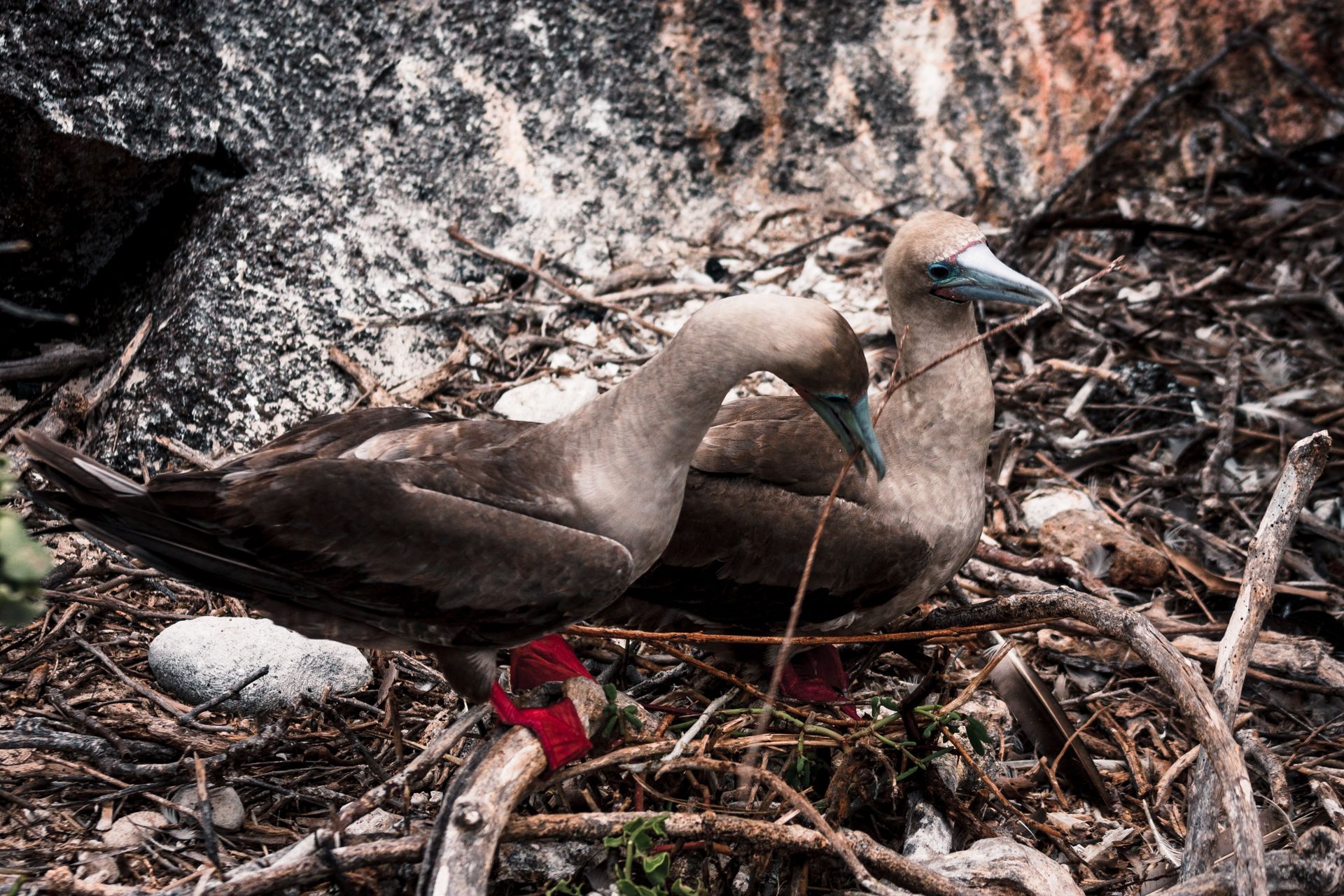
The Galapagos Islands are also home to an incredible array of bird species, including the blue-footed booby, which is known for its bright blue feet that it uses to attract a mate.
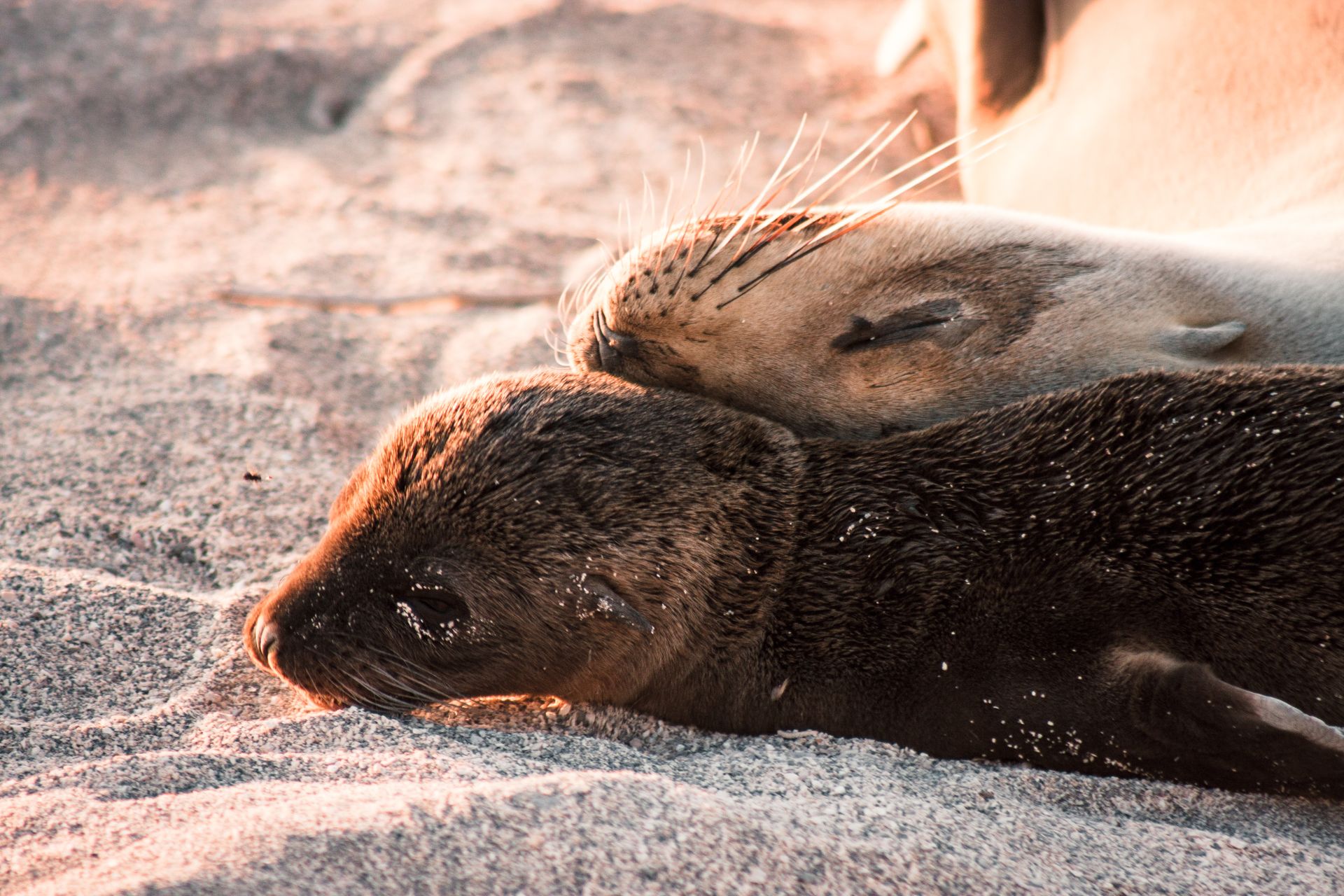
Sea lions are another common sighting, and they're known for their playful and curious nature - they're often seen swimming and playing in the waters around the islands.
The Galapagos Islands are a unique and fascinating destination for wildlife viewing, with an incredible array of species that can be found nowhere else on the planet.
A fresh viewpoint: How Long Can Galapagos Tortoises Live
Tortoise Biology
Galapagos tortoises are herbivores, which means they eat only plants. They dine on leaves, grass, cacti, flowers, vines, and fruit, and their diets vary based on the island or habitat they inhabit.
These slow-moving animals can't swim, but they do enjoy a good soak in a muddy pool or puddle. Many tortoises are migratory, moving around within their habitat at different times of the year to follow the rains to the greenest places where food is most abundant.
As cold-blooded animals, tortoises like to bask in the sunshine in the morning for a couple of hours before becoming active. They can withdraw their head, neck, and forelimbs into their shell for protection, and their legs are large and stumpy with dry, scaly skin and hard scales.
Tortoises have a unique way of regulating their body temperature - they bask in the sun for 1-2 hours after dawn to absorb heat through their dark shells. They then actively forage for 8-9 hours a day, traveling mostly in the early morning or late afternoon between resting and grazing areas.
Description
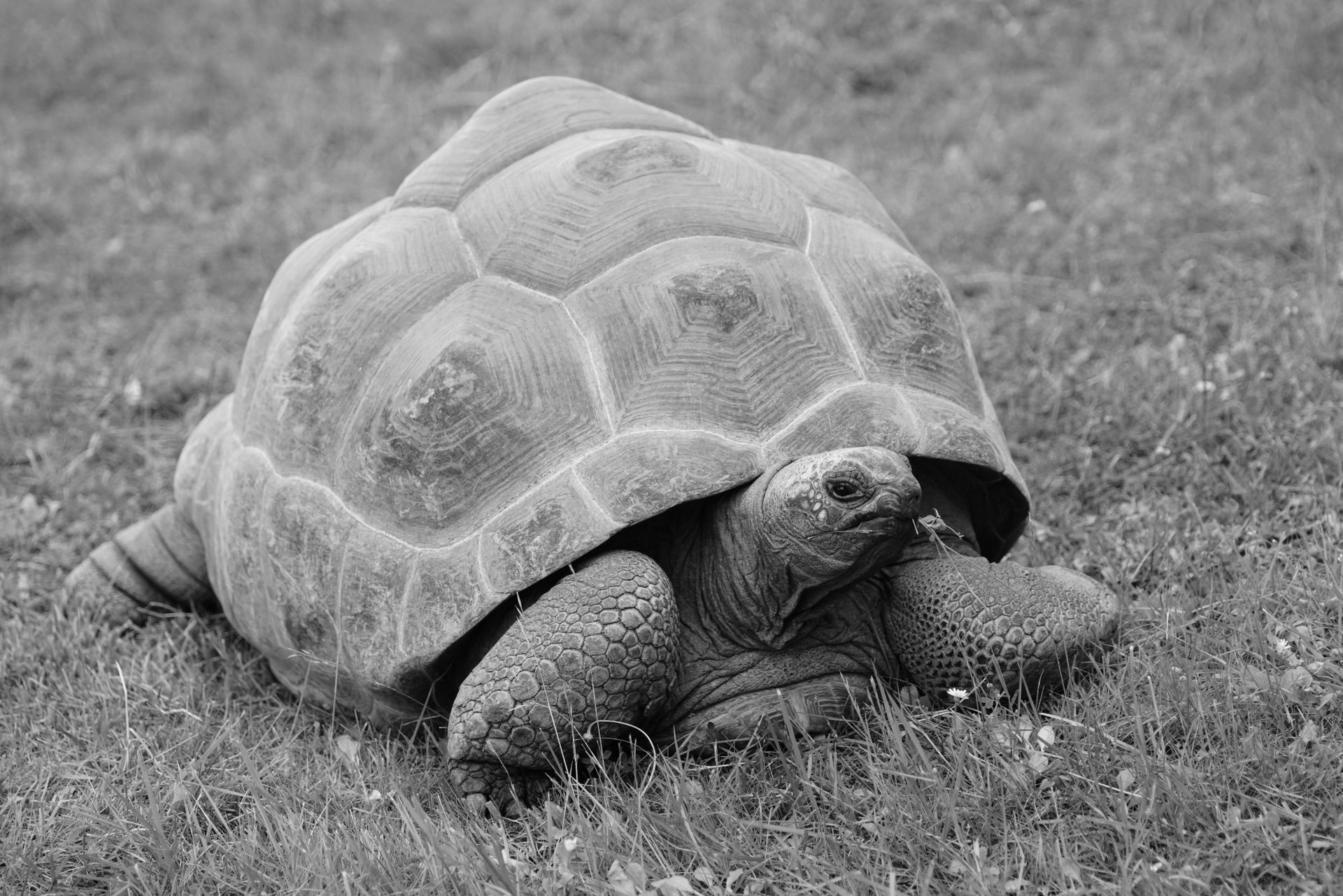
Tortoises have a large bony shell of a dull brown or grey color.
The plates of the shell are fused with the ribs in a rigid protective structure that is integral to the skeleton. This unique shell provides tortoises with excellent protection from predators.
Lichens can grow on the shells of these slow-moving animals, which is a common sight in their natural habitats.
A tortoise can withdraw its head, neck, and fore limbs into its shell for protection, making it a safe haven from harm.
The legs are large and stumpy, with dry, scaly skin and hard scales, perfect for supporting their heavy bodies.
The front legs have five claws, while the back legs have four, which helps them move slowly and steadily across the ground.
Explore further: Western Pond Turtle Shell
Routine
Galápagos tortoises are ectothermic, meaning they regulate their body temperature using external sources, so they bask for 1-2 hours after dawn to absorb the sun's heat through their dark shells.
Their daily routine involves actively foraging for 8-9 hours a day after basking, and they travel mostly in the early morning or late afternoon between resting and grazing areas.
These gentle giants walk at a speed of 0.3 km/h (0.2 mph), which is a slow pace, but they've been doing it for generations.
On the larger and more humid islands, the tortoises seasonally migrate between low elevations and meadowed areas of higher elevation, creating well-defined paths through the undergrowth known as "tortoise highways".
These routes have been used for many generations, and on the wetter islands, the domed tortoises are gregarious and often found in large herds, in contrast to the more solitary and territorial disposition of the saddleback tortoises.
Tortoises sometimes rest in mud wallows or rain-formed pools to regulate their body temperature and protect themselves from parasites like mosquitoes and ticks.
They also take dust baths in loose soil to counter parasites, and some have been observed sleeping in a snug depression in the earth or brush called a "pallet".
Local tortoises using the same pallet sites can result in the formation of small, sandy pits.
Tortoises acquire most of their water from dew and sap in vegetation, which enables them to survive for more than six months without drinking.
Shell Shape
Tortoises have a unique shell shape that provides them with protection and support. Their shell is made up of bony plates called scutes that are connected to the vertebrae.
The shell shape is dome-like, allowing tortoises to withdraw their head and limbs inside for safety. This shape also helps to distribute their weight evenly.
Tortoises have a hard, keratin-based scute on their shell that helps to prevent predators from getting a grip.
Mutualism
Mutualism is a fascinating aspect of tortoise biology, where they form symbiotic relationships with other species to benefit both parties.
Tortoises have been observed sharing a mutualistic relationship with some subspecies of Galápagos finch and mockingbirds, where the birds get a food source and the tortoises get rid of irritating ectoparasites.
The process starts with small groups of finches initiating it by hopping on the ground in an exaggerated fashion facing the tortoise, signaling to the tortoise that they're ready to start.
Tortoises signal their readiness by rising up and extending their neck and legs, allowing the birds to reach otherwise inaccessible spots on their body.
Some tortoises have even been known to exploit this mutualistic relationship to supplement their diet with protein by consuming birds that come to groom them.
Early Life
Young tortoises emerge from their nests after four to eight months and may weigh only 50 grams.
Their shells are domed, making them look quite adorable at this stage. However, the journey to the surface can take several weeks, and their yolk sac can sustain them for up to seven months.
In particularly dry conditions, hatchlings may die underground if they're encased by hardened soil, while flooding of the nest area can drown them.
These little ones stay in warmer lowland areas for their first 10-15 years, encountering hazards like falling into cracks, being crushed by falling rocks, or excessive heat stress.
The Galápagos hawk was once the sole native predator of tortoise hatchlings, with Darwin noting that young tortoises fell prey to the hawk in great numbers.
However, introduced predators like feral pigs, dogs, cats, and black rats have become a threat to eggs and young tortoises, replacing the hawk as their main predator.
Evolutionary History
The Galápagos tortoises have an incredible evolutionary history. All subspecies of Galápagos tortoises evolved from common ancestors that arrived from mainland South America by overwater dispersal.
These ancestors were likely a pregnant female or a breeding pair, and they were able to survive the 1000-km oceanic journey because they're buoyant, can breathe by extending their necks above the water, and can survive months without food or fresh water.
The closest living relative of the Galápagos giant tortoise is the Chaco tortoise, a much smaller subspecies from South America. The Chaco tortoise is a significant find in the study of tortoise evolution.
The divergence between the Chaco tortoise and the Galápagos giant tortoise probably occurred 11.95–25 million years ago. This is a staggering time frame that predates the volcanic formation of the oldest modern Galápagos Islands by millions of years.
The oldest existing islands, Española and San Cristóbal, were colonized first, and these populations seeded the younger islands via dispersal in a "stepping stone" fashion via local currents.
Readers also liked: South Island Takahe
Tortoise Revival
The Pinzón giant tortoise population was on the brink of extinction with only 100-200 adult tortoises and no surviving hatchlings for over 80 years due to predation by introduced black rats.
Through a concerted effort, over 1,000 juvenile tortoises were repatriated to the island, and the black rats were eradicated in 2012, allowing tortoise hatchlings to appear again after more than 100 years.
The repatriation effort was a huge success, and the Pinzón giant tortoise population is now close to sustaining itself in the wild.
On Española Island, the population of the Española giant tortoise was reduced to just 15 individuals in the 1960s, but thanks to conservation efforts, the population is now thriving with over 2,300 tortoises.
The tortoises were repatriated to their home island after the eradication of the primary threat to their habitat – goats – and have since begun to reproduce naturally.
Related reading: Black Snakes in North America
Galapagos Tortoise Revival
The Galapagos tortoise population was on the brink of extinction, with only 100-200 adult tortoises remaining on Pinzón Island due to introduced black rats.
Breeding and release programs have successfully brought seven of the eight endangered subspecies up to less perilous population levels, with the most significant recovery being that of the Española tortoise.
Young tortoises are raised at several breeding centers across the islands to improve their survival during their vulnerable early development, and eggs are collected from threatened nesting sites to give them a head start.
The Galapagos National Park Service systematically culls feral predators and competitors, and efforts are now underway to repopulate islands formerly inhabited by tortoises to restore their ecosystems.
The tortoises are a keystone species, acting as ecosystem engineers which help in plant seed dispersal and trampling down brush and thinning the understory of vegetation.
In May 2010, 39 sterilized tortoises of hybrid origin were introduced to Pinta Island, the first tortoises there since the evacuation of Lonesome George 38 years before.
Genetic analysis of tortoises on Isabela Island has shown that many of the tortoises present have genes from both the Pinta and Floreana populations, and an expedition to Isabela Island captured many of these hybrid tortoises to be taken to the Charles Darwin Research Station.
Recommended read: Giant Wolf Dog Hybrid
Scientists are using genetics to bring back the Pinta Island tortoise species, and it's believed that within only a couple of generations, they could have a practically purebred Pinta Island tortoise to release into the wild.
The tortoises mate from June to December, and the female lays anywhere between 18 and 28 eggs, each of which is about the size of a small tennis ball.
After 3-6 months, the eggs hatch and the little turtles must dig their way out of the sand, an exhaustive process which can take up to four weeks.
Española Island Fox: From Near Extinction to Recovery
The Española Island Fox is another remarkable story of recovery.
In the 1960s, the population was at a staggering low of just 15 individuals.
Their habitat was threatened by goats, which were eventually eradicated, allowing the fox population to start growing again.
The repatriation of offspring back to their home island was a crucial step in their recovery.
Today, the population is thriving, but unfortunately, no specific numbers are mentioned in the article about the current population.
The successful recovery of the Española Island Fox is a testament to the power of conservation efforts and the importance of preserving natural habitats.
For your interest: Santa Catalina Island Fox
Lonesome George Dead!
Lonesome George, the last of his kind, has sadly passed away at the Charles Darwin Research Station in the Galapagos Islands.
He was found dead by his caretaker Fausto Llerena, who had been looking after him for 40 years. His body was still warm but without life.
The Pinta Island tortoise, George's subspecies, is now extinct. This is a sad reminder of the importance of conservation efforts.
Lonesome George was thought to be around 100 years old, although his exact age is unknown. This is not exceptionally old for a Giant tortoise, which can live up to 200 years.
A post-mortem will be carried out to determine the cause of George's death.
Recommended read: Giant George
Where to See Them
If you're looking to see giant tortoises in their natural habitat, the misty highlands of Santa Cruz island is the place to be. The best time to spot them is during certain months of the year, specifically between July and November.
You can also catch a glimpse of these gentle creatures at the Charles Darwin Research Station on Santa Cruz, where they're kept in cages or pens for visitors to observe.
Frequently Asked Questions
Are there any giant Galapagos tortoises left?
Yes, there are still giant Galapagos tortoises left, with 12 living species remaining across 10 islands. Despite their dwindling numbers, these incredible creatures continue to thrive in the Galapagos ecosystem.
Is Steve Irwin's tortoise still alive?
No, Harriet the Galápagos tortoise, not associated with Steve Irwin, passed away in 2006.
Is it safe to touch a Galapagos tortoise?
No, it's not safe to touch a Galapagos tortoise, as they are protected animals that should be observed from a distance. Visiting designated parks and respecting their space is recommended to ensure a safe and enjoyable experience.
Featured Images: pexels.com