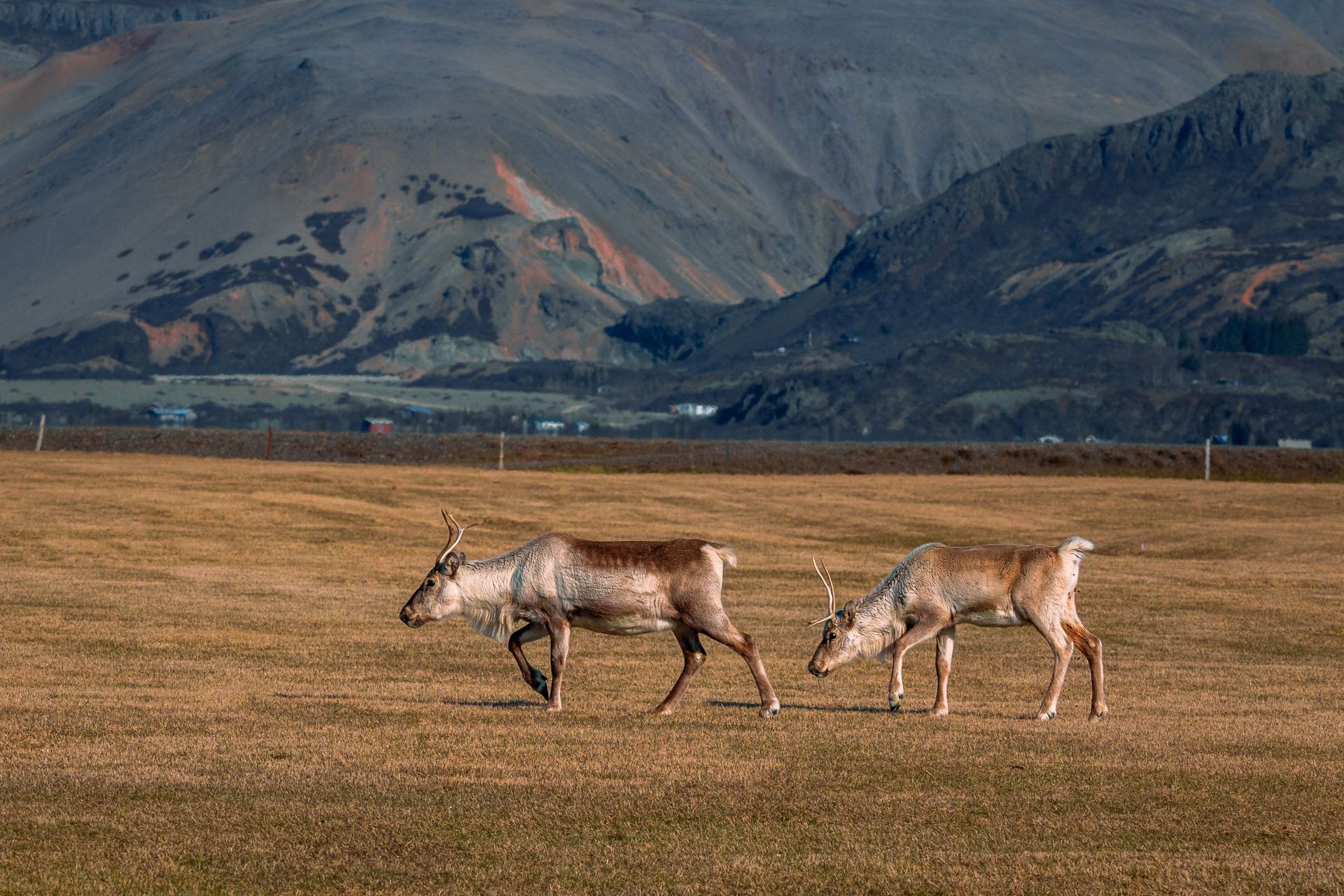
Caribou in North America are well adapted to their Arctic and sub-Arctic habitats, with a thick double coat of fur to keep warm in freezing temperatures.
Caribou are herbivores, feeding on a variety of lichens, mosses, and other vegetation that grows in the harsh, treeless environments they inhabit.
Caribou are highly mobile, migrating long distances each year in search of food and suitable habitats.
These migrations can be up to 3,000 miles round trip, with some individuals traveling over 500 miles in a single season.
You might like: Barren Ground Caribou
Caribou Biology
Caribou are well adapted to their Arctic habitat, with a thick double coat of fur that keeps them warm in temperatures as low as -50°C.
Their hooves are specially designed to grip snow and ice, allowing them to move easily across the frozen tundra.
Caribou have a unique digestive system that allows them to break down the cellulose in lichens, a key food source in the Arctic.
They are herbivores, feeding on a variety of plants including lichens, mosses, and grasses.
Caribou are also skilled navigators, able to migrate thousands of miles each year between their summer and winter ranges.
Their large eyes and excellent night vision help them navigate in low light conditions.
Caribou are social animals, often living in large herds with complex social structures.
Females give birth to a single calf each year, after a gestation period of around 230 days.
See what others are reading: Large Rodents North America
Taxonomy and Classification
Caribou in North America have a complex taxonomy, with previous classifications failing to capture the variability of the species across their range in Canada.
COSEWIC developed Designated Unit (DU) attribution to address this issue, adding to existing classifications.
The recent revision of caribou taxonomy is consistent with COSEWIC's designations and follows international rules of zoological nomenclature.
This new classification system recognizes the morphological, genetic, and behavioral variability of caribou across their range, reflecting both plasticity and adaptation to local environments.
For effective species conservation and management, it's essential to understand and respect this variability.
Broaden your view: Bird Species in North Carolina
Caribou in North America
Caribou in North America are found in Alaska, where the Western Arctic Caribou herd is one of the largest in North America, with a range that encompasses much of the Seward Peninsula.
The caribou have a highly migratory nature, and their movements are probably triggered by changing weather conditions. They can travel up to 50 miles a day, and have a built-in compass that allows them to navigate unfamiliar areas.
There are 31 caribou herds in Alaska, and four of the northernmost herds are shown on the map labeled Alaska Caribou Herds. The Porcupine herd ranges into western Canada.
Here is a list of some of the notable caribou herds in North America:
- Western Arctic Caribou herd
- Porcupine herd
- Labrador (Ungava) caribou
Overview
Caribou are found in the arctic tundra, mountain tundra, and northern forests of North America, Russia, and Scandinavia, with a world population of about 5 million.
They have a unique adaptation to their environment, with large, concave hoofs that spread widely to support them in snow and soft tundra, and also function as paddles when they swim.
Caribou are herbivores, which means they primarily eat plants, and their diet consists mainly of lichens, mosses, and other vegetation.
In North America, caribou are distributed in 31 herds in Alaska, and there are also 51 Rangifer tarandus caribou ranges in Canada.
The boreal woodland caribou is a subspecies of caribou that is found in Canada, and it has a very large range in the Northwest Territories, where the population is not considered to be at risk.
However, the southernmost populations of the boreal woodland caribou are isolated populations on Lake Superior in Ontario, Canada, such as the Slate Islands and Michipicoten Island.
Here are the 7 subspecies of caribou found in North America, as identified in the article:
- Barrenground (Rangifer tarandus granti)
- Svalbard (R.t. platyrhynchus)
- European (R.t. tarandus)
- Finnish forest reindeer (R.t. fennicus)
- Greenland (R.t. groenlandicus)
- Woodland (R.t. caribou)
- Peary (R.t. pearyi)
Caribou are social animals and live in herds, with each herd using a distinct calving area that is separate from the calving areas of other herds.
The boreal woodland caribou was once found on every single province in Canada, except Nunavut, but after the introduction of non-native Virginia deer and brainworms, the parasitic nematodes started to kill off the caribou and moose.
In western North America, there are 44 herds of woodland caribou in seven jurisdictions, with an estimated total maximum population of 61,090 caribou.
Adult caribou can weigh between 350-700 pounds, with males averaging 350-400 pounds and females averaging 175-225 pounds.
Caribou have a unique reproductive strategy, with females giving birth to a single calf per year, and the calf growing very quickly, doubling its weight in 10-15 days.
Life History
Caribou in North America have a unique life history.
Female boreal woodland caribou reach maturity at 16 months, while males take a bit longer, reaching maturity at 18-20 months.
Males usually don't breed before reaching three or four years of age due to the hierarchical nature of the herd and competition with older males.
Breeding occurs at the end of September and the beginning of October, and calves are born in mid-June.
Caribou have large, concave hoofs that spread widely to support the animal in snow and soft tundra, and their feet also function as paddles when they swim.
Newborn calves weigh an average of 13 pounds (6 kg) and grow very quickly, doubling their weight in 10-15 days.
Adult bulls can weigh up to 700 pounds (318 kg), while mature females average 175-225 pounds (80-120 kg).
Caribou tend to calve in the same general areas year after year, but migration routes used for many years may suddenly be abandoned in favor of movements to new areas with more food.
Habitat Loss and Predation
Habitat loss and predation are major threats to caribou populations in North America. The primary threat to most boreal caribou local populations is unnaturally high predation rates.
Caribou habitat fragmentation, loss, and degradation support an increase in populations of their natural predator, the wolf. The cumulative effect of oil sands development contributes to this habitat degradation.
Boreal woodland caribou were once found throughout much of Ontario's boreal forest, but their range has receded approximately 34 km/decade. This is a manifestation of widespread range collapse and population decline.
The destruction of habitat, hunting, and disturbances by humans during the construction of roads and pipelines have all contributed to the decline of Woodland Caribou. Traditional territory has been carved into a patchwork quilt, with wild land reduced to small pieces between roads, pipes, and wires.
Caribou require large areas of land with low densities of predators to survive. The cumulative effect of oil sands development has put all Alberta's boreal caribou at elevated risk of becoming extirpated, or locally extinct.
Manitoba
Manitoba is home to several small populations of boreal woodland caribou, including MB1 The Bog, MB2 Kississing, and MB3 Naosap.
These small populations are scattered throughout the province, with some being local and isolated. MB4 Reed, MB5 North Interlake, and MB6 William Lake are also small local populations.
In Manitoba, there are 13 small populations of boreal woodland caribou, each with its own unique characteristics. MB7 Wabowden, MB8 Wapisu, MB9 Manitoba North, MB10 Manitoba South, MB11 Manitoba East, and MB12 Atikaki-Berens are some of the other populations found in the province.
A national recovery strategy for boreal caribou was to be posted on the Species at Risk Public Registry in June 2007.
Readers also liked: Small Brown Bird North Carolina
Geographic Distribution
Caribou in North America can be found in a wide range of habitats, from treeless tundra and mountains to boreal forests and coastal lowlands.
The northernmost range of boreal woodland caribou in Canada is in the Mackenzie River Delta area, Northwest Territories.
In Alaska, caribou prefer treeless tundra and mountains during all seasons, but many herds winter in the boreal forest (taiga).
Caribou can be found in every province in Canada, except Nunavut.
The southernmost populations of the boreal woodland caribou are isolated populations on Lake Superior in Ontario, Canada, such as the Slate Islands and Michipicoten Island.
Boreal woodland caribou were once found throughout every province in Canada, but their range has declined significantly due to habitat loss and fragmentation.
Caribou movements are probably triggered by changing weather conditions, such as the onset of cold weather or snowstorms.
Caribou can travel up to 50 miles a day and have a built-in compass, like migratory birds, which helps them navigate unfamiliar areas.
Adult male R. t. terranovae caribou can weigh up to 270 kilograms (600 lb), while females are about a quarter smaller.
Specific Herds and Ecotypes
In North America, caribou herds are classified into various ecotypes based on their behavior and habitat use. The George River caribou herd, for example, is a migratory forest-tundra ecotype of the boreal woodland caribou.
The George River herd has faced a catastrophic decline, with a 2018 survey confirming fewer than 9,000 animals, down from 385,000 in 2001. This decline is a concerning trend in caribou populations.
In contrast, the Leaf River caribou herd, another migratory forest-tundra ecotype, increased from 270,000 individuals in 1991 to 628,000 in 2001. However, it has since decreased to 430,000 caribou in 2011.
Caribou herds can be classified into different ecotypes in various regions. In Ontario, for instance, caribou are classified into two ecotypes: forest-dwelling woodland caribou and forest-tundra woodland caribou.
Here are some examples of caribou herds and ecotypes in North America:
The mountain ecotype, found in the southern end of the Selkirk Mountains, was once home to the only extant woodland caribou population in the contiguous United States. However, this population has since been extirpated.
The boreal forest ecotype, once found as far south as northern Wisconsin, Michigan, New York, Vermont, New Hampshire, Minnesota, and Maine, has largely been considered extirpated in the lower 48 states.
Conservation Status
There are approximately 750,000 wild caribou in Alaska, with some herds shared by Alaska and Canada's Yukon Territory.
The largest herds are the Western Arctic Herd at about 325,000, the Porcupine Caribou Herd at about 169,000, the Central Arctic Herd at 67,000, the Fortymile Herd at 52,000, and the Teshekpuk Herd at about 55,000.
Caribou numbers are somewhat cyclic and not very predictable, with declines and increases happening at varying times and sizes.
Today, weather patterns, population density, predation by wolves and grizzly bears, and disease outbreaks are the main factors determining whether most herds increase or decrease.
Frequently Asked Questions
Is a caribou a deer or reindeer?
Caribou and reindeer are actually the same animal, scientifically known as Rangifer tarandus, a member of the deer family. Learn more about the fascinating similarities and differences between these two Arctic icons.
What is the difference between a mountain caribou and a caribou?
Mountain caribou migrate vertically between different mountain elevations, whereas caribou (also known as barren ground caribou) migrate horizontally across vast distances in large herds. This distinct behavior sets mountain caribou apart from their more well-known counterparts.
Did caribou ever live in Michigan?
Yes, caribou once roamed in Michigan, a significant range expansion from their current habitats. Their southern migration is a fascinating piece of history.
Are there caribou in the lower 48 states?
There are no established caribou populations in the contiguous United States, but a small group inhabits the northern parts of Washington and Idaho.
Featured Images: pexels.com