Rodeo horses are incredibly special animals, and it's easy to see why. They're bred for their athleticism, agility, and calm temperament under pressure.
Their unique physical characteristics, such as their muscular build and athletic physique, make them well-suited for the demands of rodeo events. They also have a strong instinct to follow commands and respond to their riders' cues.
Rodeo horses are often referred to as "cow horses" because of their ability to navigate challenging terrain and herd cattle with ease. This is due in part to their strong sense of smell and keen spatial awareness.
Their intelligence and trainability are also key factors in their success in rodeo events. They're able to learn complex commands and maneuvers with relative ease, making them invaluable partners for their riders.
See what others are reading: Rodeo Events with Horses
Rodeo Horses
Rodeo horses are typically mares or geldings, as stallions can be too rowdy for a herd setting.
Mares are often used in bucking strings, but a mixed herd of mares and geldings can work well together with minimal disruptions.
Geldings are generally less prone to fighting and are easier to manage than stallions, making them a popular choice for rodeos.
Events
Rodeo events showcase the incredible bond between cowboys and their horses. The Quarter Horse Show features roping and speed events like barrel racing and pole bending.
Ropings in the Quarter Horse Show include breakaway, tie-down, heading, and heeling. These events require skill and trust between the rider and horse.
In rodeos, bareback and saddle bronc riding are two of the most challenging events. The horse counts for half of the score, making strenuous bucking required.
Bareback bronc riding involves a specialized rigging that consists of a leather and rawhide composite piece attached to a surcingle. The rider leans back and spurs with an up and down motion to stay on the horse.
Saddle bronc riding uses a saddle with free-swinging stirrups and no horn. The rider grips a simple rein attached to a leather halter worn by the horse.
Steer wrestling, tie-down roping, and team roping all involve horses and cattle. These events require quick reflexes and precise timing between the rider and horse.
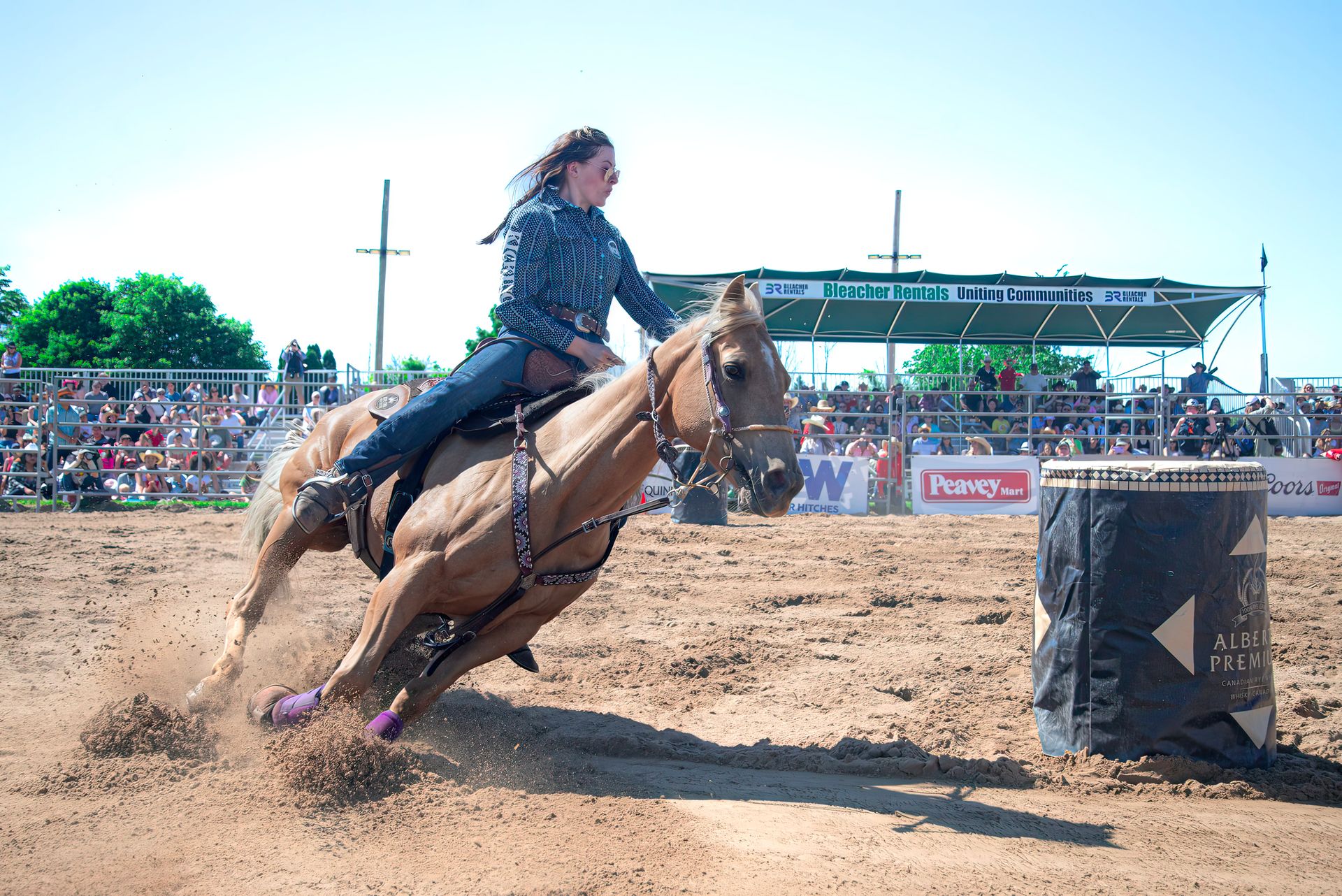
Women compete in barrel racing, a timed event where riders complete a clover-leaf pattern around barrels. This requires a strong partnership between the rider and horse.
Take a look at this: Ground Tie
History
The history of rodeo horses is a fascinating one.
American bronc riding has its roots in breaking horses for the United States Army, with early examples emerging in Wyoming and Colorado.
The first three sanctioned bronc riding championship events took place in 1901 at the Colorado Cattle and Horse Grower's Association, Denver Horse Show Association, and Northwestern Colorado competition.
These early competitions laid the groundwork for the sport we know today, with Harry Henry Brennan being a key figure in its development, earning him the title of "father of modern bronc riding."
Brennan won two major competitions in 1902, one at Cheyenne, Wyoming's Cheyenne Frontier Days and another at The Denver Horse Show Association annual event, both held on September 2, 1902.
Broaden your view: Types of Horse Riding
Description
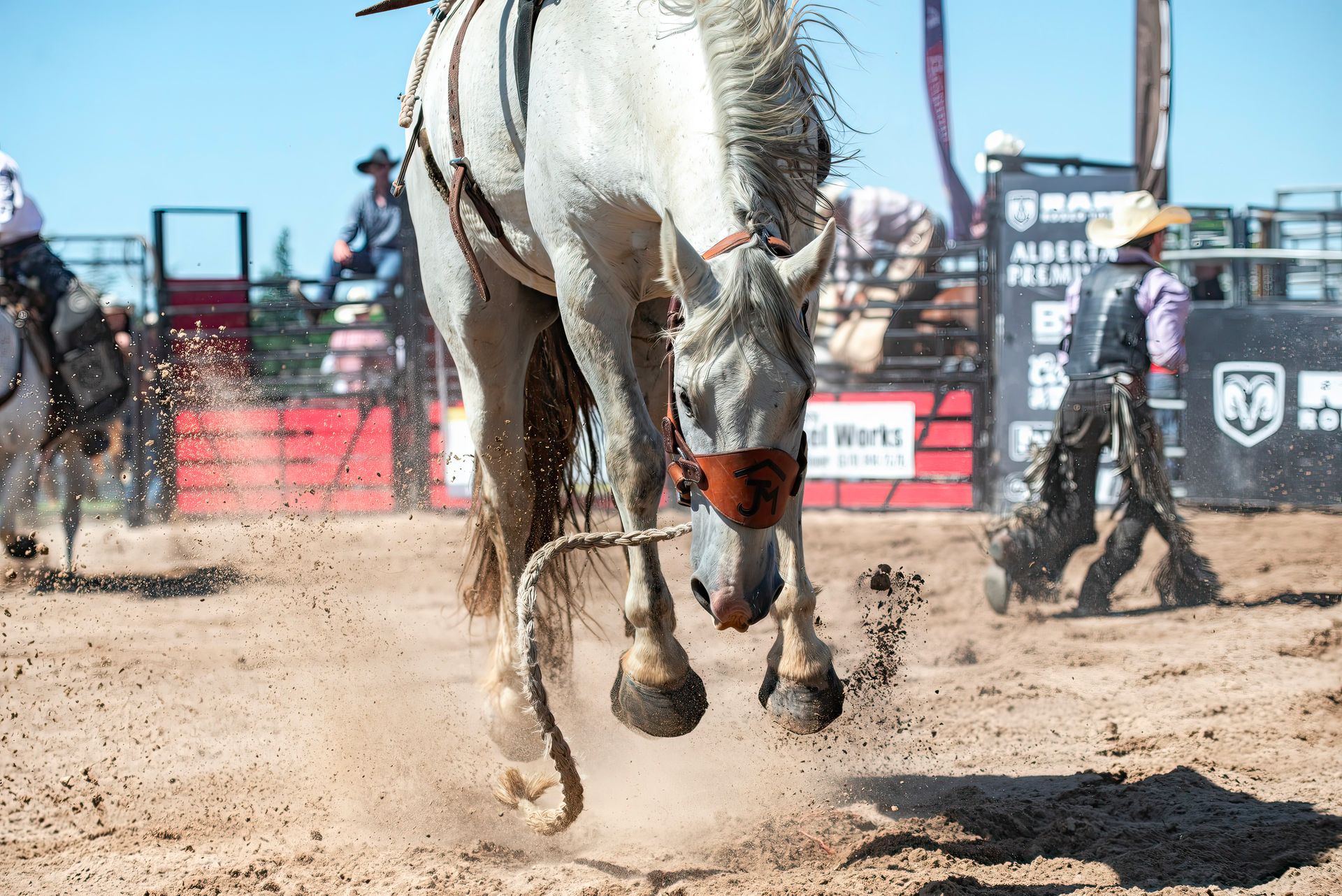
Rodeo horses are trained to burst out of a small pipe or wooden enclosure called a bucking chute. This is where the action begins in a rodeo event.
The rider's goal is to stay on the horse for eight seconds without touching the horse with their free hand. This is a crucial aspect of the ride.
The first jump out of the chute is called "marking the horse out", which requires the rider to have their heels in contact with the horse above the point of the shoulders before the horse's front legs hit the ground. This is a specific rule that riders must follow.
Riders are scored on a scale of 0-50, and the horse is also scored on a scale of 0-50. The total score is the sum of these individual scores.
A ride is considered very good if the score is in the 80s, and exceptional if it's in the 90s. This means that a score of 80 or higher is something to strive for.
Modern Usage
In modern rodeo, bucking horses are specifically bred for their bucking ability and raised for the sport. These horses are domestic animals, not wild or feral.
Rough stock contractors supply bucking horses for bronc riding events. They play a crucial role in the sport, providing the horses that riders compete against.
Check this out: Bucking Horses in Rodeo
The term "bronco" is often used informally to describe any horse that acts up and bucks, even if it's a spoiled riding horse that's learned to throw off riders. This is a nod to the horse's natural bucking behavior.
The American Bucking Horse Registry website explains that breeders aim to create bucking horses with "strength, agility, and bucking ability." This focus on breeding has led to the development of top bucking horses that can work into their 20s.
The silhouette of a cowboy on a bucking bronco is the official symbol for the State of Wyoming. This iconic image is a testament to the importance of rodeo in the state's culture.
Here's a list of some notable rodeos and organizations that feature bucking horses:
- National Cowboy Museum: Horses That Buck
- American Bucking Horse Registry: History in Action
- Houston Livestock Show and Rodeo: Horse Show
- American Association of Equine Practitioners: The Western Performance Horse -- How to Select the Right One for the Job
- Tucson Rodeo: Tucson Rodeo Events
- MidAtlantic Thoroughbred: Cowboys, Cowgirls, Cattle, and Thoroughbreds to Cut Loose at Pimlico
Bucking Horse Breeders Association
The Bucking Horse Breeders Association (BHBA) is a private company founded in 2016 by Steve Stone in Vernal, Utah.
Steve Stone saw a need for a DNA registry for bucking horses, similar to what the Professional Bull Riders, American Bucking Bull, and stock contractors had created for bucking bulls.
The BHBA was established after Stone noticed the recurrence of Sankey's foundation bucking horse sire, "Custer", who died in 1994.
Custer was a better sire of bucking horses than he was a bucking horse, and had sired strong quality athletes with longevity.
At least 30 head of the bucking horses used for the 1996 National Finals Rodeo were descendants of Custer, and at least 15 were provided by Sankey.
The remains of Custer and Gray Wolf were exhumed to register their DNA, revealing that Gray Wolf was not the sire of Custer, but rather Timberline, another stallion in the Tooke's string.
Etymology
The term "bronc" has a rich history, and it's interesting to note that it comes from the Spanish language word "bronco" meaning "rough" or "gruff". This term was borrowed and adapted in U.S. cowboy jargon.
In the American West, the word "bronc" is commonly used to refer to a bucking horse used in rodeo events. The term has also been spelled "broncho", though this form is virtually unknown in the western United States.
The word "bronc" is often associated with untrained range horses that roam freely in western North America, but they are not necessarily feral or wild horses.
Flank Strap Controversy
The flank strap controversy is a sensitive topic in the world of rodeo. A flank strap, also known as a bucking strap, is used to encourage a horse to kick out straighter and higher when it bucks. It's about 4 inches wide and covered in sheepskin or neoprene.
The flank strap fastens behind the widest part of the abdomen, and rodeo rules in the United States prohibit the use of straps that hurt the horse. However, some people have raised concerns about the use of burrs and other irritants under the flank strap, which can cause open wounds and burns.
In reality, irritants or pain generally interfere with a horse's ability to buck in an energetic and athletic fashion. This is likely because a horse in pain will become sullen and not buck very well.
Here are some key facts about flank straps and rodeo:
- The stifle joint of the hind leg limits how far back a flank strap can be attached, making harm to the genitalia anatomically impossible.
Bucking
Bucking is an integral part of rodeo, but it's not just a random characteristic in horses. Bucking horses, or broncs, aren't a specific breed, but rather a result of breeding for strength, agility, and bucking ability.
Rodeo contractors specifically breed horses for this purpose, and many top bucking horses are quarter horses or have quarter horse blood. This breeding has led to top bucking horses working into their 20s, although stallions and mares usually retire earlier to produce more buckers.
In fact, some top bucking horses have been known to work well into their 20s, with some even continuing to compete into their 30s. This is a testament to the careful breeding and training that goes into these horses.
Bucking is an instinctual characteristic in horses, serving to protect them against predators. It's not uncommon to see new foals and young horses frolic and buck playfully as they learn to navigate their surroundings.
Outside of the rodeo arena, bucking is considered an undesirable trait and is often seen as bad behavior. This can be due to a lack of familiarity with horses and the necessary horsemanship skills to understand their true nature.
Here are some key facts about bucking horses:
- Bucking horses are bred for strength, agility, and bucking ability.
- Many top bucking horses are quarter horses or have quarter horse blood.
- Stallions and mares usually retire earlier to produce more buckers.
- Bucking is an instinctual characteristic in horses.
- Outside of the rodeo arena, bucking is considered an undesirable trait.
Quarter Horse
Quarter Horse is a popular breed used in rodeos, particularly in events like steer wrestling and team roping. These horses are larger and more muscled than average, requiring both speed and stamina.
They are often used for their strength and agility, which helps them navigate the demands of these physically demanding events. Quarter Horses used for barrel racing, on the other hand, tend to be lighter and faster, often coming from racing lines or being former racehorses themselves.
Intriguing read: How Often Should I Worm My Horse?
Quarter Horse Lines
Quarter Horse Lines are incredibly diverse, and the type of horse you choose can greatly impact its performance in certain activities.
Those used for steer wrestling and team roping tend to be larger and more muscled than the average quarter horse.
The horses used for barrel racing often come from quarter horse racing lines, or were themselves former racehorses, making them somewhat lighter and faster than the traditional working quarter horse.
In general, these horses require a combination of speed and stamina to excel in their respective events.
A different take: Quarter Horse
Quarter Horse Show
The Quarter Horse Show is a thrilling event that puts these amazing horses to the test. Competitions include roping, which involves breakaway, tie-down, heading, and heeling events.
Roping is a physically demanding activity that requires skill and precision. I've seen horses and riders work together seamlessly to complete these events.
Speed events like barrel racing and pole bending are also a big part of the show. Barrel racing involves navigating a horse around three barrels in a cloverleaf pattern.
Pole bending requires horses to weave through a series of poles in a precise and agile manner. It's truly impressive to watch these horses move with such speed and agility.
Featured Images: pexels.com