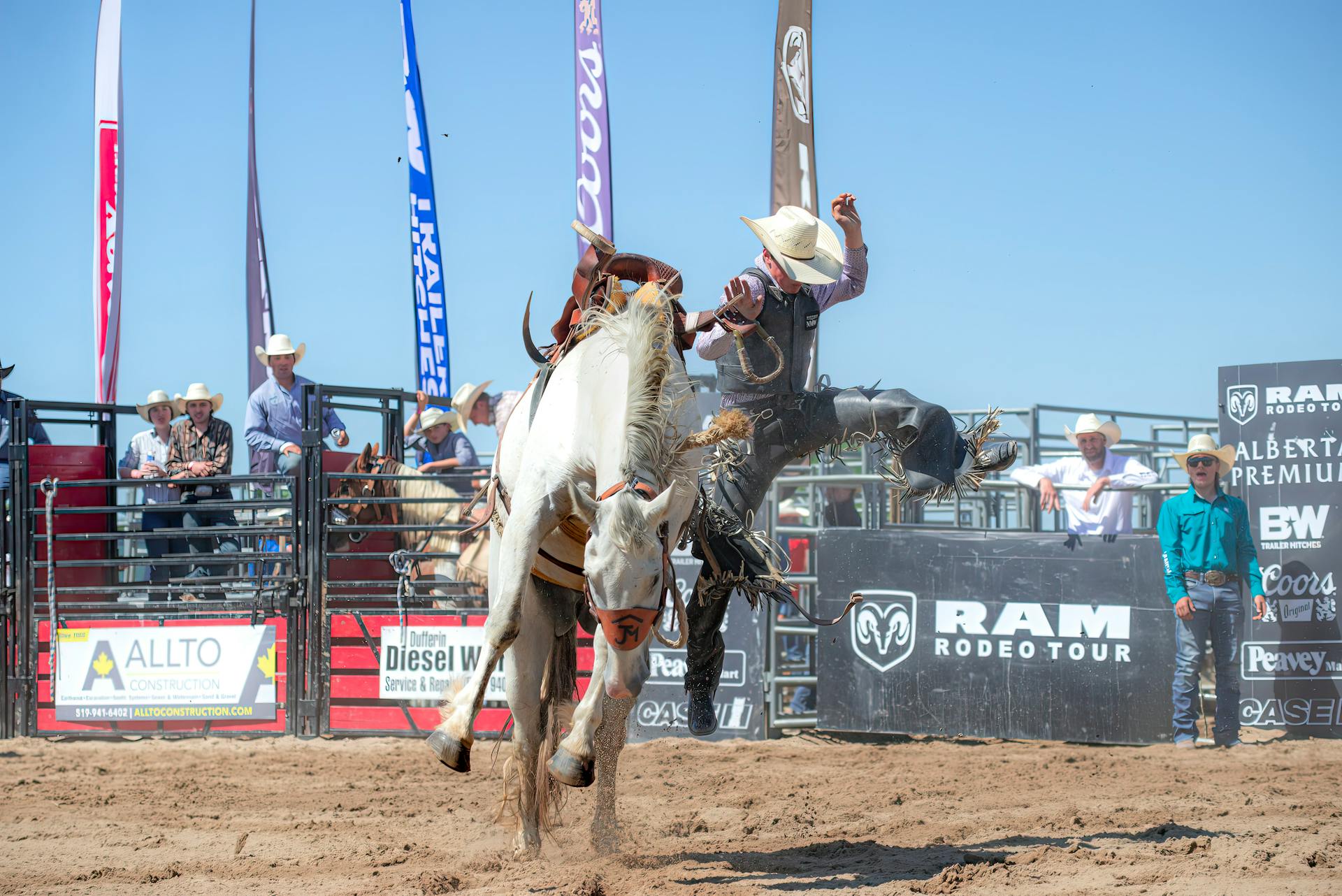
Rodeo bucking horses are a testament to the strength and agility of these magnificent animals. They can reach speeds of up to 30 miles per hour.
The bucking motion of these horses is a result of their natural instinct to throw off a rider, which is a key part of the rodeo competition. This motion can be unpredictable and requires a great deal of skill to navigate.
A well-trained bucking horse can buck for up to 8 seconds, which is the time limit for a rodeo ride.
Explore further: Bucking Horse
What Is Bucking?
Bucking is an instinctual characteristic in horses that serves to protect them against predators. It's a natural behavior for foals and young horses to frolic and buck playfully.
Bucking is triggered by the use of spurs on a horse's sides, which is a common practice in rodeos. Cowboys have a unique appreciation for horses that can buck, as it's a desirable trait in rodeo roughstock.
Outside of the rodeo arena, bucking is considered bad behavior and can cause people to fear horses. This fear often stems from a lack of familiarity with and knowledge about horses, including the necessary horsemanship skills to understand their true nature.
History and Breeders
The Bucking Horse Breeders Association was founded in 2016 by Steve Stone, who recognized the need for a DNA registry for bucking horses.
The association was established in Vernal, Utah, and its early work involved tracing the bloodlines of top bucking horses provided by stock contractors and rodeo producers.
One of the key discoveries made by Stone was the significance of Custer, a foundation bucking horse sire who died in 1994 but had a lasting impact on the breed.
Custer was a better sire of bucking horses than he was a bucking horse himself, and his descendants went on to compete in the National Finals Rodeo.
In fact, at least 30 head of bucking horses used in the 1996 NFR were descendants of Custer, with at least 15 provided by Sankey Pro Rodeo.
The remains of Custer and another stallion, Gray Wolf, were even exhumed to register their DNA, revealing that Gray Wolf was not Custer's sire after all.
The earliest examples of American bronc riding date back to the early days of breaking horses for the US Army, particularly in Wyoming and Colorado.
The first sanctioned bronc riding championship events were held in 1901, with Harry Henry Brennan emerging as a dominant force in the sport and earning the nickname "father of modern bronc riding".
Riding Techniques
To ride a bucking horse, you must stay on for eight seconds to qualify for a score. This is a crucial aspect of the competition, as any less time in the saddle can lead to a lower score.
A key rule to follow is the Mark-Out Rule, where your boots must be above the horse's shoulders until the bronc's front hooves hit the ground. Failing to follow this rule results in instant disqualification.
Your free hand is a liability in this sport - touching the horse, saddle, or yourself with it will get you disqualified. No free hand contact is allowed, so keep those hands firmly in the saddle.
Bareback vs. Saddle Riding
Bareback bronc and saddle bronc riding are two distinct styles that require different techniques.
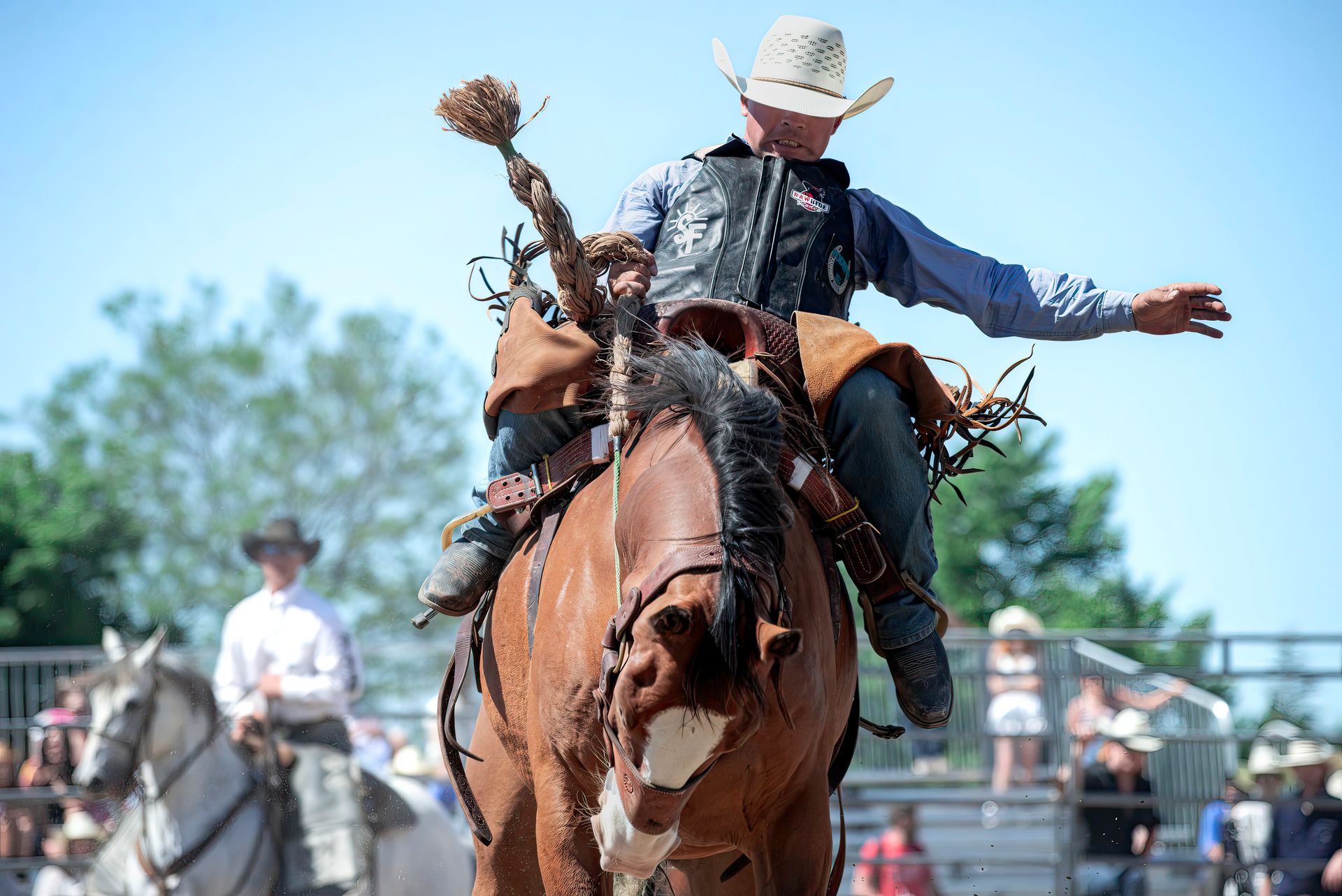
In saddle bronc riding, the rider uses a specialized saddle with free-swinging stirrups and no horn, gripping a simple rein attached to a leather halter worn by the horse.
The bareback rider, on the other hand, does not use a saddle or rein, relying on a rigging made of leather and rawhide that's often compared to a suitcase handle.
The rider leans back and spurs with an up and down motion, spurring at each jump in rhythm with the motion of the horse.
In both events, the rider's goal is to stay on the horse for the full ride, but the rules for dismounting are the same - two pickup riders in the arena attempt to help the contestants safely dismount the still-moving horses.
Bareback bronc riding began to develop as a professional rodeo sporting event around 1900, with early equipment varying from holding onto the horse's mane to using multiple handhold leather riggings based on a surcingle.
Earl Bascom invented the first one-hand bareback rigging in the early 1920s, made from a section of rubber belting and later refined to use leather and rawhide, becoming known as "Bascom's Rigging".
The rules of saddle bronc riding separate the champions from the rest, with the Mark-Out Rule requiring the rider's boots to be above the horse's shoulders until the bronc's front hooves hit the ground.
Riders must stay on for eight seconds to qualify for a score, and a perfect ride is scored on rider and horse performance, with 100 points up for grabs.
Mastering the Art
Mastering the Art of Riding a Bucking Horse is a challenging task that requires a deep understanding of the horse's behavior and body language.
The Silver Spurs Rodeo features some of the toughest bronc horses in the sport, making it a true test of a rider's skills.
To ride tall in the saddle, a rider needs to be able to anticipate and react to the horse's movements, which can be unpredictable and sudden.
This requires a combination of strength, balance, and finesse, as well as a deep understanding of horse behavior and body language.
At the Silver Spurs Rodeo, riders take on these challenging bronc horses, showcasing their skills and ability to ride tall in the saddle.
Explore further: How Tall Was Matt Dillon's Horse Buck?
The Horse
The bucking horse is usually a mare, but occasionally, a gelding is used. Mares are more prone to disruptions in a mixed herd, but they can still be kept together without great difficulties.
Geldings are generally less disruptive and more prone to getting along with one another. Stallions are less common, as they can be disruptive in a herd and may fight if there are mares present.
Most bucking stock are specifically bred for use in rodeos, with horses having exceptional bucking ability being purchased by stock contractors and fetching a high price.
Description
Riders must stay on the horse for eight seconds without touching the horse with their free hand. This is a crucial part of the competition.
The horse is released from a small pipe or wooden enclosure called a bucking chute. This enclosure is designed to hold the horse until the rider is ready to ride.
The rider must "mark the horse out" on the first jump out of the chute. This means they must have the heels of their boots in contact with the horse above the point of the shoulders before the horse's front legs hit the ground.
A rider who manages to complete a ride is scored on a scale of 0–50. The horse is also scored on a scale of 0–50.
The ride as a whole is rated as the sum of these individual scores. This means the rider and horse scores are added together to get the final score.
Scores in the 80s are considered very good, and in the 90s are considered exceptional.
What Is a Horse?
Horses are incredibly diverse, but at their core, they're athletic animals with unique personalities.
Some horses are bred for specific tasks, like the bronc horses that are known for their strength and agility.
These athletic horses are naturally inclined to buck, twist, and leap, making them a challenge to ride.
The term "bronc" actually comes from the Spanish word "bronco", which translates to "rough."
Animal Welfare and Safety
Rodeo bucking horses are often subjected to rigorous training and physical stress, which can lead to injuries and long-term health problems.
The American Society for the Prevention of Cruelty to Animals (ASPCA) estimates that up to 80% of rodeo horses suffer from injuries each year.
Rodeo horses are typically kept in small pens, which can lead to overcrowding and stress.
Many rodeos now offer safer alternatives to traditional bucking events, such as "bucking stock" that are specifically bred for their athletic ability and temperament.
The lifespan of a rodeo bucking horse is typically around 4-6 years, after which they are often retired and sold for slaughter.
Rodeo associations are starting to implement new safety protocols, including better veterinary care and more stringent guidelines for horse treatment.
Rodeo Culture and Events
Rodeos are a staple of Western culture, with events like bull riding and steer wrestling drawing huge crowds. The sport has its roots in ranching and farming communities.
Rodeos often take place in rural areas, where cowboys and cowgirls can showcase their skills. The events are usually held in large arenas or outdoor spaces.
The culture surrounding rodeos is rich and vibrant, with participants and spectators alike dressed in cowboy attire. The events are a celebration of the American West's rugged individualism and self-reliance.
History of Rodeo Horses
The history of rodeo horses is a rich one, and it all started in the American West where ranch hands would break horses for work in the 1800s. Harry Henry Brennan is considered the "father of modern bronc riding" for his victories in the first sanctioned bronc riding championships in 1901 and 1902.
Competitions were initially held in Wyoming and Colorado, with the first three sanctioned events taking place in 1901 at the Colorado Cattle and Horse Grower's Association, Denver Horse Show Association, and the Northwestern Colorado competition.
The popularity of bronc riding grew rapidly, with the first championships being held in Cheyenne, Wyoming's Cheyenne Frontier Days, and in Denver, Colorado, at The Denver Horse Show Association annual event in 1902. Both of these events were won by Harry Henry Brennan.
Here's an interesting read: Horses Show
Event Overview
Saddle bronc riding is often considered the most technical event in rodeo, requiring precision and control from the rider.
The rider must move in sync with the horse's natural motion, making it a true test of rhythm and finesse.
The clock starts ticking as soon as the chute gate swings open, and the rider must time their movements perfectly to maintain control and style.
A specialized saddle with no horn is used in saddle bronc riding, allowing the rider to move freely and make precise movements.
The rider grips a rein attached to the bronc's halter with one hand while keeping the other raised high, showcasing their skill and poise.
Silver Spurs Rodeo
The Silver Spurs Rodeo is a thrilling event that showcases the high-stakes dance between cowboys and broncs. Each ride is a split-second adjustment of instinct and skill to avoid a hard landing.
The rodeo brings raw energy to life, where riders chase glory and broncs prove why they're the backbone of rodeo tradition. This event commands attention and respect from spectators.
Saddle bronc riding is a rodeo event that's hard to ignore, making it a must-see for fans of all experience levels. Whether you're a lifelong fan or a first-time spectator, you'll be on the edge of your seat.
5 Things You Knew
Bucking horses are typically mares and geldings, with stallions being the least represented demographic. In fact, most bucking horses are mares.
The flank strap used in rodeo working tack is made of soft latigo leather and is never pulled as tightly as a pair of jeans. It's usually around 3 inches wide and covered in fleece.
No bucking horses are allowed to be stallions, as they are the least represented demographic. This is likely due to their natural instincts and behaviors.
Riding History and Rules
Saddle bronc riding has its roots in the 1800s when ranch hands in the American West would break horses for work. This necessary skill for taming wild horses quickly became a competition among cowboys, each one aiming to prove their grit and horsemanship.
The first sanctioned bronc riding championships were held in 1901, marking the start of organized competition. Harry Henry Brennan claimed victory in the first championships in 1901 and 1902, earning him the title of the "father of modern bronc riding."
Riders must follow strict guidelines to earn top scores and avoid disqualification, including the Mark-Out Rule, where their boots must be above the horse's shoulders until the bronc's front hooves hit the ground.
Saddle Riding Rules
Saddle Riding Rules
Saddle bronc riding has strict rules to separate the champions from the rest.
The Mark-Out Rule is crucial, requiring riders to keep their boots above the horse's shoulders until the bronc's front hooves hit the ground. Failing to follow this rule is an instant disqualification.
Riders must stay on for eight seconds to qualify for a score. This is a challenging task, especially for inexperienced riders.
A perfect ride is scored on rider and horse performance, with 100 points up for grabs. The score is divided evenly between the rider's technique and control, and the horse's bucking ability.
No Free Hand Contact is allowed, and if a rider touches the horse, saddle, or themselves with their free hand, they're disqualified.
Saddle Riding History
Saddle bronc riding has its roots back in the 1800s when ranch hands in the American West would break horses for work.
This necessary skill quickly turned into a competition among cowboys, each one trying to prove their grit and horsemanship. The first sanctioned bronc riding championships were held in 1901, marking the start of organized competition.
Harry Henry Brennan claimed victory in the first championships in 1901 and 1902, earning him the title of the "father of modern bronc riding." He's still considered a legend in the sport today.
The sport gained so much popularity that the first three sanctioned bronc riding championship events were held in 1901 alone.
Frequently Asked Questions
What breed are rodeo bucking horses?
Rodeo bucking horses are often of American Quarter Horse descent, with many top contenders having this breed in their ancestry.
What is the most famous bucking horse?
Virgil is widely considered the greatest bucking horse of all time, with numerous accolades including two Bucking Horse of the Year titles in both the US and Canada. He's also known for producing the highest scored bareback bronc ride in history.
Are rodeo bucking horses trained?
Yes, rodeo bucking horses are trained to perform their job, with a focus on maintaining their natural bucking style. They undergo specialized training to ensure they can handle the demands of rodeo events.
Featured Images: pexels.com