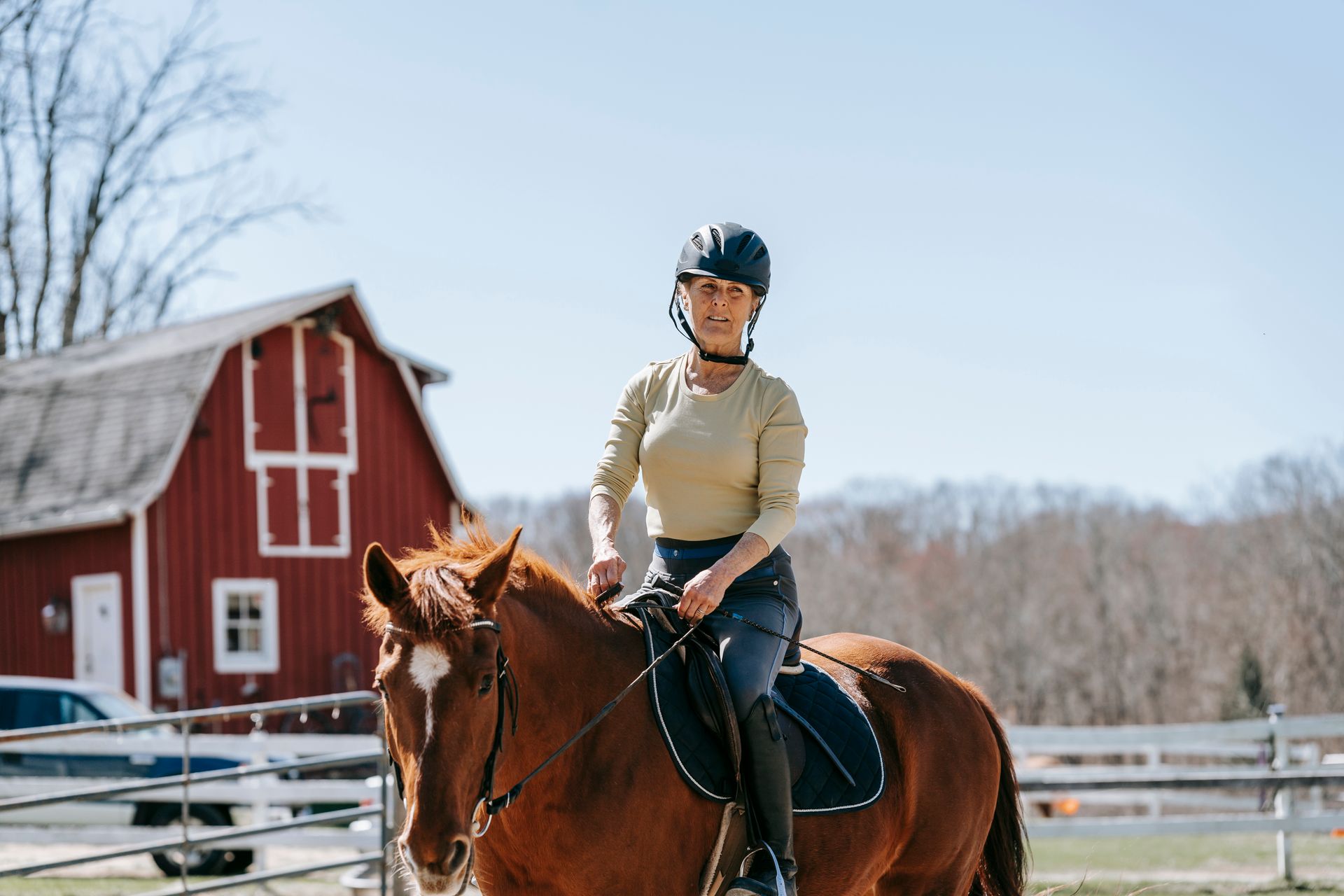
Whether you're a seasoned equestrian or just starting out, there's a type of horse riding that's perfect for you. Dressage is a precise and elegant style of riding that's all about communicating with your horse through subtle movements and body language.
Dressage requires a great deal of skill and practice to master, but it's also a fantastic way to build a strong partnership with your horse. In fact, some riders find that dressage helps them develop a deeper understanding of their horse's thoughts and feelings.
Western pleasure riding, on the other hand, is a more relaxed and laid-back style of riding that's all about enjoying the scenery and having fun. This type of riding is often associated with trail riding and is a great way to explore the great outdoors with your horse.
For your interest: Bulldog Breed Characteristics
Types of Horse Riding Disciplines
English horseback riding disciplines include combined driving, dressage, endurance, eventing, para-equestrian, show jumping, and equestrian vaulting.
Combined driving is a sport that involves horses pulling carriages, requiring great skill and trust between horse and rider.
Dressage is an equestrian sport and art that emphasizes precise movements and control over the horse's body.
Eventing is a type of equestrian triathlon, combining dressage, cross-country riding, and show jumping in a single competition.
Para-equestrian is a type of disability sport that allows riders with physical disabilities to participate in equestrian competitions.
Show jumping is a competitive equestrian sport that requires riders to navigate a course of obstacles at high speeds.
Equestrian vaulting is a unique discipline that combines gymnastics and dance on horseback, requiring great balance and trust between horse and rider.
Here are the FEI international disciplines:
Dressage
Dressage is a precision sport that requires a harmonious partnership between horse and rider. It's deeply rooted in English military history and involves a series of carefully choreographed movements and tests that showcase the horse's obedience, flexibility, and athleticism.
The goal of dressage is to develop a harmonious partnership between horse and rider while strengthening and suppling the horse training. This is achieved through a concise Pyramid of Training that develops a dressage horse over time.
In dressage competitions, the horse and rider must perform a dressage test, a series of predetermined movements executed from memory. This test is a true test of training, discipline, and connection between horse and rider.
Dressage is often compared to ballet on horseback, as it requires precise movements and poses. Imagine guiding your horse through these complex steps, almost like a dance.
Dressage is a discipline that can be done in an English saddle, as seen in classical dressage. However, it can also be done in western tack, as seen in western dressage.
For another approach, see: String Test
Cross-Country
Cross-country riding is a thrilling discipline that takes place in a more open environment than show jumping.
The terrain is varied, with jumps that mimic naturally occurring obstacles across fields and wooded areas. This requires riders to be prepared for anything, from steep hills to muddy puddles.
Speed is an important aspect of cross-country riding, as riders need to navigate the course quickly and efficiently. Accuracy is also crucial, as riders must avoid obstacles and stay on course.
The safety of both horse and rider is a top priority in cross-country riding, and riders must be aware of potential hazards at all times.
Riding
Riding encompasses a range of disciplines, each with its own unique style and focus.
Classical dressage is an art form that requires great skill and finesse, involving precise movements and subtle communication between horse and rider.
Dressage is a competitive equestrian sport that demands precision, control, and harmony between horse and rider.
English pleasure is a style of horse show class that emphasizes the horse's calm and collected demeanor.
Eventing is an equestrian triathlon that combines dressage, show jumping, and cross-country riding, pushing riders and horses to their limits.
Field hunters are a type of horse bred specifically for their agility and endurance, making them well-suited for the demands of eventing.
Foxhunting is a traditional equestrian hunting activity that involves following a pack of hounds on horseback, requiring great skill and endurance from both horse and rider.
Hunt seat is a competitive equestrian sport that focuses on the horse's ability to navigate complex courses and respond to subtle cues from the rider.
Saddle seat is a style of horse riding that emphasizes the horse's movement and agility, requiring a high level of skill and precision from the rider.
Here are some of the most popular types of horse riding disciplines:
- English pleasure
- Eventing
- Hunt seat
- Saddle seat
- Show hunter
- Show jumping
Show hunters are a type of competition horse bred specifically for their athleticism and style, making them well-suited for the demands of show jumping.
Team chasing is a thrilling and fast-paced equestrian sport that involves chasing a pack of hounds on horseback, requiring great skill and endurance from both horse and rider.
Show hacks are a type of competition horse that emphasizes their calm and collected demeanor, making them well-suited for the demands of English pleasure.
Readers also liked: Dog Type
English Riding Styles
English riding styles developed in England and other parts of Europe, focusing on discipline, elegance, and a closer, more formal relationship between horse and rider. These styles are practiced and celebrated worldwide.
There are several different styles of English horse-riding, each with its own distinct benefits. The most common styles are dressage, eventing, and show jumping.
Dressage is a horse-riding discipline that focuses on the horse's movements and gaits, often used as training for other styles of riding. It helps the horse to develop strength, balance, and flexibility.
Some of the key English riding styles include:
- Classical dressage – The art of riding
- Dressage – An equestrian sport and art
- English pleasure – A style of horse show class
- Eventing – An equestrian triathlon
- Field hunter – A type of horse
- Hunt seat – A competitive equestrian sport
- Saddle seat – A style of horse riding
- Show hunter – A type of competition horse
- Show jumping – A competitive equestrian sport
- Show hack – A type of competition horse
Show Jumping
Show Jumping is an exciting and challenging discipline where horse and rider navigate a course of jumps.
This discipline requires a great deal of trust, dedication, and athleticism from both horse and rider.
The objective is to clear each fence without the horse knocking them down or refusing to jump, while also aiming for speed and accuracy.
Jumps or obstacles can vary in terms of height and complexity throughout the course, with the difficulty increasing at higher competition levels.
Showjumping has been an Olympic event since the early 1900s.
The event takes place within a ring, which often brings many spectators to this exciting competition.
The rider and horse work together to leap over a series of barriers, aiming for speed and accuracy.
Each jump needs to be approached with just the right balance and timing, making it a dynamic and exciting discipline that tests both the rider’s strategy and the horse’s agility.
Show jumping is the equestrian equivalent of a high-stakes obstacle course.
It’s thrilling to watch and even more exhilarating to participate in.
Hunt Seat
Hunt seat riding is a style of English riding that originated from its historical association with fox hunting. This discipline focuses on the rider's position in the saddle, which should emphasize a balanced, forward seat that closes the hip angle slightly and allows the horse greater freedom of movement.
In hunt seat riding, the rider's effectiveness in communicating with the horse through their aids is crucial. This means using subtle and precise movements to guide the horse through various maneuvers.
Hunt seat riding is commonly seen in hunter and equitation classes. It's a style of riding that requires a secure and comfortable seat, allowing the horse to navigate varied terrain and clear varied fences.
Here are some key characteristics of hunt seat riding:
- Emphasizes a balanced, forward seat
- Closes the hip angle slightly
- Allows the horse greater freedom of movement
- Requires effective use of aids for communication with the horse
Saddle Seat
Saddle Seat is a unique English riding discipline found in the United States. It's characterized by high head carriage, animated gaits, and the use of specialized saddles.
Riders sit farther back in the saddle to emphasize the horse's high steps and footwork. This is a key aspect of the Saddle Seat style.
The typical breeds seen in Saddle Seat competitions are Morgans, American Saddlebreds, and Arabians. These breeds are well-suited for the style's emphasis on extravagant gaits.
Saddle Seat horses are shown at the walk, trot, and canter, but there's no jumping involved. There are also special classes for horses with five gaits.
The Saddle Seat discipline is most commonly seen in American competitions and events.
Reining
Reining is a Western discipline that requires a horse to be highly responsive to its rider's subtle aids. This means the horse should perform without resistance.
In reining competitions, riders guide their horses through a series of patterns at a lope or gallop, consisting of circles, spins, and stops. The key to success is precision, smoothness, and finesse.
Imagine a horse skidding to a halt from a gallop or spinning around on its hind legs – that's the kind of agility and control reining is all about. It's a true test of a horse's athleticism and a rider's skill.
Riders need quick reflexes and sharp decision-making to navigate these precise patterns with style and finesse.
Side Saddle
Side Saddle riding is a style that requires incredible balance and skill. It allows women to ride in a skirt without straddling the horse.
The rider sits aside with both legs on one side of the horse, using a specially designed saddle. This unique setup is a nod to tradition with a modern twist.
Riders compete in jumping and showing, making it a competitive and exciting style to watch.
Return
As we explore the world of English riding styles, it's interesting to note that Western riding has its own unique set of disciplines.
Cowboy mounted shooting is a competitive equestrian sport that originated in the American West. It involves riders on horseback shooting at targets while navigating obstacles.
Western riding is all about horsemanship, which is the use of horses for sport or work. This includes various events like reining, where riders showcase their horse's agility and control.
If you're new to Western riding, you might want to start with the basics of Western pleasure, an equestrian sport that focuses on the horse's comfort and the rider's ability to communicate with it.
Western riding has its own take on dressage, known as Western dressage, which involves riding in Western tack. This is a great way to challenge yourself and your horse.
O-Mok-See is another exciting event that combines speed racing and timed games for riders on horses. It's a fun way to test your skills and your horse's abilities.
Additional reading: How to Sweat a Horse's Neck?
Western Riding Disciplines
Western riding is a style that originated in the United States and emphasizes control and balance. The rider sits deeply in the saddle with a relaxed seat.
Barrel racing is a popular Western riding discipline that involves racing around a barrel in a figure-eight pattern. Riders must navigate the barrel quickly while maintaining control of their horse.
Reining is another Western riding discipline that focuses on the horse's ability to stop and change direction quickly. It requires a high level of communication between the rider and horse.
Recommended read: What Is Used to Control a Horse?
Eventing (Three-Day Event)
Eventing (Three-Day Event) is a discipline that combines three phases: dressage, cross-country, and show jumping. This English riding discipline is considered the triathlon of horse riding.
Eventing is often called the "equine triathlon" because it's a test of the horse and rider's athletic abilities. The dressage element is very important because it helps develop the strength and suppleness needed for cross-country and show jumping.
The cross-country test takes place on the second day of the competition, and its object is to show the speed, endurance, and jumping ability of the horse over varied terrain and obstacles. This phase is a true test of the horse's stamina and recovery.
Show-jumping occurs on the third day, and it tests the stamina and recovery of the horse after the endurance phase. This final jump phase demonstrates the horse is fit enough to continue work.
Here's a breakdown of the three phases of Eventing:
- Dressage: Develops strength and suppleness
- Cross-country: Tests speed, endurance, and jumping ability
- Show-jumping: Tests stamina and recovery
Working Cow Horse
Working Cow Horse is a style that combines aspects of reining, cutting, and herding. It showcases the horse's versatility and responsiveness to cues while working with cattle.
Riders might start with a reining pattern and then demonstrate the horse's ability to control and direct a cow. This is a true test of the horse's training and the rider's skill.
Working cow horse requires a horse that's well-trained and responsive to cues, which is why it's considered a true test of the horse's training and the rider's skill.
Pole Bending
Pole Bending is a thrilling Western riding discipline that puts both horse and rider to the test. Riders weave their horses in and out of six poles arranged in a line as fast as they can, turning sharply and accelerating between poles.
This style requires incredible agility from the horse, as they must quickly change direction and speed. It's a true test of a horse's athleticism and trainability.
Riders must also possess exceptional skills to maintain speed and precision under pressure. They need to be able to think on their feet and make split-second decisions to navigate the course successfully.
The goal is to complete the course as quickly as possible, all while maintaining control and precision.
Saddleseat
Saddleseat is a Western riding discipline that showcases the high-stepping gaits of certain horse breeds like the American Saddlebred. Riders aim to present their horse's natural movements in the most elegant way possible.
Riders focus on posture, smoothness, and the overall picture of ease and grace. It's like a pageant for horses, highlighting their beauty and spirited gaits.
Para-Equestrian
Western riding disciplines offer a range of exciting options for riders of all levels.
Para-equestrian is one of these options, providing a platform for riders with disabilities to compete at all levels, including the Paralympic Games.
Riders with disabilities can participate in para-equestrian competitions, which ensure a level playing field through classification systems.
Dressage is the most recognized para-equestrian discipline, where riders perform tests adapted to their classification of disability.
The special bond between horses and humans is a powerful reminder of the inclusiveness of horseback riding.
Additional Styles
There's more to horse riding than just Western and English styles.
Dressage is a highly precise and elegant style of riding that originated in Europe. It emphasizes the partnership between horse and rider, with a focus on subtle communication and precise movements.
One of the most distinctive features of dressage is its emphasis on collected gaits, which require the horse to move with a shorter, more compact stride. This can be a challenge for riders, but with practice and patience, it can also be incredibly rewarding.
Polo is a fast-paced and physically demanding style of riding that originated in India and is now popular around the world. It requires riders to be highly skilled and athletic, with a strong emphasis on teamwork and communication.
Endurance riding is a style of riding that involves long-distance riding over varied terrain, often with a focus on building the horse's endurance and stamina. It can be a great way to challenge yourself and your horse, and to explore new places and experiences.
Rodeo and Racing
Rodeo and Racing are two exciting forms of horse riding that showcase the strength and agility of horses.
There are different types of horse racing, including Flat racing, which is a form of equestrian sport. Harness racing uses a two-wheeled cart, adding an extra element to the traditional horse racing experience.
The thrill of watching horses jump over obstacles is a key part of steeplechase and point-to-point racing. Thoroughbred horse racing, on the other hand, is a sport and industry that focuses on the racing of Thoroughbred horses.
If you're interested in rodeo, you might enjoy learning about American rodeo events, or exploring the unique styles of Australian rodeo and Chilean rodeo.
Rodeo
Rodeo is a thrilling event that originated from the skills of cattle ranchers. It's a Western Discipline that showcases the expertise of horse and rider teams in roping and handling cows.
In rodeo events, you'll often see two types of roping: team roping and calf roping. Team roping involves two horse and rider pairs working together to rope a cow, while calf roping is a timed event where one rider must get off their horse and tie up the cow.
Roping horses are highly disciplined and must be comfortable working with cows. Quarter Horses are often favored in this discipline due to their strength, quickness, and great cow sense.
Some popular rodeo styles include American rodeo events, Australian rodeo, Charrería, and Chilean rodeo. These styles showcase the unique skills and traditions of each region.
Here are some examples of rodeo styles from around the world:
- American rodeo events
- Australian rodeo
- Charrería
- Chilean rodeo
Barrel Racing
Barrel racing is the rodeo's dash for the cash.
Riders and their horses sprint in a cloverleaf pattern around three barrels set in a triangle.
It's fast and furious.
The goal is simple: complete the course as quickly as possible without knocking any barrels over.
Racing
Racing is a thrilling aspect of equestrian sports, and I'm excited to share some key facts with you.
Flat racing is a popular form of horse racing, where horses compete on a flat track.
Harness racing is another type of horse racing that uses a two-wheeled cart, which can be a bit tricky to maneuver.
Point-to-point racing is a form of horse racing that originated in the UK, where horses compete over a course with natural obstacles.
Steeplechase racing, on the other hand, originated in Ireland and features jumps over fences and ditches, making it a challenging and exciting event.
Thoroughbred horse racing is a sport and industry that involves the racing of Thoroughbred horses, which are known for their speed and endurance.
Here's a quick rundown of the different types of racing:
- Flat racing
- Harness racing
- Point-to-point racing
- Steeplechase racing
- Thoroughbred horse racing
Other Riding Styles
English riding styles are known for their focus on discipline, elegance, and a closer, more formal relationship between horse and rider.
These styles have been practiced and celebrated worldwide, with various disciplines like dressage, show jumping, and eventing.
In contrast, Western riding styles have their roots in cattle ranching and outdoor living, which brings a practical and partnership-based approach to horse riding.
Western riding disciplines share a common thread of being exciting and diverse, with each style having its own flair and set of skills.
English riding styles, on the other hand, emphasize discipline and elegance, making them a great fit for those who value precision and refinement in their riding.
Frequently Asked Questions
What is the most common type of horse-riding?
There are two main types of horse-riding styles: English and Western, each designed for specific purposes. The most popular forms of horse riding are English and Western styles.
What are the 4 levels of horse riding?
There are 4 levels of horse riding: Beginner, Intermediate, Intermediate Plus, and Advanced, each with increasing levels of experience and skill. Learn more about the requirements for each level to determine where you fit in.
What is horse back riding called?
Horseback riding is also known as equestrianism, a term that encompasses various disciplines including riding, driving, and vaulting. It's a popular activity enjoyed worldwide under different names, including horse riding in Commonwealth English.
Featured Images: pexels.com