Rodeo events with horses are a thrilling spectacle that showcases the incredible skills of both humans and animals.
Barrel racing is a popular event where riders navigate their horses through a triangular course, making sharp turns and quick changes of direction. The rider's goal is to complete the course in the fastest time possible.
Riders in barrel racing events typically wear a specialized saddle and have a strong partnership with their horse, which is essential for success.
In steer wrestling, a rider on horseback chases a steer and then jumps off to wrestle it to the ground. The rider must be able to navigate their horse at high speeds and then quickly dismount to catch the steer.
Rodeo Events
In rodeo events, horse riders can earn up to 100 points in bareback riding by staying on a bucking horse for at least eight seconds.
Riders must keep their boots and spurs in contact above the horse's shoulder when the front feet of the horse touch the ground, and they use a bareback rigging for stability.
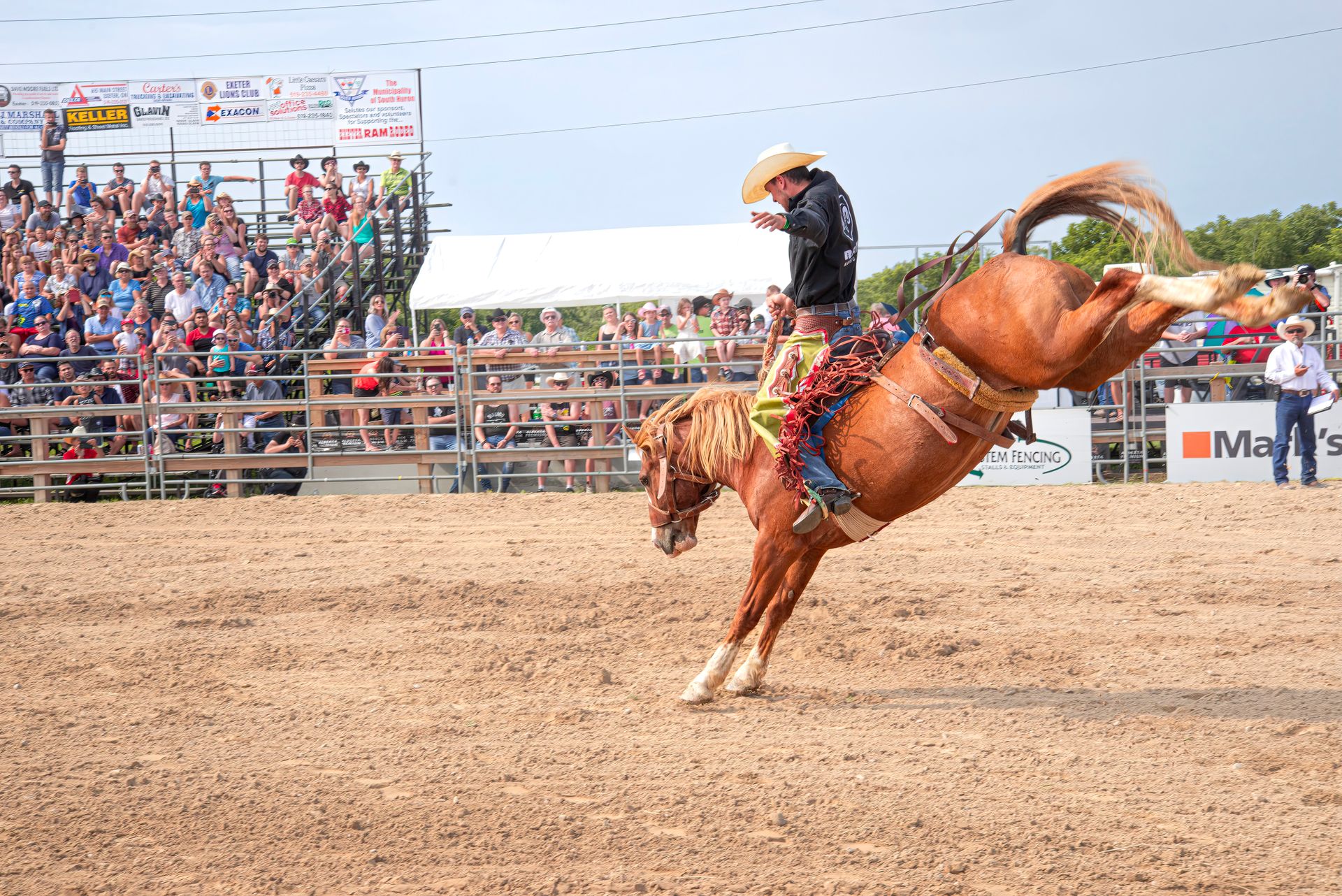
The difficulty of the horse and the rider's control, effort, and exposure are key factors in scoring, as seen in the ranch bronc riding event.
In ranch bronc riding, horses are saddled with a regular working saddle, and cowboys use a one-rein bucking horse halter for control.
Bareback Riding
Bareback Riding is one of the most physically demanding events in a pro rodeo, requiring riders to use one hand to grasp a leather "rigging" to stay on the horse.
To earn points, riders must turn the toes of their boots outward and lean way back, a technique that's crucial for a high score.
Riders must ride the bronc for at least eight seconds to earn a qualifying score.
A "mark-out" rule is in play, meaning riders must keep their boots and spurs in contact above the horse's shoulder when the front feet of the horse touch the ground.
Judges watch closely to ensure that as the horse comes out of the chute, the cowboy's feet are above its shoulders.
The feet must remain there until the horse's front feet hit the ground.
Additional reading: Pinch Boots
Saddle Bronc Riding
Saddle bronc riding is a classic rodeo event that replicates the experience of breaking out horses on the range.
The rider must mark out the horse as it exits the chute and ride for eight seconds.
In this event, the rider grips a thick rein attached to the horse's halter, rather than a rigging fastened to the horse's back.
The rider's performance is judged on spurring action, body control, and the degree to which he keeps his toes turned out.
The horse's bucking action contributes to the score, just as in bareback riding, but the rider must synchronize his spurring with the horse's movements.
The rider must also keep his boots above the breaks of the horse's shoulders after the horse's first move, usually a jump.
The rider's free hand may not touch his equipment, his body, or the horse during the ride.
Here are the key factors that contribute to a high score in saddle bronc riding:
- Consistent, high kicking action with hind legs fully extended
- Strength and force of the horse's bucking efforts
- The horse remaining closer to the bucking chutes during the ride
- The rider maintaining body control and position
The rider's performance is scored by two judges, each awarding up to 25 points for the cowboy's performance and up to 25 points for the animal's performance, for a potential of 100 points.
Barrel Racing
Barrel racing is a speed event where riders circle three barrels in a cloverleaf pattern.
Riders can choose to ride directly toward the barrel on the right or left, and the clock is stopped when the horse and rider cross the barrier.
Each knocked-over barrel incurs a five-second penalty, which can add up quickly.
The time begins when the horse and rider cross the predetermined start line and stops when they come back across the same line.
Each run is timed to the hundredths of a second, making every fraction of a second count.
Quarter horses are commonly used in barrel racing due to their agility and speed.
The horses pivot on their haunches at high speeds and execute each turn with only inches to spare, showcasing their impressive skills.
Starting in 2012, Canadian rodeos now time to the thousandth of a second, adding an extra level of precision to the competition.
Here's an interesting read: What Do We Do When We Fall off the Horse?
Team
Team roping is a thrilling rodeo event that requires precise coordination between two riders, a header and a heeler.
The two riders work together to rope the head and feet of a steer in the fastest time possible. They start in the "box" with their horses, waiting for the signal to begin.
The header throws the first loop, which must catch the steer's head or horns, protected by a horn wrap. This is a crucial moment in the competition, as a successful catch sets the team up for a quick time.
The header dallies the rope around the saddle horn and rides to the left, turning the steer away from the heeler. This clever move gives the heeler the opportunity to catch the steer's hind legs.
The heeler must catch both hind legs, as catching only one foot incurs a five-second penalty. Most heelers time their throws to catch the legs when they are in the air.
After the catch, the heeler dallies to stop the steer, and the two riders back their horses to take the slack out of their ropes. The clock stops when all the slack has been taken up and the ropers are facing each other.
For your interest: What Do Horses Do When They Are Scared?
Calf
Calf roping originated from working cowboys on the ranch who needed to tie down calves for branding and vaccinations, among other reasons.
A mounted cowboy ropes a calf, dismounts, and ties the calf's legs, with the fastest cowboy to tie three of the calf's legs winning.
The calf gets a head start out of the chute and a 10-second broken barrier penalty applies.
The calf must stay tied for six seconds while the cowboy re-mounts his horse.
Breakaway roping features a calf and one mounted cowgirl, with the calf being freed from a taut rope fastened with an easily broken string.
The roper must throw the rope in a loop around the calf's neck, and once the rope is around the calf's neck, the roper signals the horse to stop suddenly.
The rope is tied to the saddle horn with a string, which breaks when the calf hits the end of the rope, marking the end of the run.
The fastest run wins in breakaway roping.
For your interest: How to Tie a Halter on a Horse?
Rough Stock Events
Rough Stock Events are a thrilling part of rodeos, where riders face off against bucking horses and bulls. These events are divided into three categories: Bareback Riding, Saddle Bronc Riding, and Bull Riding.
In Rough Stock events, scores are awarded based on both the animal's performance and the rider's skills. The animal's score is worth up to 50 points, while the rider's score is also worth up to 50 points, for a total possible score of 100 points.
To succeed in Rough Stock events, riders must be aware of the rules and regulations. For instance, a rider's feet must be above the point of the horse's shoulders when the horse's front feet hit the ground during the first buck out of the chute, or the ride is disqualified.
Here's a breakdown of the key rules for Rough Stock events:
- Marking out the horse: The rider must keep their boots and spurs in contact above the horse's shoulder when the front feet of the horse touch the ground.
- Equipment failure or horse/bull performance: If a rider's score is affected by equipment failure or a horse or bull that doesn't buck to performance specifications, the judges may offer a clean-slate chance on a different horse or bull.
- Free hand rule: A rider cannot touch the animal or himself with their free hand, or the result is disqualification.
- Saddle bronc rule: In Saddle Bronc Riding, the rider must keep both feet in the stirrups at all times.
Scoring Rough Stock Events
Scoring Rough Stock Events is a crucial aspect of the sport. The judges assess both the rider's performance and the animal's bucking action to determine the final score.
In bareback and saddle bronc riding, the rider's performance accounts for half of the score, while the animal's bucking action accounts for the other half. Points are awarded for spurring action, body control, and the degree to which the rider keeps their toes turned out.
A key aspect of scoring is the "mark-out" rule, where the rider must keep their boots and spurs in contact above the animal's shoulder when the front feet hit the ground. If the rider fails to do so, they can lose points or even be disqualified.
The strength and force of the animal's bucking efforts are also important factors in scoring. Consistent, high kicking action with the hind legs fully extended makes for a better score.
Here's a breakdown of the scoring factors:
- Rider's performance: points for spurring action, body control, and degree of exposure
- Animal's bucking action: points for difficulty, effort, control, and exposure
- Mark-out rule: points awarded or lost based on the rider's ability to keep their boots and spurs in contact
In bull riding, the scoring is slightly different, with points awarded for the rider's ability to maintain body control and position regardless of the bull's actions.
Steer Wrestling
Steer wrestling is a physically demanding event that requires coordination and timing. The contestant and a hazer work together to control the steer's direction, with the contestant dismounting from their horse at speeds of up to 30 miles an hour.
The objective of steer wrestling is to get the steer onto its side as quickly as possible. The contestant must grasp the steer's horns and use leverage to bring it down.
A good steer wrestler needs courage, timing, and balance to execute the move correctly. The entire event can take only three to five seconds when done correctly.
The steer is given a head start before the contestant and hazer chase it down. The contestant then jumps off their horse and hooks their arms around the steer's horns to bring it down.
The size of the arena can greatly affect the time it takes to complete the event.
Explore further: Can Horses Have down Syndrome?
Calf Wrestling
Calf Wrestling is a high-speed event that requires precision and timing between the rider and horse.
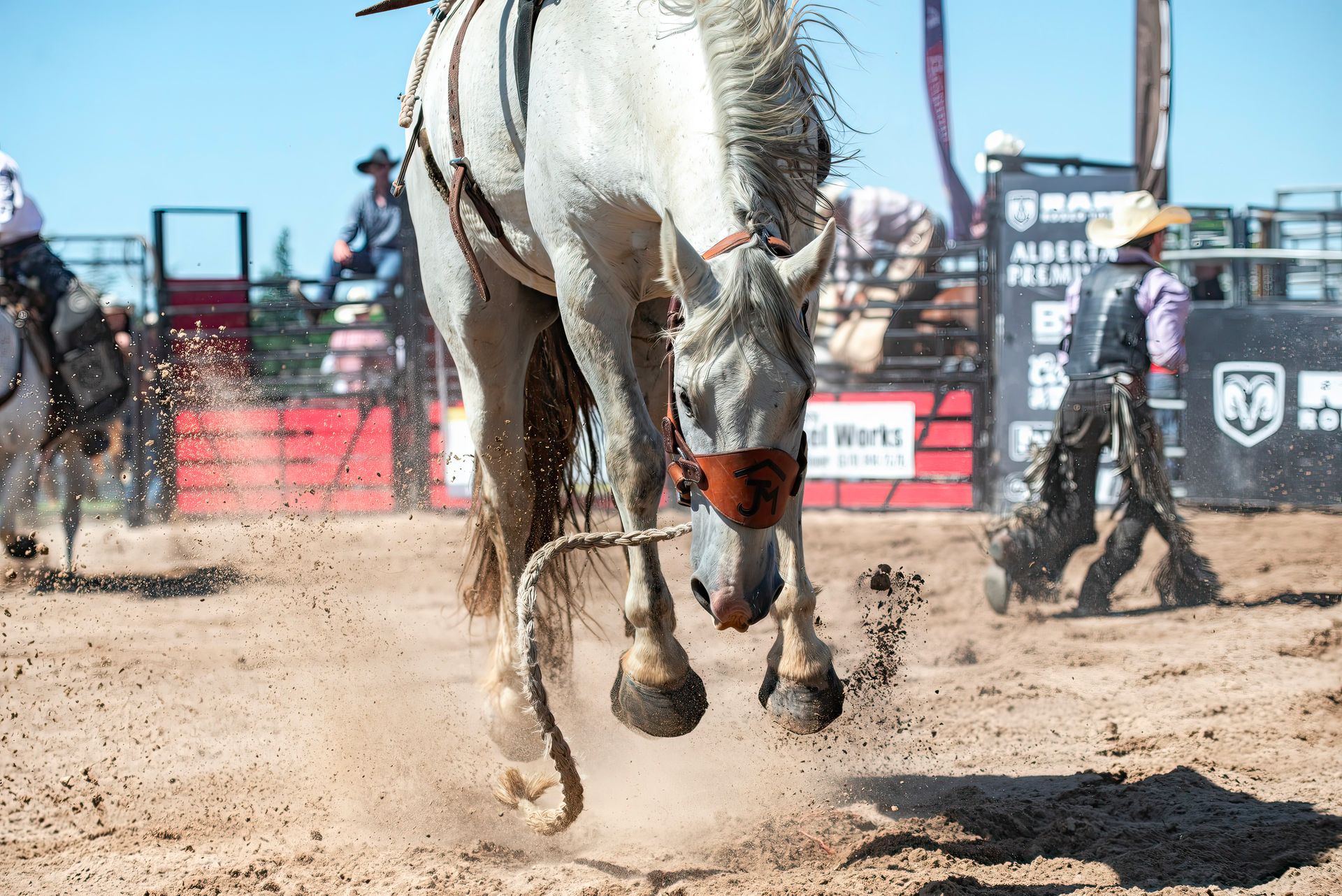
In calf wrestling, the synchronization of gestures between horse and rider is essential. This synchronization allows the horse to back up as soon as the rider steps on the ground, keeping the lasso taut.
The horse's ability to maintain a tight lasso is crucial for the cowboy to grab the calf quickly. The cowboy must then jump to the ground to lay the calf down and bind three limbs to immobilize it.
Rodeo Rules and Scoring
The scoring system is divided into two parts: the animal's performance and the rider's performance. The animal can score up to 50 points, while the rider can score up to 50 points. This means that the rider's score can be affected by the animal's performance, and vice versa.
In bareback and saddle bronc riding, the cowboy must keep both feet in the stirrups. If a rider loses a stirrup before the end of his eight-second ride, the judge will make a hand signal to the announcers and timers immediately, resulting in a no-score/disqualification.
Judges look at the way the horse or bull bucks to determine the animal's score. The harder the animal bucks, the more points it will score. Consistent, high kicking action with hind legs fully extended makes for a better score.
Here's a breakdown of the key rules and scoring factors:
- Animal score: up to 50 points
- Rider score: up to 50 points
- Rules: cowboy's feet must be above the point of the horse's shoulders, cowboy must keep both feet in the stirrups, and cowboy cannot touch the animal or himself with his free hand
- Scoring factors: animal's bucking action, cowboy's spurring action, cowboy's rhythm and timing with the animal's bucking, and cowboy's body control and position
The strength and force of the animal's bucking efforts are also important. Typically, horses and bulls that remain closer to the bucking chutes during the ride will receive a higher score. Horses and bulls that run (not buck) to the other end of the arena typically result in the contestant receiving a "re-ride."
Rodeo Terms & Definitions
A steer is a type of cattle used in rodeo events, often for steer wrestling.
Steer wrestling is a rodeo event where a rider on horseback chases a steer, then jumps off and wrestles the steer to the ground.
A bulldogger is the rider who participates in steer wrestling, requiring great strength and agility.
In team roping, two riders work together to rope a steer, one rider roping the head and the other the hind legs.
A calf is a young steer used in calf roping and barrel racing events.
Roping is a fundamental skill in rodeo events, requiring quick reflexes and accuracy with a lasso.
A lasso is a rope with a loop on the end used to rope steers, calves, and other livestock.
See what others are reading: What Is a Tie down Used for on a Horse?
Categories of
Rodeo events with horses are divided into two main categories: style events and timed events. Style events require a combination of skill and finesse, while timed events focus on speed and agility.
In style events, the performance of both the rider and the horse is judged, with an emphasis on the horse's energy, aggressiveness, and ardor. The more violently the horse tries to get rid of its rider, the higher the score.
Western riding is a distinct discipline within rodeo events. The last event of the first part is bull riding, where cowboys perform similar feats but on the back of a wild bull.
Bull riding is a thrilling event that showcases the bravery and skill of the riders.
Featured Images: pexels.com