Pocket gophers are fascinating creatures that are often misunderstood. They are solitary animals that live underground, where they can be found in a variety of habitats.
Pocket gophers are well adapted to life underground, with powerful front legs and sharp claws that allow them to dig complex burrow systems. These burrows can extend several feet underground and have multiple entrances and exits.
In the wild, pocket gophers typically live in areas with loose soil that can be easily dug through, such as meadows and grasslands. They prefer areas with rich soil that is high in nutrients, which they use to feed their young.
Pocket gophers are herbivores and feed on a variety of plants, including roots, tubers, and vegetation. They are also known to cache, or store, food for later use.
You might enjoy: Where Do Pocket Gophers Live
What is a Pocket Gopher?
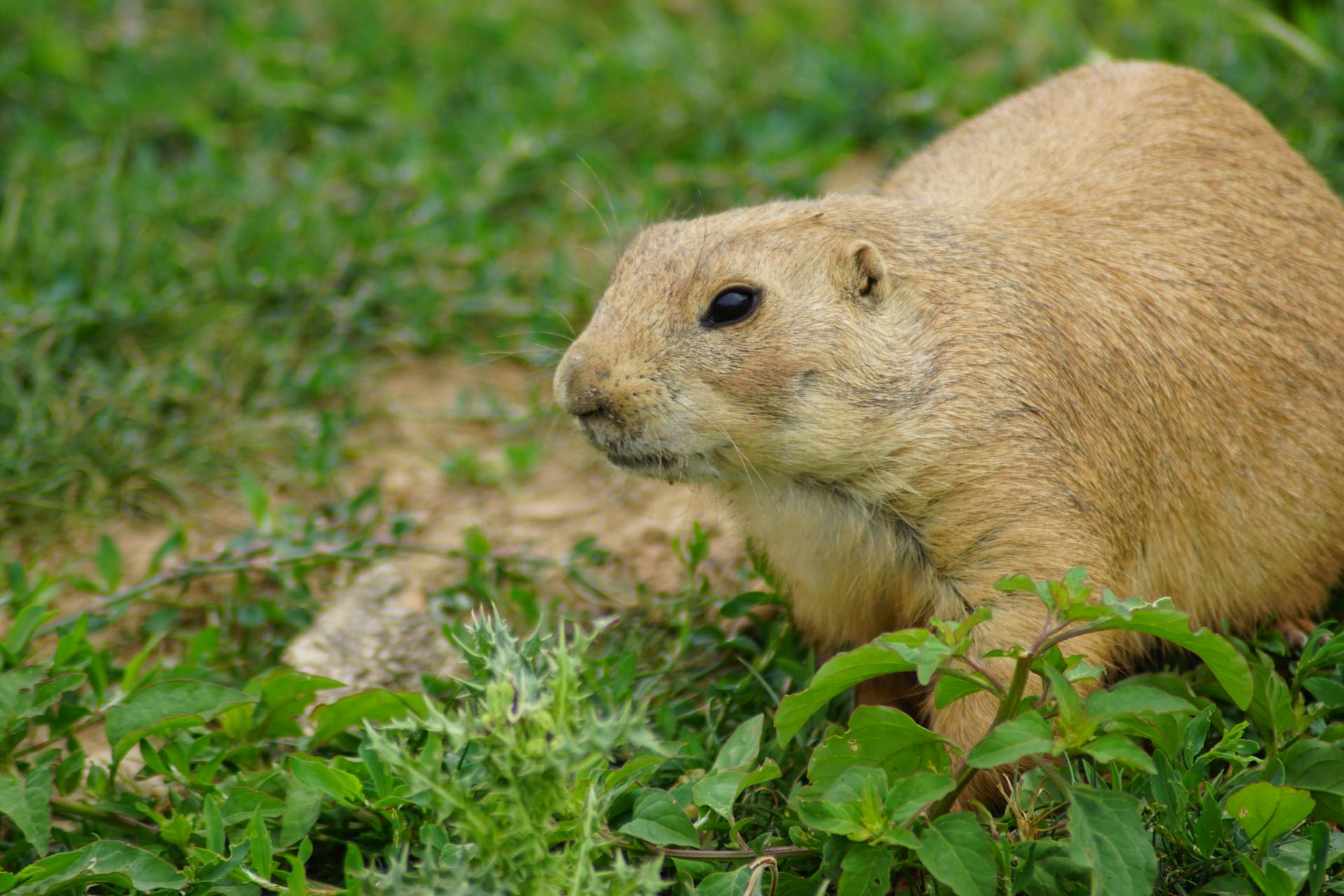
A pocket gopher is a small, furry mammal that burrows underground tunnels and dens.
They are typically between 5 and 10 inches long, including their tail, and weigh between 5 and 12 ounces.
Pocket gophers have stocky bodies and short legs, which are well-suited for digging.
Their front teeth are orange-colored and constantly growing, which helps them gnaw through tough plant roots.
They are herbivores and primarily eat roots, tubers, and other underground plant material.
Pocket gophers are found in a variety of habitats, including grasslands, forests, and deserts.
They are solitary animals and only come together during breeding season.
Their burrowing activities can sometimes cause damage to nearby buildings and landscaping.
Behavior and Habitat
Pocket gophers are solitary creatures, only coming together for breeding season, and they fiercely defend their territories, which can vary in size depending on available resources. They're not social animals like some other rodents.
Each gopher has its own tunnel system, which they use to collect food and escape predators. These tunnels can be extensive, with gophers storing large amounts of food in their burrows. They're particularly fond of moist soil, which is why you might find them in vegetable gardens or lawns.
Gophers are skilled engineers, creating complex networks of tunnels and burrows that can be identified by small piles of loose soil covering the entrances. They often visit lawns or farms, which can lead to them being treated as pests due to the damage they cause to plant life.
Habitat
Pocket gophers are found in a wide range of habitats, from mountains to lowland grasses. They prefer moist, sandy soils, such as those found in meadows or along streams.
Gophers can excavate extensive burrow systems, sometimes reaching 400 to 500 feet in length. These burrows often include food storage areas, nest sites, and tunnels for depositing feces.
In areas where gophers are abundant and active, their bare-earth mounds are highly visible. Fresh mounds are topped with loose, almost-fluffy earth and have no entrance, distinguishing them from the burrows of other ground-dwelling rodents.
Gophers are antisocial and rarely leave their own burrow system. However, they may occasionally come above ground to forage on fresh greens during nights or very cloudy days.
To reduce gopher activity in lawns and gardens, it's possible to reduce their food sources using chemical or mechanical methods. This can include removing weedy areas adjacent to yards and gardens to create a buffer strip of unsuitable habitat.
Behavior
Pocket gophers are solitary animals outside of the breeding season, aggressively maintaining territories that vary in size depending on the resources available.
Gophers are larder hoarders, and their cheek pouches are used for transporting food back to their burrows, where they can collect large hoards.
Tunnel entrances can be identified by small piles of loose soil covering the opening, a sign that gophers have been active in the area.
Gophers often visit vegetable gardens, lawns, or farms, as they like moist soil, and this has led to their frequent treatment as pests.
The resulting destruction of plant life can leave the area a stretch of denuded soil, but the soil disturbance can also lead to the early establishment of ecological succession in communities of r-selected and other ruderal plant species.
Pocket gophers are fiercely territorial and will attack other animals, including cats and humans, if threatened, and can inflict serious bites with their long, sharp teeth.
If this caught your attention, see: Animals Smarter than Dogs
Identifying and Managing Gophers
Gophers are most active at night, so if you're trying to spot one, keep an eye out for burrows and tunnels during these hours.
Their distinctive burrows can be identified by the mounds of dirt they push up to the surface, often with a small hole at the top.
Gophers are herbivores, which means they primarily feed on plant material, making them a nuisance for gardeners and landscapers.
You can deter gophers by using physical barriers such as hardware cloth or plastic sheeting to protect your plants, and also by removing any food sources that may be attracting them.
Viewing
Viewing gophers can be a challenging task, but it's not impossible. You can spot them above ground occasionally, especially when they're mending holes in their mounds.
Male gophers will leave their burrows to search for mates, and youngsters will disperse when it's time. This is when you might catch a glimpse of them.
One way to reliably spot gophers is by poking a hole in a fresh mound and waiting for them to plug it up. This can give you surprisingly good views of the gopher.
Gophers are light sensitive, so they'll quickly move to cover the hole. You might even get a good look at their species.
You can also try visiting areas with known gopher populations, like a local playground. I've taken mammal enthusiasts to see Townsend's pocket gophers at a playground before.
However, be prepared for some weird looks from your neighbors, especially if you're walking around with broomsticks and cameras.
Additional reading: Pacific Gopher Snake
Pest Notes: Introduction
Pocket gophers, also known as Thomomys species, are burrowing rodents that get their name from the fur-lined, external cheek pouches they use for carrying food and nesting materials.
Their powerful forequarters, large-clawed front paws, and fine, short fur make them well equipped for digging and tunneling.
Their small eyes and ears are adaptations for living underground, where visibility is limited.
A gopher's lips are uniquely adapted for their lifestyle, allowing them to close them behind their four large incisor teeth to keep dirt out of their mouths when digging.
Their highly sensitive facial whiskers help them navigate in the dark, making them efficient tunnelers.
Curious to learn more? Check out: Large Rodents of South America
Living with Wildlife
Pocket gophers are generally solitary creatures, only coming together during breeding season or when females have young with them. This means they're not likely to be a nuisance in your garden or yard, unless you're a fellow underground dweller.
If you have a problem with gophers, it's likely due to their burrowing activities, which can damage plants and lawns. Gophers eat roots, bulbs, and other fleshy portions of plants, and can pull entire plants into their tunnels.
To minimize damage, consider creating a gopher-friendly environment in your yard. This can be as simple as planting gopher-resistant plants or providing alternative food sources, like fruit trees or berry bushes.
Gophers are also beneficial to the environment, as they help to aerate soil and increase soil quality over time. In fact, surface mounds created by gophers can bury vegetation deeper and deeper, increasing soil quality.
Here are some ways gophers help the environment:
- Aerating soil with their burrows
- Increasing soil quality over time
- Providing a fresh seedbed for new plants in their mounds
By learning to live with gophers, you can coexist peacefully and even benefit from their underground activities.
Mazama Conservation
The Mazama pocket gopher is in trouble in the south Puget Sound area, where populations have been disappearing since the 1940s.
Habitat loss to development is a major issue, making it hard for the gophers to recolonize after local extinctions.
Loss of habitat has probably stopped much of the recolonization that was helping the gophers persist.
Homeowners trapping the gophers and domestic cats and dogs persecuting them have also contributed to the decline.
If the Mazama pocket gopher is to persist, it will need protection and lands where its needs are met.
Homeowners will need to be tolerant of the gophers in their neighborhoods, and keeping cats indoors may be a requirement for the gophers to survive in the suburbs.
The last records of Tacoma pocket gophers, a subspecies of the Mazama pocket gopher, were of individuals killed by domestic cats.
Recommended read: How Did Cats Become Pets
Damage and Control Methods
Pocket gophers can cause significant damage to your property, especially if you're not aware of their presence. Research has shown that you need to remove more than 70% of the gophers to effectively control their population.
To find the main tunnel, you'll need to locate the gophers' underground network. Traps need to be placed in both directions in the main tunnel or in each lateral tunnel to maximize efficiency. Traps should be set in the spring or fall when gophers are pushing up new mounds.
You'll want to have a sufficient number of traps to cover the area effectively. Typically, 10 to 15 traps per acre are needed. Be prepared to move the traps to new spots if you catch nothing in two days.
Fumigation methods are not always effective, especially with smoke or gas cartridges, as gophers quickly seal off their burrows. However, fumigation with aluminum phosphide, a restricted-use application, can be effective at controlling gopher populations. This method requires a state license and is usually only practical for large-scale gopher management.
Consider reading: New Guinea Singing Dog
Trapping
Trapping is a safe and effective method for controlling pocket gophers. Most common types of lethal gopher traps are 2-pronged pincer traps, such as the Macabee, Cinch, or Gophinator, which the gopher triggers when it pushes against a flat, vertical pan or metal wire.
Additional reading: Plains Pocket Gopher
Some trappers consider box traps easier to use than pincer-style traps for inexperienced gopher trappers. However, setting box traps in the main tunnel requires more surface excavation than the pincer-type traps.
To set pincer and box traps, locate the main tunnel with a probe and open the tunnel wide enough to set traps. You will need to set traps in as many tunnels as are present since you won't know which portion of the tunnel the gopher is in.
It's recommended to cover trap-sets when trapping in areas frequented by humans and pets, and to cover sets when using box traps, since gophers likely will plug tunnels before hitting the trigger wire of these traps if left uncovered.
You'll need to check traps often and reset when necessary. If you haven't captured a gopher within 1 to 2 days, reset the traps in a different location.
Trapping is very effective in controlling pocket gophers in small areas, but to be effective, you need to remove more than 70% of the gophers.
Curious to learn more? Check out: Trapping Pocket Gophers
Fumigation
Fumigation is a method of controlling gopher populations, but it's not always effective. Gophers can quickly seal off their burrow when they detect smoke or gas.
One type of fumigation that works is using aluminum phosphide, a restricted-use application that requires a state license. Licensed pest control operators have access to this method.
However, new regulations greatly restrict the use of aluminum phosphide in residential areas. It can only be applied in areas more than 100 feet from any building where humans, domestic animals, or both are or may potentially be found.
A more modern approach to fumigation is using pressurized exhaust machines, which were approved for use against burrowing rodents in California in 2012. These machines generate exhaust rich in carbon monoxide, which asphyxiates the gopher.
Biology and Damage
Northern pocket gophers are fascinating creatures, but they can also be quite destructive. They can excavate extensive burrow systems, sometimes reaching 400 to 500 feet in length.
Gophers prefer moist, sandy soils, often found in meadows, along streams, or in lowland grasses. They can cause significant damage to lawns, golf courses, and agricultural fields.
These animals are expert diggers, using their long and sharp upper incisors and front claws to burrow through the soil. A sensitive tail helps them navigate backward within their burrows.
Gophers can bring 2-4 tons of soil to the surface in a year's time, resulting in crescent-shaped mounds with a plug to one side. These mounds are hollow inside.
Their diet consists mainly of roots and tubers during the winter, while spring and summer diets are usually 60 to nearly 100 percent leaves and stems. They use all parts of plants, and their diets vary on a seasonal basis.
Farmers, nurserymen, and gardeners often view northern pocket gophers as pests, due to the significant damage they can cause to crops and gardens.
Frequently Asked Questions
What is the difference between a gopher and a pocket gopher?
Gophers are a general term for burrowing mammals, while pocket gophers specifically refer to rodents with fur-lined cheek pouches for carrying food
Featured Images: pexels.com