Trapping pocket gophers can be a challenge, but with the right approach, you can effectively control their populations and protect your garden.
Pocket gophers are primarily active at night, so setting traps during this time can increase your chances of catching them.
Their tunnels and burrows can be extensive, making it essential to identify the areas where they are most active.
For effective trapping, it's crucial to choose the right type of trap that suits your specific situation.
Expand your knowledge: What Do Pocket Gophers Eat
Identifying and Understanding Pocket Gophers
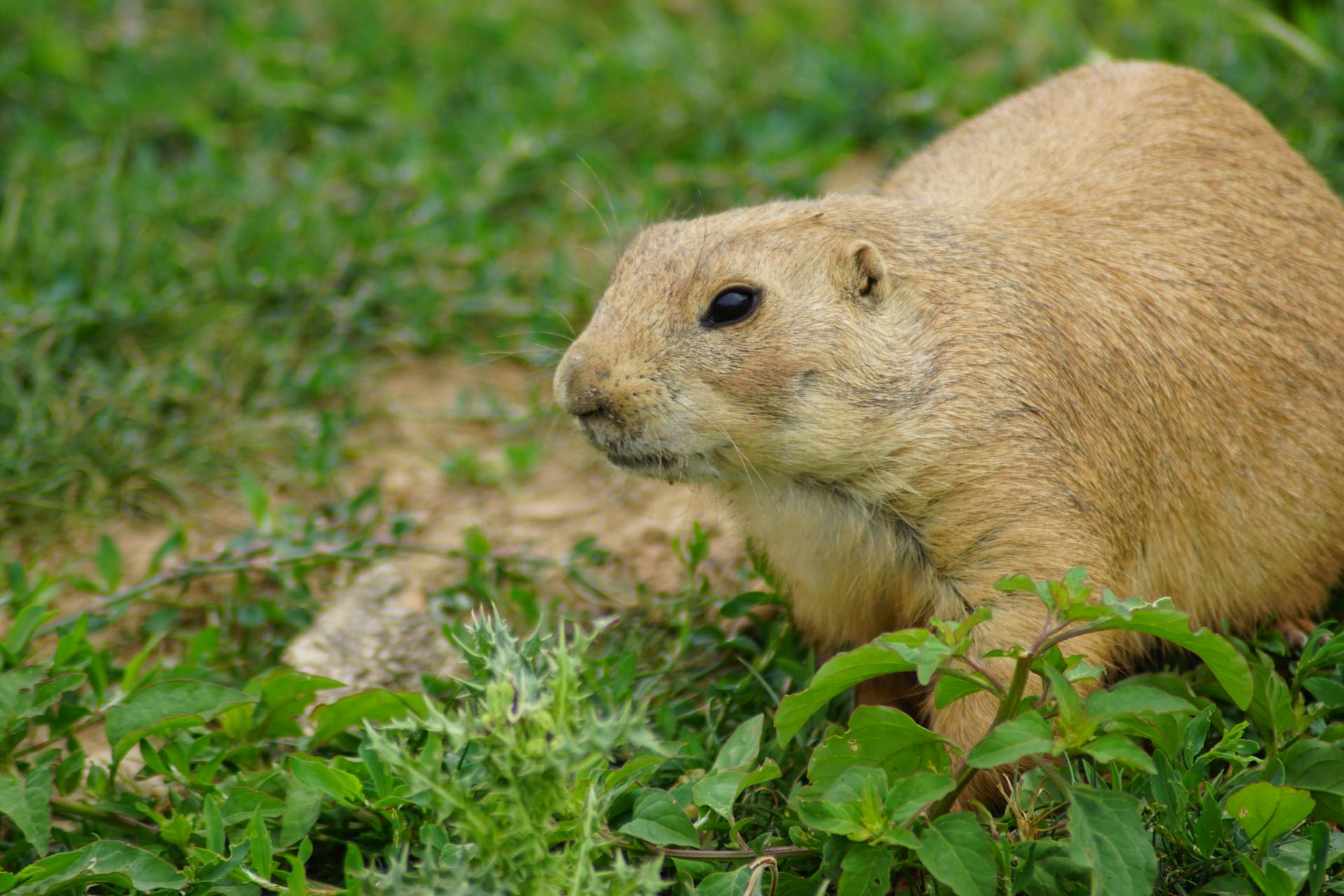
Pocket gophers are small, furry rodents that live underground, typically in areas with moist soil and abundant vegetation.
They have a stocky build, measuring around 6-12 inches in length, including their tail, and weigh between 3-12 ounces.
Pocket gophers are herbivores, feeding on a variety of plants, including grasses, roots, and tubers.
They have a unique way of eating, using their sharp incisors to cut and collect food, and their cheek pouches to store it.
Pocket gophers are primarily solitary animals, only coming together to mate or raise their young.
They are also skilled diggers, using their powerful front teeth and long claws to excavate complex burrow systems.
These burrows can extend several feet underground and have multiple entrances and exits.
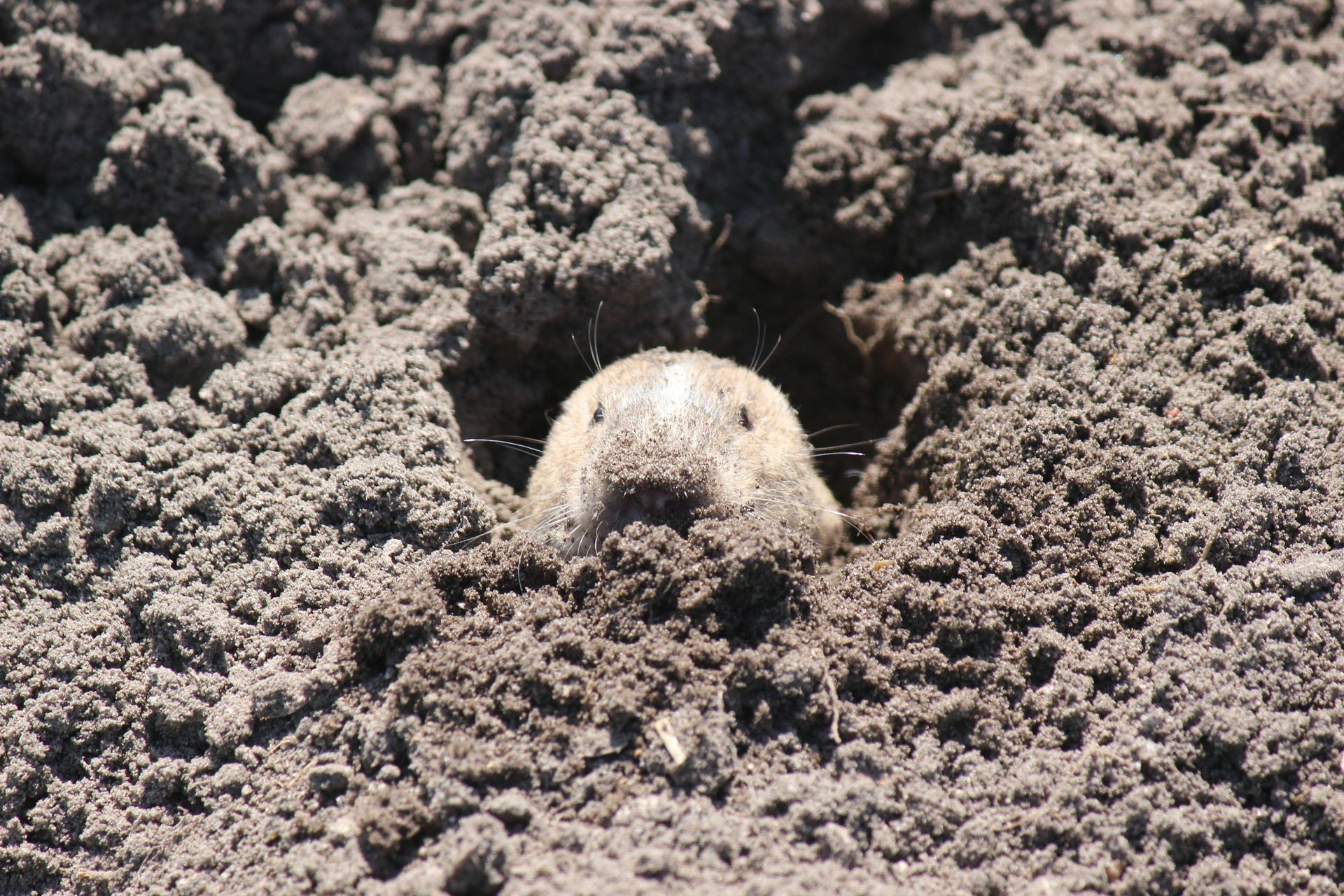
Pocket gophers are also known for their ability to create mounds of soil on the surface, often mistaken for ant hills or other small animal burrows.
Prevention and Exclusion
To prevent gophers from digging up your garden, consider using underground fencing. Bury hardware cloth or ½- to ¾-inch mesh wire at least 2 feet deep with an additional 6 inches of mesh or wire bent at a 90-degree angle away from the planting.
This method can be effective for protecting small areas like flower beds by complete underground screening of the bed's sides and bottoms. You can also underlay the soil with mesh wire when constructing raised vegetable or flower beds.
Using wire baskets around individual plants can also deter gophers, especially when they're young. Choose baskets made of light-gauge, ¾-inch, non-galvanized steel wire that will rust and disintegrate after several years, preventing growing roots from becoming strangled.
Legal Status
In California, pocket gophers are classified as nongame mammals by the Fish and Game Code. This means no trapping license is required for gopher removal.
You can control gophers at any time and in any legal manner. Underground fencing is one effective method to prevent gophers from digging around valuable ornamental shrubs or landscape trees.
To protect plantings, bury hardware cloth or ½- to ¾-inch mesh wire at least 2 feet deep. This will help keep gophers from digging around the fencing boundary.
It's essential to extend the fencing at least 1 foot aboveground to deter gophers moving overland. Use galvanized or stainless steel wire to extend the life of the fencing.
However, underground fencing is not perfect, as persistent gophers can burrow below the wire.
Exclusion
Exclusion is a key part of preventing gophers from causing damage to your property. Underground fencing can be justified for valuable ornamental shrubs or landscape trees.
Bury hardware cloth or ½- to ¾-inch mesh wire at least 2 feet deep to protect existing plantings. This will help keep gophers from digging around the fencing boundary.
To deter gophers moving overland, extend the fencing at least 1 foot aboveground. Use galvanized or stainless steel wire to extend the life of the fencing.
You can protect small areas like flower beds by complete underground screening of the bed's sides and bottoms. This involves underlaying the soil with mesh wire to exclude gophers.
Raised vegetable or flower beds can be protected by underlaying the soil with mesh wire. This will help keep gophers out and prevent damage to your plants.
To protect individual plants, install wire baskets around them. You can make these at home or buy them commercially, and choose baskets that are large enough to allow for the roots to grow for several years.
Light-gauge, ¾-inch, non-galvanized steel wire is a good option for shrubs and trees that only need protection while young. This type of wire will rust and disintegrate after several years, preventing growing roots from becoming strangled.
Deter gophers by placing 6 to 8 inches of coarse gravel (1 inch or more in diameter) around underground flexible sprinkler lines or utility cables. This will help keep gophers away and prevent damage to your property.
Damage and Control
Pocket gophers can inflict considerable damage in a very short time by pulling entire plants into their tunnel from below.
A single gopher moving down a garden row can cause a lot of harm, and their tunnels can divert and carry off irrigation water, leading to soil erosion.
Gophers also gnaw and damage flexible plastic water lines and irrigation systems, particularly those used for drip irrigation.
For home gardeners, it's not just about the plants disappearing, it's about the time, money, and energy invested in the garden going down the drain if the pest problem gets out of control.
Mounds on lawns can interfere with mowing equipment and ruin the aesthetics of well-kept turfgrass.
Readers also liked: What Is the Time on the White Rabbit's Pocket Watch?
Damage and Control
Pocket gophers can inflict considerable damage in a very short time by pulling entire plants into their tunnel from below. They often feed on many garden crops, ornamental plants, vines, shrubs, and trees.
Gophers can also feed on bark, called girdling, several feet up a tree by burrowing through the snow. Most girdling damage to trunks and large roots occurs belowground.
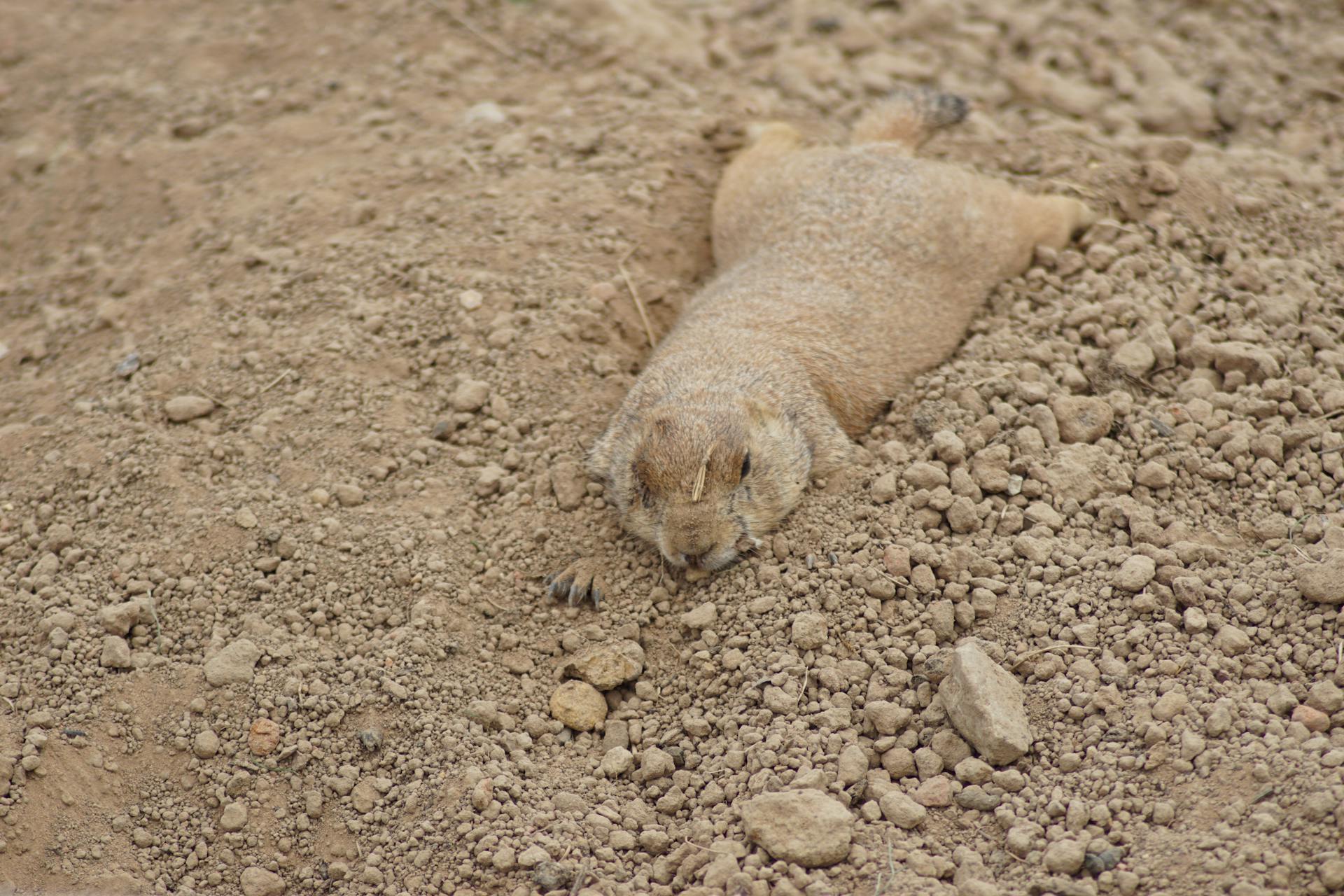
Their tunnels can divert and carry off irrigation water, leading to soil erosion. Gophers also gnaw and damage flexible plastic water lines and irrigation systems, particularly those used for drip irrigation.
Mounds on lawns can interfere with mowing equipment and ruin the aesthetics of well-kept turfgrass. Home gardeners can lose a significant portion of their garden to gopher damage, estimated to be around 30%.
To prevent gopher damage, consider planting castor beans around the perimeter of your garden. These plants are known to steer gophers away.
You might enjoy: Pacific Gopher Snake
Fumigation
Fumigation is a method that can be effective in controlling gopher populations, but it's not always the best option. Fumigation with aluminum phosphide, a restricted-use application requiring a state license, is effective at controlling gophers.
Gophers quickly seal off their burrow when they detect smoke or gas, making fumigation with smoke or gas cartridges usually ineffective. However, licensed pest control operators have access to aluminum phosphide.
New regulations greatly restrict the use of aluminum phosphide in residential areas, limiting its application to burrow systems located more than 100 feet from any building where humans or domestic animals are present.
Trapping and Removal
Trapping pocket gophers requires patience and persistence. Trapping is a safe and effective method for controlling pocket gophers.
Several types and brands of lethal gopher traps are available, including 2-pronged pincer traps like the Macabee, Cinch, or Gophinator. These traps are triggered when the gopher pushes against a flat, vertical pan or metal wire.
Choker-style box traps are another popular type, with the Gopherhawk being a more recent development that allows for direct insertion into the gopher burrow. Little is known about the efficacy of this trap type.
To set pincer and box traps, locate the main tunnel with a probe, and use a shovel, garden trowel, or hori hori knife to open the tunnel wide enough to set traps. You'll need to set traps in as many tunnels as are present since you won't know which portion of the tunnel the gopher is in.
Some trappers consider box traps to be easier to use than pincer-style traps, but setting box traps in the main tunnel requires more surface excavation. Most experienced trappers find pincer traps easier to use.
Although some advocate for using bait behind the trap to increase capture success, UC Davis researchers have observed no such benefit. There is also no impact of human scent on trapping success.
Once traps are set, be sure to wire your traps to stakes so you can easily retrieve them from the burrow, and to prevent scavengers from carrying them away.
Research and Statistics
We used the R Studio package within R statistics to execute comparisons of effectiveness between baiting and traps, and among trap types. A small sample size led us to use the Kruskal-Wallace Rank Sum Test, a nonparametric, rank-based one-way analysis of variance.
Comparisons were considered statistically different if the probability (P) was less than or equal to 0.05. This means that any differences found between the methods or trap types were significant and unlikely to be due to chance.
See what others are reading: Glue Trap
Researchers Capture Gophers by the Bucket
Researchers have developed a new and effective method for trapping pocket gophers using a PVC pipe and a plastic bucket.
The bucket trap fits into the gophers' tunnel system and has a pitfall to the bucket, allowing the gophers to fall in before they can plug the passage with soil.
Prior to using this bucket trap, researchers weren't comfortable leaving traps overnight due to the gophers' fear of predators like corn snakes.
Trapping the gophers is crucial for understanding their ecology, as they are in decline and the factors causing this reduction aren't well understood.
The gophers' genetic diversity is also being studied, with early results showing significant genetic divergence between some populations.
This may indicate the presence of two distinct species or subspecies, divided by the Apalachicola River.
Here's an interesting read: Trap Raccoons
Statistical Analysis
We used the R Studio package to execute comparisons of effectiveness between baiting and traps, and among trap types. This package is part of the R statistics software.
R statistics, developed by the R Development Core Team in 2008, was the platform for our analysis. The team's work laid the foundation for our research.
To analyze our small sample size, we employed the Kruskal-Wallace Rank Sum Test, a nonparametric, rank-based one-way analysis of variance. This test allowed us to compare the effectiveness of different trap types.
The probability (P) threshold for statistical significance was set at ≤ 0.05.
Gardening and Pest Control
Pocket gophers are well equipped for a digging, tunneling lifestyle with their powerfully built forequarters and large-clawed front paws.
Their fine, short fur doesn't cake in wet soils, making it easier for them to dig without getting stuck.
Gophers have small eyes and ears, which are less sensitive to sounds and movements, but their highly sensitive facial whiskers assist with moving about in the dark.
Their lips are also unusually adapted for their lifestyle, closing behind their four large incisor teeth to keep dirt out of their mouths when using their teeth for digging.
You can use this knowledge to your advantage when setting traps, as gophers are most active at night and rely heavily on their whiskers to navigate.
Introduction and General Information
Pocket gophers are burrowing rodents that get their name from the fur-lined, external cheek pouches, or pockets, they use for carrying food and nesting materials.
They are well equipped for a digging, tunneling lifestyle with their powerfully built forequarters.
Their large-clawed front paws are perfect for digging and moving earth.
Fine, short fur that doesn't cake in wet soils is another adaptation that helps them thrive in their underground environment.
Small eyes and ears are typical of pocket gophers, which is likely an adaptation to their dark underground lifestyle.
Highly sensitive facial whiskers assist with moving about in the dark, which is a crucial ability for gophers.
A gopher's lips are also unusually adapted for their lifestyle, allowing them to close behind their four large incisor teeth to keep dirt out of their mouths when using their teeth for digging.
Frequently Asked Questions
What food is irresistible to gophers?
Gophers are particularly drawn to nutrient-rich roots and bulbs, including root vegetables like carrots and potatoes. They'll also devour entire plants, posing a threat to trees by damaging their roots.
How deep do pocket gophers go?
Pocket gophers typically dig tunnels up to two to six feet deep, but can also create deeper burrows. Their underground tunnels can extend up to 800 feet in length.
What time of day are pocket gophers most active?
Pocket gophers are most active around dusk and at night, with a peak in spring when they can construct up to three mounds a day.
Featured Images: pexels.com