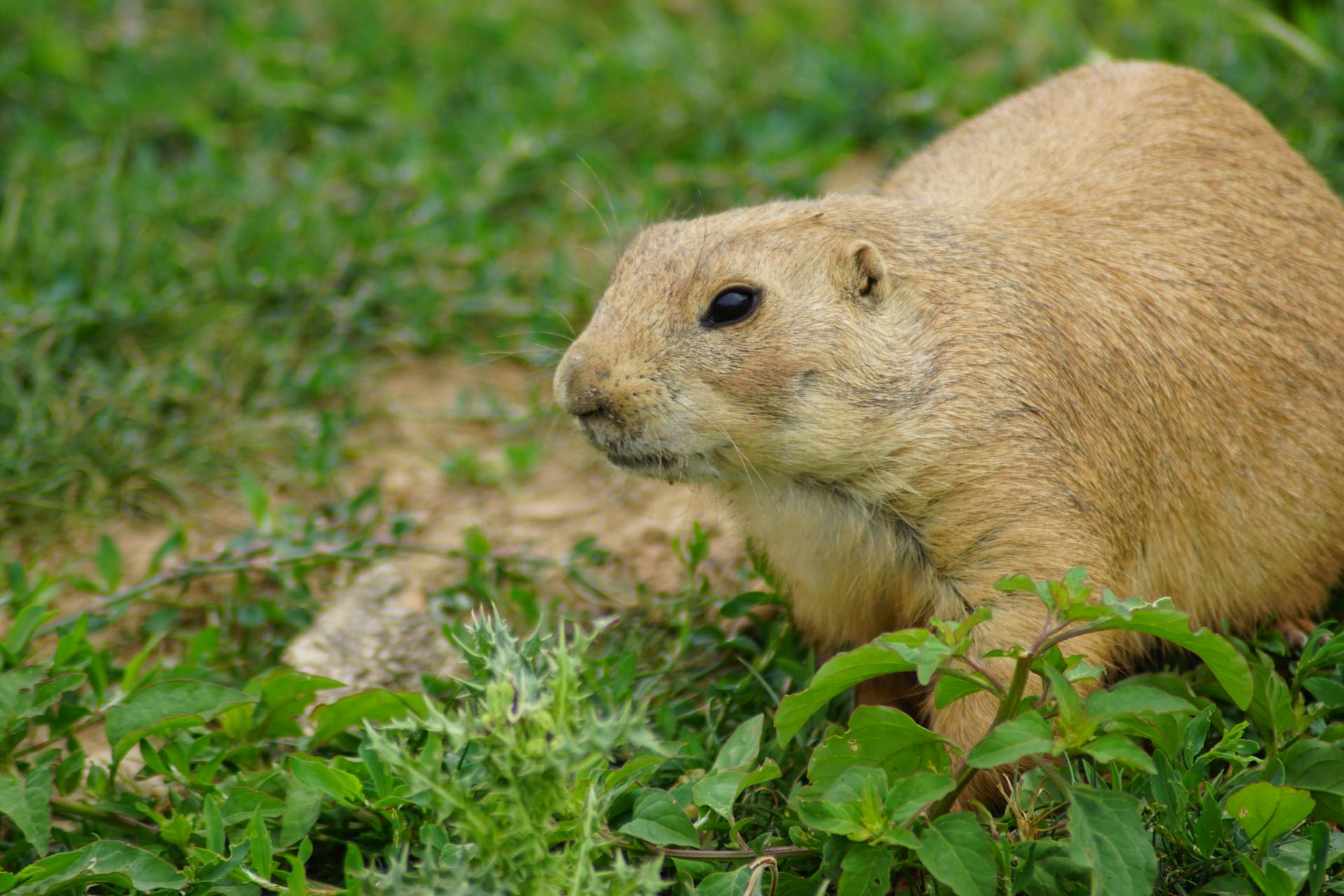
The plains pocket gopher is a fascinating creature. It's a small mammal that burrows underground, creating complex networks of tunnels and dens.
These tunnels can extend up to 30 feet underground and have multiple entrances and exits. The gopher's burrowing habits play a crucial role in shaping the prairie ecosystem.
The plains pocket gopher is an important part of the prairie ecosystem, serving as a food source for predators like owls, hawks, and foxes.
You might like: Prairie Dog Communication
Physical Characteristics
Plains pocket gophers have short fur that can vary from pale brown to black, and is usually paler on the underside. Their fur is soft, short, and dense.
Their bodies are approximately 8 to 12 3/4 inches in length, including the tail. They typically weigh up to 1 pound, with males being generally larger than females.
One of the distinctive features of plains pocket gophers is their long, hairless tail, which reaches 5 to 11 cm (2.0 to 4.3 in) in length. The tail is nearly naked and short.
Additional reading: Subantarctic Fur Seal
Their foreclaws are long and strongly curved, while the back claws are short. They also have external cheek pouches that are used to transport food and nesting materials.
Here are some key physical characteristics of plains pocket gophers:
- Short fur that can vary from pale brown to black
- Stocky bodies
- Small eyes and ears
- Sparsely furred tails
- External cheek pouches
- Long and strongly curved front claws
- Short back claws
Habitat and Distribution
Plains pocket gophers can be found throughout much of the midsection of Illinois, with their range extending from St. Clair and Madison counties to east and south of the Illinois River.
They prefer sandy soils and can be locally abundant, which is why you might spot them in areas with good drainage. Their underground burrows may be up to 500 feet long, usually within three feet of the ground's surface.
Plains pocket gophers are herbivores and feed mainly on roots, rhizomes, and bulbs. They also consume roots of shrubs and small trees, as well as leaves of plants like alfalfa and bluegrass.
Here's a breakdown of their typical diet:
- Roots
- Rhizomes
- Bulbs
- Roots of shrubs and small trees
- Leaves of plants like alfalfa, bluegrass, and dandelion
Their distribution tends to be limited by soil type, which is why you might find them in open to sparsely wooded areas with deep, sandy, crumbly soils.
Habitat
Plains pocket gophers prefer deep, sandy, crumbly soils, which are perfect for digging burrows. They can be found in open to sparsely wooded areas.
Their burrows can be up to 500 feet long and are usually within three feet of the ground's surface. This is because they spend much of their lives underground.
Pocket gophers are common within their range, which is often patchy due to their preference for specific soil types. This patchy distribution closely tracks the local soils.
Here are some key facts about the range of Plains pocket gophers:
- Range mass: 300 to 450 g (10.57 to 15.86 oz)
- Range length: 187 to 357 mm (7.36 to 14.06 in)
- Average basal metabolic rate: 0.769 WAnAge
Distribution & Abundance
Plains pocket gophers are found throughout much of the midsection of Illinois, specifically from St. Clair and Madison counties to east and south of the Illinois River. Their range extends to the Kankakee River and south of that river to the border of Indiana.
They can be locally abundant in areas with suitable soil conditions. Plains pocket gophers prefer sandy soils, which are essential for their survival.
Related reading: Plains Hognose Snake
Their distribution tends to be limited by soil type, resulting in patchy distribution patterns. This is closely related to the local soils, as they prefer deep, sandy, crumbly soils.
Here's a summary of their range and characteristics:
Behavior and Ecology
Plains pocket gophers are solitary animals and will aggressively defend their burrow from other pocket gophers.
They spend almost all of their time in their underground burrows, with tunnels that can range from 30 to 50 meters long and include nests and food caches.
The rate of tunnel construction can be quite impressive, with some gophers excavating up to 2,059 cm of new tunnels per week.
Factors affecting the size of the tunnel system appear to be influenced more by the amount of energy needed to maintain and patrol it rather than the amount of vegetation present.
The gophers share their tunnels with numerous species of insects, including flies, scarab and carrion beetles, and cave crickets.
Their daily activity pattern is bimodal, with increased activity occurring from 1300-1700 and then again from 2200-0600.
They rarely explore burrows inhabited by other gophers, although they sometimes investigate those that have been previously abandoned.
Territorial and aggressive, especially in male-to-male interaction, these rodents appear to use their greatly increased sensitivity to soil vibration to maintain their solitary lifestyle.
The gophers spend 72% of their time in their nests, coming above ground to search for food or mates, and for young animals to establish new burrows.
They are known to be territorial and will fight other pocket gophers unknown to them, with male-male aggression occurring during the breeding season.
Their burrows are relatively shallow in the summer, ranging from 20-30 cm, and somewhat deeper in the winter.
Reproduction and Life Cycle
Plains pocket gophers typically breed only once a year, although they may sometimes breed twice in good years or warmer climates.
The breeding season varies with latitude, ranging from April to May in Wisconsin to as long as January to September in Texas.
Broaden your view: Pocket Bully Breed
Females give birth to one to six young after a gestation period around 30 days, although pregnancies lasting up to 51 days have been recorded.
The young gophers are born hairless and blind, and initially weigh about 5 g (0.18 oz).
They begin to develop fur at 10 days, open their eyes at three weeks, and are weaned by five weeks of age.
After weaning, they quickly leave to establish burrows of their own, and reach the full adult size after about three months.
Breeding takes place January through spring, and plains pocket gophers have one litter each year, with an average of three to four young per litter.
The young gophers are cared for by the female only, and they are weaned by five to six weeks of age.
They typically live less than three years.
Conservation
The plains pocket gopher's conservation status is a Least Concern due to its widespread distribution and adaptability to suitable habitat. This means that it's not considered to be at risk of extinction.
One of the reasons for this status is that there are no major threats to the species. This is likely due to its ability to thrive in a variety of environments.
In fact, pocket gophers like the plains pocket gopher play active roles in soil aeration, flood control via improved drainage, and soil and plant diversity. This is a valuable contribution to the ecosystem.
Here are some of the ways that pocket gophers like the plains pocket gopher help the environment:
- Soil aeration: Pocket gophers help to aerate the soil by digging tunnels and burrows, which allows air and water to reach plant roots.
- Flood control: By improving drainage, pocket gophers help to prevent flooding and reduce the risk of water damage.
- Soil and plant diversity: Pocket gophers help to create habitat diversity by creating complex networks of tunnels and burrows, which supports a wide range of plant and animal species.
Overall, the plains pocket gopher's conservation status is a testament to the importance of these small creatures in the ecosystem.
Identification and Signs
Plains pocket gophers are relatively large rodents, typically measuring 8 to 12 3/4 inches in length, including their tail, and weighing up to 1 pound.
Adults have stocky bodies, small eyes and ears, and sparsely furred tails. They usually have black or dark brown fur with dark gray or brownish-colored undersides.
Their fur is soft, short, and dense, with the tops of their feet and the end of their tail being white. They also have external cheek pouches for transporting food and nesting materials.
Here are some key physical features to look out for:
- Short fur that can vary from pale brown to black
- Paler underside
- Long, hairless tail
- Large, rapidly growing foreclaws
- Bilateral symmetry
Plains pocket gophers are primarily underground dwellers, so their tracks and scat are rarely found. However, you can identify their presence by looking for kidney- or fan-shaped mounds of soil, which are often one to two feet in diameter and up to one foot tall.
Description and Identification
Plains pocket gophers are quite distinctive in appearance. They typically have black or dark brown fur with dark gray or brownish-colored undersides.
These rodents have stocky bodies, small eyes, and ears, and their fur is soft, short, and dense.
Their tails are sparsely furred and have a white tip. The tops of their feet are also white.
One of the most notable features of plains pocket gophers is their external cheek pouches. These pouches are used to transport food and nesting materials.
Here's a comparison of the size of plains pocket gophers to other animals:
Males are generally larger than females, with adults weighing up to 1 pound.
Signs: Tracks & Scat
Plains pocket gophers are mostly underground dwellers, so their tracks and scat are rarely seen.
Their presence can be indicated by the kidney- or fan-shaped mounds of soil they produce.
These mounds are usually one to two feet in diameter and can be up to one foot tall.
Unlike molehills, pocket gopher mounds are not connected by surface tunnels.
The mounds are often found in a line, which can be a good indicator of their activity.
Classification
The plains pocket gopher's classification is a fascinating topic. The kingdom it belongs to is Animalia, which is home to a vast array of animals.
Within the kingdom Animalia, the plains pocket gopher is further classified as a chordate, specifically a vertebrate. This means it has a backbone and a notochord, a flexible rod-like structure that provides support.
As a vertebrate, the plains pocket gopher's classification continues to narrow down to the class Mammalia, which is comprised of warm-blooded animals that produce milk for their young.
Related reading: Animals Smarter than Dogs
The order Rodentia is where we find the plains pocket gopher's closest relatives, including other rodents like mice and squirrels.
Here's a breakdown of the plains pocket gopher's classification:
The family Geomyidae is specifically where the plains pocket gopher is found, and within this family, we have the genus Geomys, which includes other eastern pocket gophers.
See what others are reading: Northern River Otter Mustelidae Family
Positive Benefits
The plains pocket gopher is a remarkable creature that brings numerous benefits to the environment.
Their tunneling behavior increases soil fertility.
As they dig their underground tunnels, pocket gophers help to loosen compacted soil, allowing water and air to penetrate deeper into the earth.
This process improves soil aeration.
By breaking up hard soil with their digging, pocket gophers also reduce soil compaction.
This is a huge advantage for plants, which can now grow stronger and healthier.
Their tunneling activities are also beneficial for the soil's fertility, as they bring nutrient-rich soil to the surface.
Frequently Asked Questions
What do plains pocket gophers eat?
Plains pocket gophers primarily feed on underground plant parts, including roots, rhizomes, and bulbs. Their herbivorous diet consists mainly of these subterranean plant structures.
Featured Images: pexels.com