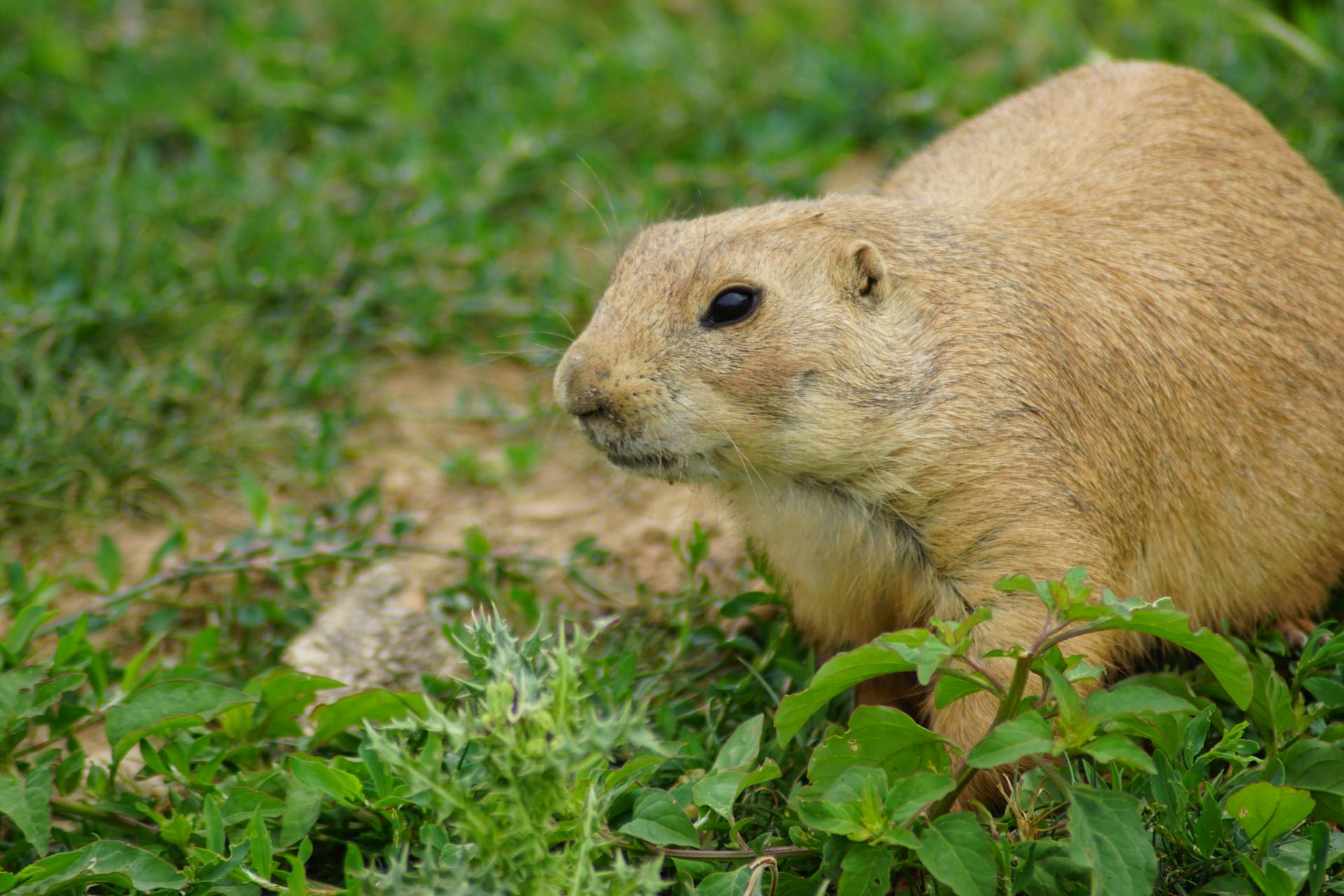
Pocket gophers are found throughout much of North America, with a range that spans from Canada to Mexico.
Their underground tunnels, called burrows, can extend several feet below the surface and have multiple entrances and exits.
Pocket gophers prefer well-drained soil, often found in areas with sandy or gravelly soil.
They thrive in areas with abundant vegetation, which provides them with food and shelter.
What Are They?
Pocket gophers are small rodents that live almost entirely underground, creating intricate tunnel systems below the surface and obvious mounds of soil on top. They're expert diggers, using their large, front-facing digging claws to push and pack soil into plugs to prevent anything from entering their tunnels.
Their bodies are highly adapted to this underground lifestyle, with reduced ears and small eyes. They even have lips that close behind their teeth to prevent soil from entering their mouth.
They're called pocket gophers because they have external, fur-lined cheek pouches which they use like pockets for transporting roots to food caches.
Pocket Gopher Habitat
Pocket gophers are well adapted to living underground, and their burrows are a key part of their habitat. They can be 200 yards long and take four tons of soil to create.
Their burrows are usually plugged, meaning there's no hole in the mound of excavated soil, and they're deep enough that a ridge of turf isn't created. Northern and valley pocket gophers create solid ribbons of excavated soil beneath the snow, which are exposed with spring thaw.
Pocket gophers need well-drained soils to live in, as they spend most of their lives underground. Their burrow systems can be up to 500 feet long and are usually within three feet of the ground's surface.
Plains pocket gophers are found throughout much of the midsection of Illinois and prefer sandy soils. They can be locally abundant in areas with suitable soil conditions.
Gophers create large horseshoe-shaped mounds as they dig, which can cause damage to passing farm equipment and interfere with irrigation systems. These underground burrows can be very deep and can cause damage to roots, tree bark, seeds, bulbs, and other plant parts in yards or farms.
Finding and Identifying Pocket Gophers
To find pocket gophers, look for their distinctive mounds in open landscapes with few trees, typically pines, and some disturbance from prescribed fire or mowing. These habitats often overlap with hay or agriculture fields.
In Georgia, you're more likely to find southeastern pocket gophers in grassy yards, hay fields, and rights of way, but they're also associated with open pine systems that are consistently burned.
Be on the lookout for large horseshoe-shaped mounds and underground tunnels, which can be very deep and cause damage to roots, tree bark, seeds, bulbs, and other plant parts.
Find Them
Southeastern pocket gophers are often found in open pine systems that are consistently burned.
Their preferred habitats usually have few trees, typically pines, and some sort of disturbance, including from prescribed fire or mowing.
You might find them in grassy yards, hay fields, and rights of way, but they're more typically associated with open pine systems.
Plains pocket gophers, on the other hand, are found throughout much of the midsection of Illinois, extending from St. Clair and Madison counties to east and south of the Illinois River.
Their range includes areas with sandy soils, where they can be locally abundant.
To spot a pocket gopher, look for areas with well-drained soils, like roadsides, old fields, hayfields, cemeteries, golf courses, or lawns.
Their burrow systems can be up to 500 feet long and are usually within three feet of the ground's surface.
If you're lucky, you might catch a glimpse of a pocket gopher near a patch of alfalfa, clover, sweet clover, bluegrass, dandelion, dock, or plantain.
Take a look at this: Pacific Gopher Snake
Signs: Tracks & Scat
Plains pocket gophers are mostly underground dwellers, so you won't often find their tracks and scat.
Their presence is best indicated by the kidney- or fan-shaped mounds of soil they produce, which are often one to two feet in diameter and up to one foot tall.
These mounds are not connected by surface tunnels, unlike molehills.
You'll usually find them in a line.
Geography and Distribution
Plains pocket gophers are found throughout much of the midsection of Illinois, specifically from St. Clair and Madison counties to east and south of the Illinois River over to the Kankakee River and south of that river to the border of Indiana.
Their range is quite extensive, covering a significant portion of the state. They can be locally abundant and prefer sandy soils.
The distribution of Mazama pocket gophers in Washington is patchy, due to the natural patchiness of the soils they can use. This patchy distribution makes it difficult for them to travel long distances.
However, some areas with good habitat can support thousands of individuals. For example, the Olympia Airport may contain thousands of Olympia pocket gophers.
In contrast, other areas with marginal habitat may contain only small numbers of individuals. This is the case for isolated sites with poor soil quality.
The northern pocket gopher lives in the mountains and northwest, the valley pocket gopher inhabits southern and western valleys, the chestnut-faced pocket gopher is found in the southeast, and the plains pocket gopher, logically enough, lives on the plains.
Related reading: Plains Pocket Gopher
Pocket Gopher Behavior and Burrows
Pocket gophers are ecosystem engineers, meaning their tunnel systems and mounds aerate the soil and provide vital nutrients for their grassland and prairie ecosystem.
They create large horseshoe-shaped mounds that can cause damage to passing farm equipment, irrigation systems, dams, fields, and homeowner's gardens. These underground burrows can be very deep.
Gophers typically forage from below-ground, clipping rootlets from forage plants or pulling entire plants below ground into their foraging tunnels. They store plant clippings for later use in special caches designed to keep their food dry.
Mazama pocket gophers are territorial, preferring to live alone in their tunnel systems. They keep their tunnel systems separate by virtue of one or more soil plugs between them.
Behavior
Mazama pocket gophers are ecosystem engineers, creating complex tunnel systems that aerate the soil and provide vital nutrients for their grassland and prairie ecosystem.
Their tunnel systems are made of excess soil from their tunneling activities, and they store plant clippings in special caches to keep their food dry.
Mazama pocket gophers typically forage from below-ground, clipping rootlets from forage plants or pulling entire plants below ground into their foraging tunnels.
They are territorial, preferring to live alone in their tunnel systems, and tunnel systems are kept separate by virtue of one or more soil plugs between them.
In the spring and summer months, more than one gopher is found in the same tunnel system, usually during mating season or when the pups are still with their mother.
Mazama pocket gophers do not hibernate during winter months, but stay active all year long, foraging and maintaining their tunnel systems.
Gophers Create Burrows
Gophers are well-equipped to live underground, where they build complex tunnel systems. They can create up to 70 mounds per month if soil conditions are ideal.
These mounds can be very large and are often horseshoe-shaped, which can cause damage to passing farm equipment. Gophers will live most of their life beneath the surface, digging tunnels that can be very deep.
As they dig, the soil is pushed to the surface, leaving a mound, usually in the shape of a fan. This can cause damage to roots, tree bark, seeds, bulbs, and other plant parts in yards or farms.
Overview and Abundance
Plains pocket gophers can be found throughout much of the midsection of Illinois, specifically from St. Clair and Madison counties to the border of Indiana.
Their range extends from the Illinois River to the Kankakee River and south of that river. They prefer sandy soils.
The Olympia pocket gopher is found only in Thurston County, Washington, and is one of four federally-listed subspecies of Mazama pocket gopher in the state.
This subspecies most likely declined with the disappearance of open prairies and grasslands in western Washington.
Featured Images: pexels.com