Sharp-tailed grouse are found in a variety of habitats across North America, including grasslands, prairies, and agricultural fields.
They inhabit areas with dense vegetation, typically between 1,000 and 7,000 feet above sea level.
Sharp-tailed grouse are known to congregate in large numbers in areas with suitable habitat, often forming massive leks during the breeding season.
These leks can be found in areas with short to mid-length grasses, usually 1-2 feet tall, and a mix of grasses and forbs.
Physical Characteristics
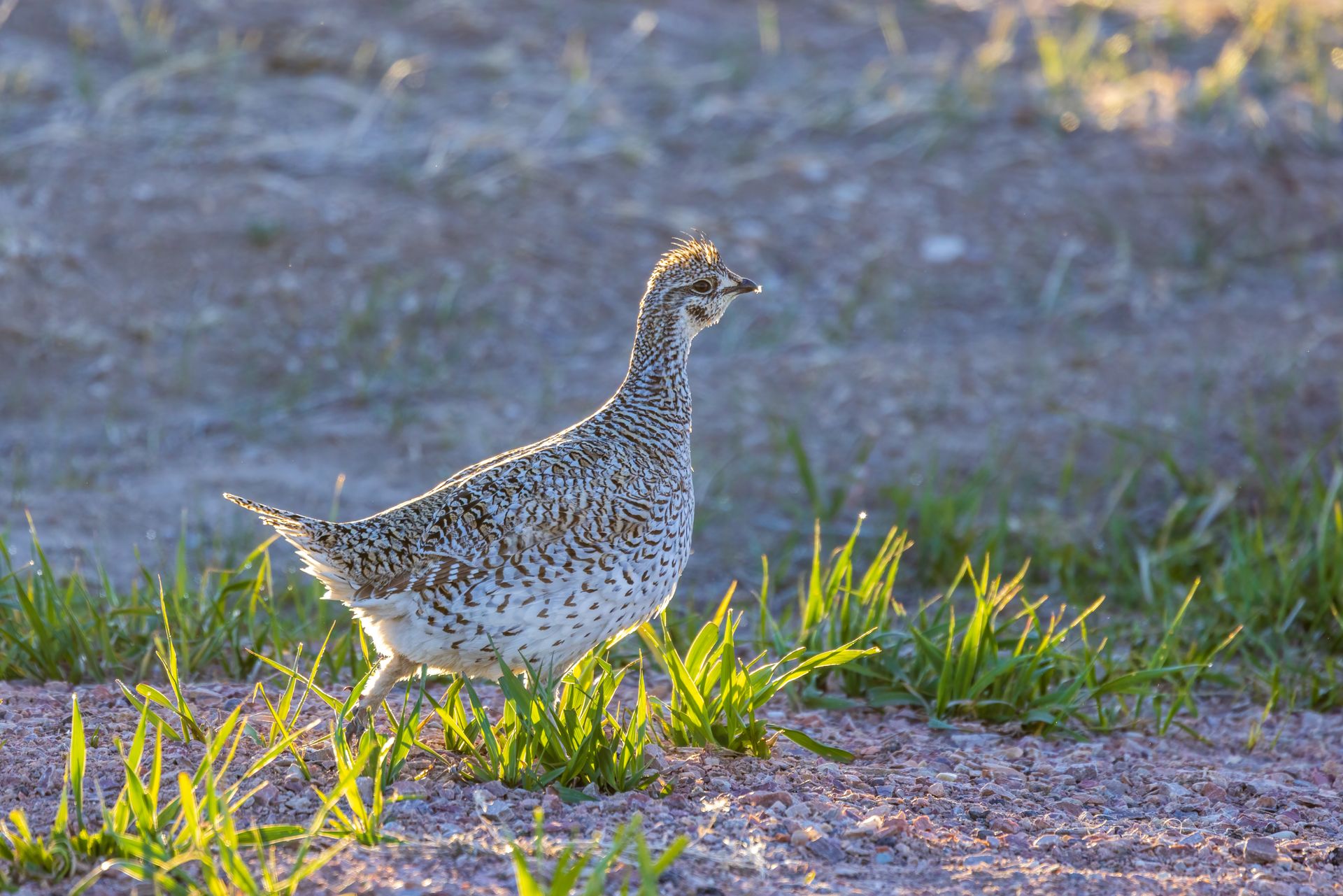
Sharp-tailed grouse have short feathered legs and a rounded body. Their feathers are patterned with a mixture of dark colors, ranging from brown and black, with V-shaped olive marks on their white breast feathers.
Males and females both have a yellow rounded crest above their eyes, but males have a bright purple air sac that they can inflate when vocalizing. This is a key distinguishing feature from other birds in the same family.
Juveniles are fully-feathered by the age of 6 weeks and have a dull grayish appearance, similar to females. Their breast feathers are more buff-colored than white.
Sharp-tailed grouse typically range in length from 41 to 47 cm (16.14 to 18.50 in) and weigh between 596 to 1,031 g (21.00 to 36.50 oz). Their wingspan is usually between 186 to 223 mm (7.32 to 8.78 in).
Here are some key physical characteristics of the sharp-tailed grouse:
- Length: 41-47 cm (16.14-18.50 in)
- Weight: 596-1,031 g (21.00-36.50 oz)
- Wingspan: 186-223 mm (7.32-8.78 in)
Habitat and Distribution
Sharp-tailed grouse can be found in a variety of habitats, including prairies, grasslands, agricultural areas, bogs, and open woodland habitats. They prefer areas with taller shrubs and open wetlands during the winter months.
In the spring and summer, they can be found in terrestrial biomes such as forest and scrub forest. During the winter, they inhabit wetlands like bogs.
Sharp-tailed grouse are native to the United States and Canada, with a range that spans from Alaska to the Hudson Bay. They can also be found in the western half of Nebraska and eastern half of Wyoming.
Here is a breakdown of their geographic range by subspecies:
- Tympanuchus phasianellus carus: Eastern Alaska, Yukon providence, British Columbia, and Alberta
- Tympanuchus phasianellus kennicotti: Northwest Territories
- Tympanuchus phasianellus phasianellus: Ontario to Quebec
- Tympanuchus phasianellus columbianus: British Columbia southward to Washington, Idaho, and Colorado
- Tympanuchus phasianellus jamesi: Alberta and Saskatchewan in Canada, and Montana, North and South Dakota, Wyoming, Nebraska, and Kansas
- Tympanuchus phasianellus campestris: Western Ontario to the western Great Lakes
Geographic Range
Sharp-tailed grouse are native to the United States and Canada, with a range that stretches from Alaska to Matagami, Canada, and from the Beaufort Sea to the Hudson Bay.
Their range continues southward into the United States, touching the northwest tip of Kansas and covering the western half of Nebraska and eastern half of Wyoming.
The sharp-tailed grouse has six subspecies that range throughout this area, with Tympanuchus phasianellus carus found from Alaska's eastern side to the Yukon providence, British Columbia, and Alberta.
Tympanuchus phasianellus kennicotti inhabits areas throughout the Northwest Territories, while Tympanuchus phasianellus phasianellus ranges from Ontario to Quebec.
Tympanuchus phasianellus columbianus can be found from British Columbia southward to Washington, Idaho, and Colorado, and Tympanuchus phasianellus jamesi ranges from Alberta and Saskatchewan in Canada, and also covers Montana, North and South Dakota, Wyoming, Nebraska, and Kansas.
Tympanuchus phasianellus campestris is found from western Ontario to the western Great Lakes.
Related reading: American Bald Eagle Range
Habitat
Sharp-tailed grouse are found in a variety of habitats, including prairies, grasslands, agricultural areas, bogs, and open woodland habitats. These habitats provide them with the food and shelter they need to survive.
In the spring and summer, you can find them in prairies and grasslands, where they forage for food and breed. During the fall, they move to areas of higher elevation with taller shrubs and open wetlands, where they stay throughout the winter.
Sharp-tailed grouse are not typically migratory birds, but they have been known to migrate less than 34km from their winter locations during harsh winters. This is likely due to the availability of food and shelter in these areas.
The habitat regions where sharp-tailed grouse are found include terrestrial biomes such as forest and scrub forest. They can also be found in wetlands, specifically in bogs.
Here are some specific habitat details:
- Habitat Regions: Terrestrial
- Terrestrial Biomes: Forest, Scrub Forest
- Wetlands: Bog
Regional Differences
Regional differences are evident in the Sharp-tailed Grouse's appearance, depending on their location. In northern populations, birds are darker, almost blackish, with more spotted upperparts.
Birds in southern populations, on the other hand, are found in open prairie habitats. They tend to be lighter in color compared to their northern counterparts.
A subspecies known as hueyi, from northeastern New Mexico, has unfortunately gone extinct.
Behavior and Ecology
Sharp-tailed grouse are social birds that spend most of their time on the ground. They fly less than 100 meters per day and usually only fly to alert other grouse to a predator's presence.
These birds are diurnal, meaning they're active during the day, and are known to form leks, which are groups of males competing for females during breeding seasons. Leks can have up to 20 males present, and females will choose three males to mate with before leaving the lek.
During the winter months, sharp-tailed grouse burrow into the ground to rest, but if the ground is too hard, they'll rest in trees instead. They're also skilled at cleaning themselves after a rainstorm by rolling in dry soil and dusting off their feathers.
Here are some key behaviors of sharp-tailed grouse:
- Terrestrial (living on the ground)
- Flys short distances
- Diurnal (active during the day)
- Motile (can move from one place to another)
- Sedentary (not migratory)
- Social (associates with others of its species)
Behavior
Sharp-tailed grouse are social birds that spend most of their time on the ground. They fly less than 100 meters per day, and when they do fly, it's usually to alert other grouse to a predator's presence.
Their wing speed is impressive, averaging 69 km/h. This speed helps them quickly respond to threats and protect their group.
In the presence of a predator, female grouse will often pretend to be injured to lure the predator away from their nest. This clever tactic helps keep their young safe.
During the winter months, males and females burrow into the ground to rest, but if the ground is too hard, they'll rest in trees instead. This adaptability helps them survive the harsh winter conditions.
Sharp-tailed grouse are diurnal, meaning they're active during the day and rest at night. They're also terricolous, meaning they live in landscapes dominated by human agriculture.
Here are some key behaviors associated with sharp-tailed grouse:
- Terricolous
- Flies
- Diurnal
- Motile
- Sedentary
- Social
These behaviors are essential to their survival and social interactions. By understanding these traits, we can better appreciate the complexities of sharp-tailed grouse behavior and ecology.
Feeding Ecology
In Alaska, sharp-tailed grouse rely heavily on dwarf-birch catkins for food during the winter months.
They vary their diet with grass seeds, waste barley, and overwintering berries when available.
In the spring, they're often observed 'budding' in young aspen trees, feasting on overwintering berries, especially kinnikinnick, and emerging green leafy vegetation.
Green leafy vegetation and insects become important food sources in the summer.
In years with abundant grasshoppers, sharp-tailed grouse will feed exclusively on them while they're available.
Their crops in September usually hold a mix of kinnikinnick berries, lowbush cranberries, blueberries, grains, and various leaves and leaf fragments.
Here's a breakdown of some of their favorite foods:
In central Alaska, sharp-tailed grouse will also feed in unharvested grain fields as long as the grain shows above the snow.
Predation
Sharp-tailed grouse are known to be cryptic, meaning they remain in the same area. This makes them vulnerable to predators.
Predation is the number one cause of death for sharp-tailed grouse, particularly during their breeding season when they congregate in high density on leks.
Mammals that prey on sharp-tailed grouse include coyotes, American mink, long-tailed weasels, and red foxes. These predators are skilled hunters that can catch grouse off guard.
Birds that prey on sharp-tailed grouses are numerous and varied, including red-tailed hawks, northern goshawks, peregrine falcons, and great horned owls. These birds of prey are expert hunters that can swoop down on grouse quickly.
Nest predators of sharp-tailed grouses include striped skunks, bullsnakes, ground squirrels, and black-billed magpies. These predators can infiltrate grouse nests and steal eggs or chicks.
Here are some examples of predators that threaten sharp-tailed grouse:
- Coyotes (Canis latrans)
- American mink (Neovison vison)
- Long-tailed weasels (Mustela frenata)
- Red foxes (Vulpes vulpes)
- Red-tailed hawks (Buteo jamaicensis)
- Northern goshawks (Accipiter gentilis)
- Peregrine falcons (Falco peregrinus)
- Great horned owls (Bubo virginianus)
- Striped skunks (Mephitis mephitis)
- Bullsnakes (Pituophis catenifer sayi)
- Ground squirrels (Spermophilus)
- Black-billed magpies (Pica pica)
Ecosystem Roles
Sharp-tailed grouse are affected by various parasites, including lice, tapeworms, roundworms, and protozoans.
One of the most common external parasites is the louse, specifically Goniodes nerbraskensis, Armyrsidea megalosoma, and Lagopoecus perplexus.
Tapeworms, such as Rhabdometra millicolis and Raillietina centrocerci, can also infest sharp-tailed grouse, causing harm to their internal organs.
Roundworms, including Oxyspriura petrowi, Dispharynx nasuta, Subulura strongylina, and Cyrnea colini, are another type of internal parasite that these birds may encounter.
Protozoans like Trypanosoma ayium, Eimeria angusta, and Leucocytozoon bonasae can also affect the health of sharp-tailed grouse.
Some of these parasites can be identified, while others, such as mites, chiggers, and flukes, remain unidentified.
Nesting
Sharp-tailed grouse hens need dense tall residual vegetation for their nests. This type of vegetation provides the perfect cover for them to lay their eggs and raise their young.
The specific characteristics of nesting habitat can vary depending on the subspecies of sharp-tailed grouse. For example, prairie sharp-tailed grouse nests are often found in dense brush and woods at marsh edges.
Dense shrub stands with taller, denser shrubs are preferred by Columbian sharp-tailed grouse. Plains sharp-tailed grouse, on the other hand, select nest sites with dense residual vegetation and a shrubby component.
In Alberta, Canada, sharp-tailed grouse hens have been found to select shrub steppe habitats for their first nest attempts. This is because the shrubs provide increased concealment, making it easier for the hens to hide from predators.
Taller, woody vegetation is also preferred by sharp-tailed grouse in southern Alberta, where they use this type of habitat in greater proportions than available woody habitat.
You might like: Great Tailed Grackle Habitat
Selection
Sharp-tailed grouse are found in a variety of prairie ecosystems across North America.
Their habitat selection is variable among different subspecies, depending on the quality of habitat available to them.
They prefer savannah-style prairie with grasses dominant and shrub patches mixed throughout, with minimal patches of trees.
The taller the woody vegetation, the less of it there should be in the habitat, according to Hammerstrom (1963).
Savannah-style habitat is mostly preferred during the summer and brood rearing months through autumn.
Habitat selection and usage vary by season, with different features used during each time.
Lekking, nesting, brood rearing, and winter habitats are all selected and utilized differently by sharp-tailed grouse.
Intriguing read: Sharp Tailed Grouse Habitat
Life Cycle and Reproduction
Sharp-tailed grouse congregate on specific areas called dancing grounds, or leks, in the early morning during breeding season.
These leks are where males perform their impressive dance displays to attract females.
The male's dance involves extending its wings, raising its tail vertically, lowering its head, and moving its feet rapidly while making a clicking noise with its tail feathers.
If this caught your attention, see: What Does a Cat Do When It Loses Its Tail?
As an invitation to the females, the sharp-tailed male cackles loudly and jumps three to four feet in the air rapidly beating its wings.
This display is called the "flutter-jump."
Females typically lay 10 to 13 buff-brown eggs in a grass-lined depression in tall grass or brush.
Courtship displays occur in late April and early May, where males produce a hollow booming sound and engage in strutting and frenetic dashing about.
Males may mate with several females, and a hen may mate with more than one male.
In late May, hens lay 6 to 15 eggs in a shallow nest on the ground, often far from the lek.
Conservation and Status
Sharp-tailed grouse are considered a species of "Least Concern" by the IUCN Red List, and there is no special status listed by the United States government for sharp-tail grouse.
The subspecies Columbian sharp-tailed grouse have been petitioned twice for threatened or endangered in the state of Washington.
Habitat loss and hunting are the two main causes of death for sharp-tailed grouse.
Fire can contribute to short-term population decline, but it also has a positive long-term impact on vegetation, resulting in higher growth rates among grouse populations in subsequent years.
Sharp-tailed grouse are hunted in 18 states and provinces across the U.S. and Canada, with harvest rates due to hunting being determined to be 30% of the population in 1948 in Wisconsin.
Some states may close hunting seasons in an attempt to increase population sizes, but the effectiveness of this strategy has been questioned.
Here is a list of conservation statuses for sharp-tailed grouse:
- IUCN Red List: Least Concern
- US Migratory Bird Act: No special status
- US Federal List: No special status
- CITES: No special status
- State of Michigan List: No special status
Lekking
Lekking is a unique behavior exhibited by sharp-tailed grouse males.
Males gather at specific sites called leks to perform courtship displays for females.
These leks are usually made up of short, relatively flat native vegetation, such as sun sedge, needle and thread grass, and blue grama.
In fact, a study in the Sheyenne National Grassland in North Dakota found these types of vegetation on lekking grounds.
Males select hilltops, ridges, or other areas with a good field of view for leks, so they can see surrounding displaying males, approaching females, and predators.
This is crucial for their survival and success in attracting females.
During the spring, male sharp-tailed grouse attend these leks from March through July, with peak attendance in late April, early May.
The males display on the lek by stamping their feet rapidly, about 20 times per second, and rattle their tail feathers while turning in circles or dancing forward.
They also use "cooing" calls to attract and compete for females.
Females select the most dominant one or two males in the center of the lek, copulate, and then leave to nest and raise the young in solitude from the male.
Photos and Videos
The sharp-tailed grouse is a bird that's quite the show-off when it comes to its courtship display, which involves a complex dance with elaborate displays of wings and feathers.
During this display, the male grouse will often spread its tail feathers to show off its sharp, pointed tail, which can be up to 2 inches long.
The sharp-tailed grouse is also known for its unique mating rituals, which involve a series of calls and displays to attract a mate.
The male grouse will often use its wings to create a "drumming" sound by beating them against the ground, which can be heard for long distances.
This drumming sound is an important part of the grouse's mating ritual, and it's something that's often captured on camera by wildlife photographers.
Additional reading: Long Tailed Planigale
General Information
Sharp-tailed grouse are small game birds that weigh around 2 pounds on average, with males being slightly larger than females.
Their overall color pattern is white with varying shades of brown and gray flecks, and their undersides are lighter in color.
Sharp-tailed grouse have a distinctive short pointed tail, and the two sexes can be distinguished by close examination of the color patterns on their tail feathers.
Male sharp-tailed grouse have vertically striped tail feathers, while females have horizontally crossbarred tail feathers.
These birds can be found in Colorado's eastern grasslands, where they inhabit the plains.
During breeding season, male plains sharp-tailed grouse exhibit purple air sacs on their necks.
Check this out: Plains Pocket Gopher
Winter and Fragmentation
Sharp-tailed grouse have a unique way of adapting to winter. They seem to shift their habitat usage towards denser cover for thermal insulation.
In Michigan and Wisconsin, Hammerstrom and Hammerstrom (1951) noticed that grouse use thicker edge type habitat more than open ground during winter. This trend is also observed in Montana by Swenson (1985).
Habitat usage in winter varies greatly as a function of snow depth, with grouse selecting shelterbelts and woody vegetation as snow depth increases. I can imagine how difficult it must be for them to find shelter in deep snow.
One clever adaptation of sharp-tailed grouse is that they select large snow banks to burrow into, keeping warm during cold nights. This behavior is also noted by Gratson (1988).
Winter
Winter is a challenging time for sharp-tailed grouse, but they have adapted to survive. They seem to shift their habitat usage towards denser cover for thermal insulation.
In Michigan and Wisconsin, Hammerstrom and Hammerstrom (1951) noticed that grouse use thicker edge type habitat more than the open ground during the winter. Birds found in open habitat were usually no more than a few hundred meters from thicker cover, often utilizing grain fields.
Sharp-tailed grouse in more semi-arid and arid areas utilize brush less frequently in winter, but in Washington and California, they were observed using edge type habitats more frequently during winter months.
Habitat usage in winter varies greatly as a function of snow depth, with grouse selecting shelterbelts and woody vegetation as snow depth increases. In North Dakota, Manske and Barker (1987) noticed that sharp-tailed grouse in small flocks joined together to form larger packs in severe weather.
These packs move from open prairie, to shelterbelts, and adjacent croplands with standing corn and sunflowers. To keep warm during cold nights, grouse will select large snow banks to burrow into, or use burrows altogether, as noted by Gratson (1988) and Hamerstrom and Hamerstrom (1951).
Fragmentation
Habitat fragmentation has been a major driver of the decline of sharp-tailed grouse populations across North America.
The largest contributor to habitat fragmentation has been the agriculture industry, which has led to the plowing of semi-arid rangelands and the introduction of invasive woody species.
Early settlers' land use practices, such as homesteading and excessive cattle grazing, have also contributed to habitat fragmentation.
Cattle can be a useful tool for managing habitat structure for sharp-tailed grouse when managed properly.
The Homestead Act of 1862 opened up vast areas of virgin prairie to settlers, leading to widespread habitat fragmentation.
Much of this land was in semi-arid rangelands with limited precipitation to support crop production, making it difficult to sustain agriculture.
Unmonitored and excessive cattle grazing has further degraded the habitat of sharp-tailed grouse.
The introduction of non-native vegetation, such as smooth brome and crested wheatgrass, has also had a significant impact on native vegetation and habitat diversity.
These invasive species have forced out native vegetation in some areas, creating monoculture habitats that are not favored by sharp-tailed grouse.
Taxonomy and Classification
The sharp-tailed grouse has a long history of classification, dating back to 1750 when English naturalist George Edwards included an illustration and description in his book A Natural History of Uncommon Birds.
Edwards used the name "The Long-tailed Grous from Hudson's-Bay" and based his work on a preserved specimen brought from Hudson Bay by James Isham. This early classification laid the groundwork for future taxonomists.
In 1758, Carl Linnaeus updated his Systema Naturae and placed the sharp-tailed grouse in the genus Tetrao, coining the binomial name Tetrao phasianellus and citing Edwards' work. The genus name combines the Ancient Greek "tumpanon" meaning "kettle-drum" with "ēkheō" meaning "to sound".
The sharp-tailed grouse is now classified in the genus Tympanuchus, introduced by German zoologist Constantin Wilhelm Lambert Gloger in 1841. This genus includes six extant and one extinct subspecies, listed below:
- T. p. phasianellus: the nominate race or northern sharp-tailed grouse
- T. p. kennicotti: the northwestern sharp-tailed grouse
- T. p. caurus: the Alaskan sharp-tailed grouse
- T. p. columbianus: the Columbian sharp-tailed grouse
- T. p. campestris: the prairie sharp-tailed grouse
- T. p. jamesi: the plains sharp-tailed grouse
- †T. p. hueyi: the New Mexico sharp-tailed grouse (extinct)
Family Species
The Phasianidae family is a diverse group of birds that includes pheasants, grouse, and their allies. They belong to the order Galliformes.
Pheasants, grouse, and their allies are found in a wide range of habitats, from forests to grasslands. They are known for their distinctive calls and elaborate courtship displays.
Some species within this family are found in Asia, while others are native to Europe or North America. The Phasianidae family is a great example of how taxonomy and classification can help us understand the relationships between different species.
Take a look at this: Northern River Otter Mustelidae Family
Taxonomy
Taxonomy is the process of classifying living things into groups based on their characteristics and evolutionary relationships. The sharp-tailed grouse, for example, has a long history of classification.
In 1750, George Edwards included an illustration and description of the sharp-tailed grouse in his book A Natural History of Uncommon Birds, using the English name "The Long-tailed Grous from Hudson's-Bay". This was the first recorded classification of the species.
The genus name Tympanuchus was introduced in 1841 by Constantin Wilhelm Lambert Gloger, combining the Ancient Greek words "tumpanon" meaning "kettle-drum" and "ēkheō" meaning "to sound". The specific epithet phasianellus is a diminutive of the Latin word "phasianus" meaning "pheasant".
The sharp-tailed grouse is part of the genus Tympanuchus, which includes six extant and one extinct subspecies, found only in North America. These subspecies include the nominate race, the northwestern sharp-tailed grouse, the Alaskan sharp-tailed grouse, the Columbian sharp-tailed grouse, the prairie sharp-tailed grouse, the plains sharp-tailed grouse, and the extinct New Mexico sharp-tailed grouse.
Recommended read: Long Tailed vs Short Tailed Chinchilla
Here are the recognized subspecies of the sharp-tailed grouse:
- T. p. phasianellus: the nominate race or northern sharp-tailed grouse
- T. p. kennicotti: the northwestern sharp-tailed grouse
- T. p. caurus: the Alaskan sharp-tailed grouse
- T. p. columbianus: the Columbian sharp-tailed grouse
- T. p. campestris: the prairie sharp-tailed grouse
- T. p. jamesi: the plains sharp-tailed grouse
- †T. p. hueyi: the extinct New Mexico sharp-tailed grouse
Frequently Asked Questions
Are sharp-tailed grouse good to eat?
Yes, sharp-tailed grouse are a delicious and tender game bird, suitable for medium-rare to medium cooking. They're a great option for both hunters and non-hunters alike, even those who may have previously been skeptical about eating them.
Are sharp-tailed grouse rare?
No, sharp-tailed grouse are not considered rare, with an estimated global breeding population of 750,000. Their relatively large population size earns them a low conservation concern rating.
Featured Images: pexels.com