
To become a veterinary technician, you'll need to earn an associate's degree or a certificate in veterinary technology from an accredited program. This usually takes two years to complete.
These programs combine classroom instruction with clinical experience, teaching you the skills you need to assist veterinarians with medical procedures and care for animals.
To get into a veterinary technology program, you typically need a high school diploma or equivalent, with a strong foundation in sciences like biology and chemistry. Some programs may also require prerequisite courses, such as anatomy and physiology.
In addition to formal education, becoming a veterinary technician also requires passing the Veterinary Technician National Examination (VTNE) to become certified.
For your interest: Mcc Veterinary Technician Program
Education and Training
To become a veterinary technician, you'll need to complete a veterinary technology program. These programs typically take two years to complete and result in an associate degree.
It's essential to choose an accredited program, as this will ensure you receive a quality education and are eligible to take the Veterinary Technician National Examination (VTNE). You'll also gain hands-on experience working with animals in a clinical setting.
You'll take courses in animal anatomy and physiology, pharmacology, radiology, and more during your program.
Readers also liked: Tcc Veterinary Technician Program
Key Takeaways
To become a vet tech, you must complete an accredited vet tech program and obtain state-specific credentials.
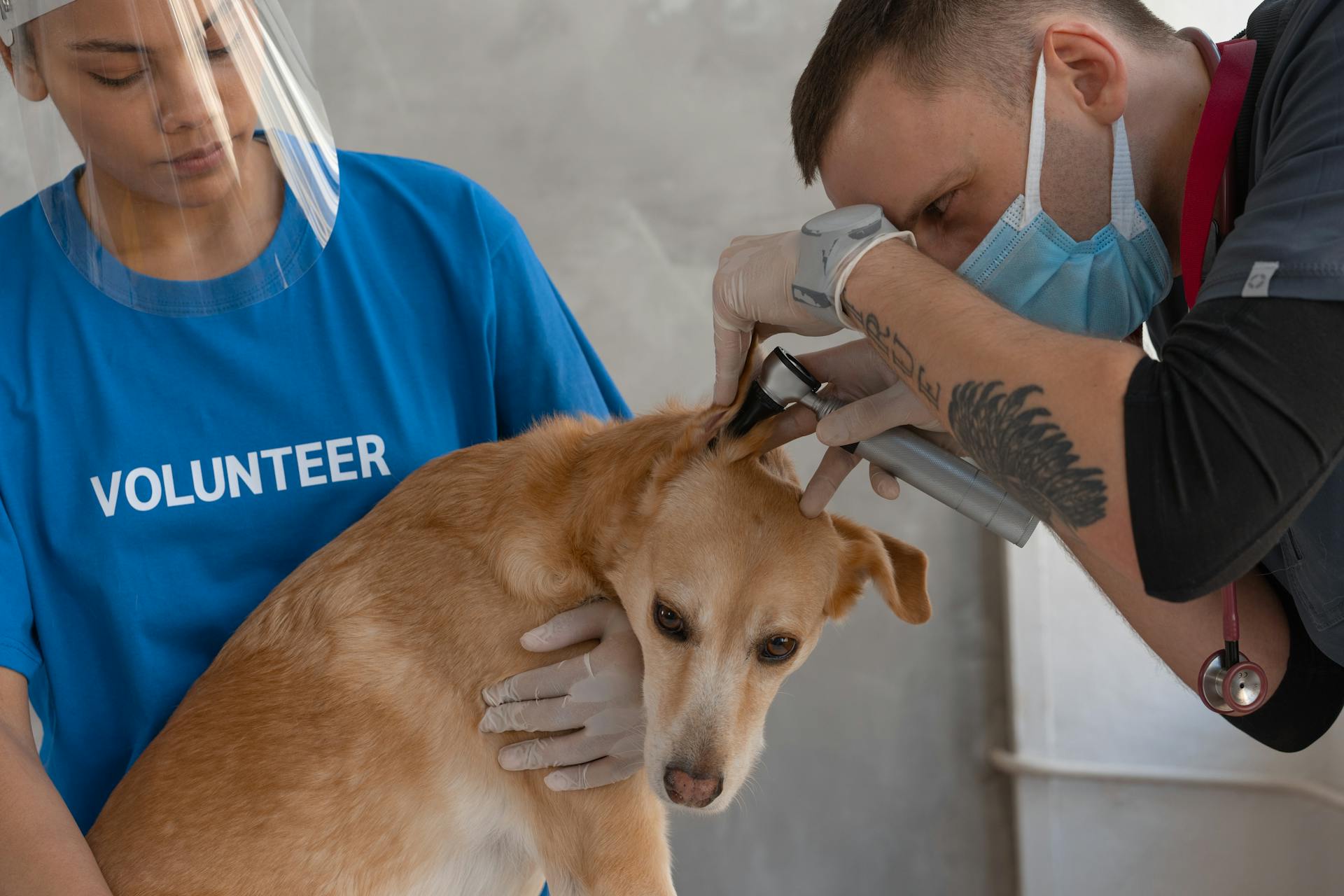
You'll perform a wide range of duties under the supervision of a licensed veterinarian, including administering medication, assisting with surgeries, and providing care to sick and injured animals.
Becoming a vet tech requires dedication, hard work, and a commitment to ongoing learning, but it can be a rewarding career path with opportunities for growth and advancement.
To give you a better idea of the responsibilities involved, here are some key tasks vet techs perform:
- Administering medication
- Assisting with surgeries
- Providing care to sick and injured animals
Day-to-Day Responsibilities
As a vet tech, your day-to-day responsibilities will keep you on your toes. You'll be assisting veterinarians with diagnostic procedures, such as X-rays, ultrasounds, and blood tests.
Administering medications and treatments is a crucial part of the job. You'll be giving medications and treatments exactly as prescribed by the veterinarian.
Preparing animals for surgery requires attention to detail. You'll need to make sure everything is ready to go before the procedure.
Consider reading: Veterinary Technician Day

Monitoring vital signs during surgery is a top priority. You'll be keeping a close eye on the animal's heart rate, breathing, and other vital signs.
Providing post-operative care is just as important as the surgery itself. You'll be helping the animal recover by managing wounds and controlling pain.
Educating pet owners is a big part of the job. You'll be teaching them how to care for their pets and what to expect during treatment.
You'll be maintaining accurate medical records and updating patient files regularly. This helps keep track of the animal's medical history and ensures that everyone involved in their care has the latest information.
Consider reading: Animal Health Technician
High School Preparation
High school is a great time to start laying the groundwork for a future career as a vet tech. Taking courses in biology will help you understand living organisms and their interactions with their environment.
Chemistry courses are also a must, as they'll teach you about the properties and reactions of matter. This will be essential in understanding the complex processes that occur within the bodies of animals.
Math skills are crucial for calculating medication dosages and understanding medical records. English and communication courses will help you develop strong writing and speaking skills, which are vital for recording patient information and communicating with pet owners.
By taking these courses, you'll build a strong foundation for your future studies and set yourself up for success in the vet tech field.
Here's an interesting read: Veterinary Assistant Skills
Post-Secondary Education
To become a vet tech, you'll need to complete a veterinary technology program. These programs typically take two years to complete and result in an associate degree. It's essential to choose an accredited program to ensure you receive a quality education and are eligible to take the Veterinary Technician National Examination (VTNE).
You'll take courses in animal anatomy and physiology, pharmacology, radiology, and more during your program. Hands-on experience working with animals in a clinical setting is also crucial.
Some veterinary technician programs offer specialized training in areas such as anesthesia, dentistry, or emergency medicine. These programs typically take an additional year to complete and provide in-depth training in a specific area of veterinary medicine.
See what others are reading: Training for Veterinary Technician
To become a vet tech in California, you must have a high school diploma or equivalent and complete a two-year veterinary technology program accredited by the American Veterinary Medical Association's Committee on Veterinary Technician Education and Activities (CVTEA). You must also pass the Veterinary Technician National Examination (VTNE) and the California Veterinary Medical Board (CVMB) state examination.
The typical course work for a veterinary technology program includes veterinary math, chemistry, terminology, surgical nursing, anatomy and physiology, restraint, animal behavior, nutrition, nursing, veterinary economics, anesthesia, parasitology, animal psychology, radiology, office practice, and animal management.
Here is a list of the typical course work for a veterinary technology program:
- Veterinary math
- Chemistry
- Terminology
- Surgical nursing
- Anatomy and physiology
- Restraint
- Animal behavior
- Nutrition
- Nursing
- Veterinary economics
- Anesthesia
- Parasitology
- Animal psychology
- Radiology
- Office practice
- Animal management
Every program has some classes that require hands-on contact with animals, and every program requires an externship of between 200 to 400 hours.
A different take: Pima Veterinary Technician Program
Certification and Licensure
To become a veterinary technician, you'll need to obtain certification and licensure, which can be a bit confusing, but don't worry, I've got you covered.
Certification is a process of obtaining a credential from a professional organization, such as the National Association of Veterinary Technicians in America (NAVTA), and it's a crucial step in becoming a vet tech.
You'll need to pass the Veterinary Technician National Exam (VTNE) to become certified, which is a nationally recognized exam that's accepted in most states.
The cost of the VTNE is $300, which is a one-time fee.
To practice as a vet tech, you'll also need to obtain state licensure, which requires submitting an application to your state's veterinary board and providing proof of your education, certification, and passing score on the VTNE.
Some states may also require additional exams, background checks, and continuing education, so be sure to check with your state's veterinary board for specific requirements.
It's essential to note that certification and licensure are not interchangeable terms, and licensure is a state-regulated process that grants legal permission to practice as a vet tech.
By preparing for and passing the VTNE and obtaining state licensure, you'll be qualified to provide high-quality care to animals and work alongside licensed veterinarians.
Intriguing read: Veterinary Education
Most states require a high school diploma or equivalent and completion of a two-year veterinary technology program accredited by the American Veterinary Medical Association's Committee on Veterinary Technician Education and Activities (CVTEA) to become a vet tech.
You'll also need to pass the VTNE and a state-specific exam to become licensed in most states.
Costs of Becoming a Vet Tech
Becoming a vet tech can be a costly endeavor, but it's essential to understand the expenses involved before embarking on this career path.
Education costs can vary widely depending on the school and location, with community colleges generally offering lower tuition rates than state and private schools.
You'll also need to purchase textbooks, laboratory supplies, and other materials required for your coursework, which can add up quickly.
The cost of tuition and fees for an associate's degree in veterinary technology can range from $5,000 to $20,000 or more per year.
To become certified and licensed, you'll need to take the National Veterinary Technician Exam (NVTE), which costs $300.
Curious to learn more? Check out: Do You Need a Degree to Be a Veterinary Assistant
Obtaining a license to work as a vet tech in most states also comes with a fee, which can vary depending on the state.
In addition to certification and licensure costs, you may need to purchase scrubs, stethoscopes, and other equipment required for your job.
Continuing education courses to maintain your certification and licensure can also be a recurring expense, which can vary depending on your employer and location.
Overall, the costs of becoming a vet tech can be significant, but the rewards of working with animals and helping to improve their health and well-being can be well worth the investment.
Recommended read: How to Get Veterinary Technician Certification
State-Specific Requirements
Becoming a vet tech requires meeting state-specific requirements, which can vary significantly. In California, you must complete a two-year veterinary technology program accredited by the CVTEA and pass the VTNE and CVMB state examination.
In most states, you'll need a high school diploma or equivalent and completion of a two-year veterinary technology program accredited by the CVTEA. Passing the VTNE is also a requirement in many states. The requirements to become a vet tech are similar across the country, but some states have additional requirements.
The specific requirements can vary depending on the state you work in. For example, in Florida, you must complete a two-year veterinary technology program accredited by the CVTEA and pass the VTNE and the Florida Veterinary Technician State Examination.
Check this out: Certified Veterinary Technician Florida
Requirements for Becoming a Vet Tech in California

To become a vet tech in California, you'll need to meet the state's specific requirements. You must have a high school diploma or equivalent and complete a two-year veterinary technology program accredited by the CVTEA.
The program you choose should be accredited by the American Veterinary Medical Association's Committee on Veterinary Technician Education and Activities. This ensures that you receive a quality education that prepares you for the VTNE.
You'll also need to pass the VTNE, which is a three-hour exam with 150 questions. The exam costs $300 and is administered by the American Association of Veterinary State Boards.
To qualify for the VTNE, you must have a degree from an accredited veterinary technology program or complete the alternate route. This means that you'll need to meet the program's requirements and pass the required exams.
In addition to passing the VTNE, you'll also need to pass the California Veterinary Technician Examination, which is administered by the California Veterinary Medical Board. This exam is computer-based and is administered throughout the state.
A unique perspective: Veterinary Technician Free Ce
To keep your license current, you'll need to complete 20 hours of continuing education (CE) annually. Sixteen of these hours must be taken from approved CE providers, and four hours can be accomplished through self-study.
Here's a breakdown of the requirements:
- High school diploma or equivalent
- Two-year veterinary technology program accredited by CVTEA
- Pass VTNE
- Pass California Veterinary Technician Examination
- Complete 20 hours of CE annually
- 16 hours from approved CE providers
- 4 hours through self-study
Vet Techs by State
As a vet tech, your responsibilities can vary depending on the state you work in. In some states, you may be allowed to perform high-level clinical care tasks.
Texas has specific requirements for vet techs, but the article doesn't specify what they are. California, on the other hand, has requirements that are similar to most other states.
In Florida, vet techs may have more limited responsibilities compared to other states. Pennsylvania also has its own set of requirements for vet techs.
Most states require a high school diploma or equivalent to become a vet tech. This is a common requirement across the country.
To become a vet tech in most states, you'll need to complete a two-year veterinary technology program accredited by the CVTEA. This is a standard requirement for the profession.
Passing the VTNE is a must for vet techs in most states. You'll also need to pass a state-specific exam to become certified.
How to Become a Vet Tech in Florida
To become a vet tech in Florida, you must complete a two-year veterinary technology program accredited by the American Veterinary Medical Association's Committee on Veterinary Technician Education and Activities (CVTEA).
You'll need to earn a high school diploma or equivalent and complete the program, which will take around 18 to 36 months to graduate with an Associate of Science degree in Registered Veterinary Technology.
In addition to the program, you must also pass the Veterinary Technician National Examination (VTNE) and the Florida Veterinary Technician State Examination.
To maintain your license, you'll need to complete a minimum of 15 hours of continuing education every two years.
Here's a breakdown of the typical course work you can expect to take in a veterinary technology program in Florida:
- Veterinary math
- Chemistry
- Terminology
- Surgical nursing
- Anatomy and physiology
- Restraint
- Animal behavior
- Nutrition
- Nursing
- Veterinary economics
- Anesthesia
- Parasitology
- Animal psychology
- Radiology
- Office practice
- Animal management
Specializations and Career Development
As a veterinary technician, you can specialize in various areas of veterinary medicine to further your career and interests. Specialized training programs can provide in-depth training in areas such as anesthesia, dentistry, or emergency medicine.
Worth a look: Veterinary Medicine
These programs typically take an additional year to complete and can be a great way to gain expertise in a specific area. You can also gain hands-on experience by volunteering at animal shelters or rescue organizations.
Volunteering can provide valuable experience working with a variety of animals and help you develop your animal handling and care skills. It's a great way to get a feel for what it's like to work with animals on a daily basis.
Some specializations you can consider include:
- Behavior Technician
- Emergency and Critical Care Technician
- Nutrition Technician
- Zoological Medicine Technician
These specializations can open up new career opportunities and allow you to work with animals in a variety of settings.
Frequently Asked Questions
What is the difference between a vet tech and a vet technician?
Vet techs and vet technicians have similar roles, but typically require different levels of education: a 4-year degree for techs and a 2-year degree for technicians. Both often need to pass a credentialing exam to become registered, licensed, or certified.
What degree is best for a vet tech?
To become a vet tech, earn an associate's or bachelor's degree in Veterinary Technology from an accredited program. While a BS in Biology can be beneficial, it's not a direct path to a vet tech credential.
Can you be a vet tech without a college degree?
Currently, only 3 states (Alaska, California, and Wisconsin) allow On-the-Job Training (OTJ) or alternate degrees for VTNE eligibility, requiring additional paperwork and qualifications
What basics do you need for vet tech?
To become a vet tech, you'll need a postsecondary degree, starting with a high school diploma or GED and relevant science courses. Completing these basics will prepare you for the next steps in your vet tech career.
Featured Images: pexels.com