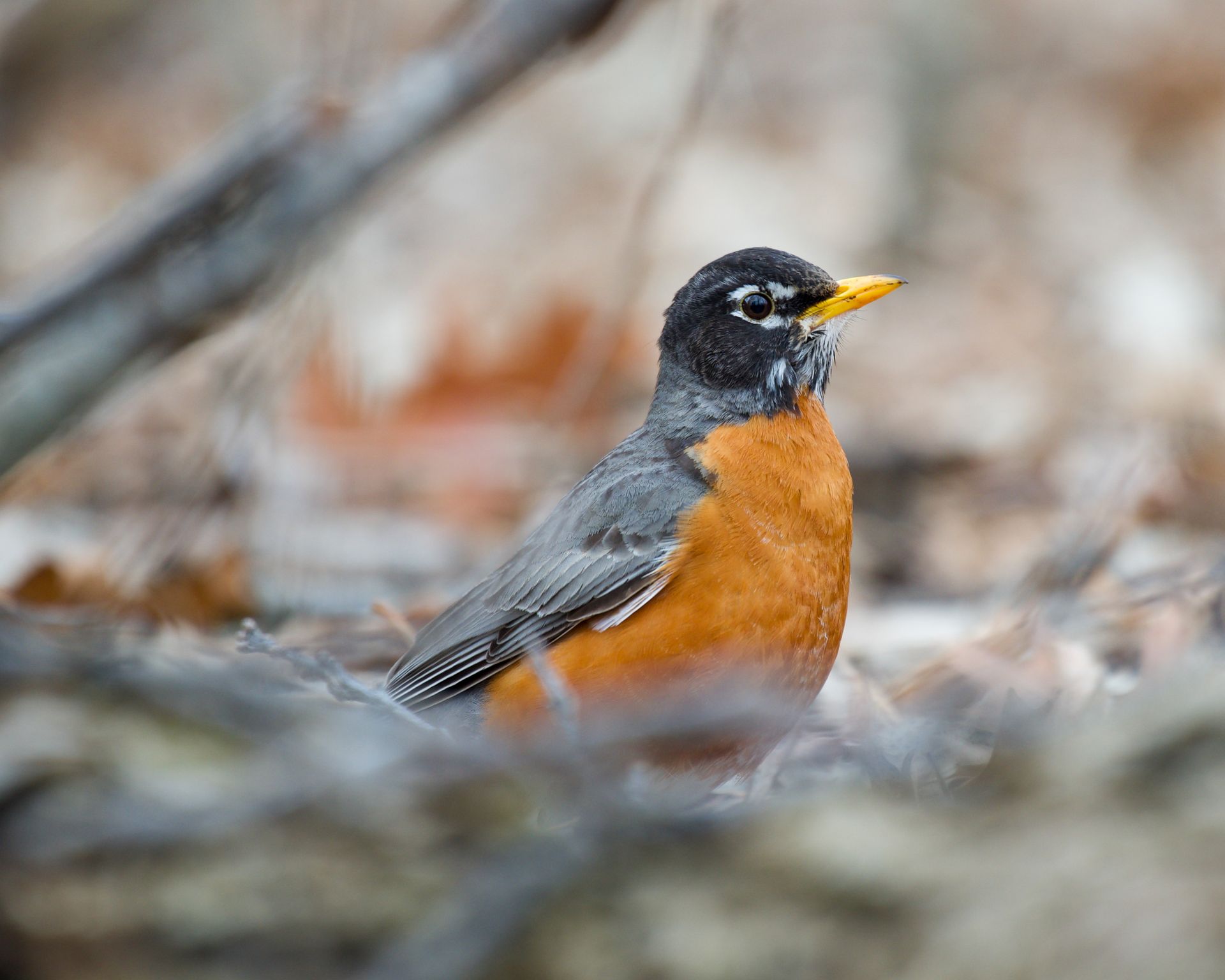
The Northeast is a birdwatcher's paradise, with over 400 species calling the region home. The American Robin is one of the most recognizable birds in the Northeast, with its distinctive red breast and cheerful song.
In the spring, the Northeast is a haven for warblers, with species like the Yellow Warbler and Black-and-white Warbler migrating through the region. These tiny birds are a thrill to spot, with their bright colors and intricate songs.
The American Goldfinch is a common sight in Northeastern backyards, particularly during the summer months when its bright yellow feathers are on full display. Its song is a series of short, musical phrases that are sure to delight.
The Northern Cardinal is a year-round resident in the Northeast, known for its vibrant red plumage and distinctive song. Its crest and beak make it a striking sight, even in a busy backyard.
Explore further: Warbler Bird Identification
Backyard Bird Identification
Identifying the birds visiting your backyard feeder is a fun and rewarding experience that can be enjoyed by people of all ages. Recognizing the species of birds can also help you improve your feeding strategy and attract the desired birds back to your feeder.
The Northeast Region is home to a diverse range of bird species, with 41 species visiting backyard feeders in this area. Some of the most common birds include sparrows, finches, and their allies, which make up 17 species.
To get started with backyard bird identification, it's helpful to know which species are most likely to visit your feeder. Here are some common birds you might see:
- Sparrows, Finches, and their allies: 17 species.
- Woodpeckers: 5 species.
- Blackbirds: 4 species.
- Doves: 1 species.
- Mockingbird and Thrashers: 2 species.
- Bluebirds and Robins: 2 species.
- Jays and Crows: 2 species.
- Titmouse and Chickadees: 2 species.
- Nuthatches: 2 species.
- Wrens: 1 species.
- Kinglets: 1 species.
- Starlings: 1 species.
- Brown Creeper 1 species
Birds at Backyard Feeders
Birds visiting backyard feeders in the Northeast Region are a diverse group, with some species occurring in most of the United States and Canada.
Most of the birds visiting backyard bird feeders in the northeast region are widespread and occur in more than one region.
Sparrows, finches, and their allies are the primary groups visiting bird feeders in the Northeast Region, with 17 species represented.
The top 41 most frequently reported backyard feeder birds in the Northeastern Region of North America include the Northern Cardinal, House Finch, and Dark-eyed Junco, which take the top three spots.
Here's a breakdown of the top 10 most frequently reported backyard feeder birds in the Northeastern Region of North America:
The frequency of bird visits can be influenced by the birds' reproductive stages, with parents feeding young in the nest visiting feeders less frequently.
Some birds, like the Mourning Dove and the Northern Mockingbird, are migratory species that visit feeders for a few months or weeks before disappearing.
Identification of Backyard Bird Species in North America
Recognizing the species of birds visiting your backyard is not only rewarding but can also help them. Backyard birders can contribute to these birds' study and conservation by submitting their sightings to databases for scientific research.
Knowing which birds come to your bird feeder can help you improve your feeding strategy. If you pay attention to the birds that visit your feeders and those that don't, you can choose the right food and feeder type to attract and keep the desired birds coming back for more.
Cardinals like hulled sunflower seeds, while American goldfinches prefer nyjer or thistle seed.
For another approach, see: Backyard Bird Identification
Eastern Bluebirds
Eastern Bluebirds are a delight to have in your backyard, and with the right food and habitat, you can attract them year-round. They're especially fond of mealworms, suet, peanut hearts, and fruit.
Adult male eastern bluebirds are a stunning sight, with their deep blue feathers and red-brick breast and belly. Females, on the other hand, have a bluish-gray back and rich brown breasts.
Eastern bluebirds are non-aggressive and easy-going at feeders, but they can be submissive to other birds, even smaller ones. They'll happily visit your platform feeder or even forage on the ground.
These birds favor open fields, open woodlands, and park-like habitats, so if you have a yard with some of these features, you're already on the right track. They'll also happily take advantage of nesting boxes.
If you live in the right region, you might spot eastern bluebirds even in winter, as they can be found year-round in warmer coastal areas.
Curious to learn more? Check out: Eastern Whippoorwill Call
Sparrows, Finches, Allies
Sparrows, finches, and their allies are a common sight in northeastern backyards, making up the largest group of backyard feeder birds. Most are ground-feeder birds that feed on platforms, hoppers, and tube feeders.
These birds have heavy, conical, seed-crushing bills perfect for eating seeds and grains. They love to eat seeds and grains offered at backyard feeders, and some even take insects and other invertebrates during the breeding season.
Chipping sparrows, a popular species in the northeast, can be attracted with hulled sunflower seeds, nyjer, cracked corn, millet, and milo. They favor large and small hoppers and platform feeders, but also eat spilled seeds below elevated feeders.
White-crowned sparrows, on the other hand, are mainly ground feeders but will take platform feeders. They can be attracted with black oil and hulled sunflower seeds, cracked corn, millet, and milo.
Tree sparrows are another frequent visitor during northeast winters, eating seeds from feeders and off the ground. White-throated sparrows can be found in all but the northernmost areas of the northeast during wintertime, often visiting the ground around feeders to look for small seeds that have fallen out.
These sparrows, finches, and allies can be quite submissive to other birds at feeders, even those smaller in size.
Consider reading: Sound of White Throated Sparrow
Cardinals and Grosbeaks
Cardinals are notoriously difficult to attract, but having a feeder near a bush or tree, or providing hidden areas in your backyard, can bring them in. This is especially true in the northeast, where you can spot cardinal couples during any season.
The Rose-breasted Grosbeak is a highly migratory bird that can be expected in all northeastern states from April to December. They're stocky birds with a large bill, and males have a bright red breast chevron.
To attract both cardinals and grosbeaks, consider filling your feeders with oil sunflower seeds, which are a favorite of the evening grosbeak. This will also help to attract the Rose-breasted Grosbeak, which is comfortable feeding on platform and hopper feeders.
Northern Cardinal
Northern cardinals are year-round residents in the northeast region, so you can expect to see them at your feeders any time of the year.
The male northern cardinal is a stunning sight, with its all-red plumage and long tail. The female, on the other hand, is a warm brown color with red on her wings and tail.
For more insights, see: Northern California Bird Identification
Northern cardinals are attracted to large tube, large hopper, and platform feeders, but they also enjoy feeding on the ground. Offer them a variety of foods like black oil sunflower seeds, hulled sunflower seeds, safflower, cracked corn, peanut hearts, millet, and milo.
These birds are fiercely protective of their territory, especially during breeding season, which takes place from March through mid-September. They can be aggressive to smaller birds, but are often displaced by larger birds like blue jays, woodpeckers, and grackles.
If you're trying to attract northern cardinals to your yard, make sure to provide dense cover and tall shrubs and trees, as they favor these types of habitats.
Rose-Breasted Grosbeak
The Rose-Breasted Grosbeak is a highly migratory bird that can be expected in all states of the US and Provinces of Canada as a breeder and during migration from the second half of April through mid December.
These birds are stocky with a large bill, and males have a bright red breast chevron, while females and immatures have a streaked brown/white plumage with a bold face pattern.
They appear to be comfortable feeding on platform and hopper feeders, and their favorite food is oil sunflower seeds and hulled sunflower seeds.
Rose-Breasted Grosbeaks forage in dense foliage/branches, and also hover or hawk insects, often found alone, in pairs, or in loose flocks during migration/winter.
To attract these birds to your backyard, it's best to have plenty of trees, as they favor forested and semi-open woodland areas.
They build an open cup of sticks/twigs, lined with finer material, in the vertical fork/crotch of a sapling, usually in forest openings, field edges, parks, or residential areas.
The breeding season for Rose-Breasted Grosbeaks is from mid-June through mid-August, and they lay 1-5 pale green to blue eggs with brown spots.
Evening Grosbeaks
Evening Grosbeaks are a common sight in the northeast during winter, but they're a year-round visitor in the northern sections of New York, New Hampshire, Vermont, and Maine.
They have a special fondness for black oil sunflower seeds, and they also enjoy fruits and seeds from many trees and shrubs.
Take a look at this: Bird Identification New Jersey
Grackles and Blackbirds
Red-winged blackbirds are a great sight during winter, when they're likely to enjoy the seeds and nuts you offer them. Females look nothing like their red-and-yellow-winged mates, resembling oversized sparrows instead.
Red-winged blackbirds can be seen standing on railings next to bird feeders, staring at you with their beady eyes before taking off.
The seeds and nuts you offer can be a welcome treat for these birds, especially during winter.
Common Grackle
The Common Grackle is one of the most recognizable birds at our feeders, with its shiny greenish head and purple body.
They look black from a distance, but take a closer look and you'll see the beautiful colors. Note the pale eye in adults, which is a great way to tell them apart from other grackles.
Common Grackles are aggressive birds and will take over feeders when they're present, so be prepared for some competition at your feeders.
They favor large hopper and platform feeders, and will also feed on the ground.
Consider reading: Common Yellowthroat Juvenile
You can attract Common Grackles to your yard with a variety of foods, including black oil sunflower seeds, hulled sunflower seeds, safflower, suet, cracked corn, peanuts, peanut hearts, fruit, millet, oats, and milo.
They're not picky eaters, so try offering a mix of these foods to see what they like best.
In the spring and summer, Common Grackles can be found breeding in open and semi-open habitats, and will visit all types of yards in flocks.
They build bulky nests with an open cup in trees and shrubs, usually 20 feet or less above the ground.
They're also known to nest in barns, rock crevices, and even stored farm equipment - so keep an eye out for these creative nesting spots.
Common Grackles breed in early March through early July, and will lay 1-7 brownish to pale bluish-gray eggs spotted with brown.
It takes about 28 days from egg-laying until the young birds fledge, with an incubation period of 13 days and a nestling period of 15 days.
With a lifespan of at least 23 years and 1 month, Common Grackles are a long-term commitment to your backyard birding adventures.
Brown-Headed Cowbird
The Brown-Headed Cowbird is a fascinating bird species that's often overlooked in favor of its more charismatic cousins, the grackles and blackbirds. Brown-headed cowbirds are glossy black with chestnut-brown heads, and their females are a gray-brown color with faint dark streaks on the breast and belly.
They're aggressive birds, dominant over smaller birds, and you'll often see them attending feeders in large flocks. Brown-headed cowbirds favor large hopper and platform feeders, as well as the ground, and they can be expected at feeders any time of the year in most of the northeast.
In terms of their habitat, brown-headed cowbirds prefer open backyards near open woods and farmlands. They don't build nests, but instead lay their eggs in the nests of other birds, a behavior known as brood parasitism.
Interestingly, brown-headed cowbirds can live for at least nine years, which is impressive for a bird of their size. Their breeding season typically runs from early April to the end of August, during which time a female cowbird will lay 1-7 eggs with brown spots in the nests of other birds.
Red-Winged Blackbirds
Red-winged blackbirds are a great sight during winter, when they're likely to enjoy the seeds and nuts you offer them.
Females of this species look nothing like their red-and-yellow-winged mates, often mistaken for oversized sparrows.
They're not a typical sight at the bird feeder, but I've seen them standing on the railing next to it, staring at me with their beady eyes before taking off.
Red-winged blackbirds are a common visitor to bird feeders during the winter months, and they're easy to attract with the right food offerings.
American Crow
The American crow is a large and social bird, often moving about in flocks of various sizes. They are all black, with a glossy appearance that's quite distinctive.
One way to attract American crows to your backyard is to offer them a variety of food, such as oil sunflower seeds, hulled sunflower seeds, safflower, nyjer, cracked corn, peanut hearts, fruit, millet, oats, and milo.
A unique perspective: North American Bird Identification
American crows are aggressive and dominant over most other feeder birds, so be prepared for them to take over the feeders when they're present. They can be a bit of a challenge to share with other birds.
If you're lucky enough to have an American crow visit your feeder, you can expect to see them any time of the year in most of the northeastern American states. However, in the Canadian provinces, they're only expected during the breeding months of spring and summer.
American crows build simple nests in trees or tall shrubs, typically 10 to 70 feet above the ground. They're not too fussy about their nesting sites, as long as they're relatively safe and secure.
The breeding season for American crows is mid-March through late July, and they lay 3-9 greenish-olive eggs blotched with brown. It takes about 47 days from egg-laying for the young to fledge, with a 17-day incubation period and a 30-day nestling period.
Woodpeckers
Woodpeckers are regular visitors to backyard bird feeders in the Northeast, where they feed on insects, other arthropods, fruit, nectar, and seeds.
The red-bellied woodpecker often takes seeds from feeders to cache elsewhere for later consumption.
The pileated woodpecker is a year-round resident in the Northeast Region and can be expected at backyard bird feeders throughout the year.
Pileated woodpeckers favor wooded areas, including suburban areas with enough trees.
Suet cages are the preferred feeder type for pileated woodpeckers.
Their size is enough to dominate the feeder when they visit one, and they may be submissive only to crows or ravens.
The colorful red-bellied woodpecker can be seen at feeders during wintertime, and they're fun to watch, especially when they start scaring off starlings.
Pileated woodpeckers can excavate a nesting cavity in 3-6 weeks, and they rarely reuse the same cavity after use for breeding.
Pileated woodpeckers lay 3-5 white round eggs and live at least 12 years and 11 months.
Titmice and Chickadees
Titmice and chickadees are fascinating birds that are commonly found in the Northeast Region of the United States. They belong to the avian family Paridae and feed mostly on insects, but switch to seeds, buds, and fruit when they're scarce.
As the cold winter months approach, titmice and chickadees store food for later consumption, often taking it from feeders into the woods to cache in trees and holes.
Tufted titmice and Carolina/black-capped chickadees are the most common species found in this region. They're easy to identify, with the tufted titmouse having a gray crest and black forehead, and the black-capped chickadee having a distinctive black cap and throat.
Both species are attracted to black oil sunflower seeds, hulled sunflower seeds, safflower, nyjer, suet, peanuts, peanut hearts, and mealworms. They prefer large and small tube feeders, suet cages, large hoppers, and platform feeders.
Titmice and chickadees are non-aggressive birds that are submissive to most larger birds. They're often seen visiting feeders placed in their natural habitat, and can be expected at backyard bird feeders throughout the year.
Consider reading: Black Capped Chickadee Songs
The tufted titmouse nests in natural tree cavities and cavities excavated by woodpeckers, while the black-capped chickadee nests in cavities it pairs excavate in rotten soft wood. They both lay 3-9 white to creamy white eggs spotted with rich reddish-brown, and take about 29-27 days from egg-laying until fledging.
Both species live at least 12-10 years and 5-8 months, making them a delight to observe and learn about.
Take a look at this: White Bird Identification
Nuthatches and Creepers
The white-breasted nuthatch is a year-round resident in most of the Northeast Region and can be expected at backyard bird feeders throughout the year.
To attract a white-breasted nuthatch, try offering peanut hearts, hulled sunflower seeds, and suet at your feeder. They also take millet, so consider adding that to your offerings.
White-breasted nuthatches are known to be feisty and aggressive toward other birds, but they tend to lose to cardinals, woodpeckers, grackles, and blue jays.
Readers also liked: Bird Song White Throated Sparrow
White-Breasted Nuthatches
White-breasted nuthatches have a distinctive appearance, with white sides of the head, throat, and belly, and a black narrow cap.
They're known to flock with chickadees and titmice for safety, so you may notice them with other birds at a feeder.
White-breasted nuthatches are attracted to peanut hearts, hulled sunflower seeds, and suet, and they also take millet.
To attract them to your feeder, try using large tube, large hopper, and platform feeders, as they tend to cling to these types of feeders.
If you live in the Northeast Region, you can expect to see white-breasted nuthatches at your backyard bird feeder throughout the year.
They're a feisty bird, but they can be outcompeted by cardinals, woodpeckers, grackles, and blue jays.
White-breasted nuthatches are birds of deciduous and semi-open woodlands, so they tend to visit feeders located in or near these habitat types.
They're skilled at storing seeds for later, and will often shove seeds into holes in the bark to crack them open later.
Red-breasted Nuthatch
The red-breasted nuthatch has a distinctive black-and-white head pattern and typically creeps along tree trunks and branches.
They have blue-gray upperparts and brown-orange underparts, and their similar appearance to the Pygmy Nuthatch can be distinguished by the red-breasted nuthatch's brown head.
Red-breasted nuthatches are feisty birds, but they're not aggressive to others and will stand their ground against similar-sized birds at feeders.
They can be attracted to backyard bird feeders with black oil and hulled sunflower seeds, suet, and mealworms, and they typically feed on large and small tube feeders, suet cages, and hopper and platform feeders.
In the fall and winter, red-breasted nuthatches can be expected at backyard bird feeders in certain states and provinces, including Virginia, West Virginia, and Illinois.
They are a forest bird and are more likely to visit feeders surrounded by woodlands or various types.
Red-breasted nuthatches breed in late April through early August, and a female lays 2-8 pinkish-white eggs spotted with brown.
It takes about 32 days from egg-laying for the young to fledge, with an incubation period of 12 days and a nestling period of 20 days.
Red-breasted nuthatches live at least 7 years and 6 months, and they can be found year-round in most of the northeast.
Related reading: West Virginia Bird Identification
Brown Creeper
The Brown Creeper is one of the most inconspicuous birds in North America. It has a cryptic coloration that blends in with the bark, making it hard to spot.
They prefer to forage for food on coniferous, mixed, and deciduous forests. Woodcreepers are a common sight in these types of forests.
During the winter months, Brown Creepers are more likely to visit backyard bird feeders when food becomes scarce.
Kinglets and Warblers
Kinglets and Warblers are two groups of tiny birds you might spot flitting around the Northeast Region. Kinglets are particularly tiny, relatively drab birds that breed in northern latitudes.
As they forage, they flick their wings rapidly and often hover at the tips of branches to snag insects. Warblers, on the other hand, are known for their bright plumage and varied songs.
American Goldfinch
The American Goldfinch is a delightful bird that can be a welcome visitor to your backyard, especially during the spring and summer months when it expands its range further north.
Its winter plumage is quite mottled, featuring an unmarked brown with blackish wings and two broad pale wing bars, but breeding males are a stunning sight with their bright yellow feathers and black cap.
American Goldfinches are non-aggressive and easy-going at feeders, often clinging to them horizontally, and are submissive to most other feeder birds.
They're particularly fond of hulled sunflower and nyjer seeds, so consider adding these to your bird feeders to attract them.
American Goldfinches are year-round residents in most of the northeast, and can be expected at feeders any time, making them a great addition to your local birdwatching scene.
To attract American Goldfinches, plant some shrubs, tall weeds, and seed-producing weeds in your backyard, as these provide them with the perfect habitat.
Their nests are quite neat, consisting of a cup-shaped structure built on twigs, dense shrubs, and dense foliage in overhanging branches of trees 4 to 15 feet above the ground.
American Goldfinches typically breed in early June through late September, laying 2-7 pale bluish-white eggs with brownish dots on the wide side of the egg.
Kinglets
Kinglets are tiny, relatively drab, hyperactive birds. They flit nervously, flick their wings while foraging, and often hover at the tips of branches to glean insects.
They breed in northern latitudes. Kinglets are winter visitors in most of the lower 48 states, including the Northeast Region.
Cedar Waxwings
Cedar Waxwings are a common sight in the northeast year-round, especially if you have fruiting shrubs or trees in your backyard.
These birds don't like regular birdseed, so if you'd like to attract them, set out fruit or mealworms on a platform.
They eat fruit whole, without breaking it into smaller pieces, so provide small berries or cut apples and other large fruits into bite-size pieces for the most success.
Cedar Waxwings are known to arrive in large groups, which are called murmurations, and can be quite a show in the sky when they leave.
Other Backyard Visitors
Some birds that visit backyard feeders in the Northeast Region are migratory, which means they move from region to region in search of food or better breeding opportunities. This can explain why some birds visit your feeders for a few months or even weeks, and then disappear.
Birds that are feeding young in the nest switch their diets to protein-rich foods like insects, and visit feeders offering bird seeds less frequently. This reproductive stage can affect the rate of feeder visitations.
Other groups of birds, like doves and wrens, have fewer species visiting backyard feeders in the Northeast Region. Here's a breakdown of the number of species per group:
Eastern Towhee
The Eastern Towhee is a year-round resident in Virginia and southern West Virginia, but if you live further north, you can expect to see them only during the spring and summer months.
These birds are ground feeders, which means they'll often forage for seeds spilled below elevated feeders. They also use platform feeders and hopper feeders, but less often.
Eastern Towhees are attracted to seeds like black oil sunflower seeds, hulled sunflower seeds, safflower, cracked corn, peanut hearts, millet, and milo.
If you want to attract these birds to your backyard, consider placing feeders near dense low vegetation, as they tend to stay close to their preferred habitat.
Expand your knowledge: Bird Identification Virginia
In terms of nesting, Eastern Towhees will often build their nests in accumulations of leaf litter on the ground, or less often in vine tangles above the ground.
Here are some seeds that Eastern Towhees find particularly appealing:
- Black oil sunflower seeds
- Hulled sunflower seeds
- Safflower
- Cracked corn
- Peanut hearts
- Millet
- Milo
Eastern Towhees are also quite long-lived, with a minimum lifespan of nine years.
Dark-Eyed Junco
The Dark-Eyed Junco is a year-round resident in northern Wisconsin, Michigan, Pennsylvania, Rhode Island, Vermont, the Appalachian mountains, Maine, New Brunswick, Nova Scotia, Newfoundland, and Prince Edward.
It's a great bird to attract to your backyard with black oil sunflower seeds, hulled sunflower seeds, safflower, cracked corn, peanut hearts, millet, and milo.
Dark-eyed Juncos feed mostly on the ground, so it's best to place your feeders on the ground or use platform and hopper feeders to make it easy for them to access.
They're not aggressive birds, but they can be easily displaced by more aggressive birds, so it's a good idea to place your feeders in a spot where they have some protection.
Dark-eyed Juncos build their nests on sloping ground or among the large roots of upturned trees, so if you have a yard with some vegetation cover, you might be able to attract a breeding pair.
They lay 3-6 pale greenish spotted with brown eggs and take about 25 days to incubate and care for their young before they fledge.
Backyard Bird Visitors
Backyard Bird Visitors are a delight to watch and attract to your yard. Many bird species can be found visiting backyard feeders in the Northeast Region.
The most common bird groups visiting backyard feeders are sparrows, finches, and their allies, which include 17 species. These birds are widespread and occur in more than one region.
Some birds, like the Northern Cardinal, are year-round residents and can be found visiting feeders frequently. Others, like the Pine Siskin, are migratory and only visit for a few months.
The top 10 most frequently reported backyard feeder birds in the Northeast Region are a mix of year-round residents and migratory species. These birds include the Northern Cardinal, House Finch, Dark-eyed Junco, and American Goldfinch.
Here's a list of the top 10 most frequently reported backyard feeder birds in the Northeast Region:
Some birds, like the Woodpeckers, have fewer species visiting feeders, with only 5 species found in the Northeast Region.
On a similar theme: Bird Species Identification
Pine Siskins
Pine Siskins are a rare but awesome sight at northeast feeders.
They don't come every year, but you'll see flocks of them gathering for small seeds depending on how well things grew the year prior.
Their appearances are unpredictable, but if you're lucky, you might spot a few.
Birds of Prey Guide
The Birds of Prey Guide is a must-have for any bird enthusiast in the Northeast. This comprehensive guide covers all 30 species of raptors found in the region, making it an invaluable resource for identifying these magnificent birds.
The guide is organized by group, making it easy to determine which section to turn to. You can identify the group by common visual characteristics, such as the bird's shape, size, and plumage.
One of the standout features of this guide is the inclusion of full-color photographs and range maps. These help you identify the birds you see in the wild and understand their habitats.
The guide also includes a quick-compare section, which features sketches, silhouettes, and photos for side-by-side comparisons. This is a game-changer for anyone who's ever struggled to tell two similar-looking birds apart.
The guide is written by Stan Tekiela, a renowned naturalist and expert in the field. His expert insights and notes add an extra layer of depth and understanding to the guide.
Here are the key features of the Birds of Prey Guide:
- Only Northeastern birds: All 30 species of raptors
- Simple organization: identify species by group and then by size
- Quick-compare section: sketches, silhouettes, and photos for side-by-side comparisons
- Stan’s Notes: naturalist tidbits and facts
- Professional photos: crisp, stunning images
Winter Birds
Common redpolls are smaller birds that venture south to the northeast during winter, making them a common sight at backyard feeders. They enjoy thistle and nyjer seeds, so you may spot flocks of them around your feeder in wintertime.
These birds are well adapted to the cold, having lived in the northern reaches of Canada and Alaska, bordering on the Arctic Circle, during the breeding season.
Common Redpolls
Common Redpolls are smaller birds that venture south to the northeast during winter.
They're attracted to thistle and nyjer seeds, so you may spot flocks of them around your feeder in wintertime. These birds are not aggressive to other birds at feeders and may be submissive to most birds.
They typically visit feeders located near semi-open and deciduous woodlands, their favorite habitat. You can attract them with hulled sunflower seeds, nyjer, and black oil sunflower seeds.
Common Redpolls can be expected at backyard bird feeders year-round in parts of Ontario, Quebec, New Brunswick, Nova Scotia, Prince Edward, and some US states. They're rare visitors to states further south during the fall and winter.
The breeding season for Common Redpolls is late May through late August, during which time they lay 2-6 bluish eggs spotted with brown.
Winter Wren
The Winter Wren is a small plump bird with brown feathers and a distinctive appearance. Its tail is stubby, but its legs are long with large talons. The Winter Wren's long thin beak and round eyes make it easily recognizable. You can spot this bird hopping with its tail straight out, looking for insects around upturned roots and vegetation.
Check this out: Long Island Bird Identification
Its call is a long and bubbly sound that's ten times more powerful by body weight than a rooster's call. You can catch the Winter Wren's call early in the morning between April and July during its mating season. The Winter Wren's call can be heard more frequently in the winter, when they spread across the eastern forests.
Winter Wrens live in the dense understory of eastern forests and nest in brush piles. They can also be found by streams foraging for insects in streambanks and off the water's surface in evergreen forests during the summer.
Purple Finches
Purple finches are a treat to spot at your feeder, especially against the snowy backdrop. They're far more red than purple, but only the males have that bright color.
Look closely at their sides to tell them apart from house finches. House finches have prominent brown streaks under their wings.
Purple finches have faint or nonexistent streaks under their wings, making them a bit easier to identify.
Common Birds
If you're new to birdwatching in the northeast, it can be overwhelming to keep track of all the different species you might see. But don't worry, I've got you covered.
The most common birds you'll spot at backyard feeders in the northeast are sparrows, finches, and their allies, with a whopping 17 species to look out for. These birds are widespread and can be found in most of the United States and Canada.
Some of the most common feeder birds include goldfinches, siskins, and juncos. You might also catch a glimpse of a woodpecker, with five species to spot in the northeast. Blackbirds are another common group, with four species to look out for.
Here's a breakdown of the most common bird groups in the northeast:
- Sparrows, Finches, and their allies: 17 species.
- Woodpeckers: 5 species.
- Blackbirds: 4 species.
- Doves: 1 species.
- Mockingbird and Thrashers: 2 species.
- Bluebirds and Robins: 2 species.
- Jays and Crows: 2 species.
- Titmouse and Chickadees: 2 species.
- Nuthatches: 2 species.
- Wrens: 1 species.
- Kinglets: 1 species.
- Starlings: 1 species.
- Brown Creeper: 1 species.
House Finches
House finches live year-round in the northeast. They love black oil sunflower seeds, so watch for flocks appearing at a feeder for them!
House finches have a distinctive appearance, but it can be tricky to tell them apart from purple finches. To tell the difference, look at their sides - house finches have pronounced brown streaks below their wings, while purple finches don’t.
House finches are a common sight at backyard bird feeders, especially if you offer the right food.
Eastern Bluebird
The eastern bluebird is a beautiful bird to have in your backyard. Adult male eastern bluebirds are deep blue above with a red-brick breast and belly.
Eastern bluebirds are relatively easy to attract with the right food, including mealworms, suet, peanut hearts, and fruit. They favor platform feeders and the ground.
If you live in southeast Pennsylvania, Delaware, New Jersey, or West Virginia, you can expect to see eastern bluebirds at your feeder any time of the year. They're non-aggressive and easy-going at feeders, but will submit to other birds.
Eastern bluebirds build cup-shaped nests in natural or woodpecker-excavated cavities at any height from the ground. They'll also readily take nesting boxes.
Eastern bluebirds breed from mid-February through late September, laying 2-7 pale blue or rarely white or pink eggs. It takes about 35 days from egg-laying for the eggs to hatch and the young to fledge.
These birds can live at least 10 years and 6 months, making them a long-term addition to your backyard.
On a similar theme: Blue Bird Identification
Robins
Robins are a common sight in the northeast, and they can be expected at feeders any time of the year. They're known for their distinctive red breast and cheerful song.
American robins are attracted to feeders that offer hulled sunflower seeds, suet, peanut hearts, fruit, and mealworms. They're particularly fond of platform feeders and the ground.
In the northeast, robins can be found in relatively open habitats and yards with feeders in open spaces. They're non-aggressive at feeders, usually feeding on the ground and jumping to platform feeders.
Robins build their nests in a well-shaped cup on forks or horizontal branches 5-25 feet above the ground. They can also nest on the ground, light fixtures, house ledges, and bridges.
The breeding season for American robins is from April to mid-August, during which they lay 3-5 blue eggs with no markings. It takes about 26 days from egg-laying until the young robins fledge.
Featured Images: pexels.com