Identifying warbler birds can be a thrilling experience, especially for bird enthusiasts. Warblers are small, energetic birds that can be found in various habitats, from woodlands to backyards.
Their size can vary, but most warblers range from 3 to 5 inches in length. Some warblers, like the Black-and-white Warbler, can be quite small, measuring just 4 inches long.
Warblers have distinctive songs, which can be a key identification feature. The song of the Yellow Warbler, for example, is a series of musical whistled notes.
Warbler Identification
A male chestnut-sided warbler's distinctive chestnut markings can be a key identifier in the field.
To identify warblers, start by looking for their bright colors and patterns. The common yellowthroat, for example, has a bold yellow throat patch that's hard to miss.
Some warblers are more challenging to identify, like the black-throated blue and green warblers, which have similar names but distinct differences. Learning to ID these birds requires a closer look at their field marks.
Warblers can be found in a variety of habitats, from forests to backyards, and can be identified by their unique songs and calls. The black-and-white warbler, for instance, is an efficient forager for insects and can be heard singing its distinctive song.
Readers also liked: Black Birds
Identifying a Northern Parula
To identify a Northern Parula, first, learn what it looks like - a small, colorful warbler with a distinctive black throat patch and white wing bars.
These warblers can be found in the southeastern United States, particularly in swamp and pine forests, where they forage high in the canopy.
Listen for their song, which is a series of high-pitched, musical notes.
Northern Parulas are known to eat insects, which they catch in mid-air or pick from leaves.
They're a member of the redstart's family, which is worth noting if you're trying to identify other warblers.
If you're trying to attract a Northern Parula to your yard, consider adding a water feature like a bird bath, as they're drawn to water sources.
Discover more: Northern Mocking Bird
Black-Throated Blue
The Black-Throated Blue Warbler is a stunning bird with formal black and white plumage, accented with rich blues in males.
In the dense forest understory, Black-Throated Blue Warblers thrive from the southern Appalachians to the Canadian Maritime Provinces and Quebec.
Their formal attire is reminiscent of a prom ensemble, with white patches in the wings that resemble pocket squares.
Females show a more subdued appearance, with a blush of faint indigo.
Identifying Chestnut-Sided Warblers
To identify a chestnut-sided warbler, start by looking for its unique color combination. An olive-yellow cap and rufous sides make this bird stand out.
You can spot chestnut-sided warblers on forest edges, particularly during their migration through the eastern U.S.
To confirm the identification, check for the distinctive olive-yellow cap on the male and female birds.
The chestnut-sided warbler's diet consists of insects, which they forage for in the forest.
Black-Throated Green
The Black-Throated Green Warbler is a bird you won't want to miss. Listen for its distinctive song, zoo, zee, zoo zoo zee, to locate one.
These warblers stay high up in coniferous or mixed forests throughout the summer in the northeast. You'll need to look up to spot them.
Males and females both have olive backs, which is how they get their "green" name.
Meet the Blackburnian
The Blackburnian Warbler is a bird that's black, white, and orange all over. Its striking plumage is a sight to behold.
It's one of the most beautiful warblers you'll ever see, with a black throat patch and a distinctive white wing patch that's reminiscent of a pocket square. This warbler's unique appearance is sure to make it stand out in a crowd.
The Blackburnian Warbler is found east of the Rockies, and is known to mimic other birds in its search for invertebrate snacks. Its methodical feeding style is a touch of class.
In the spring, warblers are a treat to spot, and the Blackburnian Warbler is no exception. With its bright orange and black coloring, it's a bird that's sure to catch your eye.
Blackpoll
The Blackpoll Warbler is a remarkable bird, weighing as much as a pen.
Some Blackpoll Warblers summer in Alaska, and others migrate to Brazil for the winter.
These songbirds are known for their epic journeys, flying nonstop from the eastern seaboard to northern South America.
They gorge on insects to build fat reserves, which they need to fuel their three-day trip.
Kirtland's
Kirtland's warblers are found in the world, with only a few thousand individuals.
Their main nesting grounds are in jack pine forests in central Michigan, with populations expanding into Wisconsin and Ontario.
Each year during migration, a few Kirtland's warblers are spotted between their breeding ranges and their wintering habitats in the Bahamas.
Townsend's
The Townsend's Warbler is a stunning bird that's fairly common during migration in the West. It breeds in the wet evergreen forests from Idaho to Alaska.
This bird's range is quite extensive, stretching from the West Coast inland in Arizona and Texas, and south into Mexico and Central America.
Townsend's Warblers can be found in the same areas as Hermit Warblers, where their ranges overlap. Hermit Warblers are similar in appearance and closely related to Townsend's Warblers, and they even mate and hybridize with them.
How to Identify a Hooded Animal
The hooded warbler is a great bird to spot, but it can be tricky to identify.
One key way to identify a hooded warbler is to learn what it looks like, specifically its distinctive markings.
Hooded warblers have a hood-like patch of color on their head, which is a great field mark to look for.
They also have a yellow throat patch and a white eye ring, which can be a bit harder to spot but are still important to note.
If you're trying to identify a hooded warbler, look for it in forests with dense undergrowth, particularly in the eastern United States.
Hooded warblers eat insects, spiders, and other small invertebrates, so they're often found near the forest floor where their food is abundant.
Cape May
The Cape May Warbler is a species you'll want to keep an eye out for during your spring and fall migrations through Pennsylvania and nearby regions.
Cape May Warblers spend their summer in spruce forests of eastern Canada.
You can identify them by the thin black streaks running down their yellow chest and sides.
Blue-Winged
The blue-winged warbler gets its name from the bluish-gray color of its wings.
Males sing to defend a territory and attract a mate.
They croon from the tops of tall shrubs or at the edges of fields when calling to females.
Listen for a raspy, unmistakable buzzing.
Discover more: How to Put a Bird Out of Its Misery?
Cetti's
Cetti's warblers are a rare sight, but a treat to spot. They're found in dense waterside vegetation, mainly in southern Britain.
Their song is incredibly loud and explosive, often compared to a boorish nightingale. It's a sound you won't easily forget.
These birds are notoriously hard to see, but if you're lucky, you'll catch a glimpse of their warm brown plumage and large tail.
Dartford
The Dartford warbler is a rare bird with a unique appearance. Its long tail and tiny body make it look special, and its raspberry red underparts and red eye only add to its distinctive appearance.
This bird is very much a creature of lowland heaths, where it's attracted to the combination of heather and gorse. It's a skulking bird, making it very hard to see.
Resident in certain areas, the Dartford warbler can be found in numbers, with 1,700 pairs recorded.
A unique perspective: Red Heads
Garden
The garden warbler is a common sight, with an estimated 145,000 pairs found in the UK during the breeding season.
It's worth noting that the garden warbler is not as likely to be seen in gardens as its name suggests, but rather in tall scrub areas.
This bird has a distinctive song, often described as lively and babbling, although it's usually sung out of sight in thick vegetation.
Grasshopper
The Grasshopper warbler is a tricky bird to see, which walks along the ground to feed.
Its distinctive freckles and streaks, as well as its heavy tail, make it relatively easy to identify once you've spotted it.
This bird sings from cover, often at night, and its song is quite unusual, sounding like an angler's reel or a freewheeling bicycle.
It's a rare bird, with only 9,750 pairs recorded in the UK during its breeding season, which runs from April to October.
Lesser Whitethroat
The lesser whitethroat is a tricky bird to spot, but it's worth the effort. They're scarce, with only around 79,000 pairs in the area during the spring and summer months.
One of the key things to look out for is their distinctive appearance. The lesser whitethroat has a pristine white underside, which sets it apart from its relative, the whitethroat.
Their legs are also a giveaway - they're black, not pink like the whitethroat. This small detail can make all the difference in identifying these birds.
If you're lucky enough to catch a glimpse of the lesser whitethroat, you might hear its unusual song - a bit of a rattle, really.
Sedge
The sedge warbler is a common sight in many areas from April to September, with a massive population of 220,000 pairs.
One of the easiest ways to distinguish a sedge warbler from a reed warbler is by its distinctive whitish eyebrow.
The sedge warbler's song is a wild and turbo-charged mix of imitations, often accompanied by a short song-flight from its perch.
In terms of size and shape, the sedge warbler is similar to the reed warbler, but with a few extra streaks on the back that set it apart.
Willow
The willow warbler is a common sight in the north, and its gorgeous, gentle song is a sure sign that spring is here. Its song is a soft lilting down the scale that's easily recognizable.
This small, greenish bird is the size of a tit and can be easily missed among the fresh spring leaves of birches and willows. The willow warbler is listed as Amber on the Conservation Concern list.
The willow warbler is most commonly found in the north, and it's estimated that there are around 2 million pairs in the area.
How to Identify a Wilson's Warbler
To identify a Wilson's Warbler, look for its distinctive black cap. This small yellow-colored songbird is a great bird to spot in the wild.
The Wilson's Warbler's black cap is a special field mark that makes it easy to identify. It's a small bird, so you'll need to keep an eye out for it.
One thing to remember is that the Wilson's Warbler's yellow color is quite vibrant, so it can be hard to miss.
How to Identify an American Redstart
The American redstart is a black and orange warbler. Its striking coloration makes it a standout among other warblers.
Males and females of this species can be distinguished by their appearance, with males having a more vibrant orange plumage. Females, on the other hand, have a more subdued orange coloration.
To identify an American redstart, look for its distinctive black and orange pattern, which covers its entire body. The pattern is made up of black stripes and orange patches, creating a unique visual effect.
How to Palm
To identify a palm warbler, learn what it looks like. They have a distinctive appearance with a yellow throat and breast, and a grayish-brown back.
Palm warblers can be found in different seasons, typically in areas with palm trees or shrubs. They're most commonly seen in the spring and fall.
These birds are small, measuring around 4-5 inches in length. Their small size makes them a bit tricky to spot, but they're worth looking for.
In the spring, palm warblers can be found in the southeastern United States, where they breed and nest. They're attracted to areas with an abundance of insects and seeds.
In the fall, palm warblers migrate to the Gulf Coast and the southeastern United States, where they spend the winter months.
Attracting Warblers
Warblers are colorful and awe-inspiring birds. Of all the types of warbler birds in North America, these deserve special attention.
To attract warblers, consider planting native shrubs and trees in your yard, as they are naturally drawn to these habitats.
Warblers are most active during the spring migration, so timing is everything when trying to spot them.
Attract a Prothonotary
To attract a Prothonotary Warbler, learn what they look and sound like and where to find them. They have a distinctive song and a bright yellow head, which makes them stand out.
One of the key things to know about Prothonotary Warblers is their nesting habits. They typically nest in cavities, such as tree holes or nest boxes, often near water.
If you're lucky enough to attract a Prothonotary Warbler to your yard, they'll likely be after insects, which are a big part of their diet. They also eat spiders and other small invertebrates.
Adding a water feature, like a birdbath, to your landscape can be a great way to attract a Prothonotary Warbler. They need water for drinking and bathing, so it's a crucial element to include.
Attract a Yellow-Rumped Bird
To attract a yellow-rumped warbler, see what they look like first. Their bright yellow rump patch is a distinctive feature.
These birds are nicknamed "butterbutts" due to their yellow rump. They're a type of warbler that's easy to spot.
Yellow-rumped warblers eat insects, spiders, and fruit. They're attracted to areas with dense vegetation and a reliable food source.
During their migration, they travel in large flocks, often with other warbler species. This is an exciting time for birders, as they can spot many different species in one place.
To attract a yellow-rumped warbler, consider planting native shrubs and trees in your yard. This will provide them with the food and shelter they need to thrive.
A different take: Bird Dogs Food
Warbler Identification Guides
The American Goldfinch, a common warbler species, has a distinctive bright yellow color with black wings and tail. It's a great bird to start with for beginners.
To identify warblers, look for their distinctive songs, which can be a key identifier. The Yellow Warbler's song is a series of clear, whistled notes that sound like "sweet-sweet-sweet".
The warbler's size and shape can also be a helpful identifier. The Common Yellowthroat, for example, is a small warbler with a distinctive black mask on its face and a yellow throat patch.
Pine
If you're looking at a pine warbler, note the overall yellow color. This is a distinctive field mark that can help you identify the species.
Their faces are also quite striking, with a specific pattern that sets them apart.
Pine warblers have two whitish wing bars on dark gray wings, which is another key identification feature.
These birds are relatively small, with a thin bill that's worth noting.
Blackcap
The Blackcap is a common bird in the UK, with 1.1 million pairs calling it home from March to October, and a few sticking around in the winter.
This bird is easily identified by its distinctive black cap, which is a key field mark to look out for.
In the male Blackcap, the cap is a deep black color, while in the female it's a caramel-brown hue.
One of the most notable behaviors of the Blackcap is its aggressiveness at bird feeders in gardens, where it's not afraid to take its place at the front of the queue.
The Blackcap's song is a bit of a slow starter, beginning hesitantly before building into a stronger, more flutier tune.
In the summer months, you can find Blackcaps in woodland and edge areas, where they spend their days flitting between trees and undergrowth.
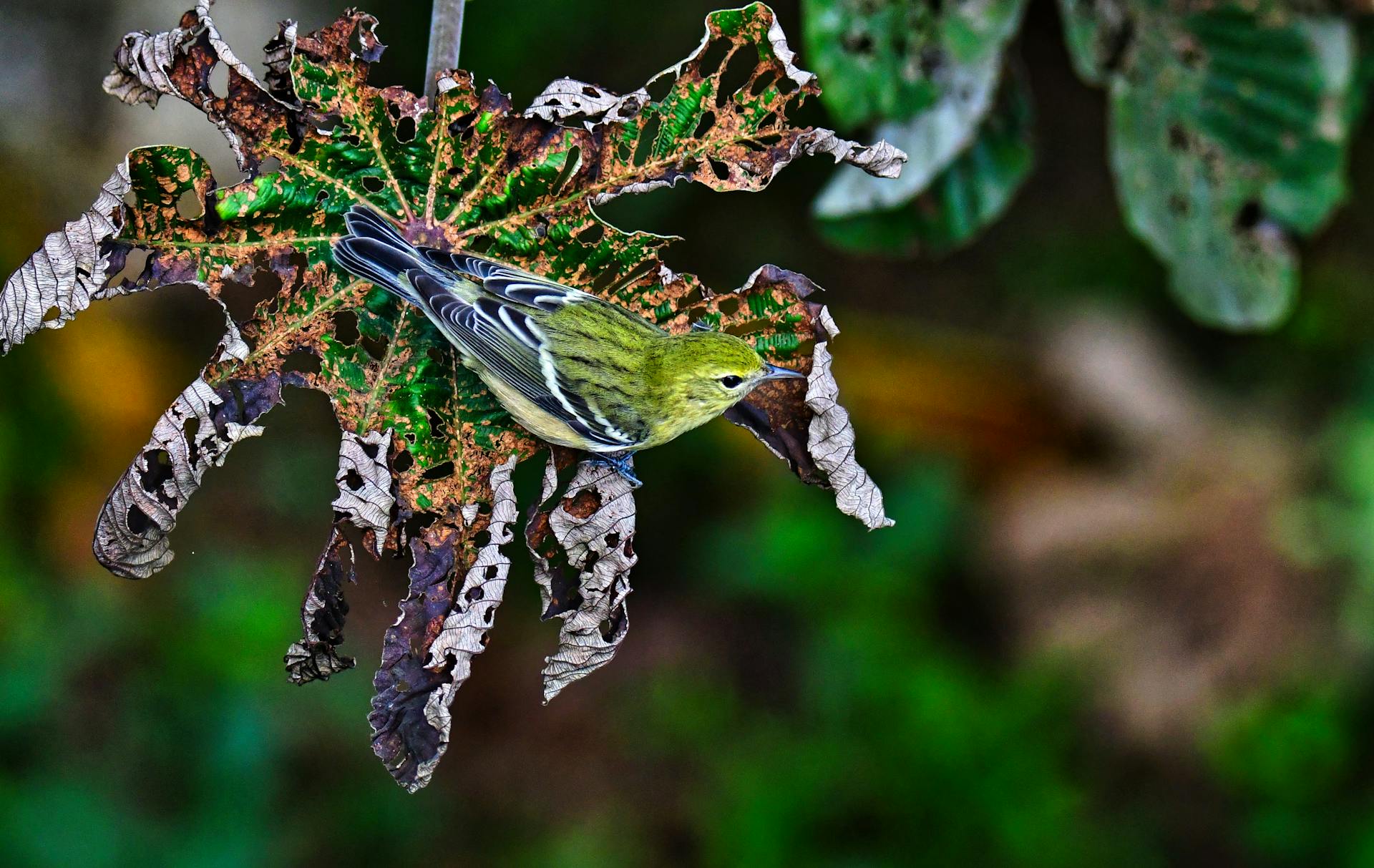
Blackpoll vs Bay Breasted Warblers
Fall warblers can be very confusing, especially when trying to tell the difference between the Blackpoll Warbler and the Bay Breasted Warbler.
One key difference is the Blackpoll Warbler's distinctive white wing bars, which are often absent in the Bay Breasted Warbler.
The Blackpoll Warbler's black cap and white cheek are also notable features, making it stand out from the Bay Breasted Warbler.
The Bay Breasted Warbler, on the other hand, has a gray hood and white wing bars that are often less prominent.
In the fall, the Bay Breasted Warbler's breast is often more buff-colored, whereas the Blackpoll Warbler's breast is a deeper buff.
Both warblers have a similar size and shape, making them easily confused.
However, paying close attention to the subtle differences in their markings can help you tell them apart.
Black-Throated Blue (and Green)
The Black-Throated Blue Warbler is a stunning bird, with its formal black and white plumage accented with rich blues in males.
These birds can be found in the dense forest understory from the southern Appalachians to the Canadian Maritime Provinces and Quebec.
The Black-Throated Blue Warbler's white patches in the wings remind many birders of pocket squares.
To tell it apart from the Black-Throated Green Warbler, you'll need to learn its unique characteristics.
Black-throated blue warblers and black-throated green warblers look and sound different, making them distinct species.
Warbler Migration and Tips
Even casual birders get excited during warbler migration season! Try these tips to identify the most warblers this spring.
One of the best times to spot warblers is during their migration season, which typically occurs in the spring.
Casual birders can get excited by following the migration patterns of warblers, which can be tracked using online resources or by joining a local birding group.
The most warblers can be identified by trying these tips.
The tips for identifying warblers include observing their distinctive songs, which can be a key identifier for each species.
Warblers can be identified by their bright plumage and distinctive markings, making them a delight to spot in the wild.
Warblers can be identified by their habitats, with some species preferring dense forests and others open fields.
Casual birders can get excited by spotting warblers in their natural habitats, which can be found in a variety of locations, including forests, fields, and backyards.
Worth a look: Bird Identification by Photo
How to Paint Cerulean
The cerulean warbler is a beautiful bird, and painting its likeness can be a fun and rewarding experience. To get started, you'll want to learn what colors to use - cerulean blue, of course, is a great place to begin.
The cerulean warbler's bright blue back and wings are a key part of its distinctive appearance. You can achieve this color by mixing a combination of blue and white pigments.
To capture the warbler's cheery personality, consider adding some warm, sunny colors to your painting - think of the Cape May warbler's bright yellow and orange hues. These colors will help bring your painting to life.
The cerulean warbler's song is a series of short, musical phrases, often described as a series of descending notes. You can use this information to create a sense of movement and energy in your painting.
To add some texture and interest to your painting, try using a mix of brushstrokes and techniques - just like the bird's feathers, which can be smooth and sleek in some areas and more textured in others.
11 Reasons Why Birders Are Obsessed
Warblers are a welcome sign of spring for birdwatchers, and their unique characteristics make them a favorite among birders.
Warblers are incredibly small, with some species weighing as little as 0.2 ounces.
Their bright plumage is a sight to behold, with colors ranging from vibrant yellows and oranges to deep blues and greens.
Warblers are expert singers, with some species producing over 100 different songs.
They're also incredibly agile, flitting between branches with ease.
Warblers are known for their distinctive migration patterns, with some species traveling over 9,000 miles each year.
Their small size allows them to navigate through dense vegetation with ease.
Warblers are social birds, often traveling in large flocks.
Their migrations are a crucial part of their life cycle, with some species making multiple trips between their breeding and wintering grounds.
Some warbler species are expert mimics, able to reproduce the songs of other birds.
Warblers are a challenging but rewarding group to identify, with many species requiring a keen eye and a good understanding of their distinctive characteristics.
33 Pictures of Birds to Inspire Birding
Warblers are a welcome sign of spring for birdwatchers, and their vibrant colors make them a joy to spot. Check out these amazing facts about warblers to get you started on your birding journey.
Warblers are small, bright fliers that can be seen during spring and fall migration. They come in a range of colors, from yellow to black-and-white.
If you're new to birding, warblers can be a great place to start, with over 20 stunning species to look for in spring. Warblers are colorful and awe-inspiring birds that deserve special attention.
Warbler sightings are a great way to know that spring has arrived, and their beauty will make you want to grab your binoculars and head outside. Enjoy splendid pictures of warblers to get a glimpse of these amazing birds.
Frequently Asked Questions
What is the most common warbler?
The Yellow-rumped Warbler is the most common warbler in North America, found in vast areas of Canada, the U.S., and Mexico. Its widespread presence makes it a fascinating bird to learn more about.
How to tell the difference between a warbler and a goldfinch?
Determine if it's a warbler or a goldfinch by looking at its beak shape: warblers have thin beaks for insects, while goldfinches have conical bills for seeds
What is the difference between a yellow warbler and a Wilson's warbler?
Distinguishing Wilson's Warbler from Yellow Warbler: Wilson's has a black eye and long tail, while Yellow Warbler has yellow wing edging
Featured Images: pexels.com