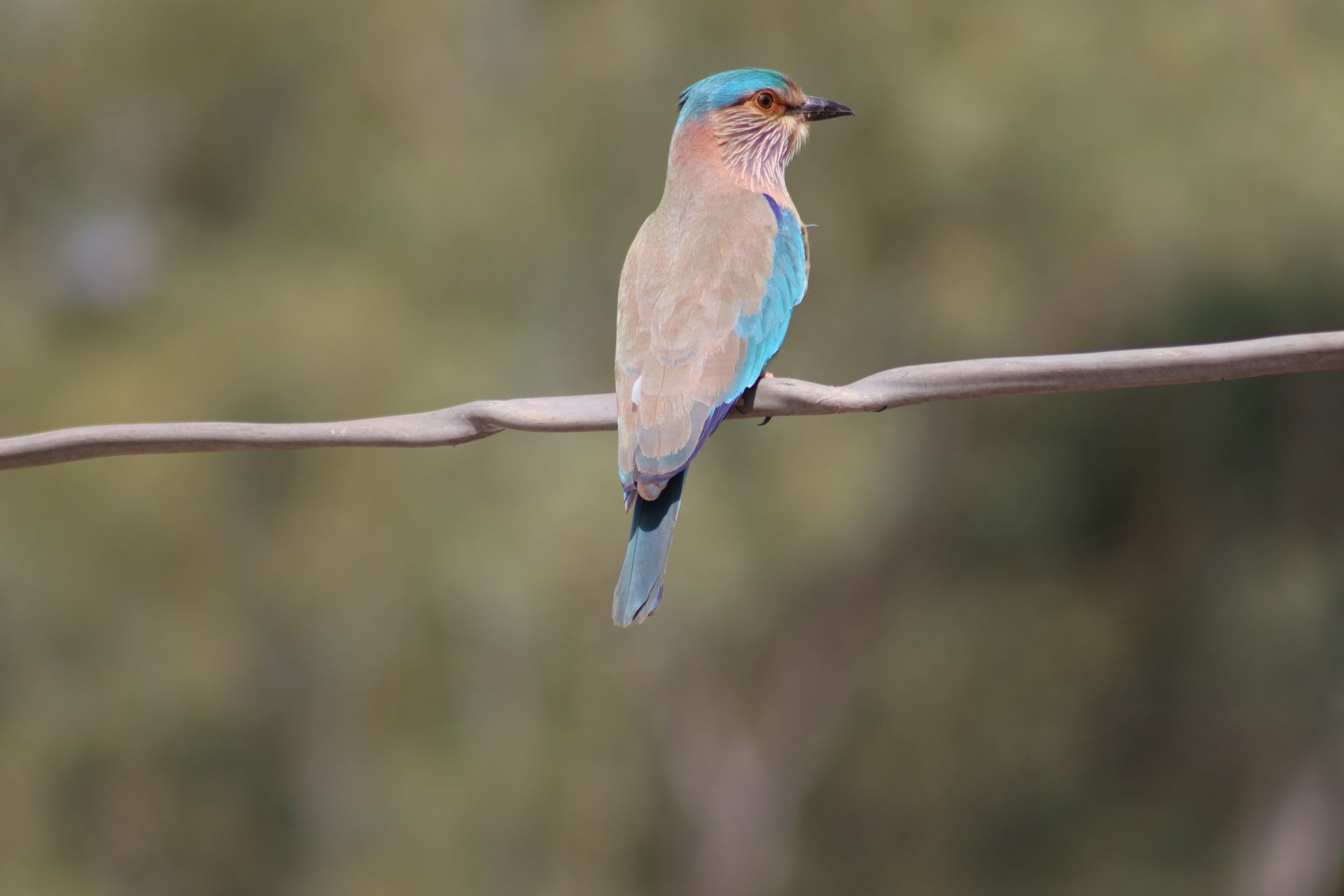
The Indian Roller Coracias benghalensis is a bird of vibrant beauty, known for its iridescent blues and greens that seem to shimmer in the light.
They are found in open woodlands and forests, often perched on trees or power lines, scanning the ground below for potential prey.
These birds are carnivores, feeding on insects, reptiles, and amphibians, which they catch with their sharp, hooked beaks.
Their diet consists mainly of insects, including beetles, grasshoppers, and crickets, which they catch while in flight or on the ground.
Physical Characteristics
The Indian Roller's plumage is a stunning sight to behold. The bird's forehead, chin, and lores are a beautiful pinkish buff colour.
The ear coverts are a darker red-brown with pale cream or pinkish streaks. This adds a lovely depth to the bird's overall appearance.
The throat is a dull wine-red with narrow cream streaks, giving the bird a subtle yet striking look. I've seen birds like this in the wild, and it's always a treat to observe their unique colouration.
On a similar theme: Red Rumped Parakeet
The crown and nape are a darker dull turquoise, which provides a nice contrast to the brighter colours on the bird's body. This colouration helps the bird to blend in with its surroundings.
The back and rump are a bright turquoise, while the belly is a pale blue. This colour scheme is not only visually striking but also helps the bird to communicate with other members of its species.
The tail coverts are dark purple-blue with turquoise tips, while the middle two tail feathers are greyish blue-olive with black shafts. The surrounding tail feathers are an intense purple-blue with a broad pale blue band and greenish tinge towards the tips.
The flight feathers on the wings have the same purple-blue colour of those on the tail, with a similar pale blue band across the most distal five or six primaries. This helps the bird to fly efficiently and effectively.
The underwing coverts and axillary feathers are pale blue, while the upperwing coverts are a dull green-blue. The primary coverts are pale blue with olive or purple-blue tips, and the lesser coverts are purple-blue along the leading edge of the wing.
Expand your knowledge: Blue Jay Cyanocitta Cristata
The colours of the Indian Roller's plumage are not just aesthetically pleasing but also serve a practical purpose. When the bird is perched, the colours may look dull, but they become vibrant in flight, helping the bird to communicate and attract a mate.
In terms of size, the Indian Roller's plumage is not the only impressive feature of this bird.
Habitat and Distribution
The Indian roller is a bird that's found in a wide range of habitats, from the wetlands of Pakistan to the gardens of India.
It's distributed from Iraq and the United Arab Emirates through the Indian subcontinent, including Sri Lanka.
In Pakistan, you can find them in the wetlands around Chotiari Dam in Sindh, in Jiwani Coastal Wetland in Balochistan, and in Punjab along the Tonsa Barrage and Chenab River.
They've also been recorded as a summer visitor to Jalalabad in northeastern Afghanistan.
In Kuwait, it's a common winter visitor at Green Island and farmlands near Al Jahra.
The species is common, and often found in open woodland dominated by trees of the genera Acacia and Prosopis.
It's adapted well to human-modified landscapes such as parks and gardens, fields, date and coconut palm plantations.
In Oman, it's been nicknamed "roundabout bird" in northern Oman, where pairs live in vegetation at roundabouts.
In India, it was sighted at elevations ranging from sea level in the Bhitarkanika Mangroves and the Gulf of Mannar to about 2,100 m (6,900 ft) in the Nilgiri Mountains.
Behavior and Ecology
The Indian roller is generally not very gregarious and is usually found alone or in pairs. It's a solitary bird that likes its space.
It's often territorial, though migrants may forage in flocks with no aggression. They patrol their territory by flying at treetop height or three-stories high.
When an intruder is spotted, they drive it away by a fast rolling flight. This is a clever way to defend their territory.
The Indian roller spends a few minutes preening followed by flying around its roosting site. It's a bit like getting ready for bed before settling in for the night.
It favours electric or telegraph wires as perches, and has been observed perching in trees and shrubs at a height of 3–9 m (10–30 ft) from where it flies down to forage for ground insects.
Behaviour and Ecology
The Indian roller is generally not very gregarious, often found alone or in pairs. It's a territorial bird that patrols its territory by flying at treetop height or three-stories high.
Migrants, however, may forage in flocks with no aggression. They seem to be more common in winter than summer in Oman.
The Indian roller spends a few minutes preening before flying around its roosting site. It's a fan of electric or telegraph wires as perches, but it's also been spotted perching in trees and shrubs at a height of 3–9 m (10–30 ft).
Explore further: Indian Giant Flying Squirrel
In agricultural habitats in southern India, the Indian roller has been found at densities of about 50 birds per km. This is quite high, especially considering its territorial nature.
The Indian roller's display is quite impressive, with aerobatic twists and turns. It's attracted to wildfires and darts into hot smoke in pursuit of insects.
Nesting Indian rollers are fiercely protective of their young, driving away potential predators like Indian jungle crows and even Egyptian vultures.
Bird Sounds
Birds use sound to communicate with each other, and it's a vital part of their behavior and ecology.
They make different sounds to signal alarm, such as the loud, shrill calls of the American Crow. The alarm calls of the Black-capped Chickadee are also high-pitched and loud.
Birds also use song to attract a mate, like the melodious song of the Northern Cardinal. Males of this species sing from the tops of trees to show off their territory and attract a female.
Some birds, like the Common Loon, use a distinctive yodeling call to locate their mate. This call is often described as a haunting, wailing sound.
Birds also use sound to warn other birds of potential predators, such as the loud, harsh calls of the Red-winged Blackbird. This bird's call is often accompanied by a flashing of its black and red plumage.
Readers also liked: Red Billed Leiothrix
Breeding
The Indian roller's breeding season is a fascinating time, lasting from March to June, slightly earlier in southern India.
During this period, adult males and females form pair bonds, which they seal with aerial displays that include steep, undulating flights, somersaults, nose-drives, hovering, and lateral rolling.
These aerial displays are accompanied by vocalizations, showcasing the birds' impressive communication skills.
The pair then perches and displays to each other with bows, dropped wings, and fanned tails, and may even engage in allopreening.
The Indian roller's nest site is usually an existing hole in a tree, a dead palm, or a building, but may also be a hole in a mud bank.
In some cases, the hole may be excavated completely in soft material such as rotten wood.
A thin mat of feathers, straw, or grass is placed at the bottom of the cavity to make it cozy for the eggs.
In Bandhavgarh National Park, nests have been recorded at heights of 3 m (10 ft) in Shorea robusta trees and 7.5 m (25 ft) above the ground in Syzygium cumini trees.
The clutch consists of 3–5 eggs, which are white and oval with an average size of 33 mm × 27 mm (1.3 in × 1.1 in).
The female Indian roller incubates the eggs mainly by herself, beginning as soon as the first egg is laid.
The eggs hatch asynchronously after 17 to 19 days, and the young birds are naked when first hatched.
The parents take turns feeding and caring for the young, and the fledging period lasts 30 to 35 days.
Conservation Status
The Indian Roller Coracias benghalensis has a stable conservation status.
As of 2016, the Indian Roller was listed as a species of least concern on the IUCN Red List. This is due to its wide range and apparent increasing population.
Its total population size is unknown, but it appears to be common in most of its range.
In Iraq, around 2,500 breeding pairs were estimated to live as of 2015.
The population in the Arabian Peninsula was estimated to be around 15,000 breeding pairs as of 2015.
The population was thought to have increased in particular in the United Arab Emirates.
Species Information
The Indian roller is a colorful bird found throughout South Asia, stretching from Iraq eastward to Bangladesh, and as far south as Sri Lanka.
It has a stunning blue plumage and chunky body, reaching lengths of 30-34 cm (12–13 in) with a wingspan of 65-74 cm (26–29 in).
Males and females are similar in appearance, showcasing vibrant blue on the wings, belly, and tail, with a contrasting brown back and a pale blue crown.
Recommended read: Blue Throated Barbet
The Indian roller thrives in a variety of habitats, from open grasslands to urban areas, making it quite adaptable.
It prefers open cultivated areas or light deciduous forests, often seen perched conspicuously on trees or wires.
The Indian roller feeds on insects like beetles, grasshoppers, and crickets, as well as small reptiles and amphibians.
It captures its prey primarily on the ground, performing acrobatic flights to snatch up insects.
Breeding season for the Indian roller occurs from March to June, peaking with the onset of the monsoon.
Male rollers are known for their dramatic aerial acrobatics during the breeding season, which is thought to be part of their courtship display.
The typical clutch consists of 3-5 eggs, which are incubated for about 17-20 days.
Chicks fledge approximately a month after hatching and continue to receive parental care for a short period thereafter.
The Indian roller is classified as least concern on the IUCN Red List, thanks to its wide distribution and possibly increasing population numbers.
Frequently Asked Questions
What does the Indian Roller symbolize?
The Indian Roller is a symbol of good fortune and happiness, often considered a harbinger of auspicious events in Indian culture. Its presence is believed to bring joy and prosperity, making it a highly revered and lucky bird.
What is the real Neelkanth bird?
The Indian Roller, also known as Neelkanth, is a medium-sized bird with vibrant blue and green plumage. It's a bird of striking beauty, often spotted scanning the ground for insects and small prey.
What is the Bengali name for Indian Roller?
The Bengali name for Indian Roller is Nilkontho (নীলকন্ঠ) or Nilkanto (নীলকান্ত).
Featured Images: pexels.com