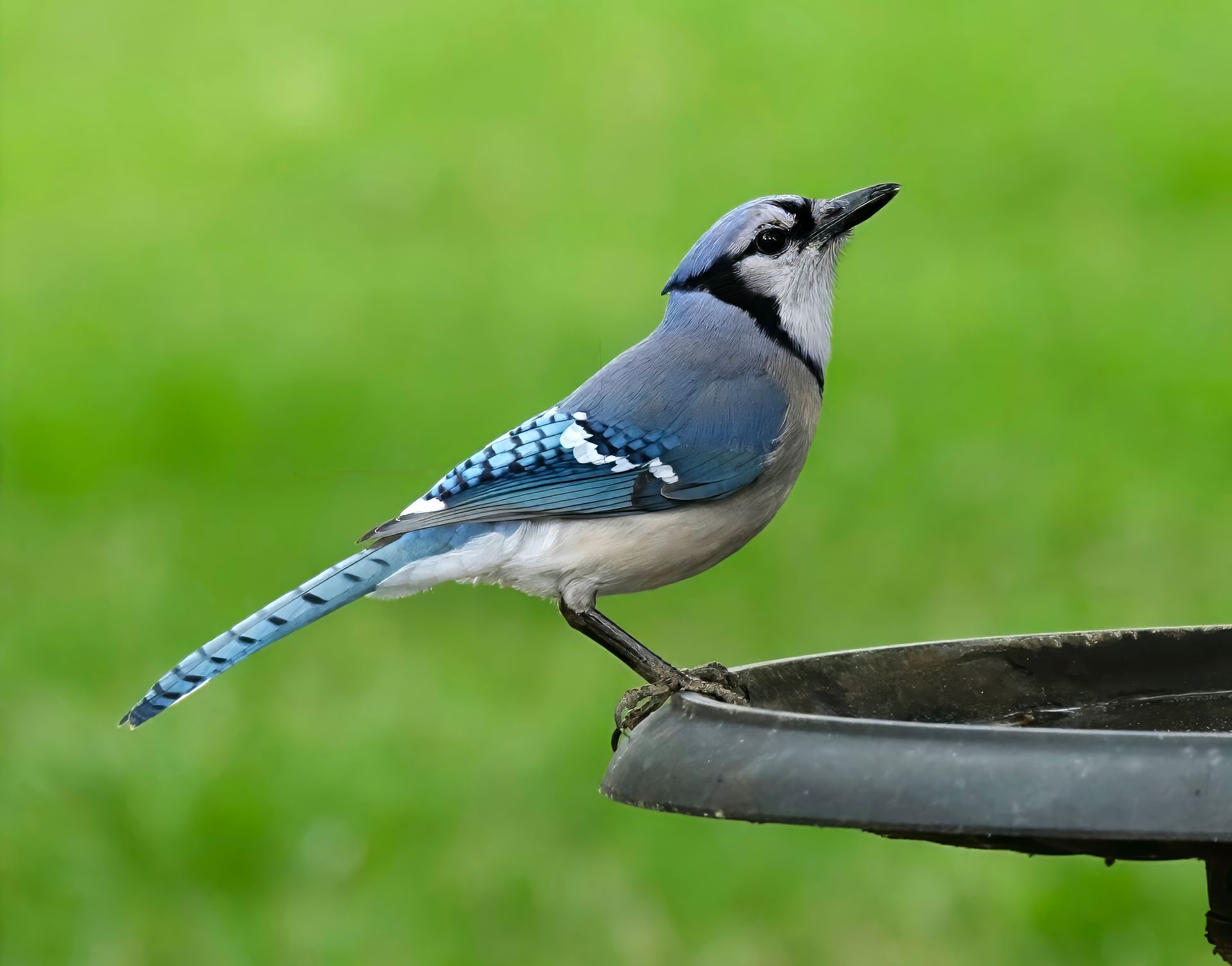
Blue jays are incredibly intelligent birds, known to solve problems and remember the location of cached food. They are a common sight in many North American backyards.
These birds are known for their bright blue and white feathers, with a distinctive crest on top of their heads. Their distinctive call is a loud, raspy "jay, jay, jay" that can be heard throughout the day.
Blue jays are also known for their complex social structures, often living in large groups with a strict hierarchy. They are monogamous birds, with pairs forming during the breeding season and staying together for several years.
In the wild, blue jays can be found in a variety of habitats, including forests, woodlands, and even urban areas. They are adaptable birds, able to thrive in a wide range of environments.
See what others are reading: Blue Cardinal Birds
Physical Characteristics
Blue jays have a striking appearance, with a bright blue back and whitish gray belly and chin. They have a distinctive gray-blue, feather crested head that can be raised and lowered.
Their wings and tails are a vibrant blue with white and black bands, making them a stunning sight to behold. The black collar of feathers across the throat and around the head adds to their striking appearance.
Males are slightly larger than females on average. Blue jays have a total body length of 22 to 30 cm, which is quite impressive.
Here are some key physical characteristics of blue jays:
- Endothermic and homoiothermic, meaning they regulate their own body temperature.
- Bilateral symmetry, with their body parts arranged on either side of a central axis.
Their range in mass is 65 to 109 g, which is equivalent to 2.29 to 3.84 oz. Their length ranges from 8.66 to 11.81 inches.
Geographic Range
Blue jays are native to the Nearctic region and can be found in southern Canada and in the United States, east of the Rocky Mountains. They have a broad geographic range that spans across various habitats.
Blue jays are commonly found in mixed woodlands, particularly those with clearings, as well as in suburban areas and city parks. This adaptability to different environments is a key factor in their widespread distribution.
Here are some key facts about the geographic range of blue jays:
- Nearctic region
- Temperate
- Terrestrial
Behavior and Ecology
Blue jays are highly social birds, often living in small family groups of up to 20 individuals.
These groups are usually led by a dominant male and female, who work together to forage for food and protect their territory.
Blue jays are also known to be fiercely territorial, with a strong sense of ownership and defense of their territory, which can be up to 50 acres in size.
In addition to their social behavior, blue jays are also skilled foragers, using their intelligence and problem-solving abilities to find food in a variety of environments, including forests, fields, and backyards.
Their diet consists mainly of nuts, seeds, and fruits, but they will also eat insects, spiders, and small vertebrates.
Behavior
Blue jays are very aggressive birds, driving other birds away from food sources and their territories. They're not afraid to get loud either, making a lot of noise to assert their dominance.
In the winter, these birds will often hide far more food than they can eat. This is likely a strategy to remove food from their territories and discourage intruders from trying to steal it.
Blue jays are also partially migratory, traveling in large flocks of over a hundred birds in the fall. I've seen this firsthand in the woods near my home, where the skies are filled with the sound of their distinctive calls.
Here are some key behaviors of blue jays:
- Flies: Blue jays are capable of flight, which helps them travel and forage for food.
- Diurnal: These birds are active during the day, which is when they're most likely to be seen.
- Motile: Blue jays are able to move around and change their location.
- Migratory: As mentioned earlier, blue jays are partially migratory, traveling to different areas at certain times of the year.
- Territorial: Blue jays are protective of their territories and will defend them against other birds.
- Social: Despite their territorial nature, blue jays are also social birds that often travel in large flocks.
Ecosystem Roles
Blue jays play a crucial role in dispersing seeds, as they often hide seeds and nuts and sometimes forget to find and eat them.
Their bold and active nature makes them easy to observe, allowing us to witness their fascinating behaviors firsthand.
These birds act as a reservoir for West Nile virus, although they don't directly harm humans.
Here's a summary of their ecosystem impact:
- disperses seeds
Predation
Blue jays are fiercely protective of their nests and will attack and chase predators away. This includes hawks, falcons, raccoons, cats, snakes, squirrels, and even humans.
Adult blue jays are often preyed on by hawks, owls, and falcons. These birds of prey are skilled hunters and can catch blue jays off guard.
Nestlings, on the other hand, are vulnerable to a variety of predators. Squirrels, cats, snakes, American crows, other jays, raccoons, opossums, and birds of prey all pose a threat to their survival.
Despite these predators, blue jay populations are on the rise. This is likely due to their adaptability and ability to thrive in a variety of environments.
Conservation Status
Blue jays have a relatively stable conservation status. They are listed as Least Concern on the IUCN Red List, which is a positive sign for their population.
The US Migratory Bird Act protects blue jays, but they don't have any special status on the US Federal List or the CITES list. Similarly, they don't have any special status on the State of Michigan List.
Here's a breakdown of their conservation status:
- IUCN Red List: Least Concern
- US Migratory Bird Act: Protected
- US Federal List: No special status
- CITES: No special status
- State of Michigan List: No special status
Media and Information
Blue jays are known for their striking appearance, but have you ever wondered how they use their vibrant feathers to communicate?
Their bright blue and white feathers are a key part of their identity, and they use them to signal dominance and attract mates.
In fact, the blue jay's distinctive crest is made up of feathers that can be raised and lowered at will, giving them a unique expression.
They also use their feathers to blend in with their surroundings, changing their plumage to match the colors of the trees and leaves around them.
By adjusting their feathers, blue jays can send a range of messages to other birds, from warning calls to friendly chirps.
This complex communication system is made possible by the blue jay's highly developed sense of vision, which allows them to see a wide range of colors and subtle variations in tone.
Their exceptional eyesight is likely an adaptation for foraging, as they spend a lot of time searching for food on the forest floor.
In fact, blue jays are known to cache, or store, food for later use, often burying seeds and nuts in various spots around their territory.
Suggestion: Blue Heeler Colours
This behavior is likely a response to the changing seasons, as they prepare for the leaner months by stockpiling food.
By burying their caches, blue jays can recall the locations of their hidden food, using a combination of memory and spatial awareness.
Their remarkable ability to recall the locations of their caches is a testament to their intelligence and problem-solving skills.
General Information
The blue jay is a medium-sized bird with a distinctive crest on its head, which is typically raised when it's feeling alert or threatened.
Blue jays are members of the Corvidae family, which also includes crows, ravens, and magpies.
These birds are found throughout much of North America, from Canada to Mexico, and are known for their bright blue and white feathers.
Their diet consists mainly of seeds, nuts, and fruits, but they're also opportunistic omnivores and will eat insects, spiders, and even small vertebrates if the chance arises.
Frequently Asked Questions
Is it illegal to have a blue jay?
In the United States, it's illegal to possess a native bird, including a blue jay, without proper permits. Check local regulations before considering a blue jay as a pet
Featured Images: pexels.com