The Blue Throated Barbet is a bird of stunning beauty. Its vibrant plumage and distinctive call make it a standout in the avian world.
Native to the Indian subcontinent, the Blue Throated Barbet inhabits tropical forests and woodlands. Its range spans across India, Sri Lanka, and parts of Southeast Asia.
This bird's striking appearance is characterized by its bright blue throat patch, which gives it its name.
Additional reading: Barbet Water Dog
Taxonomy
The Blue-throated Barbet has a complex taxonomic history, with its original placement in the genus Cyanops by Latham in 1790 later being synonymized with Megalaima.
Its classification has undergone significant changes, with phylogenetic studies in 2013 indicating that Psilopogon is embedded within Megalaima, leading to the subsumption of Megalaima into Psilopogon due to Psilopogon having priority.
The Blue-throated Barbet has two recognized subspecies, with the Red-crowned Blue-throated Barbet (P.a. asiaticus) being a resident in NE Pakistan to W, N Myanmar and SW Yunnan, and the Blue-crowned Blue-throated Barbet (P.a. davisoni) being a resident in SE Myanmar to SE Yunnan and N Indochina.
The Blue-throated Barbet is listed as a least concern species by the IUCN Red List.
Here's a breakdown of the subspecies:
Physical Characteristics and Behavior
The blue-throated barbet is a medium-sized bird, about the size of a myna, measuring 19-22 cm (7.5-8.7 in) in length.
Sexes are similar, with females being slightly heavier than males, weighing 87-103 g (3.1-3.6 oz), while males weigh 79-100 g (2.8-3.5 oz).
Juveniles have muted and dull colors, with the red on their forehead possibly tinged with orange, and the black on their crown may be blue-black or dusky.
The bird's stout, conical bill is pale at the base with a dark upper mandible and tip, and its feet are slate-gray to gray-green.
Here's an interesting read: Queensland Heeler Black
Vivid Display
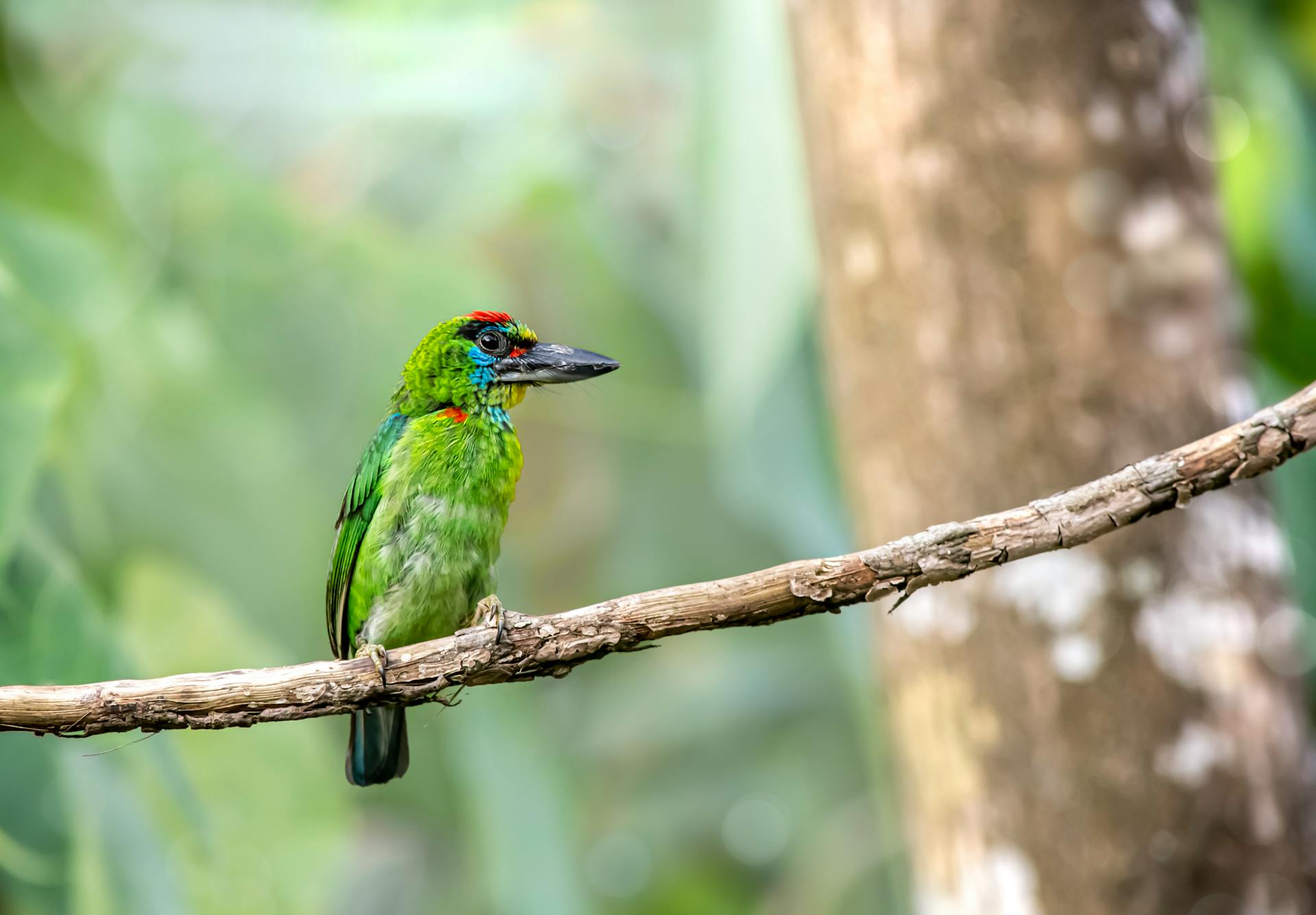
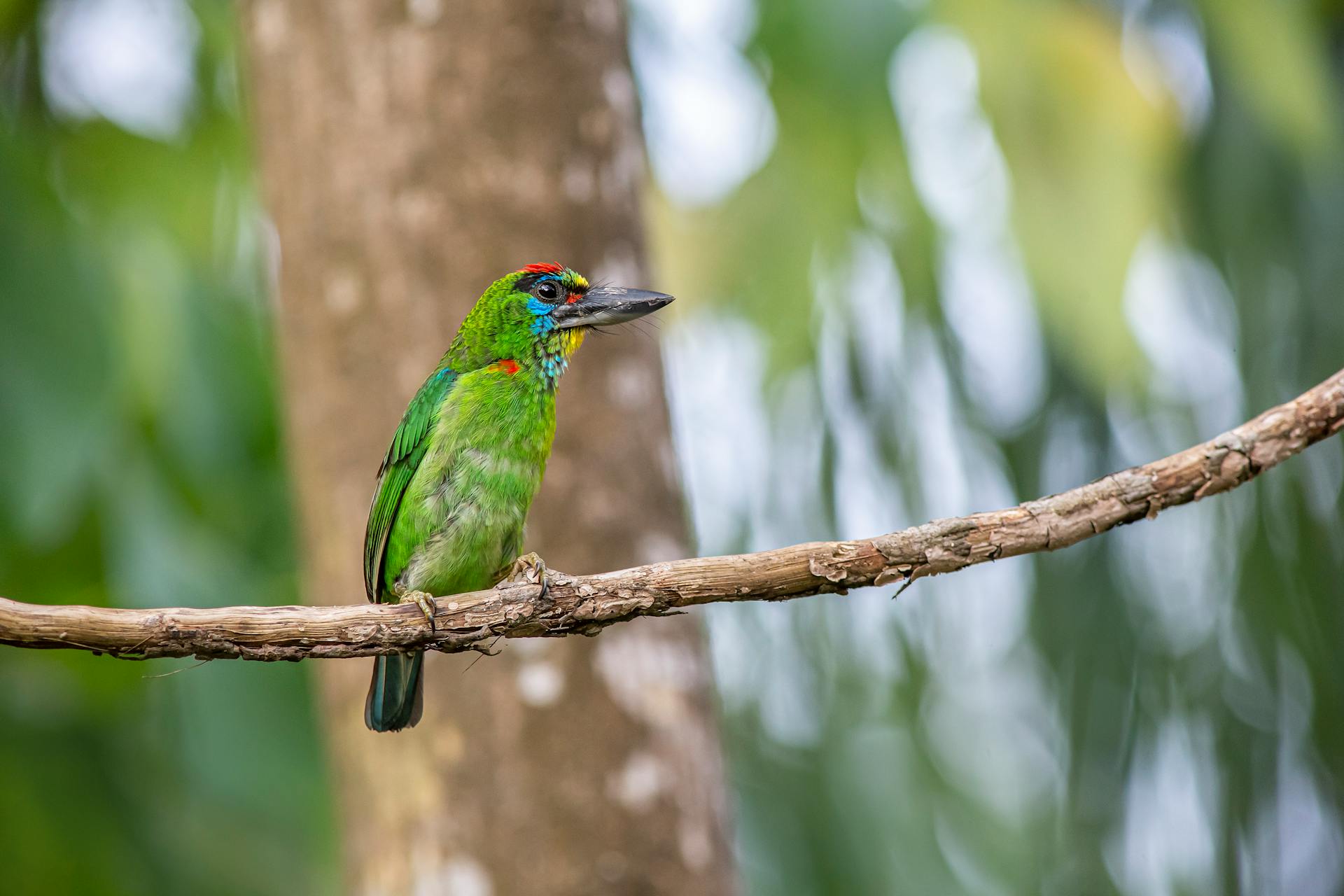
The Blue-throated Barbet's vibrant plumage is a sight to behold, with its stunning turquoise-blue throat, emerald green body, and bold red forehead creating a captivating visual display.
Both males and females of the species share similar coloration, making them monomorphic, which is somewhat uncommon in the world of bird species.
The bird's bright red forehead is a distinctive feature, and it's worth noting that the red may be tinged with orange in juveniles.
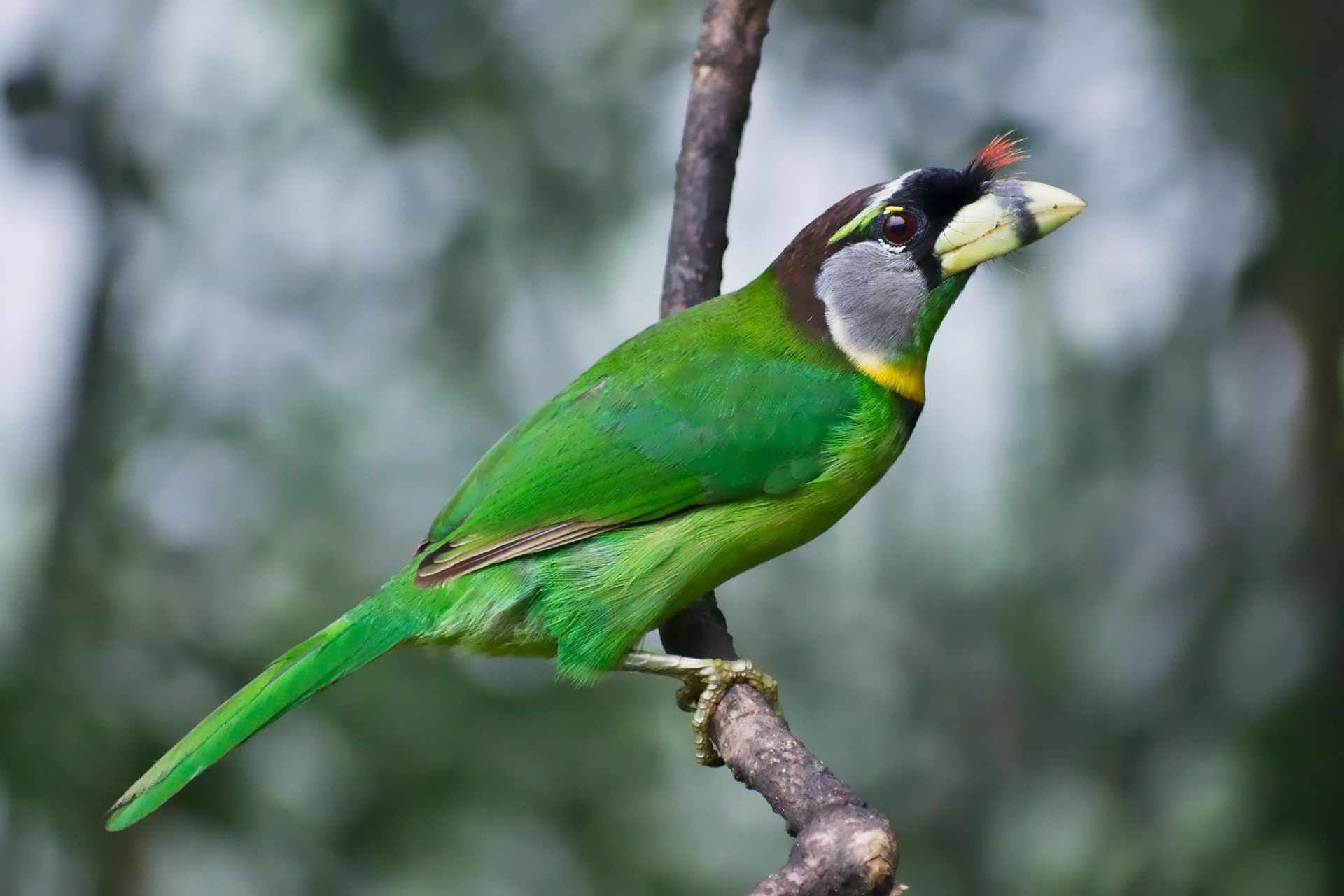
The Blue-throated Barbet's emerald green body is a striking contrast to the verdant foliage it inhabits, making it a challenging but rewarding bird to spot.
The bird's stout, conical bill is pale at the base with a dark upper mandible and tip, adding to its unique appearance.
The Blue-throated Barbet's feet are slate-gray to gray-green, providing a subtle contrast to its vibrant plumage.
If this caught your attention, see: Polioptila Caerulea
An Acoustic Delight
The Blue-throated Barbet's call is a distinctive "kwok-kwok-kwok" sound that echoes through the forest canopy.
This signature song serves multiple purposes, including establishing territory, attracting mates, and communicating with others of its kind.
An Arboreal Existence
The Blue-throated Barbet spends most of its time high up in the trees, leading an arboreal lifestyle in the subtropical and tropical moist forests of Nepal.
It primarily feeds on fruits, insects, and small invertebrates.
This bird is particularly fond of figs and plays an essential role in seed dispersal within its ecosystem.
Distribution and Habitat
The blue-throated barbet is a resident breeder in the Lower Himalayas from northeastern Pakistan through northeast India, and in the hill ranges of Southeast Asia.
It can be found in lowland and foothill tropical, evergreen and deciduous forests, typically between 200–2,000 m (660–6,560 ft) above sea level.
It's adaptable to secondary forests and even urban areas, but only if fruiting trees are readily available.
The blue-throated barbet prefers elevations over 600m and can be found in primary and secondary evergreen and broadleaved forest, as well as second growth forest.
It also inhabits forest edges, clearings, and orchards.
Consider reading: Barbet Dog Grooming
Life Cycle and Breeding
The Blue-throated Barbet's life cycle is quite fascinating. During the breeding season, which typically occurs between March and July in Nepal, these birds exhibit some truly unique behavior.
They are cavity nesters, which means they excavate holes in dead or decaying tree trunks with their strong beaks. The female lays 2 to 4 eggs, which both parents will take turns incubating over approximately 14 days.
Both parents share the duties of nest building, incubation, and rearing of the young. They feed and vocalise together during courting, and display unique behaviors like bobbing and twisting of the head and wagging of the tail.
The nesting season is a busy time for these birds, with nests being made by excavating holes in tree trunks and sloping branches. Nests are usually between 3–7.5 m (9.8–24.6 ft) above the ground.
The female lays 3-4 matte white eggs, which are incubated for 14 days with both parents ensuring continuous incubation. After the chicks hatch, they remain with the parents for a short duration only.
Old nests of woodpeckers may be taken over by the Blue-throated Barbet, and they often reuse their nests over several years.
Conservation and Threats
The blue-throated barbet is not threatened, it's actually considered one of the commonest birds in its range in Northeast India.
According to BirdLife International, the species is placed in the Least Concern (LC) IUCN category, indicating that it's not under significant threat.
In Mizoram, northeast India, the species is uncommon in oil plantations, likely due to the lack of fruit-bearing trees.
The population of blue-throated barbets has not been determined, but it's believed to be stable.
Take a look at this: White Throated Sparrow
Identification and Subspecies
The blue-throated barbet is a striking bird with some distinctive features. Its length is around 22-23 cm (8½-9 in).
To identify this bird, look for its bright blue chin, throat, and sides of its head, along with its crimson forehead. Black bristles surround its bill, adding to its unique appearance.
There are two recognized subspecies of the blue-throated barbet. Here is a breakdown of their ranges:
Identification
The identification of a bird species can be a fascinating process. To start, let's take a look at some key characteristics.
A blue chin, throat, and sides of the head are distinctive features to look for. These markings can be quite vibrant and eye-catching.
The crimson forehead is another notable feature that can help with identification. It's a striking color that can be a dead giveaway.
The green body is a common trait among many bird species, but it can also be a helpful identifier. In this case, the green body is a key characteristic to note.
Some birds also have black bristles surrounding their bill. This can be a subtle feature, but it's worth paying attention to.
Here are some key identification features summarized in a list:
- Blue chin, throat, and sides of head
- Crimson forehead
- Green body
- Black bristles surrounding the bill
Subspecies
The Blue-throated Barbet has two recognized subspecies.
The Blue-throated Barbet is found in a range of countries, including north-eastern Pakistan, central Burma, and southern China.
One of these subspecies is P. a. davisoni.
This subspecies is found in south-eastern Burma, southern China, and central Vietnam.
Explore further: Barbet Dog Breeders
General Information
The Blue-throated Barbet is a common inhabitant of lowland and hill forests from the Himalayas eastward through mainland Southeast Asia.
It's almost ubiquitous in parts of its range, such as northeastern India, where it's abundant in various habitats including villages and even urban areas.
This adaptable bird has two subspecies: the nominate subspecies asiaticus in the west of its range and the subspecies davisonii in the east.
The Blue-throated Barbet's rapid, monotonous call is one of the most common bird sounds of these landscapes, and it's uttered almost constantly.
A Cherished Treasure of Nepal
The Blue-throated Barbet is a remarkable example of the biodiversity thriving within Nepal's picturesque forests.
Its captivating appearance is a sight to behold, with a mesmerizing song that echoes through the trees.
The bird's engrossing behavior offers an insight into the incredible intricacies and wonder of nature.
The Blue-throated Barbet is undoubtedly a jewel amidst the verdant boughs it calls home.
Introduction
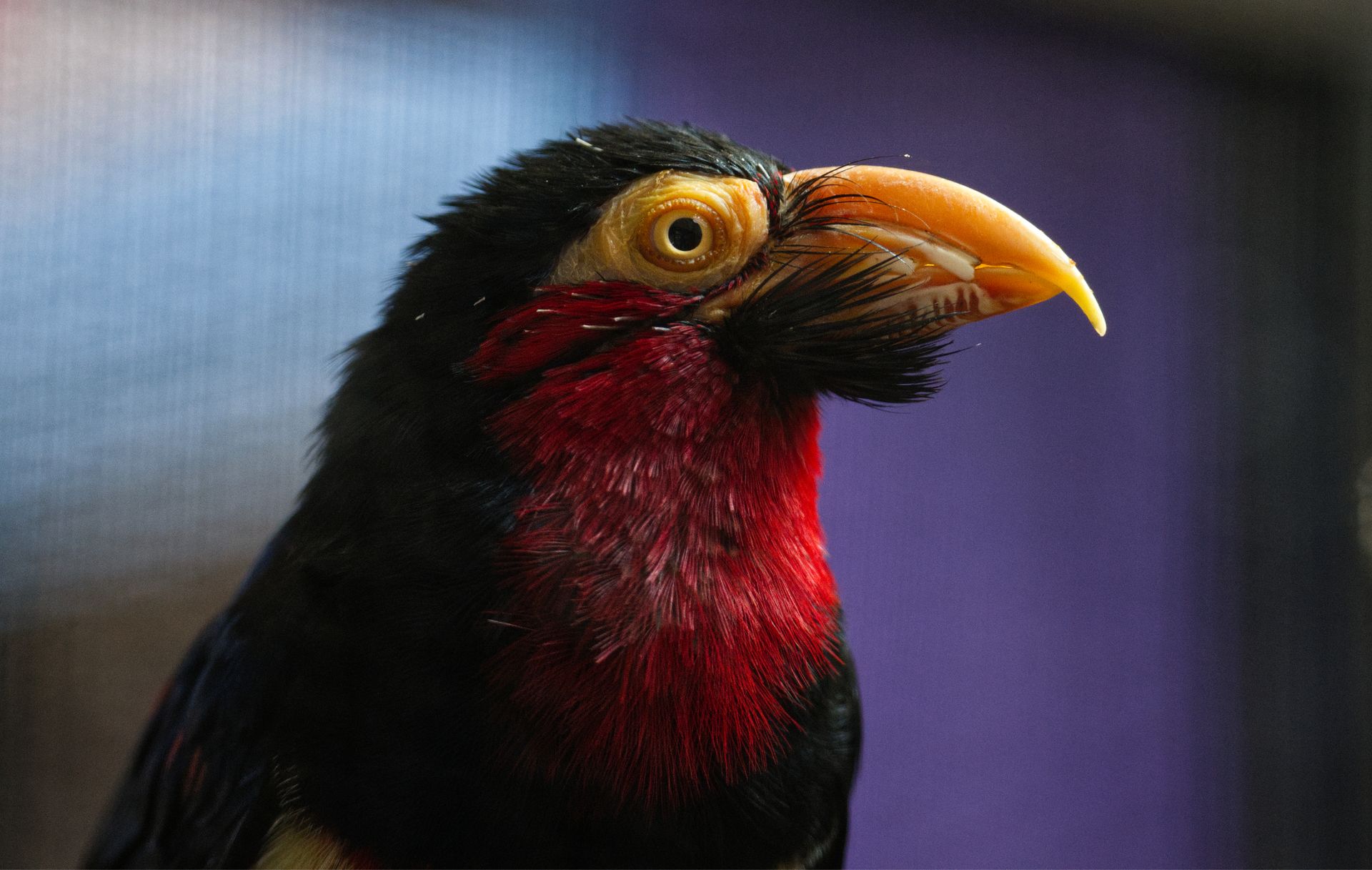
The Blue-throated Barbet is a common bird species found in lowland and hill forests from the Himalayas eastward through mainland Southeast Asia.
In parts of its range, such as northeastern India, it is almost ubiquitous, being abundant in various habitats including villages and even urban areas.
Its rapid, monotonous call is one of the most common bird sounds of these landscapes, often heard even if the bird itself is unseen.
The Blue-throated Barbet has two subspecies: the nominate subspecies asiaticus in the west of its range and the subspecies davisoni in the east.
The Turquoise-throated Barbet of peninsular Thailand was formerly considered a subspecies of the Blue-throated Barbet but has been recently split as a separate species.
This bird can be difficult to locate because of its green plumage and its preference for perching high up in dense foliage, despite its gaudy colors.
You can spot the Blue-throated Barbet at fruiting trees, where numbers may congregate, or at nesting sites in cavities in dead wood, which the birds excavate themselves.
Frequently Asked Questions
Is blue-throated barbet rare?
No, the blue-throated barbet is not considered rare, as it is listed as Least Concern by BirdLife International. Its population is believed to be stable and common in Northeast India.
What does a blue-throated barbet eat?
A blue-throated barbet's diet consists of fruits and insects. They also eat nectar and seeds, making them a common visitor to gardens and orchards.
Featured Images: pexels.com