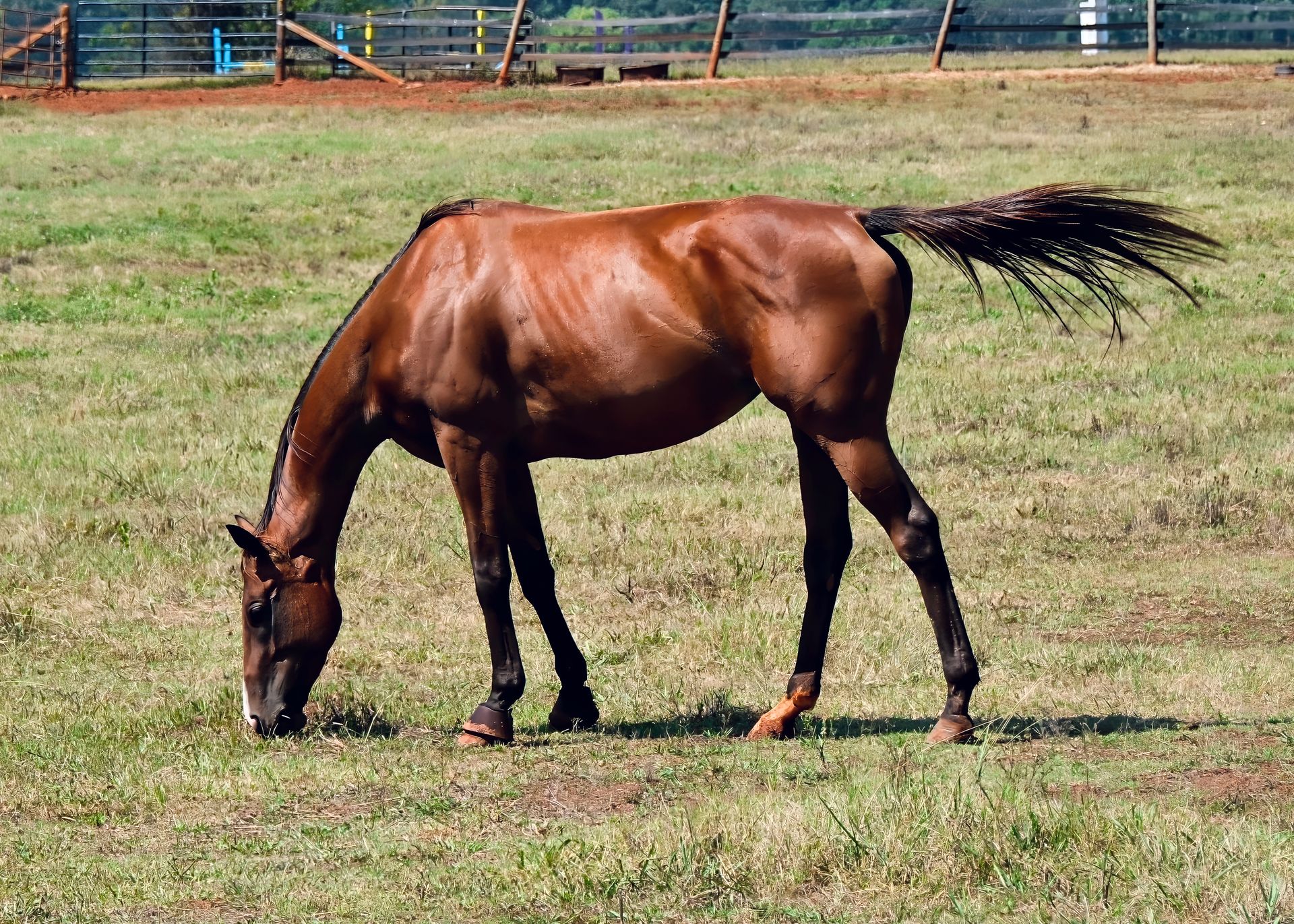
Horse skin diseases can be a real concern for horse owners, affecting not only the animal's comfort but also its overall health.
Some common skin diseases in horses include rain rot, scratches, and mud fever, which can be caused by bacterial, fungal, or parasitic infections.
Preventing skin diseases in horses is key, and one way to do this is by keeping your horse's living area clean and dry.
Regular grooming can also help identify any skin issues early on, making it easier to treat them before they become more serious problems.
Common Horse Skin Diseases
Horses can develop skin diseases that are similar to those found in humans, such as eczema and psoriasis.
One common skin disease in horses is equine eczema, also known as atopic dermatitis. It causes intense itching, redness, and skin thickening.
This condition is often triggered by allergies to environmental factors like pollen, dust, or mold.
Horses with equine eczema may also develop secondary infections, which can lead to further skin problems.
Another common skin disease is rain rot, also known as rain scald. It occurs when the skin is exposed to wet conditions for an extended period.
Rain rot causes the skin to become soggy, soft, and prone to bacterial infections.
In severe cases, rain rot can lead to the formation of crusts and scabs on the horse's skin.
Horses with rain rot often require regular grooming and treatment to prevent further complications.
Allergic and Irritant Reactions
Allergic skin disease can be a real challenge to manage in horses. It's characterized by pruritus, or intense itching, which may be widespread or localized.
Horses can be affected by a wide variety of possible allergens, but insect bite hypersensitivity, also known as sweet itch, is by far the most common.
A blood test is available, but intra-dermal skin testing provides more accurate results for diagnosing allergic skin disease.
The best treatment for allergies is to avoid the causative allergen as much as possible. This can be tricky, but it's worth a try.
Explore further: Vestibular Disease
Sweet Itch
Sweet Itch is the most common allergic skin disease in horses, caused by the Culicoides insect, also known as midges, which inject salivary gland proteins into the horse's skin when they bite.
These proteins cause sensitization and allergies in predisposed horses, leading to intense itching and open wounds.
The mane, tail, and withers are most often affected, and most horse breeds are susceptible to sweet itch, although the prevalence varies from country to country.
Icelandic horses exported to other areas appear to be most at risk for developing the condition.
Treating sweet itch is notoriously difficult, but preventative measures such as stabling the horse from dusk until dawn, using special blankets, and insect repellents can be effective.
Glucocorticoid therapy can also be used to treat the condition.
Allergic Disease
Allergic skin disease in horses can be a real challenge to manage, with symptoms like intense itching, hair loss, and sores due to rubbing.
The most common allergen responsible for sweet itch, a type of allergic skin disease, is the Culicoides insect, also known as midges.
Intriguing read: Treat Black Skin Disease
Horses with sweet itch often experience intense itching, especially in the mane, tail, and withers, which can lead to open wounds and secondary infections.
Preventing midges from biting your horse is key, so consider stabling from dusk until dawn and using special blankets and insect repellents.
Blood tests are available to diagnose allergic skin disease, but intra-dermal skin testing provides more accurate results.
Corticosteroids can be used to reduce itching, but the best treatment is to avoid the causative allergen as much as possible.
Sweet itch is notoriously difficult to treat, but with the right preventative measures, you can help your horse feel more comfortable.
Infectious Diseases
Ringworm is a common skin disease in horses that can be tricky to detect because it doesn't always itch. Equine ringworm causes hairless, crusty patches on the skin.
These patches can appear anywhere on the horse's body and may not show any other symptoms, making early detection a challenge.
Rain Rot
Rain rot is a common skin condition that affects horses and other mammals, characterized by oozing, crusty lesions and matted hair.
It's most common in warm, humid areas with rainy seasons, which makes sense if you've ever noticed how quickly horses can get dirty and develop skin issues after a long ride in the rain.
The good news is that rain rot usually resolves on its own within 14-21 days if the horse is kept out of the elements, but some horses can develop chronic cases.
Chronic cases can result in hair loss and thick, crusty skin in affected areas, making it essential to address the issue promptly.
Severe rain rot can also lead to lameness, performance loss, secondary infection, spontaneous abortion, and even death in rare cases.
To treat rain rot, medicated shampoo with chlorhexidine is often used, and it's crucial to keep lesions dry until they resolve.
Applying tea tree oil and other essential oils may also help improve afflicted areas, and in severe cases, antibiotics may be prescribed.
Ringworm
Ringworm is one of the most common skin diseases affecting horses. It's caused by a fungus, usually Trichophyton equinum and Trichophyton mentagrophytes, which can be transmitted through shared tack, grooming supplies, or even clothing.
This condition appears as an itchy, circular pattern of hair loss, which may also be red or appear like a rash. It usually occurs on the girth and saddle areas but can spread to other parts of the horse's body.
Ringworm can resolve without treatment in some cases, but it will take a month or longer. Treating horses as soon as possible will help to limit discomfort and prevent the spread of the fungus to other animals or people.
Tack, grooming supplies, and other potentially contaminated surfaces should be disinfected to prevent re-exposure. Anti-fungal shampoos or topical therapies are used to treat ringworm.
Ringworm can be categorized based on where it appears on the horse's body: mucocutaneous (lips), haired skin, or ears.
For another approach, see: How Big Is a Horse's Brain?
Cellulitis
Cellulitis is a potentially serious condition that affects a horse's limbs, often causing severe swelling and lameness.
It usually affects one limb at a time, most often in the hind end, and can develop rapidly.
The affected limb is warm and painful to the touch, and fever and lethargy may also be present.
Staphylococcus spp. is often found in the skin with cellulitis cases, so antibiotics may be used as part of the treatment.
Prompt diagnosis and treatment of cellulitis are crucial to increase the chances of a successful outcome.
Hydrotherapy, bandaging, hand-walking, and lunging may all be helpful in managing the condition.
Recommended read: How Often Should I Worm My Horse?
Skin Conditions
Skin conditions in horses can be a challenge to diagnose and treat. One or more symptoms such as dryness, greasiness, redening, pruritus, hair loss, raised lumps, sores, crusts, and oozing can represent a primary skin condition or be secondary to another medical condition.
Your vet will ask for a full history and perform a general clinical examination, as well as a more specific examination of the affected areas of skin to diagnose a skin condition. Diagnostic tests may include hair plucks, 'sellotape' strips, skin scrapes, swabs for culture, skin biopsy, and blood tests.
Some common skin conditions in horses include sarcoids, dermatitis, and rain rot. Sarcoids can be locally invasive and appear as a cosmetic defect, while dermatitis is characterized by redness, irritation, and inflammation.
Sarcoids
Sarcoids are the most common skin tumor found in horses, and they can also affect other equids like zebras, donkeys, and mules. They're not a metastatic cancer, meaning they don't spread to other organs, but they can be locally invasive and appear as a cosmetic defect.
Sarcoids can occur in horses of any age, but they're most common in younger horses. They usually appear on the head, limbs, neck, and shoulder, but can form anywhere on the horse's body.
The cause of sarcoids is suspected to be associated with two types of bovine papillomaviruses, BPV1 and BPV2. However, some biopsied sarcoids aren't associated with either virus, and the cause is unknown in those cases.
There are five general types of sarcoids that exist in horses: occult, verrucose, nodular, fibroblastic, and mixed. The fibroblastic type is usually a fast-growing, fleshy mass that can begin as a complication of a skin wound.
Worth a look: Types of Horse Breeds
Here are the five types of sarcoids and their characteristics:
- Occult: Flat patch where hair is absent with a grey, scaly surface. Often circular in shape and commonly confused with ringworm.
- Verrucose: Wart-like and scaly but extend deeper into the tissue than the occult sarcoid. Often irregular in shape, and multiple lesions may appear.
- Nodular: Lumps form under the skin and often appear shiny. These vary in size–some being more than 5 centimeters in diameter.
- Fibroblastic: Usually a fast-growing, fleshy mass which can begin as a complication of a skin wound. Often become ulcerated and “hang” on a stalk.
- Mixed: A variable combination of two or more types of sarcoids, often appearing at different times, forming a “colony”.
Sarcoids can be difficult to treat and may return after treatment. The most effective treatment for sarcoids is usually complete removal of the lesion and surrounding skin.
Dermatitis
Dermatitis is a common skin problem in horses that causes redness, irritation, and inflammation. It can be caused by a variety of factors, including bacterial overgrowth, fungal infections, and allergies.
One of the most common forms of dermatitis in horses is scratches, also known as pastern dermatitis or greasy heel. This condition is characterized by redness, flaking, and crusting of the skin, typically on the legs and pasterns.
Scratches can be caused by damp conditions and skin irritation, which leads to bacterial overgrowth. If left untreated, scratches can lead to more serious complications, such as cellulitis, a bacterial infection that can spread to the lymph nodes and make a horse systemically ill.
Other forms of dermatitis include rain rot, which is caused by a secondary infection of bacteria and fungus, and ringworm, a fungal infection that causes hair loss in characteristic circles.
Here are some common signs of dermatitis in horses:
- Redness and irritation of the skin
- Flaking and crusting of the skin
- Hair loss
- Open wounds and secondary infections
- Bad odor
If you suspect that your horse has dermatitis, it's essential to seek veterinary advice as soon as possible. A veterinarian can perform a general clinical examination and take a full history to determine the underlying cause of the condition. They may also perform diagnostic tests, such as skin scrapes or swabs for culture, to confirm the diagnosis.
Treatment for dermatitis will depend on the underlying cause of the condition, but may include topical treatments, antibiotics, and anti-fungal medications. In some cases, a veterinarian may recommend a combination of these treatments to address the underlying cause of the condition.
Diagnosis and Images
Diagnosing horse skin conditions can be a challenge, but a thorough examination by your vet is essential to determine the cause of the symptoms. Your vet will ask for a full history and perform a general clinical examination, as well as a specific examination of the affected areas of skin.
A variety of symptoms can indicate a skin condition, including dryness, greasiness, redness, pruritus (itching), hair loss, raised lumps (hives), sores, crusts, and oozing. These symptoms can either represent a primary skin condition or be secondary to another medical condition.
To confirm a diagnosis, your vet may use diagnostic tests such as hair plucks, 'Sellotape' strips, skin scrapes, swabs for culture, skin biopsy, or blood tests. These tests can help identify the underlying cause of the symptoms and guide treatment.
Here are some common diagnostic tests used to diagnose horse skin conditions:
- Hair plucks
- 'Sellotape' strips
- Skin scrapes
- Swabs for culture
- Skin biopsy
- Blood tests
Diagnosing Horse Skin Conditions
Diagnosing horse skin conditions can be a complex process, but it's essential to get to the bottom of the issue as soon as possible. One or more of the following symptoms can represent a primary skin condition or be secondary to another medical condition: dryness, greasiness, redening, pruritus (itching), hair loss, raised lumps (hives), sores, crusts, oozing, and scabs.
Your vet will ask for a full history and perform a general clinical examination, as well as a more specific examination of the affected areas of skin. This will help identify the underlying cause of the skin condition.
Diagnostic tests may be needed to confirm diagnosis or differentiate between possible causes. These can include hair plucks, 'Sellotape' strips, skin scrapes, swabs for culture, skin biopsy, and blood tests.
It's essential to note that some skin conditions can be roughly identified from their appearance, but a definitive diagnosis often requires a combination of these tests. Your vet will be able to guide you through the process and provide a clear diagnosis.
Here are some common diagnostic tests used to identify horse skin conditions:
- Hair plucks
- 'Sellotape' strips
- Skin scrapes
- Swabs for culture
- Skin biopsy
- Blood tests
Remember, early diagnosis and treatment are key to managing horse skin conditions. If you're concerned about your horse's skin health, it's always best to consult with a veterinarian.
Horse Images
Horse Images can be incredibly helpful in the diagnosis process.
There are over 144,400 images of horses with skin problems available for browsing.
These stock photos can provide a wealth of information for veterinarians and horse owners alike.
They can help identify potential skin issues and guide treatment decisions.
By exploring these images, you can gain a better understanding of the various skin problems that can affect horses.
Featured Images: pexels.com