Horse eye diseases can be a serious concern for horse owners, as they can significantly impact a horse's quality of life and vision.
Equine recurrent uveitis (ERU) is a common eye disease in horses, affecting up to 90% of horses with equine eye diseases.
This condition causes inflammation in the uvea, the middle layer of the eye, which can lead to vision loss and even blindness.
A horse with ERU may exhibit signs such as squinting, tearing, and sensitivity to light.
The exact cause of ERU is still unknown, but it is believed to be linked to a combination of genetic and environmental factors.
Horses with ERU often require ongoing treatment and management to control the condition and prevent vision loss.
Understanding Equine Vision
Understanding equine vision involves how light enters the horse's eye and is processed into an electrical impulse. This process starts with light passing through the cornea, aqueous humor, lens, and vitreous humor, which are all clear structures that focus light on the retina.
The retina converts light into an electrical signal, which travels through the optic nerve to the brain where it is interpreted into vision. This complex process allows horses to perceive their surroundings, both in well-lit and dimly lit conditions.
Light enters the horse's eye by passing through the cornea, aqueous humor, lens, and vitreous humor, which are all clear structures that focus light on the retina by bending it.
Check this out: Grey Hound Cocktail
Anatomy
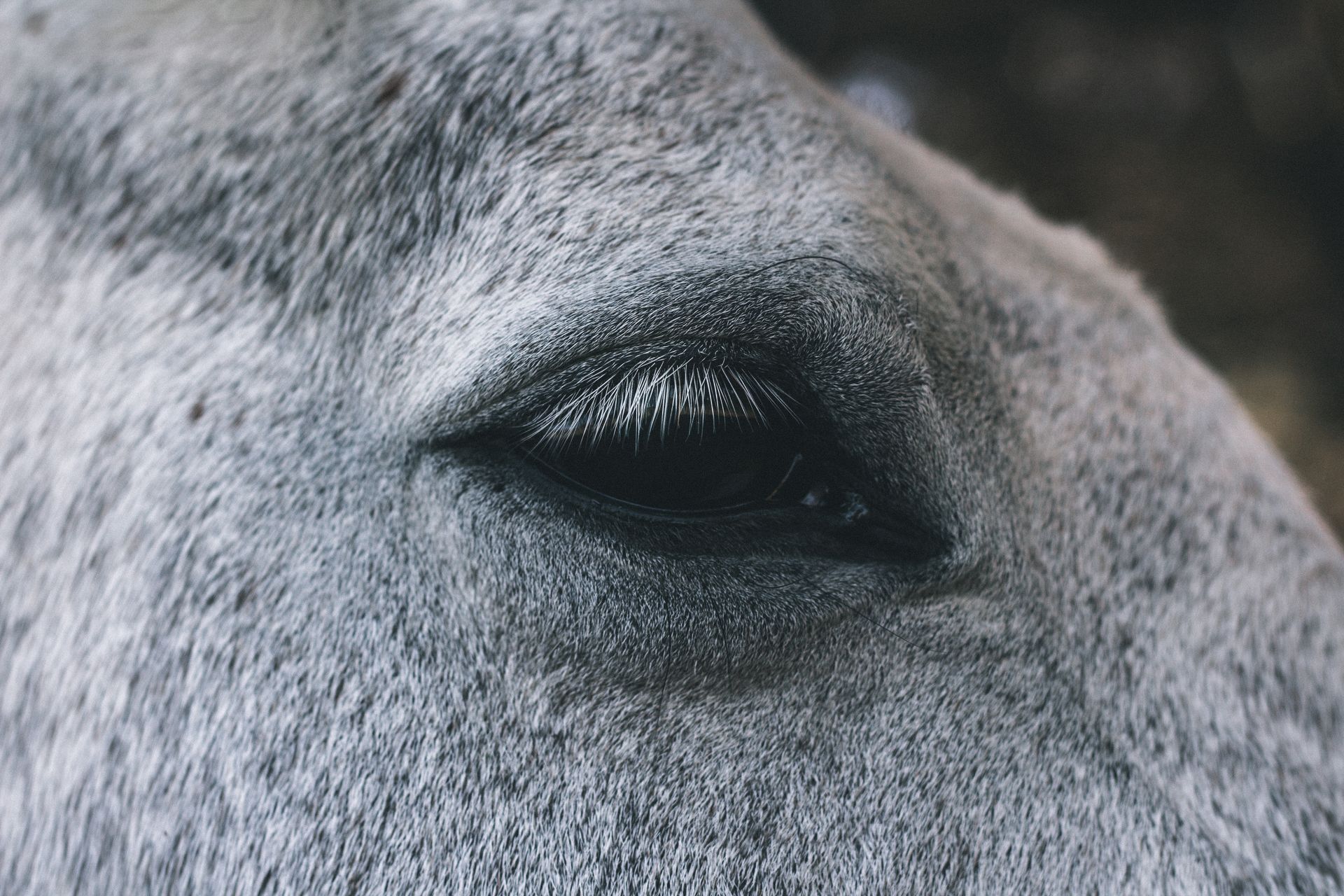
The horse's eye is made up of several intricate structures that work together to enable vision. The wall of the eye is composed of three layers: an outer fibrous tissue layer, a vascular tissue layer, and an inner layer of nervous tissue.
The outer layer is made up of the sclera, which is the white part of the eye, and the cornea, which is the clear dome in the front of the eye. This layer provides protection and structure to the eye.
The vascular tissue layer, also known as the uvea, contains the iris, ciliary body, and choroid. The iris is the colored part of the eye, and the ciliary body is responsible for changing the shape of the lens.
The inner layer of nervous tissue is the retina, which converts light into electrical impulses that are sent to the brain. The retina is a complex structure that is responsible for detecting light and color.
Here's a breakdown of the different parts of the eye:
- The pupil is the hole in the center of the iris through which light passes.
- The lens is a disc-like structure behind the iris and pupil that changes shape to focus light.
- The aqueous humor is a clear, watery fluid that bathes the lens and cornea, bringing oxygen and nutrients and removing waste.
- The vitreous humor is a clear, gel-like fluid that holds the retina in place.
- The conjunctiva is a protective layer of tissue that covers the sclera and lines the inside of the eyelids and the third eyelid.
- The lacrimal glands produce tears to keep the surface of the eye lubricated.
Common Impact Vision
Horses can experience a range of eye problems that impact their vision. These problems can be caused by various factors, including corneal disease, uveitis, cataracts, squamous cell carcinoma, and corpora nigra cysts.
Some of the most common eye problems in horses include corneal disease, which can cause ulcers, abscesses, and immune-mediated keratitis. Uveitis is another common issue, which can lead to inflammation and damage to the uvea, the middle layer of the eye.
See what others are reading: What Is Canine Lupus
Cataracts can also affect a horse's vision, causing cloudy or opaque areas in the lens of the eye. Squamous cell carcinoma is a type of skin cancer that can occur on the horse's eye, while corpora nigra cysts are benign growths that can appear on the iris.
Here are some common eye problems in horses:
- Corneal disease (ulcers, abscesses, immune-mediated keratitis)
- Uveitis
- Cataracts
- Squamous cell carcinoma
- Corpora nigra cysts
These eye problems can have a significant impact on a horse's performance and overall well-being. If left untreated, they can lead to further complications and even blindness.
Horse Eye Diseases
Horse eye diseases are a serious concern for horse owners. Corneal ulcers, for example, can be caused by plant material becoming lodged in the eye, leading to symptoms like squinting, redness, and discharge.
Some common eye problems in horses include corneal disease, uveitis, cataracts, squamous cell carcinoma, and corpora nigra cysts. These conditions can impact a horse's vision and even lead to blindness if left untreated.
If you suspect your horse has an eye condition, it's essential to act quickly and seek veterinary attention. Discharge, squinting, eyelid closure, cloudiness, and eyelid swelling are all signs that your horse's eyes need to be checked. Regular monitoring and prompt action can help prevent vision loss and even save your horse's eyesight.
For another approach, see: How to Cut a Horse's Mane?
Cataracts
Cataracts are a common eye problem in horses that can cause varying levels of blindness. They are caused by tiny, opaque spots on the lens of the eye.
Cataracts can be either genetic or caused by trauma or environmental factors such as toxins. If your horse has cataracts, you may notice a white lens or white discoloration in the pupil opening.
In some cases, mild cataracts can be treated with anti-inflammatory medications. However, severe cataracts may require the expertise of a veterinary ophthalmologist.
Here are some common signs of cataracts in horses:
- White lens or white discoloration in the pupil opening
If you suspect that your horse has cataracts, it's essential to consult with a veterinarian as soon as possible. Early detection and treatment can help preserve your horse's vision and overall eye health.
Signs of ErU

Equine recurrent uveitis (ERU) is a complex and sometimes painful condition in horses, and it's essential to recognize the signs of ERU early on to prevent vision loss or even blindness.
The symptoms of ERU can be subtle, ranging from mild tearing or swelling of the eyelids to more obvious squinting and changes in the eye's appearance, such as cloudiness.
One or both eyes can be affected, and the condition is not contagious, meaning it can't be spread from one horse to another.
Some horses may experience recurring episodes of active, painful inflammation in one or both eyes, followed by a dormant phase, while others may have persistent, low-grade inflammation, often in both eyes, with gradual tissue destruction.
The following table highlights some common symptoms of ERU:
Horses at increased risk for ERU include Appaloosas, European Warmbloods, and draft breeds, although any horse can be diagnosed with the condition.
It's essential to work closely with a veterinarian to diagnose and treat ERU, as the underlying cause may not always be clear and the condition requires a comprehensive approach to manage.
Squamous Cell Carcinoma
Squamous cell carcinoma is a common tumor in or around the equine eye, particularly in breeds like Belgians and Haflingers.
These breeds are predisposed to ocular SCC, which can be locally aggressive and tend to recur after initial treatment.
Surgical tumor removal or complete eye removal may be recommended, along with other treatments like chemotherapy or radiation.
Horses with a history of SCC should receive eye exams at least twice yearly to monitor for tumor recurrence.
UV light also plays a role in SCC development, so it's essential for predisposed breeds to wear a UV-blocking fly mask to reduce the chances of tumor development.
Horses who lack pigment around their eyes are also at a higher risk, making a UV-blocking fly mask a crucial addition to their grooming routine.
Periocular Sarcoids
Periocular Sarcoids are a common horse eye problem that occurs on the eyelid, often caused by bovine papillomavirus in younger horses.
These lesions can be aggressive, but fortunately, they are non-cancerous.
Sarcoids can vary in size and shape, and may occur in one or several locations on the eyelid.
There are five types of sarcoids that can develop: occult, verrucose, nodular, fibroblastic, and mixed.
Each type of sarcoid has its own unique characteristics, but all can be a concern for horse owners and veterinarians alike.
Sarcoids can also occur in other areas of the body, not just the eyelid, which is why it's essential to monitor your horse's overall health.
You might enjoy: Sarcoids Contagious
Common Types
Horse eye problems can be quite common, and it's essential to be aware of the most common issues that can affect your horse's vision.
Corneal disease is one of the most common eye problems in horses, which can manifest as ulcers, abscesses, or immune-mediated keratitis.
Uveitis is another common condition that affects the uvea, the pigmented layer of the eye.
Cataracts can also occur in horses, causing cloudiness or opacity in the lens of the eye.
Squamous cell carcinoma is a type of skin cancer that can affect the horse's eyes, particularly the eyelids and conjunctiva.
Corpora nigra cysts are benign growths that can form on the corpora nigra, a structure in the eye.
Here is a list of some common horse eye problems:
- Corneal disease (ulcers, abscesses, immune-mediated keratitis)
- Uveitis
- Cataracts
- Squamous cell carcinoma
- Corpora nigra cysts
Signs of Horses
Horses with eye problems can be quite a challenge to deal with. Clumsy behavior is one of the most common signs of a horse having eye issues.
If you notice your horse stumbling or tripping over its own feet, it could be a sign that something is wrong with its vision.
Self-trauma is another red flag that indicates your horse may have eye problems. This can manifest as excessive rubbing or pawing at its eyes.
Reluctance to move can also be a sign of eye issues in horses. If your horse is normally energetic and willing to move, but suddenly becomes sluggish, it's worth checking its eyes.
For your interest: Horses Eyes
Spooked behavior is another common sign of eye problems in horses. If your horse is easily startled or nervous, it could be a sign that its vision is impaired.
Head shaking is a clear indication that your horse is experiencing eye discomfort or pain.
Here are some common signs of horse eye problems:
- Clumsy behavior
- Self-trauma
- Reluctance to move
- Spooked behavior
- Head shaking
- Pastern Dermatitis
Visit to Ophthalmology Service
If your horse needs a closer look at its eyes, your primary veterinarian will likely refer you to the ophthalmology service.
A visit to the ophthalmology service at Cornell University Hospital for Animals (CUHA) is a great option for a thorough evaluation.
Each case receives a complete ophthalmic exam, which is tailored to the horse's specific needs.
You'll get individualized recommendations based on the diagnosis, and the ophthalmologists will work closely with you to decide the best course of treatment.
CUHA's ophthalmologists are trained in advanced surgical techniques, including corneal and intraocular surgeries like cataract surgery.
The team at CUHA is committed to providing comprehensive care alongside your primary veterinarian.
CUHA's ophthalmologists use advanced diagnostics like high-frequency ultrasound and in vivo confocal microscopy to get a detailed view of the horse's eyes.
They'll also use electroretinography to help diagnose eye problems.
The ophthalmologists at CUHA will keep your primary veterinarian updated on your horse's treatment and care plan.
See what others are reading: How to Get a Horse's Attention?
Diagnosing and Managing Conditions
Diagnosing and managing conditions in horses with eye diseases requires a careful approach. Veterinary eye examinations are best performed under sedation to ensure the horse remains calm and the eye can be thoroughly examined.
Fluorescein staining is often used to identify the extent of the lesion on the surface of the eye. This helps the veterinarian understand the severity of the condition and develop an effective treatment plan.
If your veterinarian suspects a problem with your horse's eye, they will first need to sedate your horse. This allows them to perform a thorough examination and determine the best course of action.
The delivery method for treatment depends on which part of the eye needs attention. Topical therapy, such as eye drops, is typically used to treat conditions affecting the conjunctiva, cornea, anterior chamber, and iris.
However, treating your horse with eye drops can be difficult or even dangerous if the condition is causing pain. In such cases, your veterinarian may explore other possible solutions.
To manage a horse with an eye condition, it's essential to create an ideal healing environment. This includes feeding your horse from the ground to prevent further contaminating the eye and using sawdust instead of straw as stall bedding.
Common Equine Conditions
Many eye problems can affect a horse's vision, ranging from minor to serious conditions. Usually, only one eye is affected, but in some cases, both eyes can be affected.
Corneal disease is one of the most common eye problems in horses, and it can manifest as ulcers, abscesses, or immune-mediated keratitis.
Here's an interesting read: One Blue Eye One Brown Eye Dog Names
Uveitis is another common eye condition that can cause inflammation in the eye. It's a serious condition that requires prompt veterinary attention.
Cataracts can also affect a horse's vision, causing cloudiness or opacity in the lens of the eye.
Squamous cell carcinoma is a type of skin cancer that can affect the eyes of horses, and corpora nigra cysts are a common eye condition that can cause discomfort and vision problems.
Here are some of the most common eye conditions that veterinarians see in horses:
- Corneal disease (ulcers, abscesses, immune-mediated keratitis)
- Uveitis
- Cataracts
- Squamous cell carcinoma
- Corpora nigra cysts
Frequently Asked Questions
What is the most common ophthalmic disease in horses?
The most common ophthalmic disease in horses is a superficial corneal ulcer, which affects the clear layer covering the front of the eye. This condition requires prompt veterinary attention to prevent vision loss and complications.
What does a horse eye infection look like?
A horse eye infection, also known as conjunctivitis, causes red, sore eyes with excessive watering and a yellow discharge that can stick eyelids together. If you suspect your horse has conjunctivitis, it's essential to seek veterinary care to prevent complications.
Featured Images: pexels.com