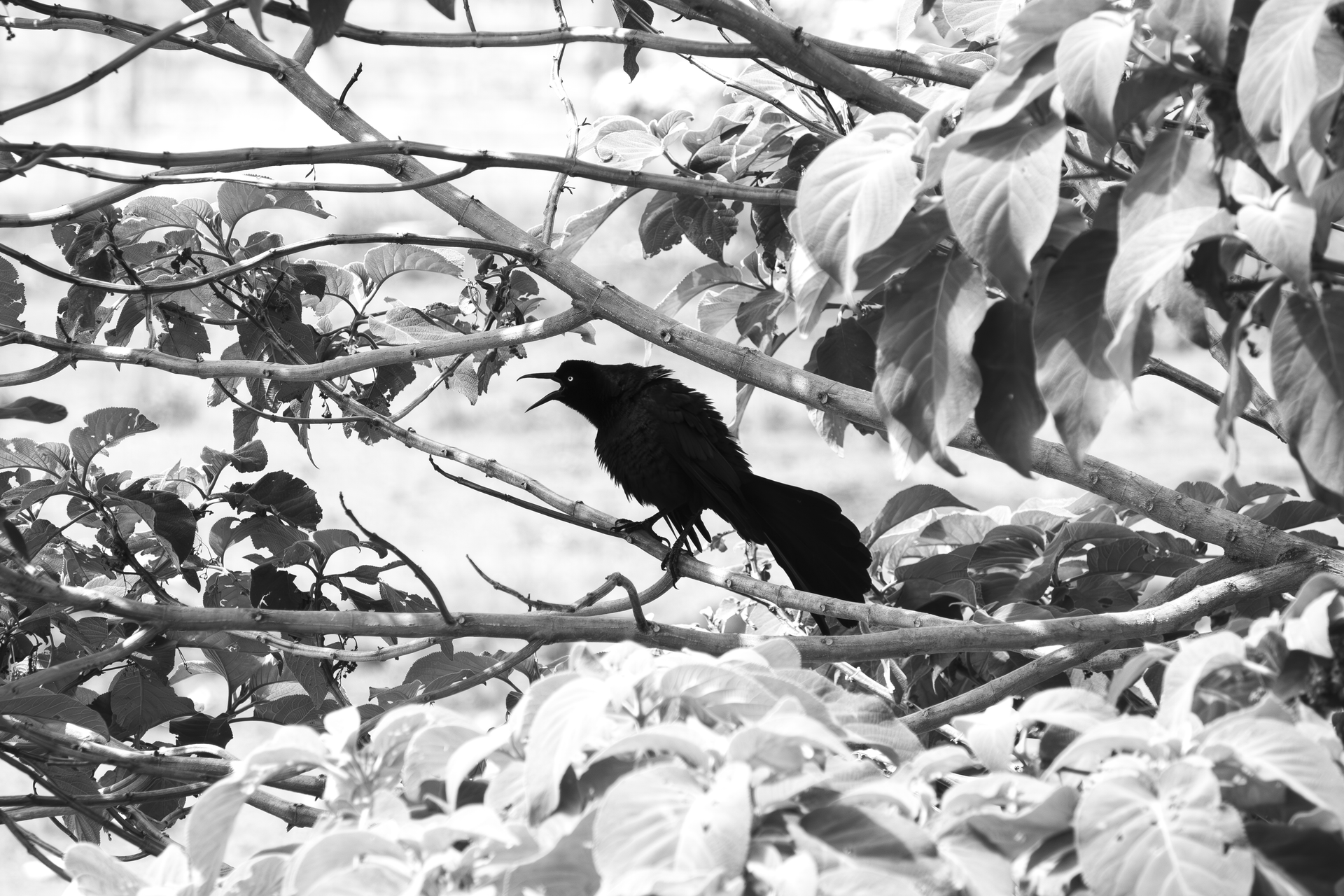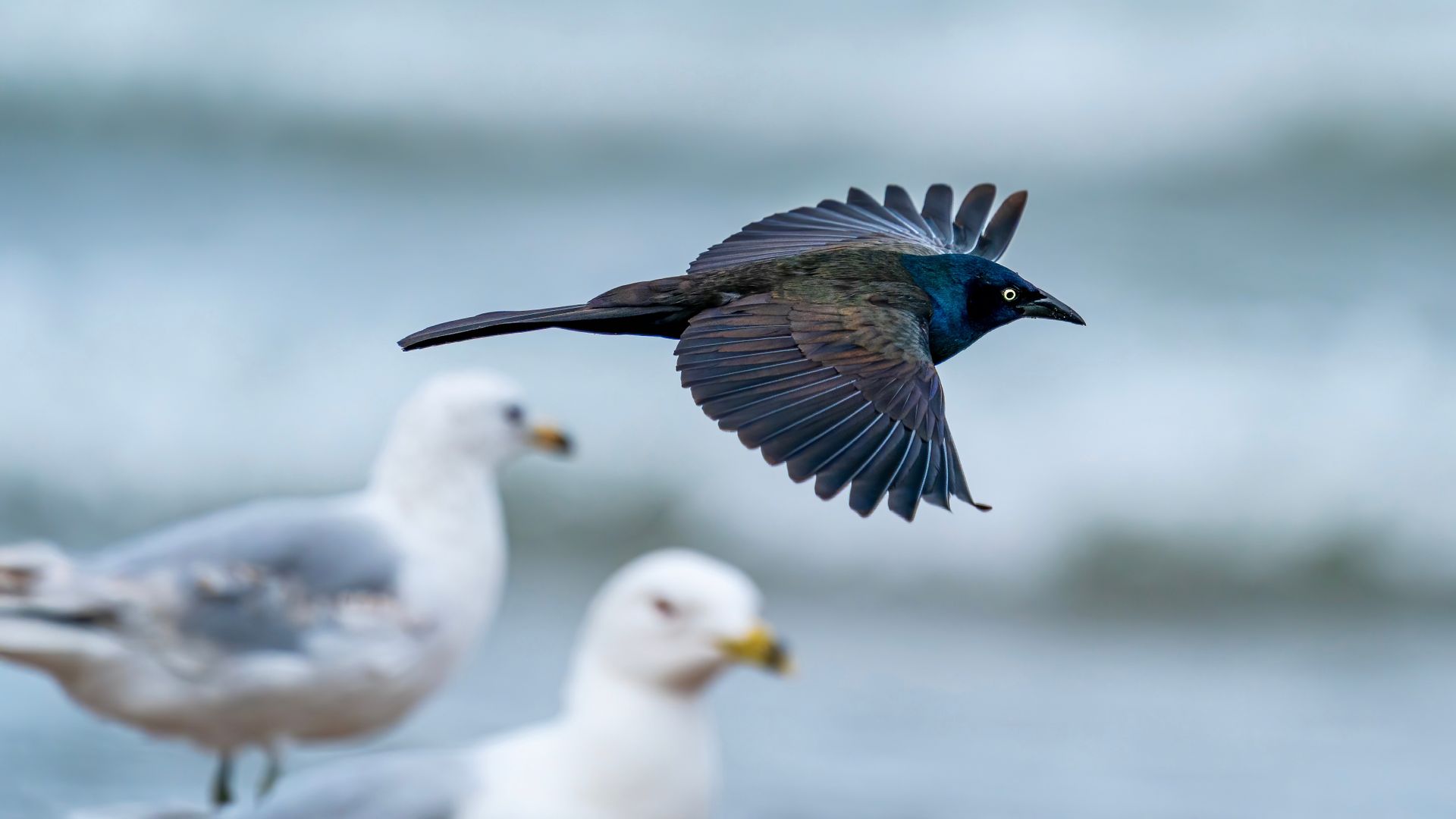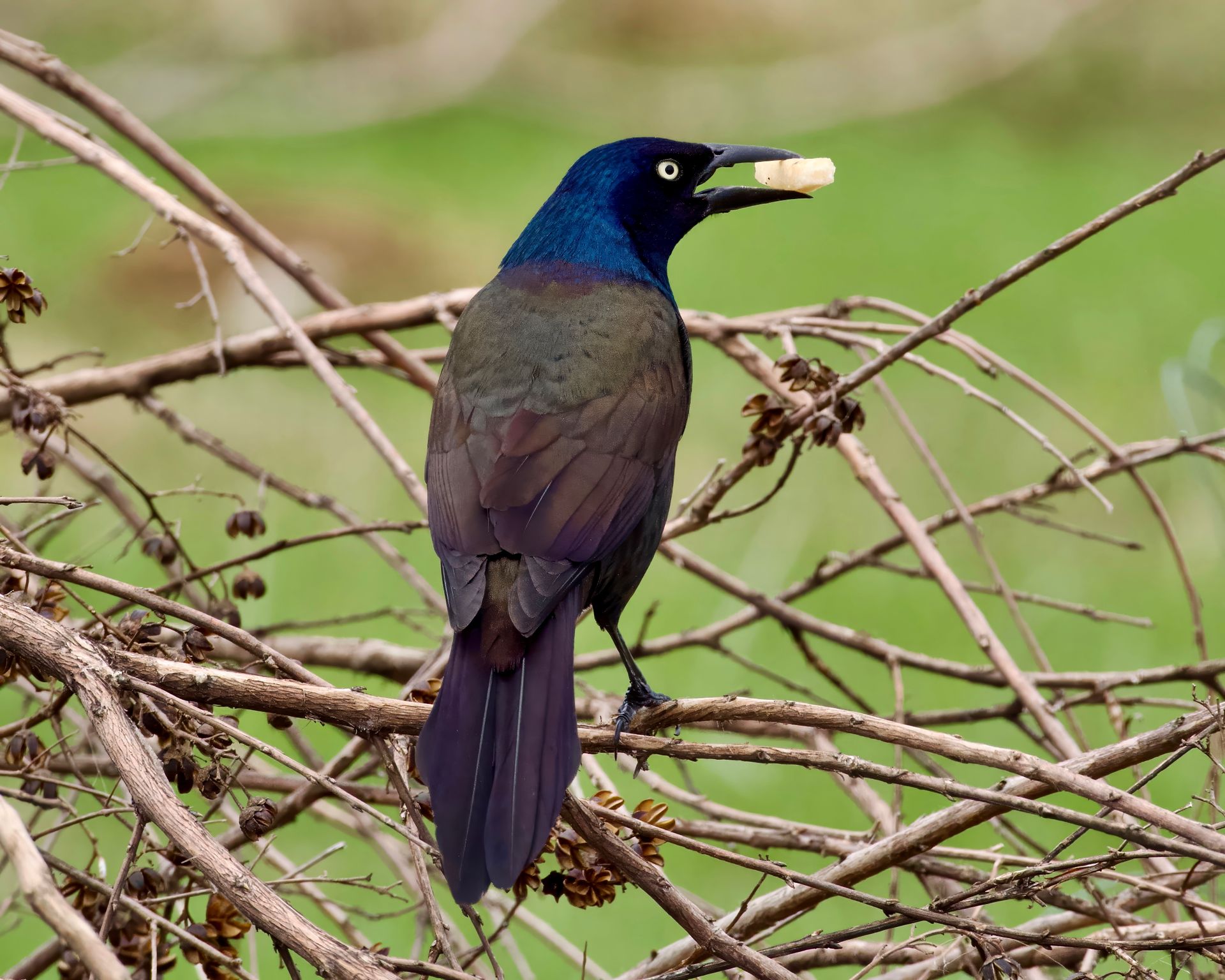
The Greater Antillean Grackle is a bird species found in the Caribbean region, specifically in the Greater Antilles islands of Cuba, Hispaniola, Jamaica, and Puerto Rico.
This bird species is known for its iridescent feathers, which give it a distinctive glossy appearance.
The Greater Antillean Grackle is a member of the Icteridae family, which also includes other grackle species found in North and South America.
It's a medium-sized bird, typically measuring between 10 and 12 inches in length.
Explore further: American White Ibis Bird
Physical Characteristics
The greater antillean grackle is a relatively large songbird, with males reaching around 27 cm (11 inches) long and females averaging 24 cm (9.4 inches).
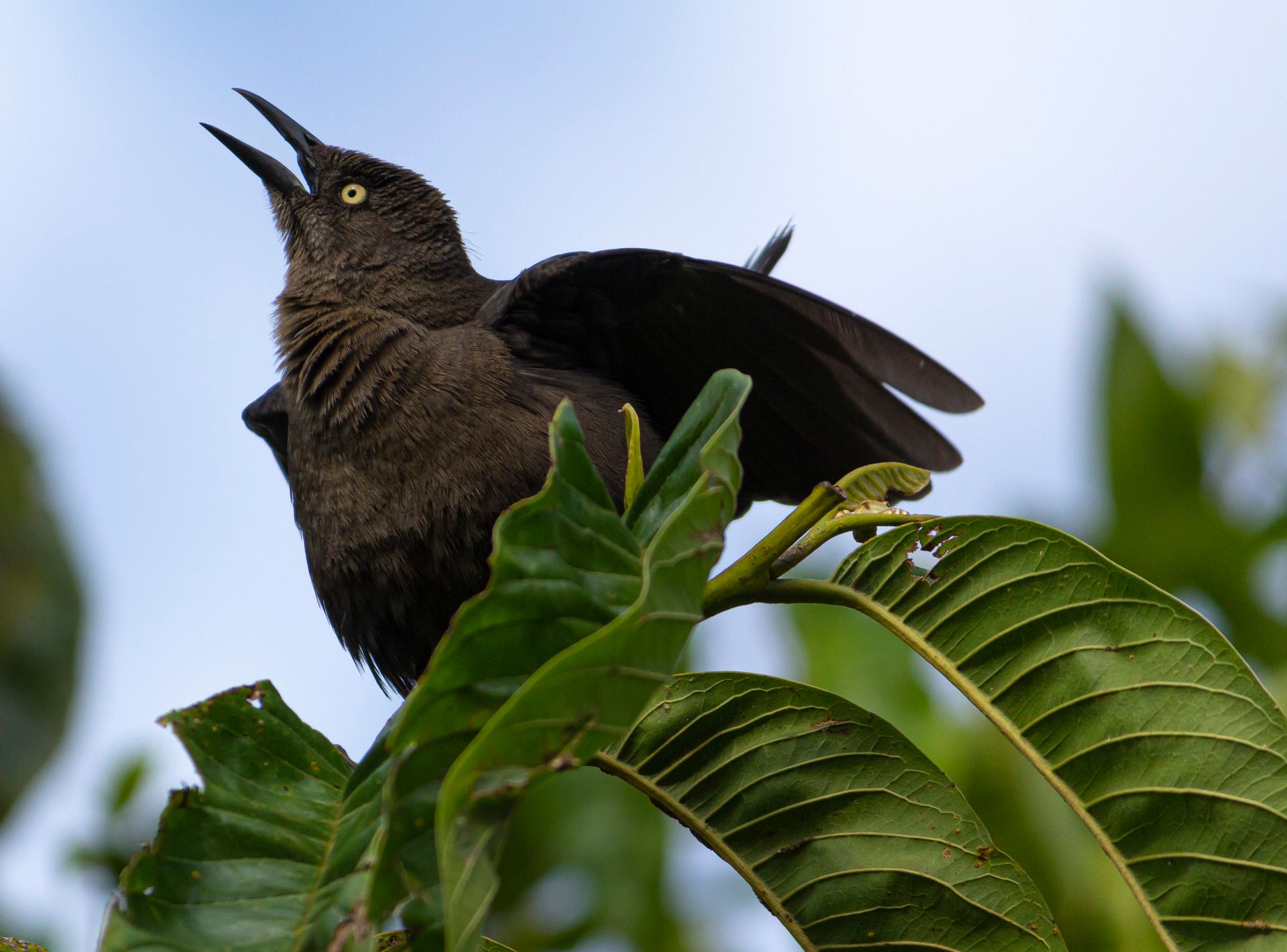
Their weight ranges from 62-73 g (2.2-2.6 oz), which is a decent size for a songbird. The males tend to show a deeper glossy black tone, especially on the head and breast, contrasting with their bright yellow eyes.
Females, on the other hand, exhibit a slightly duller, less iridescent black overall, but they have beautiful silver-speckled undertail coverts, especially mature ones.
Both sexes share the grackle's iconic keel-shaped tail, though this steering rudder is more pronounced on males. The white undertail becomes visible in flight, creating a flashy contrast against the bird's otherwise dark coloration.
Here are some key physical characteristics of the greater antillean grackle:
- Males: 27 cm (11 inches) long, 62-73 g (2.2-2.6 oz) weight
- Females: 24 cm (9.4 inches) long, 62-73 g (2.2-2.6 oz) weight
- Males: Deeper glossy black tone on head and breast, bright yellow eyes
- Females: Slightly duller, less iridescent black overall, silver-speckled undertail coverts
Habitat and Diet
The Greater Antillean grackle is a bird that thrives in a variety of habitats, including mangrove forest edges, pastures, farms, and towns in the Greater Antillean islands.
It's common to see them in urban and suburban developments, frequenting parks, streets lined with trees, and backyards, where they often nest on buildings and forage for scraps.
These birds are adaptable and can be found in open areas like pastures, agricultural lands, coastal scrub, and beaches, as long as there are elevated perches like powerlines or scattered taller trees for them to scan for food.
Some of their favorite foods include insects, fruit, and seeds. They'll probe the ground to flush out crickets, beetles, grubs, and spiders, and eagerly consume figs, mangoes, citrus fruits, guavas, papayas, and berries when available.
Their opportunistic diet also includes tree frogs, anoles, small snakes, and nestling birds, as well as scraps and trash associated with human habitation.
Habitats
The Greater Antillean Grackle is a versatile bird that thrives in various habitats across the Caribbean region. It's commonly found in lowlands and open areas, including mangrove forest edges, pastures, farms, and towns.
These birds often nest on buildings and forage for scraps in cities, frequenting parks, streets lined with trees, and backyards. They can also be found in more open areas like pastures, agricultural lands, coastal scrub, and beaches.
In fact, the Greater Antillean Grackle exploits any habitat that provides elevated perches like powerlines or scattered taller trees, allowing it to scan for food on the ground while staying safe from predators.
Their diet consists of various food sources, including insects, fruit, and possibly scraps. Access to grassy areas for foraging insects and trees bearing fruit or nesting cavities are other habitat musts.
For another approach, see: Great Tailed Grackle Habitat
What Do Eat?
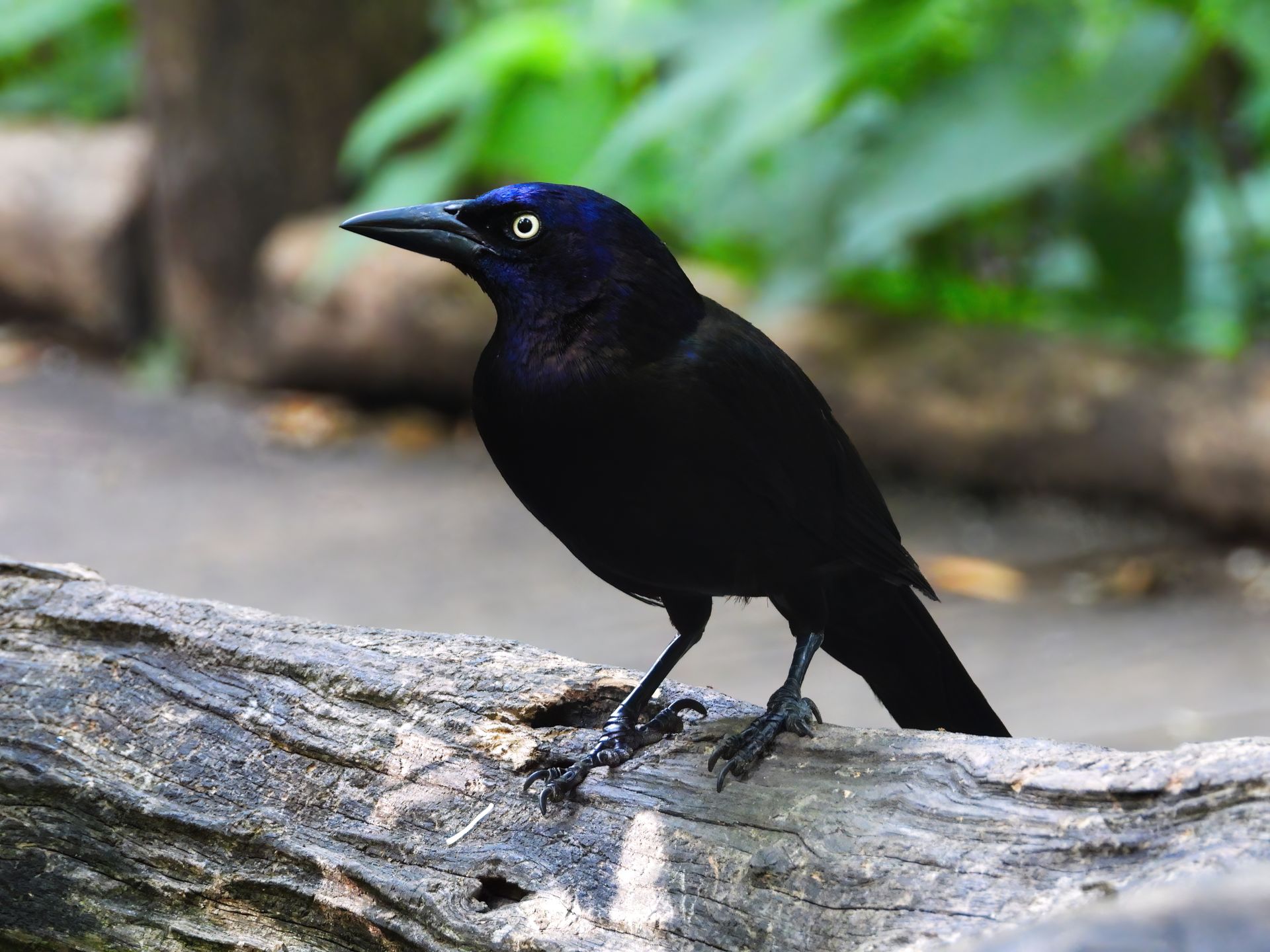
The Greater Antillean grackle is an opportunistic generalist when it comes to diet. Equipped with a strong beak, they can handle various food sources with ease.
Insects and other arthropods make up a substantial portion of their nutrition. They probe the ground to flush out crickets, beetles, grubs, spiders, and more.
Fruit and seeds are also on the menu when available. Figs, mangoes, citrus fruits, guavas, papayas, and berries have all been recorded as grackle foods.
Their droppings play a role in distributing seeds, and their flexible food preferences span fruit to French fries. They make the most of the resources available across their Caribbean range.
Here are some examples of the grackle's varied diet:
- Insects and other arthropods
- Fruit (e.g. figs, mangoes, citrus fruits, guavas, papayas, berries)
- Seeds
- Small animals (e.g. tree frogs, anoles, small snakes, nestling birds)
- Scraps and trash associated with human habitation
What Eats Grackles?
Grackles have a few predators to watch out for. Birds of prey like hawks, falcons, owls, and vultures are known to prey on grackle adults, chicks, or eggs.
Some mammals also pose a threat to grackle nests. Raccoons, coatis, and even feral cats have been known to raid nests.
Snakes are another predator to be aware of. Boa constrictors and other climbing snakes have been spotted raiding bird nests.
To avoid predation, grackles have adapted to disturbed habitats with sparser predator populations. Their social behavior also helps adult birds avoid predators.
The cost of losing some chicks or eggs to predators is likely tolerable for the grackle population.
Behavior and Social Structure
The Greater Antillean grackle is a highly social bird that thrives in the company of its own kind. Flocks can range from a handful to over 100 individuals, mixing males and females, and even including first-year juveniles that have just fledged the nest.
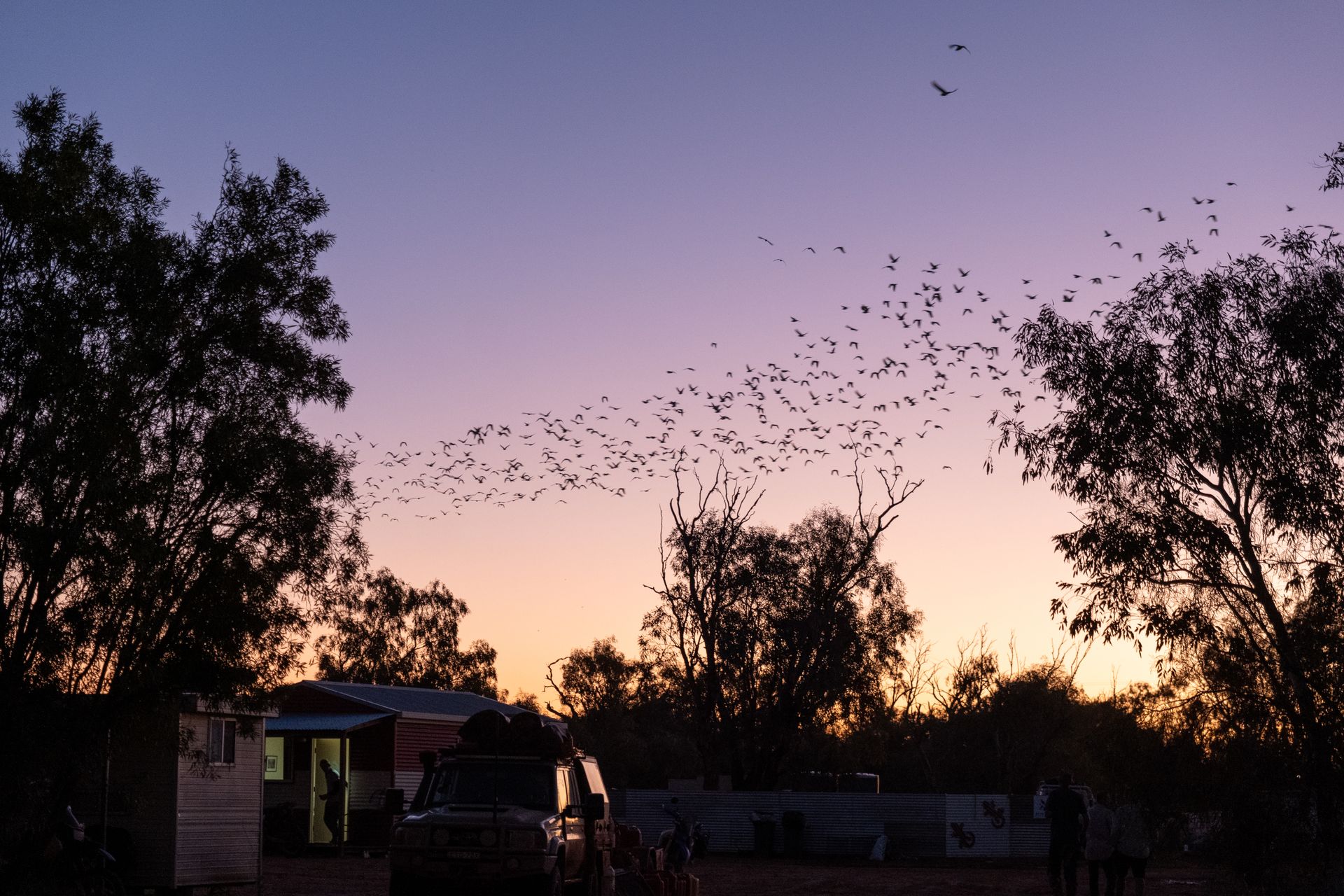
Grackles are known to roost communally in trees or on rooftops at night, with some aggregations containing several thousand birds. They jostle noisily for the best protected perching spots, making for a lively scene.
To communicate with each other, grackles use a variety of sounds, including squeals, croaks, and chatter. While these noises might seem chaotic to human ears, they play a crucial role in maintaining flock cohesion and warning others of potential threats.
Social Behavior
The Greater Antillean grackle is a social butterfly - or rather, bird! It spends much time in small to large flocks, especially foraging.
Flock sizes can range from a handful to 100+ individuals, mixing males and females. First-year juveniles may also join flocks after fledging the nest.
To communicate within these flocks, grackles use a variety of sounds, including squeals, croaks, and chatter. These vocalizations may seem chaotic to human ears, but they serve to maintain flock cohesion.
Grackles also vocalize aggressively when defending feeding or nesting territories. This is just one way these birds work together to protect their interests.
In the evenings, grackles roost communally in trees or on rooftops, often jostling noisily for the best protected perching spots. These roosting aggregations can contain several thousand grackles!
Breeding Habits
The Greater Antillean Grackle's breeding habits are quite fascinating. They build nests made of grass and sticks, typically high up in palm fronds or the fork of a tree, to protect themselves from predators.
The breeding season for this species is quite long, spanning from February to September, but it's most active from March to June. This means that they're not just limited to a short spring season, but rather have a prolonged breeding period.
Both male and female grackles participate in nest construction, weaving the sturdy baskets from various materials like sticks, grass, plastic fibers, paper, and mud. This collaborative effort ensures that the nest is strong and secure.
A typical grackle clutch contains 3 to 5 eggs, which the female incubates for around 12-14 days before they hatch. After that, both parents share feeding duties for the noisy nestlings.
Here's a breakdown of the breeding season for the Greater Antillean Grackle in different locations:
Classification and Taxonomy
The Greater Antillean grackle is a member of the diverse Icterid family of songbirds, which includes New World blackbirds, orioles, cowbirds, and other grackle species. This family is known for its vibrant songs and striking plumage.
The Greater Antillean grackle is classified as Quiscalus niger, a name coined by Pieter Boddaert in 1783. This species has further differentiated into 7 recognized subspecies, each located on a distinct island or island group.
Here are the 7 subspecies of the Greater Antillean grackle, each with its unique characteristics:
- Quiscalus niger niger: Found on Hispaniola.
- Quiscalus niger caribaeus: Occurs in western Cuba.
- Quiscalus niger gundlachii: Lives in central/eastern Cuba.
- Quiscalus niger caymanensis: Only found on Grand Cayman Island.
- Quiscalus niger bangsi: Restricted to Little Cayman Island.
- Quiscalus niger crassirostris: Native to Jamaica.
- Quiscalus niger brachypterus: Found only in Puerto Rico.
Taxonomy
The Greater Antillean grackle has a rich taxonomy that's worth exploring. The species was first described by Georges-Louis Leclerc, Comte de Buffon in 1775 in his Histoire Naturelle des Oiseaux.
The grackle's scientific name, Quiscalus niger, was coined by Pieter Boddaert in 1783. The genus Quiscalus was introduced by Louis Pierre Vieillot in 1816, and it now includes seven species, with the Greater Antillean grackle being one of them.
The genus name Quiscalus is derived from the specific name Gracula quiscula, coined by Carl Linnaeus for the common grackle. The specific name niger is Latin for "black", which refers to the bird's glossy black plumage.
Take a look at this: Common Yellowthroat Scientific Name
Here are the seven recognized subspecies of the Greater Antillean grackle, each with its own unique characteristics:
- Q. n. niger – found on Hispaniola (Haiti and the Dominican Republic)
- Q. n. caribaeus – found in western Cuba and on Isla de Juventud
- Q. n. gundlachii – found in central and eastern Cuba
- Q. n. caymanensis – found on Grand Cayman Island
- Q. n. bangsi – found on Little Cayman Island
- Q. n. crassirostris – found in Jamaica
- Q. n. brachypterus – found in Puerto Rico
Comparison with Relatives
The Greater Antillean Grackle's family ties are quite interesting. It shares similarities with other icterids like the Common Grackle of North America and the Carib Grackle of South America.
One of the key differences between the Greater Antillean Grackle and these relatives is the lack of iridescent blue-purple sheen on its head and body, found in Carib Grackles.
The Greater Antillean Grackle also has yellow eyes, whereas its relatives have pale yellow or white eyes.
In flight, the Greater Antillean Grackle's tail shape is more rounded and fan-like, whereas the Common Grackle's tail is rectangular.
Here are some key differences to help you distinguish the Greater Antillean Grackle from its relatives:
- Lacks iridescent blue-purple sheen on head and body
- Has yellow eyes
- Tail shape in flight is more rounded fan
This restricted range to Caribbean islands also helps you rule out the Greater Antillean Grackle if you spot an all-black grackle on the North or South American mainlands.
Conservation and Status
The Greater Antillean Grackle has a stable population within its distribution range and is listed as a species of Least Concern by the IUCN (BirdLife International 2018).
Locally, this species is very common and not listed under any threatened categories of PRDNER or USFWS. In Puerto Rico, the Greater Antillean Grackle has a protected habitat in land covering 11 percent of the total area, or 1078 km2.
The Greater Antillean Grackle is classified as Least Concern due to its wide distribution as of 2018 assessment, according to the IUCN Red List and BirdLife International.
Endemic Bird
The Greater Antillean Grackle is a clever bird that's quite comfortable in heavily disturbed habitats or areas with high human activity. It's not shy at all and can become a nuisance, trying to steal humans' food!
This bird is found on several islands in the Greater Antilles, including Cuba, Jamaica, Hispaniola, Puerto Rico, the Cayman Islands, and adjacent offshore islands. There are seven sub-species of the Greater Antillean Grackle.
A different take: Black Capped Chickadee Images
The Greater Antillean Grackle has a distinctive 4-syllable song "cling cling clii-ing" that sounds like a rusty hinge, and also gives musical notes, a sharp "cluck", and wheezy gasps. It's a vocal bird that expresses itself well.
Locally referred to as Chango, Cling-cling or variations of this name, the Greater Antillean Grackle is a common bird that's easy to spot. It's classified as Least Concern, but deforestation of its nesting and roosting habitats is a common threat.
The Greater Antillean Grackle is a bird that thrives in water, and can often be seen splashing around in bird baths in the rain! It forages mostly on the ground, eating fruits, plants, small vertebrates, invertebrates, and human food scraps.
A different take: Common Yellowthroat Female
Conservation Status
The Greater Antillean Grackle is a species of least concern, according to the IUCN Red List and BirdLife International.
Its population is stable within its distribution range, and it's not listed as threatened by PRDNER or USFWS.
Locally, this species is very common in Puerto Rico, where it has a protected habitat covering about 11% of the island's land area.
The total area protected for this species is 1078 km2, which is larger than the island's total terrestrial area.
The Greater Antillean Grackle is not considered to be under any threat due to its wide distribution.
Its conservation status is classified as Least Concern as of the 2018 assessment by the IUCN Red List and BirdLife International.
Expand your knowledge: Inaccessible Island Rail
Identification and Sound
The Greater Antillean Grackle's song is a distinctive metallic 4-syllable phrase "cling cling clii-ing" that sounds like a rusty hinge.
This unique sound is a key identifier for the species, and it's often described as a sharp "cluck" and wheezy gasps.
Scientific Details
The greater antillean grackle is a bird species that's been around for a while. It was first named by Pieter Boddaert in 1783.
Its scientific name is Quiscalus Niger, a name that's been stuck with it ever since Boddaert gave it to the species.
See what others are reading: Brown Headed Cowbird Scientific Name
Fun Facts
The Greater Antillean Grackle is a fascinating bird species. Their scientific name, Quiscalus niger, comes from the Latin term for a kind of thrush, while niger means black or dark.
The grackle's common name refers to the Greater Antilles Island group in the Caribbean where it occurs, differentiating it from the smaller Lesser Antilles chain.
One of the grackle's most distinctive features is its keel-shaped tail, which helps it steer and maneuver adeptly while flying through its island habitat.
Here are some of the grackle's unique vocalizations and local names: “Chango” in Puerto Rico“Ching ching” in the Cayman Islands
The grackle's behavior is just as interesting as its appearance. They practice "anting" by perching over fire ants to let the insects swarm through their feathers, which may help deter lice and other feather parasites.
Male grackles are quite the show-offs, putting on an acrobatic courtship display by fanning their long tail vertically while strutting and puffing their glossy feathers to entice females.
The grackle's affinity for berries helps disperse seeds far and wide through their droppings, playing an unsung role in enriching new vegetation growth across the islands!
For another approach, see: Northern Mockingbird Scientific Name
Frequently Asked Questions
How do you tell the difference between male and female greater antillean grackles?
To identify a male Greater Antillean Grackle, look for its entirely black plumage with purple gloss on the head and upperparts, while females are smaller and less glossy. The key difference lies in their size and glossiness, with males having a more vibrant appearance.
Are grackles native to Puerto Rico?
Yes, the Greater Antillean Grackle is native to Puerto Rico, one of the four main islands in the Greater Antilles where it can be found.
Featured Images: pexels.com