The American White Ibis is a fascinating bird species, and understanding its behavior and diet is key to appreciating its unique characteristics.
These birds are social creatures, often gathering in large groups, especially during breeding and foraging seasons.
They're known to form long-term monogamous relationships, with some pairs staying together for up to 20 years.
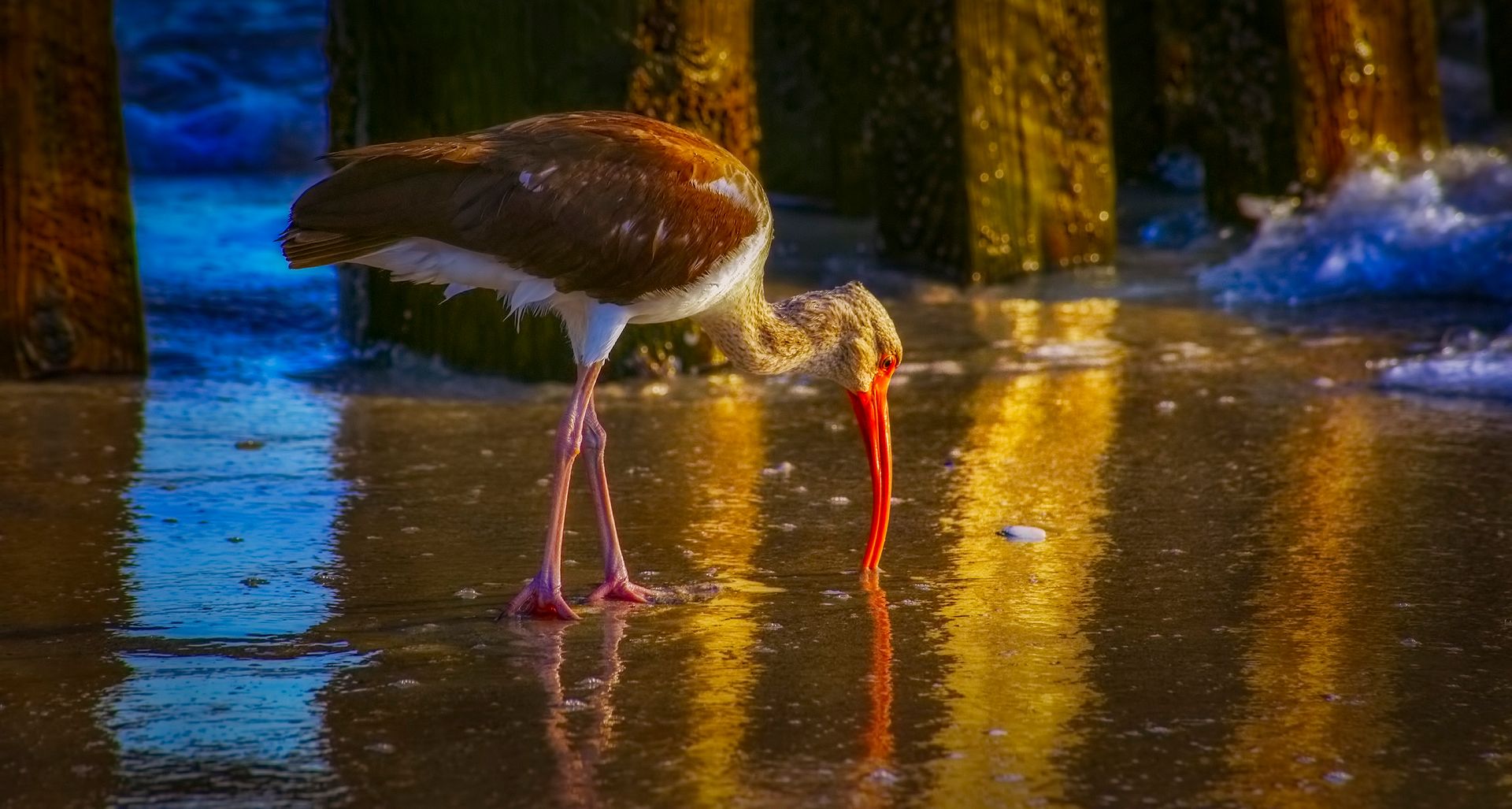
In their search for food, American White Ibises are opportunistic waders, using their sensitive bills to probe into shallow waters and mudflats.
What They Look Like?
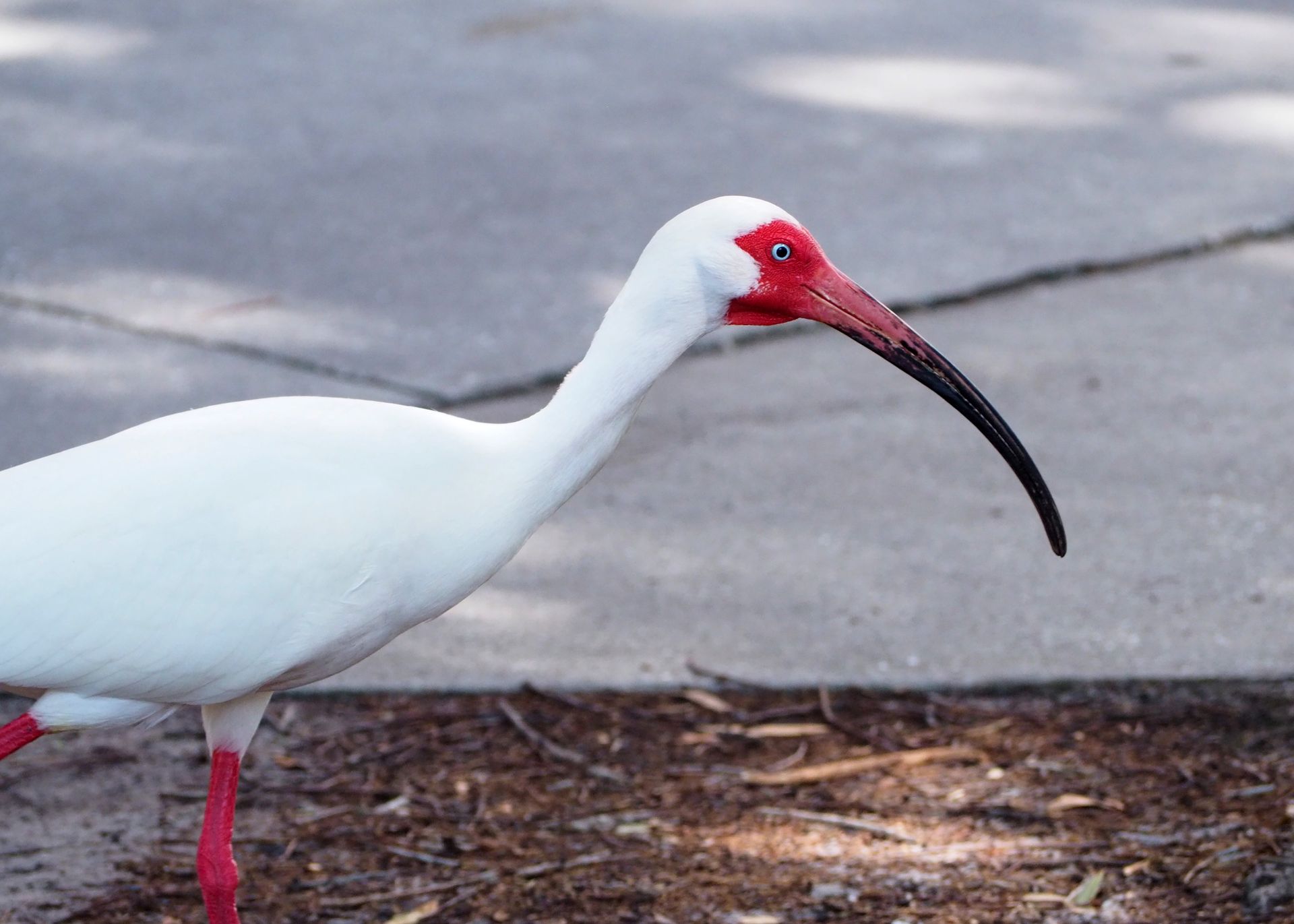
The American White Ibis is a stunning bird with a unique appearance. Adult ibises have white feathers with pink skin on their faces, and their black wingtips are usually only visible when they fly.
Their long, curved bill and legs are bright red-orange when they're not breeding. During breeding season, their skin darkens, and their bill becomes a deep pink, while their legs turn a purplish-red.
Males are generally bigger and heavier than females, weighing around 870-1260 grams (2-2.8 pounds), compared to females who weigh about 590-860 grams (1.3-1.9 pounds). These birds are approximately 53-70 cm (21-28 inches) long, with a wingspan of 90-105 cm (35-41 inches).
Baby ibises are covered in violet-colored down feathers when they first hatch. Their head and wings are dark brown or black, and their eyes are brown. Their skin is initially pink but turns gray within a few days.
Adult American White Ibises fly with their neck and legs stretched out, often in long lines or V-shapes, which helps them conserve energy while flying. They make a distinctive honking noise, like "urnk, urnk" or "hunk, hunk", which they use for various purposes.
Here's a comparison of male and female American White Ibises:
Where Do They Live?
The American White Ibis is a bird that can be found in a variety of habitats, including fresh and salt water wetlands, coastal areas, salt marshes, ponds, lakes, streams, and surrounding areas.
They are most common in Florida, where over 30,000 have been counted in a single breeding colony, and also occur throughout the Caribbean, on both coasts of Mexico, and Central America.
The species is known to wander, and has been sighted in states far out of its usual range, including as far north as New Jersey and Virginia.
In North America, breeding takes place along the Atlantic coast, from southern New Jersey south to Florida and thence west along the Gulf Coast.
Here are some specific habitats where American White Ibises can be found:
- tropical
- terrestrial
- saltwater or marine
- freshwater
They can be found in a range of aquatic biomes, including lakes and ponds, coastal areas, and brackish water.
Their range territory size can vary, but is typically between 100 to 800 km^2.
They are found year-round from Delaware south to the shores of Central America, and can be seen as far north as New York at the end of the summer.
Behavior and Diet
The American White Ibis is a fascinating bird species, and understanding its behavior and diet is crucial to appreciating its unique characteristics.
They search for prey in shallow waters, typically around 10 to 15 cm deep, where they feed on a variety of aquatic organisms.
Their diet includes insects, crustaceans, small fish, snails, frogs, and other aquatic organisms, which they hunt by feeling the ground with their long, curved bill.
Adult White Ibises feed in very large groups, while juveniles feed on the perimeter of the colony in the less desirable waters.
Here's a breakdown of their primary diet:
- Primary Diet: carnivore
- Animal Foods:
- reptiles
- fish
- insects
- terrestrial non-insect arthropods
- mollusks
- aquatic crustaceans
What Do They Eat?
White ibises are skilled hunters that search for prey in shallow waters, typically around 10 to 15 cm deep. They have a varied diet that includes insects, crustaceans, small fish, snails, frogs, and other aquatic organisms. Their long, curved bill allows them to dig into the mud and find prey, and also helps them search for food in slightly deeper water.
Their diet consists of a variety of animal foods, including reptiles, fish, insects, terrestrial non-insect arthropods, mollusks, and aquatic crustaceans. They hunt by feeling the ground with their bill, which is a unique adaptation that helps them find food in their environment.
In the wild, I've observed that adult white ibises feed in very large groups, while juveniles tend to feed on the perimeter of the colony in less desirable waters. This suggests that they have a social hierarchy and that younger birds may have limited access to food sources.
Here's an interesting read: American White Pelican Diet
Home Range
White ibises are quite flexible when it comes to traveling. They usually travel based on how much food is available and the conditions of their current habitat.
Their daily foraging trips typically cover less than 40 km at a time. This allows them to easily return to their colonies.
Colonies of more than 1,000 breeding pairs can cover over 800 square kilometers of wetlands. This extensive range helps ensure the survival of the species.
Breeding and Lifespan
The American White Ibis is a remarkable bird species. They can live up to 16 years and 4 months in the wild, although this is the maximum lifespan recorded so far.
Nesting ibises face significant challenges, particularly in the first 20 days post-hatching. Predation is a major concern during this critical period.
In captivity, the maximum recorded lifespan is 27 years and 7 months. This is significantly longer than their wild counterparts.
Here's a summary of the American White Ibis's lifespan in the wild and captivity:
- Range lifespan (wild): 16.3 years
- Range lifespan (captivity): 27.6 years
- Average lifespan (captivity): 20 years
- Average lifespan (wild): 196 months
Conservation and Threats
American white ibises face several threats that affect their populations. Alligators might eat nesting ibises, but there hasn't been much research on this.
Parasitic worms have been found in American white ibises, with some types more common in freshwater habitats and others in saltwater areas. These worms mostly live in their stomachs and intestines.
Protecting the places where ibises nest and find food is crucial for maintaining healthy populations. This can be a challenge due to the birds' tendency to move their breeding colonies around.
The number of breeding birds can fluctuate, with 166,000 counted in Texas, Louisiana, Florida, and the Carolinas in 2001, and 209,000 in 2004.
Taxonomy
The American white ibis has a rich history in taxonomy. The species was first described by Carl Linnaeus in 1758 as Scolopax albus, with the species name "albus" meaning "white" in Latin.
The original name was given due to the bird's distinctive white plumage. However, over time, other common names have been used, including Spanish curlew and white curlew.
Mark Catesby, an English naturalist, even mistook immature birds for a separate species, which he called the brown curlew. This highlights the complexity of bird classification.
The American white ibis was later given its current binomial name, Eudocimus albus, by Johann Georg Wagler in 1832. This name change reflected the bird's unique characteristics and placement within the genus Eudocimus.
The genus Eudocimus also includes the scarlet ibis (E. ruber), a closely related species. However, there has been ongoing debate about whether the two species should be considered subspecies or closely related species.
Here are some key taxonomic facts about the American white ibis:
The American Ornithologists' Union considers the two species to be a superspecies due to their parapatric distribution. This means that they are found in different geographic areas, but their ranges overlap in some regions.
In fact, researchers have observed interbreeding between the two species in areas where their ranges overlap, such as along the coast and in the Llanos region of Colombia and Venezuela.
In Culture
The American white ibis has a rich cultural significance, particularly in Native American folklore, where it's believed to be the last bird to seek shelter before a hurricane and the first to emerge afterwards.
This unique characteristic made the bird a symbol of both danger and optimism. The University of Miami took notice of this symbolism and adopted the American white ibis as its official athletics mascot in 1926.
The university's yearbook was also named The Ibis from that year, reflecting the bird's newfound importance on campus.
Worth a look: American White Ibis Habitat
Similar Birds
It can be very hard to tell young American white ibises apart from young scarlet ibises. Scarlet ibises usually have darker legs and bare skin around their face.
A young American white ibis might also look like a young glossy ibis. However, the glossy ibis is completely dark brown and doesn't have a white belly or rump.
Adult white ibises are different from the wood stork, which is much larger and has more black on its wings.
General Information
The American White Ibis is a bird species that can be found in various parts of North America.
They have a distinctive appearance, with a white body, pink legs, and a curved bill.
Their habitat ranges from coastal wetlands to inland areas, including mangrove forests and salt marshes.
These birds are social creatures and are often seen in large flocks.
The American White Ibis breeds in colonies, with both males and females taking turns incubating eggs and caring for their young.
Their diet consists mainly of small crustaceans, fish, and other aquatic animals.
Some of the key threats to their populations include habitat loss and degradation, as well as entanglement in fishing nets and other human activities.
Here are some interesting facts about the American White Ibis:
Frequently Asked Questions
Are white ibis friendly?
White ibis can be aggressive during mating season, but they are generally social birds that live in large flocks near water. Their friendly nature is often overshadowed by their territorial behavior during breeding.
What does the white ibis mean in the United States?
In Native American folklore, the white ibis is a symbol of both optimism and danger, associated with hurricanes. This bird is said to be the last to seek shelter and the first to emerge after a storm.
Can American white ibis eat bread?
Yes, American white ibises are known to eat bread, but it's not a natural part of their diet and can be detrimental to their health.
Featured Images: pexels.com