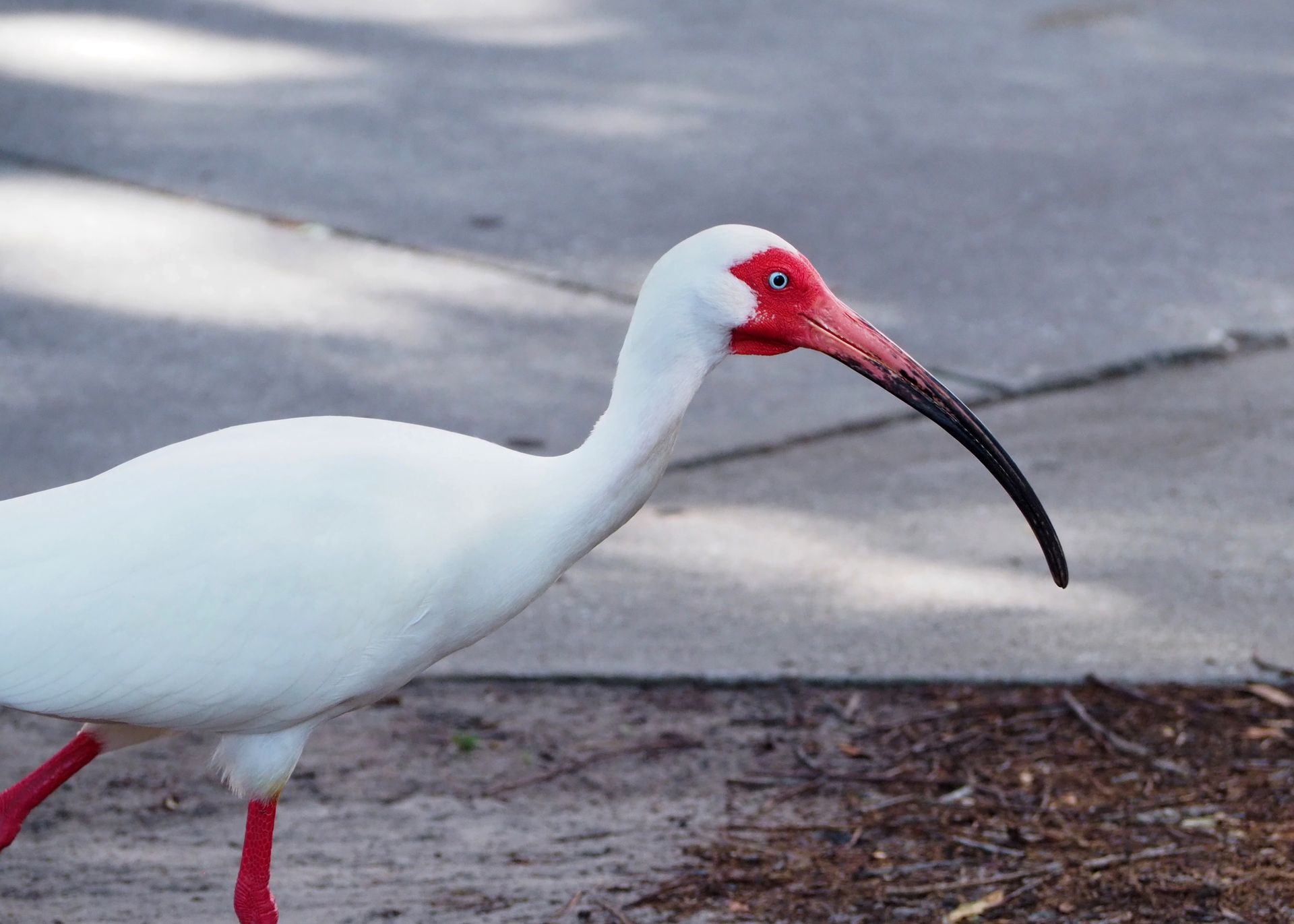
The American White Ibis is a fascinating bird species that thrives in a variety of habitats.
These birds are found in coastal regions, including mangrove swamps, salt marshes, and beaches, where they can forage for food in the shallow waters.
Their habitat range extends inland, where they inhabit freshwater and brackish wetlands, including marshes, swamps, and shallow lakes.
The American White Ibis is known to be adaptable and can even be found in urban areas, such as golf courses and parks.
Additional reading: American White Ibis Bird
Distribution and Habitat
The American White Ibis is a bird that can be found in a variety of wetland environments, from freshwater marshes to coastal estuaries and mangroves.
They prefer to wade in shallow water, often seen on lawns and parks, and probe the mud with their large bills in search of insects and crustaceans.
In Florida, over 30,000 American White Ibises have been counted in a single breeding colony, making it one of the most common places to find them.
The non-breeding range of the American White Ibis extends further inland, reaching north to Virginia and west to eastern Texas, although they are known to wander and can be seen in states far out of their usual range.
They are found throughout the Caribbean, on both coasts of Mexico, and Central America, and as far south as Colombia and Venezuela.
In North America, breeding takes place along the Atlantic coast, from southern New Jersey south to Florida and thence west along the Gulf Coast.
The American White Ibis is not faithful to the sites where they breed, and large breeding colonies can congregate and disband in one or two breeding seasons.
Breeding populations across its range have fluctuated greatly, with wholesale movement between states, and colonies last between one and seventeen years, depending on the size and quality of nearby wetlands.
Degradation of wetland or breeding sites are reasons for abandonment, as seen in the case of the Pumpkinseed Island colony in South Carolina, where the population dropped from 10,000 to zero between 1989 and 1990 due to Hurricane Hugo.
You might enjoy: Eastern Diamondback Rattlesnake South Carolina
Habitat Details
American White Ibises can be found in a variety of wetland habitats, including shallow coastal marshes and mangrove swamps. They thrive in freshwater environments, such as marshes, ponds, and flooded fields.
They are also known to inhabit muddy pools, mudflats, and even wet lawns. In fact, they're not picky and can be seen on lawns and parks, as long as there's shallow water around.
The American White Ibis adapts well to both natural and man-made water bodies, making them a resilient species.
Related reading: Diamondback Water Snake Range Map
Habitat
American White Ibises can be found in a variety of wetland environments, including freshwater marshes, coastal estuaries, mangroves, flooded pastures, mudflats, and swamps. They often wade in shallow water and can even be seen on lawns and parks.
In the non-breeding season, they forage for food in coastal wetlands, but prefer freshwater wetlands when breeding. They use their large bills to probe the mud in search of insects and crustaceans.
The species is known to wander, and has been sighted in states far out of its usual range. In North America, breeding takes place along the Atlantic coast, from southern New Jersey south to Florida and thence west along the Gulf Coast.
American White Ibises prefer shallow coastal marshes, wetlands, and mangrove swamps, but can also be found in muddy pools, on mudflats, and even wet lawns. In southern Florida, they often reside in other forms of wetlands such as marshes, ponds, and flooded fields.
In the summer, they move to more coastal and estuarine habitats as inland waterways become flooded with summer rains and the water levels become too deep to forage effectively.
For your interest: How to Become a Zoo Veterinary Technician
Nests
American White Ibises are social birds that build their nests in colonies. They typically choose a location in a fork of a live or dead tree, up to twelve feet above the ground.
Females take the lead in selecting the perfect spot for their nest. If no suitable trees are available, they'll settle for a clump of grasses or sedges.
The male ibis gathers sticks for the nest, often scavenging from the ground, a dead tree, or even stealing from another's nest. He's quite resourceful!
The female ibis then constructs the nest, arranging the sticks into a messy platform. It's not the most elegant structure, but it gets the job done.
Both parents share the responsibility of incubating their eggs, which usually range from two to four in number.
Featured Images: pexels.com