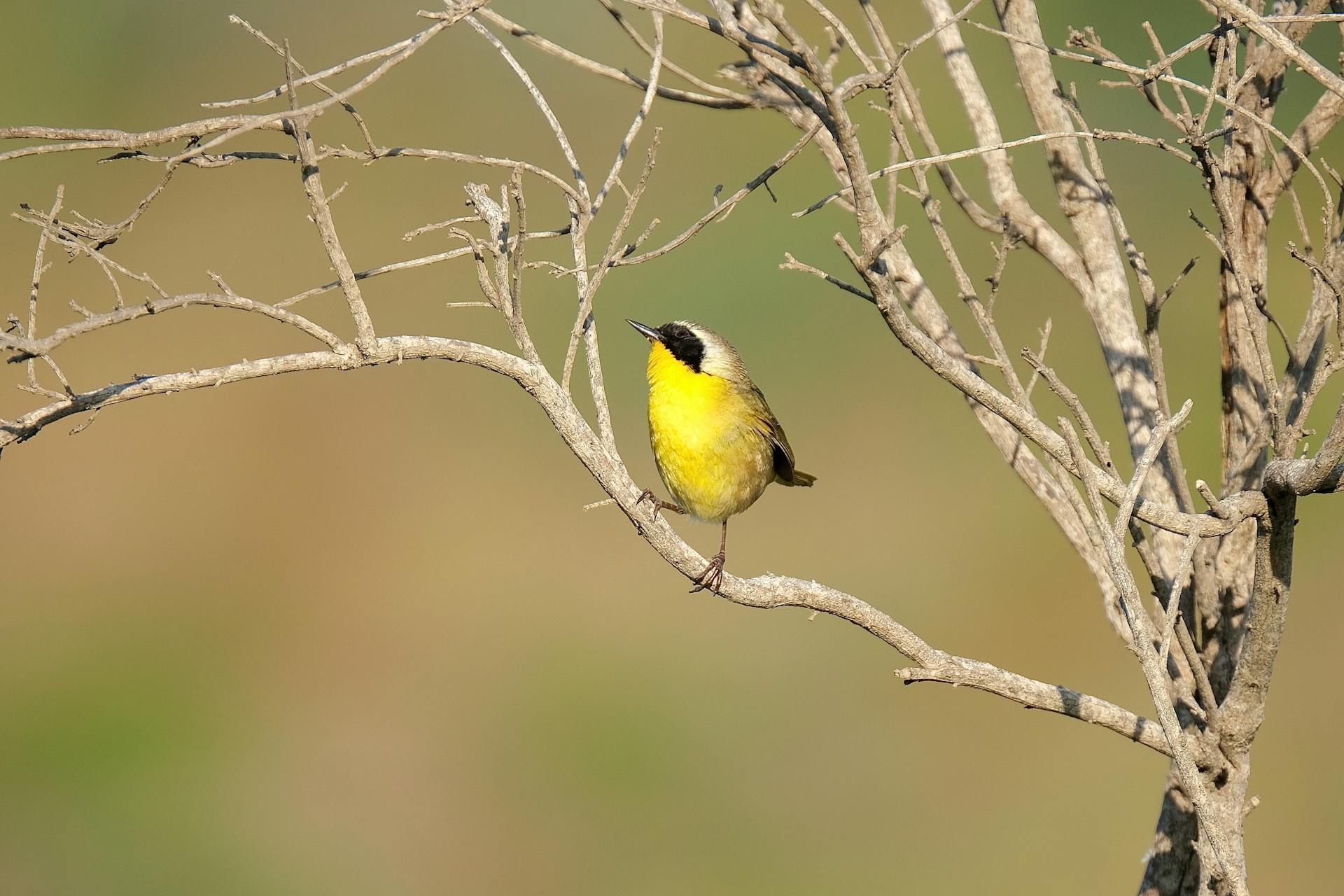
The Common Yellowthroat is a bird species that's a delight to spot in the wild. They're small, measuring about 4.3 to 5 inches in length.
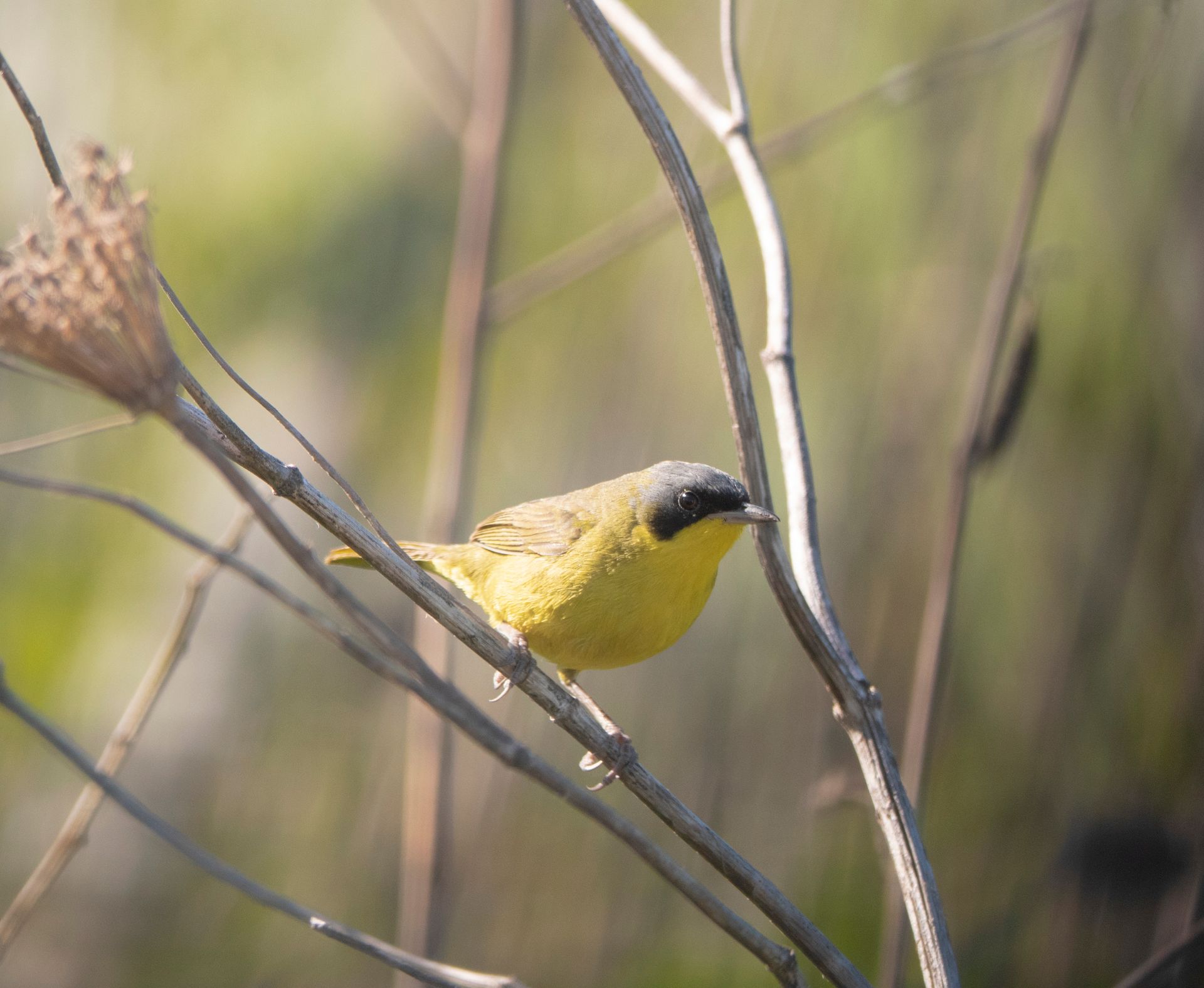
One of the easiest ways to identify a Common Yellowthroat is by its distinctive black mask that covers its eyes, giving it a bit of a mysterious look. This mask is a key identifier for the species.
In the breeding season, males have a bright yellow throat patch, which is a clear indicator of their sex. Females, on the other hand, have a white throat patch with a yellow stripe above it.
Common Yellowthroats are known to be quite vocal, making a variety of sounds, including a distinctive "witchita" call. This call is often used for communication between mates.
Broaden your view: Common Snapping Turtle Species
Taxonomy
The common yellowthroat's taxonomy is a fascinating story. It was formally described by Carl Linnaeus in 1766 in the twelfth edition of his Systema Naturae under the binomial name Turdus trichas.
Linnaeus based his account on "The Maryland yellow-throat" described by George Edwards in 1758. He specified the locality as North America, but this was later restricted to the state of Maryland by the American Ornithologists' Union in 1931.
The common yellowthroat is now one of 15 species placed in the genus Geothlypis, introduced by Jean Cabanis in 1847. The genus name combines Ancient Greek words for "ground-" or "earth-" and an unknown small bird.
The genus Geothlypis includes 15 species, and the common yellowthroat is one of them. Thirteen subspecies of the common yellowthroat are recognised, each with its own unique characteristics.
Here are the 13 subspecies of the common yellowthroat, listed for easy reference:
- G. t. trichas (Linnaeus, 1766) – southeast Canada and east USA (except southeast)
- G. t. typhicola Burleigh, 1934 – inland southeast USA
- G. t. ignota Chapman, 1890 – coastal southeast USA
- G. t. insperata Van Tyne, 1933 – south Texas (central south USA)
- G. t. campicola Behle & Aldrich, 1947 – interior west Canada and northwest, central north USA
- G. t. arizela Oberholser, 1899 – coastal west Canada, west USA and northwest Mexico
- G. t. occidentalis Brewster, 1883 – central west USA
- G. t. sinuosa Grinnell, 1901 – north California (west USA)
- G. t. scirpicola Grinnell, 1901 – southwest USA and northwest Mexico
- G. t. chryseola Van Rossem, 1930 – southwest to central south USA and central west Mexico
- G. t. melanops Baird, SF, 1865 – central Mexico
- G. t. modesta Nelson, 1900 – west Mexico
- G. t. chapalensis Nelson, 1903 – Lake Chapala in Jalisco (central west Mexico)
Physical Characteristics and Description
The common yellowthroat is a small songbird with a distinctive appearance. They have olive backs, wings, and tails, which are a great camouflage for their forest habitats.
One of the most striking features of the common yellowthroat is their bright yellow throats and chests. Adult males have a black face mask that stretches from the sides of the neck across the eyes and forehead, bordered above with white or gray.
The females are similar in appearance, but have paler underparts and lack the black mask. They're a bit more subtle in their coloring, but just as beautiful in their own way.
Here are some key physical characteristics of the common yellowthroat:
- Length: 11–13 cm (4.3–5.1 in)
- Wingspan: 15–19 cm (5.9–7.5 in)
- Weight: 7.6–15.5 g (0.27–0.55 oz)
Description
Common yellowthroats are small songbirds that have distinct physical characteristics. Their olive backs, wings, and tails are a notable feature.
The yellow throat and chest area is a bright spot on these birds, making them easy to identify. Adult males have a distinctive black face mask that stretches from the sides of the neck across the eyes and forehead.
This black mask is bordered above with white or gray, adding a touch of contrast to the bird's overall appearance. Females, on the other hand, have paler underparts and lack the black mask altogether.
Immature birds are similar in appearance to the adult female, but first-year males have a faint black mask that darkens completely by spring. The subspecies of common yellowthroats mainly differ in the males' facial patterns and the brightness of the yellow underparts.
Here are some key physical characteristics of the common yellowthroat:
- Length: 11–13 cm (4.3–5.1 in)
- Wingspan: 15–19 cm (5.9–7.5 in)
- Weight: 7.6–15.5 g (0.27–0.55 oz)
The
The word "the" is a definite article used to specify a particular noun. It's a small but mighty word that helps us identify and clarify the subject of a sentence.
In English grammar, "the" is used to indicate that the noun it precedes is specific and already known to the listener or reader. For example, "I'm reading the book on my shelf" implies that the book is a specific one, rather than any book in general.
"The" is often used to refer to a singular noun, but it can also be used with plural nouns, especially when the plural noun is a specific group or collection. For instance, "I'm meeting the team at 2 PM" implies that the team is a specific group, rather than any team in general.
In some cases, "the" is used to refer to a location or a place, especially if it's a specific or well-known location. For example, "I'm going to the park" implies that the park is a specific one, rather than any park in general.
Habitat and Distribution
Common yellowthroats can be found in marshes and other wet areas with low, dense vegetation.
They also inhabit areas with dense shrubs, although they're less commonly found in dry areas.
Females seem to have a preference for males with larger masks.
Both parents take on the responsibility of feeding the young, which are laid in a cup-shaped nest in low vegetation.
Behavior and Ecology
The common yellowthroat is a fascinating bird species, and understanding its behavior and ecology can help us appreciate its unique characteristics.
These birds feed on insects, which are usually captured in dense vegetation, but sometimes caught in midair.
One of the most interesting things about common yellowthroats is that their nests are often targeted by brood parasites, specifically the brown-headed cowbird.
Conservation Status
The common yellowthroat is still quite abundant, despite a decline in numbers due to the loss of its preferred habitat.
According to the IUCN Red List, the common yellowthroat is classified as a "least concern species", which means it's not considered to be threatened with extinction.
This species is a member of the Geothlypis genus, which includes other bird species that are native to North America.
Here are some of the taxonomic classifications for the common yellowthroat:
- IUCN Red List least concern species
- Geothlypis
- Birds of North America
- Birds of the United States
- Meso-American wintering birds
- Birds described in 1766
- Animal taxa named by Carl Linnaeus
- Extant Pleistocene first appearances
Bird Information
Common Yellowthroats live in thick, tangled vegetation in a wide range of habitats, from wetlands to prairies to pine forests, across North America.
They can be found at places like Meadowbrook Park in Urbana, where the author and their wife frequently hear and see them throughout late spring and summer.
Males are quite striking with olive backs, bright yellow throats, and a black mask, while females have yellow throats but lack the distinctive black mask.
Their song is a distinctive "wichity-wichity-wichity" that can help you locate them.
Female yellowthroats take 4 to 5 days to build a well-hidden nest near the ground in dense vegetation, and they incubate 1 to 6 eggs for 12 days.
Brown-headed Cowbirds often lay their eggs in Common Yellowthroat nests, but yellowthroats have developed strategies to deal with this, such as abandoning the nest or building a new one on top of it.
Explore further: Common Snapping Turtle Eggs
Photos and Videos
The Common Yellowthroat is a bird that's not always easy to spot, but with the right photos and videos, you can get a good look at its distinctive features. Females are brownish above with a yellow throat and undertail coverts, the intensity of which varies geographically.
They're found in open areas with thick, low vegetation, ranging from marshes to grasslands to open pine forests. This is where they spend most of their time, skulking low to the ground in dense thickets and fields.
If you're lucky enough to catch a glimpse of a Common Yellowthroat, you'll notice its bright yellow throat and undertail coverts. These features are a key part of its identification, and can be seen in photos and videos of the bird.
A unique perspective: American Yellow Warbler
Bird of the Month
The Common Yellowthroat is a great bird to start with, especially for beginners. They're common in our area and can be found in thick vegetation, like wetlands, prairies, and pine forests.
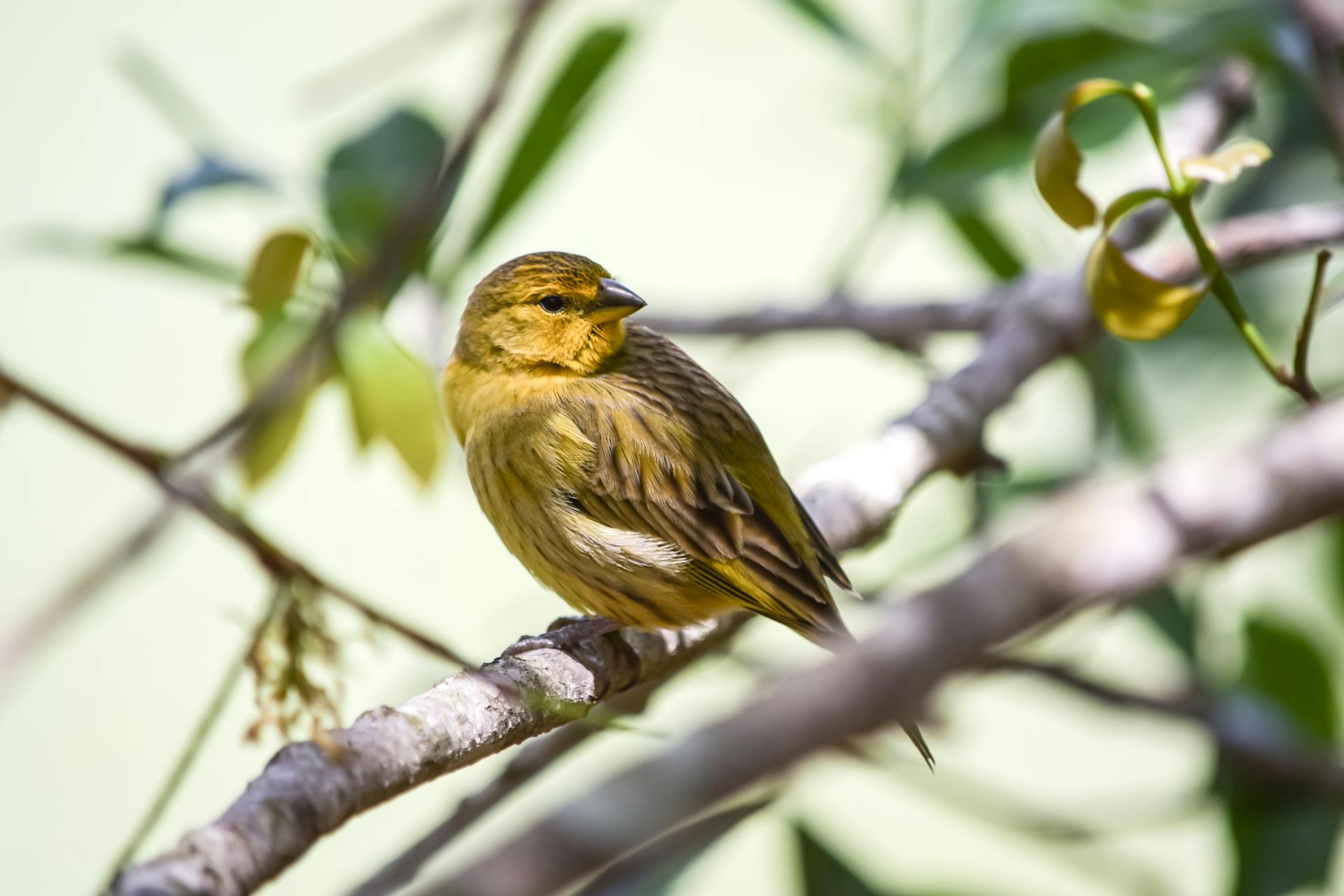
One of the best ways to spot them is to listen for their distinctive song, which sounds like "wichity-wichity-wichity." Males are quite striking, with olive backs, bright yellow throats, and a black mask.
Female Yellowthroats are a bit harder to spot, but they still have yellow throats and are just as fascinating. They're often hidden in dense vegetation, but their presence can be heard through their song.
If you're lucky, you might catch a glimpse of them perched high up in a tree, but be patient, as they can be quite shy. According to the article, they prefer to stay hidden, but you can easily hear the males' song to find them.
Common Yellowthroats are social birds and can be found in pairs, especially during breeding season. After mating, the female takes 4 to 5 days to build a well-hidden nest near the ground in dense vegetation.
Related reading: Yellow Collared Lovebird
General Information
The common yellowthroat is a small songbird that's a member of the warbler family. They're found in North and Central America, breeding in wetlands and open woods.
These birds are known for their distinctive black mask that covers their eyes, making them look like they're wearing a little mask. They're also recognized by their bright yellow throat patch, which gives them their name.
Common yellowthroats are about 4-5 inches long, with a short tail and a rounded head. They have a brown back and wings, with a yellow belly and a distinctive black stripe above their eye.
In the wild, common yellowthroats eat insects, spiders, and other small invertebrates. They forage for food on or near the ground, using their sharp eyesight to spot their prey.
They're social birds that often live in small groups, and they're known to be aggressive when defending their territory.
Frequently Asked Questions
Are Common Yellowthroats rare?
No, Common Yellowthroats are relatively common in North America during spring and summer. They can be easily found in open habitats such as marshes and brushy fields.
Do Common Yellowthroats come to feeders?
Common Yellowthroats are not typically attracted to bird feeders. They are one of the few wood warblers that rarely visit backyard birdhouses or feeders.
What is the difference between a Kentucky warbler and a Common Yellowthroat?
Distinguishing between a Kentucky Warbler and a Common Yellowthroat: The Common Yellowthroat has a larger black mask and a whitish belly, while the Kentucky Warbler has a smaller black mask and a bright yellow belly
What is the Common Yellowthroat nickname?
The Common Yellowthroat is nicknamed the "yellow bandit" due to its distinctive black mask. This nickname highlights the bird's bold and colorful appearance.
Featured Images: pexels.com