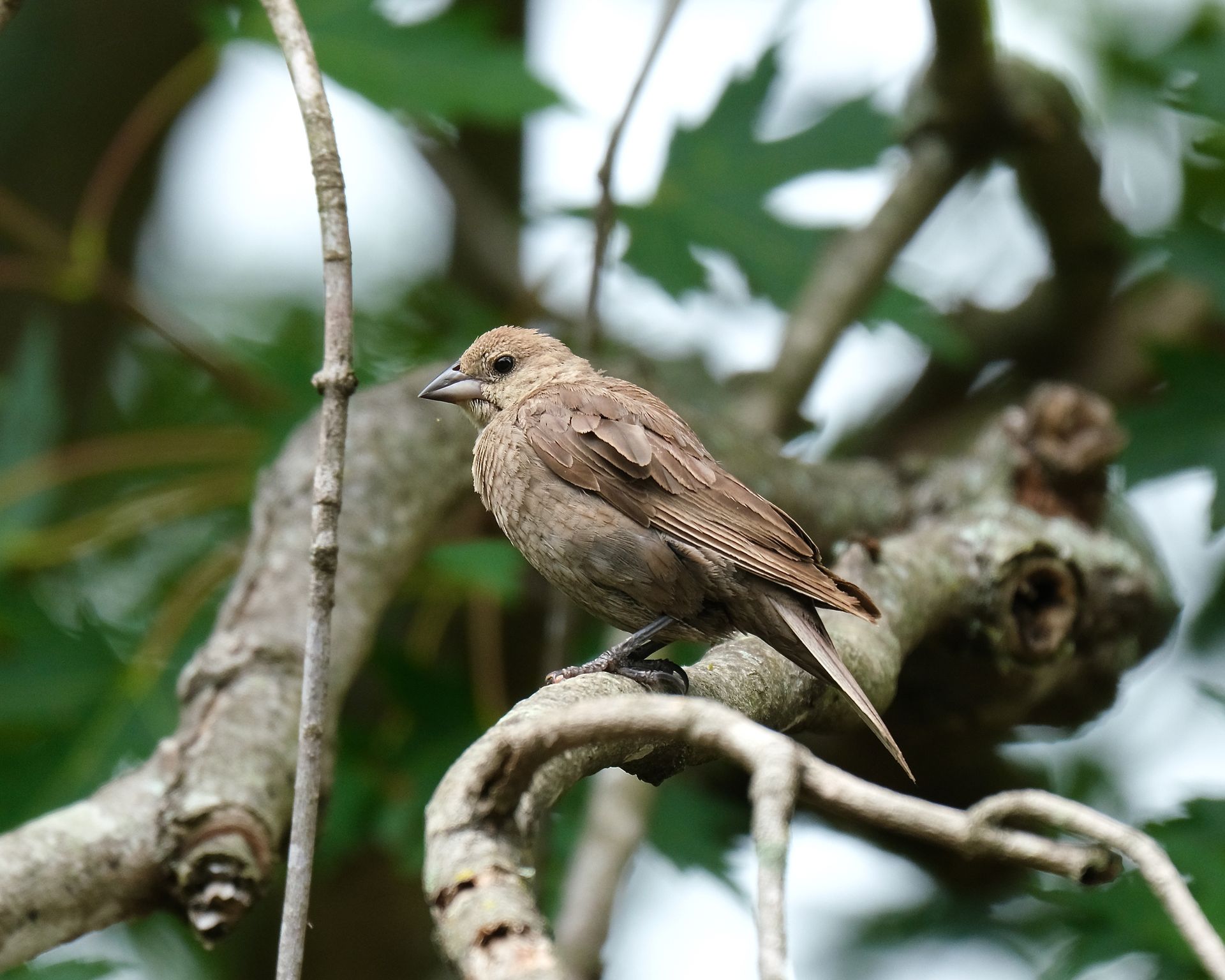
The Brown Headed Cowbird, a bird known for its distinctive brown head and black body, is a brood parasite.
Its scientific name is Molothrus ater.
This bird is found in North America, specifically in the central and western regions.
The Brown Headed Cowbird is known to lay its eggs in the nests of other birds, a behavior that has led to its classification as a brood parasite.
Check this out: Photos of Black Capped Chickadees
Habitat and Human Impact
Human activity has played a significant role in shaping the brown-headed cowbird's modern range and habitat use. Forest fragmentation caused by logging, agriculture, and urbanization has increased edge habitat, creating opportunities for cowbirds to access host nests.
Studies have shown that small forest patches experience significantly higher parasitism rates. This is because cowbirds exploit edges where host birds nest.
In the Sierra Nevada and Appalachian regions, cowbird parasitism is particularly severe in narrow riparian corridors and disturbed forests. Host birds nest in high densities in these areas.
Reducing overall cowbird density is more effective than simply altering habitat structure. This is because cowbirds will move into less ideal habitats when competition is high.
Controlling cowbird population size, rather than eliminating specific nesting areas, remains the most effective strategy for protecting vulnerable host species.
Additional reading: Brown Headed Cowbird Parasitism
Behavior and Breeding
Brown-headed cowbirds are highly social birds that exhibit adaptable behavior, shaped by their brood parasitic reproductive strategy and historical association with large grazing mammals.
During the breeding season, males engage in vocal displays and aggressive interactions to attract females, gathering in communal singing sites rather than defending fixed territories.
Females devote significant time to monitoring host nests, searching for suitable places to deposit their eggs. This behavior is strongly influenced by seasonality, with shifts between breeding, flocking, and migratory habits throughout the year.
Outside the breeding season, cowbirds form large flocks, often associating with other blackbird species in winter roosts that can number over a million individuals in certain regions.
Despite their high mobility, cowbirds remain closely tied to open habitats and human-modified landscapes, where food sources are stable and host species are abundant.
In the fall and winter, cowbirds form large, mixed-species flocks, often associating with red-winged blackbirds, grackles, and starlings. These flocks can gather in communal roosts, sometimes containing hundreds of thousands of individuals.
At night, these roosts are typically located in dense vegetation, marshes, or urban areas, often near livestock feedlots or agricultural fields, where food remains abundant throughout winter.
Fledgling survival is moderate compared to other North American songbirds, with studies showing that 47.6% of fledglings survive from the moment they leave the nest until they reach independence at 25-39 days old.
Regional differences in song dialects and courtship displays influence mating success, suggesting that local adaptations play a role in reproductive compatibility. This flexibility in breeding behavior is a key factor in the brown-headed cowbird's success as a brood parasite.
Social Behavior
The brown-headed cowbird is a highly social bird species that exhibits unique social behavior.
During the breeding season, males engage in vocal displays and aggressive interactions to attract females, often gathering in communal singing sites rather than defending fixed territories.
Females, on the other hand, devote significant time to monitoring host nests, searching for suitable places to deposit their eggs. They can lay an egg quickly, sometimes within 20-40 seconds, to minimize detection by the host.
Outside the breeding season, cowbirds form large flocks, often associating with other blackbird species in winter roosts that can number over a million individuals in certain regions.
These roosts are typically located in dense vegetation, marshes, or urban areas, often near livestock feedlots or agricultural fields, where food remains abundant throughout winter.
Cowbirds remain closely tied to open habitats and human-modified landscapes, where food sources are stable and host species are abundant.
Their social behavior is also influenced by social learning, with young cowbirds acquiring their species' vocalizations and flocking behavior after leaving their host nests.
In the wild, I've observed cowbirds engaging in retaliatory behavior when hosts reject their eggs. If a host removes a cowbird egg, the female cowbird may return and destroy the entire nest, forcing the host to rebuild and create a new opportunity for parasitism.
This behavior has been observed in prothonotary warblers, among others, discouraging them from rejecting cowbird eggs.
Cowbirds may also engage in farming behavior, where they deliberately destroy non-parasitized nests to induce renesting, increasing their chances of successfully laying eggs in future host nests.
In large flocks, cowbirds are known to exhibit aggressive begging behavior, often receiving a disproportionate share of food from foster parents, which can result in stunted growth, starvation, or reduced survival rates for host chicks.
For more insights, see: Brown Headed Cowbird Egg
Threats
The brown-headed cowbird's impact on its environment is a complex issue. It's classified as Least Concern by the IUCN, but its population has declined slightly in recent decades.
Deforestation and agriculture have allowed cowbirds to expand their range, leading to conservation concerns for songbirds with small or fragmented populations. This range expansion has allowed cowbirds to parasitize a wider variety of host species.
Cowbird parasitism has been implicated in the declines of several endangered species, including the Kirtland's warbler, black-capped vireo, and southwestern willow flycatcher. Conservation programs have implemented cowbird removal efforts in areas where parasitism poses a major threat.
Between 2009 and 2015, over 3.4 million cowbirds were culled in agricultural settings to mitigate crop damage. However, their overall impact on agriculture remains smaller than that of other blackbird species.
Conservation efforts are shifting from direct cowbird removal toward holistic habitat-based approaches. This approach focuses on improving habitat quality, which reduces the need for direct cowbird control.
Intriguing read: Brown Headed Cowbird Range
Similar Species and Identification
The brown-headed cowbird (Molothrus ater) is often confused with other blackbird species that share its habitat.
Some of the most frequently mistaken species include the red-winged blackbird, the common grackle, and the brown thrasher.
The red-winged blackbird, in particular, is known to occupy similar grassland and agricultural environments as the brown-headed cowbird, making it a common point of confusion.
See what others are reading: Blue Winged Parakeet
Similar Species
The brown-headed cowbird shares its habitat with several other blackbird species that can be easily mistaken for it. These species include the red-winged blackbird, the common grackle, and the brown thrasher.
One of the most frequently mistaken species is the red-winged blackbird, which also inhabits grasslands and agricultural environments. However, the red-winged blackbird has a distinctive red and black plumage, while the brown-headed cowbird has a brown head and black body.
The common grackle is another species that can be confused with the brown-headed cowbird, as both birds have a similar size and shape. However, the common grackle has a keel-shaped tail and a more iridescent sheen to its feathers.
The brown thrasher is also often mistaken for the brown-headed cowbird, as both birds have a similar brown coloration. However, the brown thrasher has a more rounded tail and a distinctive white eye ring.
In order to accurately identify the brown-headed cowbird, it's essential to look for its distinctive brown head and black body.
Identification
The key to identifying similar species is to focus on distinct characteristics that set them apart.
One of the most important characteristics is the shape and size of the beak. In the case of the Black-capped Chickadee and the Carolina Chickadee, the Black-capped Chickadee has a slightly larger beak.
The color and pattern of the plumage can also be a crucial identification factor. The Black-capped Chickadee has a black cap on its head, while the Carolina Chickadee has a gray cap.
The size of the bird is another important consideration. The Black-capped Chickadee is slightly larger than the Carolina Chickadee.
Readers also liked: Black Capped Chickadee vs Nuthatch
In some cases, the song of the bird can be a giveaway. The Black-capped Chickadee has a distinctive "fee-bee-fee" song, while the Carolina Chickadee's song is more complex and whistled.
A closer look at the bird's behavior can also provide clues. The Black-capped Chickadee is more likely to visit bird feeders, while the Carolina Chickadee is more likely to forage for food in trees.
A unique perspective: Black Capped Chickadee vs Carolina Chickadee
Featured Images: pexels.com