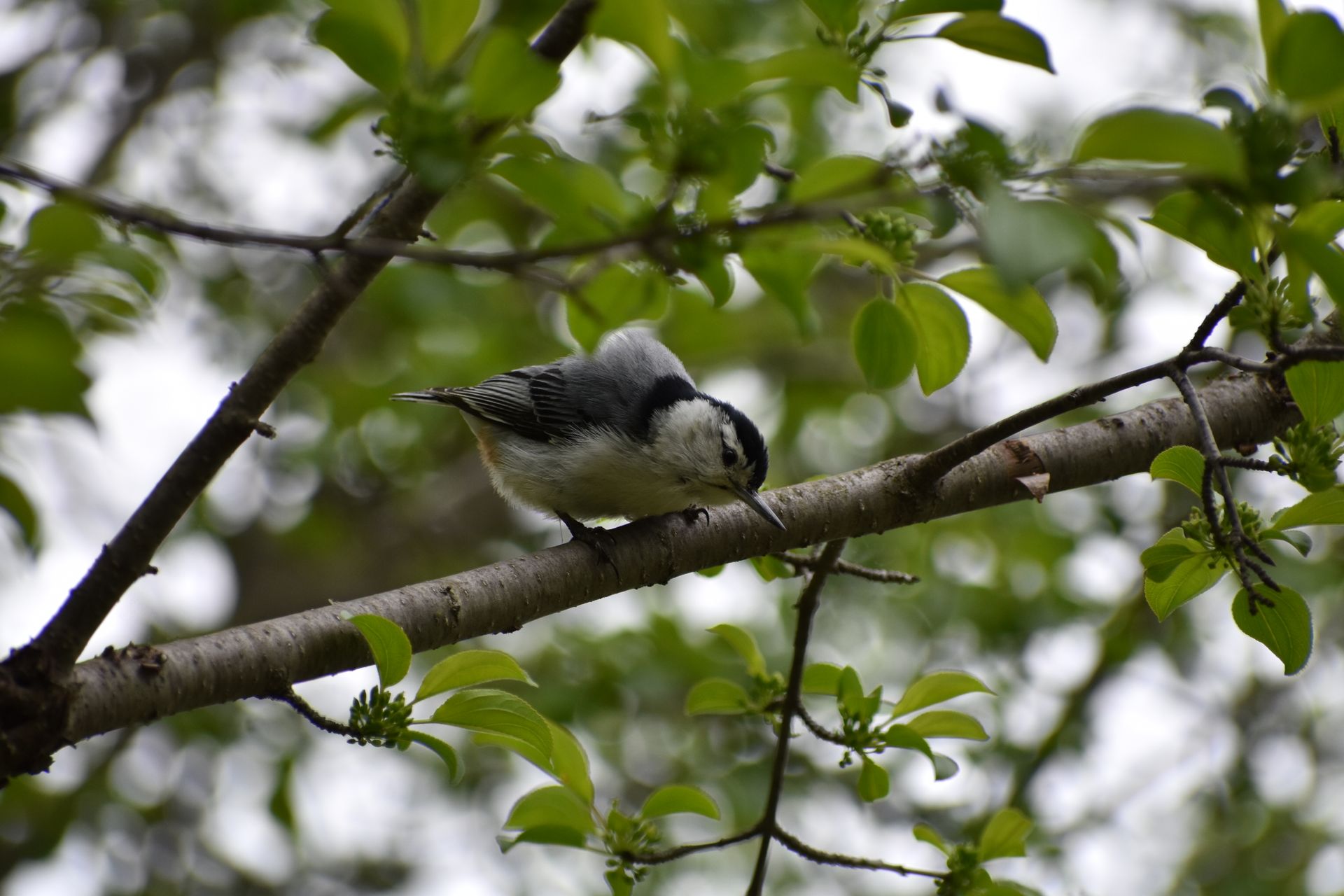
The Black Capped Chickadee and the Nuthatch are two of the most recognizable birds in North America. The Black Capped Chickadee is a year-round resident in many parts of the continent.
One of the most notable differences between these birds is their size, with the Black Capped Chickadee weighing in at around 0.5 ounces, while the Nuthatch weighs slightly more at around 0.7 ounces.
The Black Capped Chickadee is known for its distinctive "chick-a-dee-dee-dee" call, which it uses to communicate with other birds.
Recommended read: White Breasted Nuthatch Range
Nuthatch Comparison
Nuthatches often walk headfirst down tree trunks and cling to bird feeders upside down. They have shorter tails and longer bills than chickadees.
Their feeding behavior is quite unique, as they can hang upside down and climb downward a tree-trunk, finding out places that other birds cannot reach. This is a key characteristic that sets them apart from chickadees.
One of the most common nuthatch species is the white-breasted nuthatch, which is widespread in forests, parks, and backyards across the United States. It does not migrate, so you can see them year-round across their range.
Discover more: White Breasted Nuthatch Size
Here's a comparison table of some key features between nuthatches and chickadees:
The colors of nuthatches are quite distinct, with a range of hues including black, white, buff, bright orange, bluish-gray, and bright blue. This makes them stand out from chickadees, which have more muted colors.
Red breasted nuthatches are a migratory species, so you may see them at your feeders in fall and winter. They have a white eyebrow and a black eye stripe, as well as a light orange chest and belly.
Overall, nuthatches are fascinating birds with unique characteristics that set them apart from chickadees.
You might like: Lineolated Parakeet Colors
Similarities and Differences
These two birds may look similar at first glance, but they have some key differences. One distinct similarity is the presence of black crowns and black eyes in both chickadees and nuthatches. They're also about the same size.
Both chickadees and nuthatches can be spotted close to humans in backyards, munching peacefully from feeders. Insects, seeds, and berries make up a huge portion of their diet during harsh winter conditions. They both frequent tree cavities for nesting purposes.
Here are some key differences between the two birds:
Vs Nuthatch: Similarities
Chickadees and nuthatches share some striking similarities. They both have black crowns and black eyes, making them look like they're wearing a sleek, all-black outfit. They're also roughly the same size, which can make them hard to tell apart at first glance.
Both chickadees and nuthatches love to sing, and their harmonious melodies can be a delight to hear. You might even spot them in your backyard, munching peacefully on seeds and berries from your feeders. In fact, they're both frequent visitors to bird feeders, where they'll happily snack on insects, seeds, and berries during harsh winter conditions.
Tree cavities are another common feature of both chickadees and nuthatches. They'll often use these cozy nooks for nesting purposes, making them a great place to spot these birds in the wild.
Differences Explained
Let's dive into the differences between nuthatches and chickadees. One key difference is the way they cache food, with chickadees storing over 80,000 seeds in their memory and nuthatches hiding bugs, seeds, and nuts in small crevices.
Chickadees have a more social nature, often flocking with other birds, whereas nuthatches tend to be less social and only come together for protection. You're more likely to see chickadees flitting about in a group, while nuthatches might be seen alone or in pairs.
In terms of appearance, chickadees have a more muted color palette, with black and white being the dominant hues. Nuthatches, on the other hand, have a broader range of colors, including bright orange, bluish-gray, and buff.
One of the most distinctive features of chickadees is their call - a clear "chick-a-dee-dee-dee" sound. Nuthatches, by contrast, make a variety of sounds, including whistles, trills, and yanks.
Here's a quick comparison of the two birds:
Overall, while both birds are delightful to watch, their differences in behavior, appearance, and call make them unique and interesting in their own ways.
Nuthatch Species
The Nuthatch Species is a fascinating group of birds. There are six species of nuthatches in North America, with the most common being the Red-breasted Nuthatch and the White-breasted Nuthatch.
One of the most distinctive features of nuthatches is their ability to climb down trees head-first. This is made possible by their zygodactyl feet, which have two toes pointing forward and two backward.
Nuthatches are known for their bold and curious nature, often approaching humans for food. In fact, they have been known to cache seeds in people's bird feeders, much to the dismay of the bird's owners.
Nuthatches are primarily insectivores, feeding on insects, spiders, and other small invertebrates. They also eat seeds, nuts, and fruits, particularly during the winter months when insects are scarce.
The Red-breasted Nuthatch is a smaller species, measuring around 4-5 inches in length, while the White-breasted Nuthatch is slightly larger, measuring around 5-6 inches in length.
Worth a look: Picture of Black Capped Chickadee
Similar Species
Both Black-capped Chickadees and nuthatches have distinctive black crowns and black eyes, making them look quite similar at first glance. They're also about the same size, which can make identification even trickier.
One key difference is the coloration on their chests - Black-capped Chickadees don't have the same level of orange coloration as nuthatches. They can be seen singing harmoniously and visiting backyard feeders, just like nuthatches.
Both birds love to eat insects, seeds, and berries during harsh winter conditions, which is a great reason to keep your feeders stocked. They also both use tree cavities for nesting purposes.
If you're trying to tell them apart, take a look at their tails - Black-capped Chickadees have longer tails than nuthatches. And if you see a bird with a brown cap, it's likely a Pygmy Nuthatch, not a White-breasted Nuthatch.
Frequently Asked Questions
What bird looks like a Black-capped Chickadee?
The White-breasted Nuthatch resembles a Black-capped Chickadee, but has a distinctive white face and throat. Look for its black cap and blueish gray back to identify this non-migratory bird.
Featured Images: pexels.com