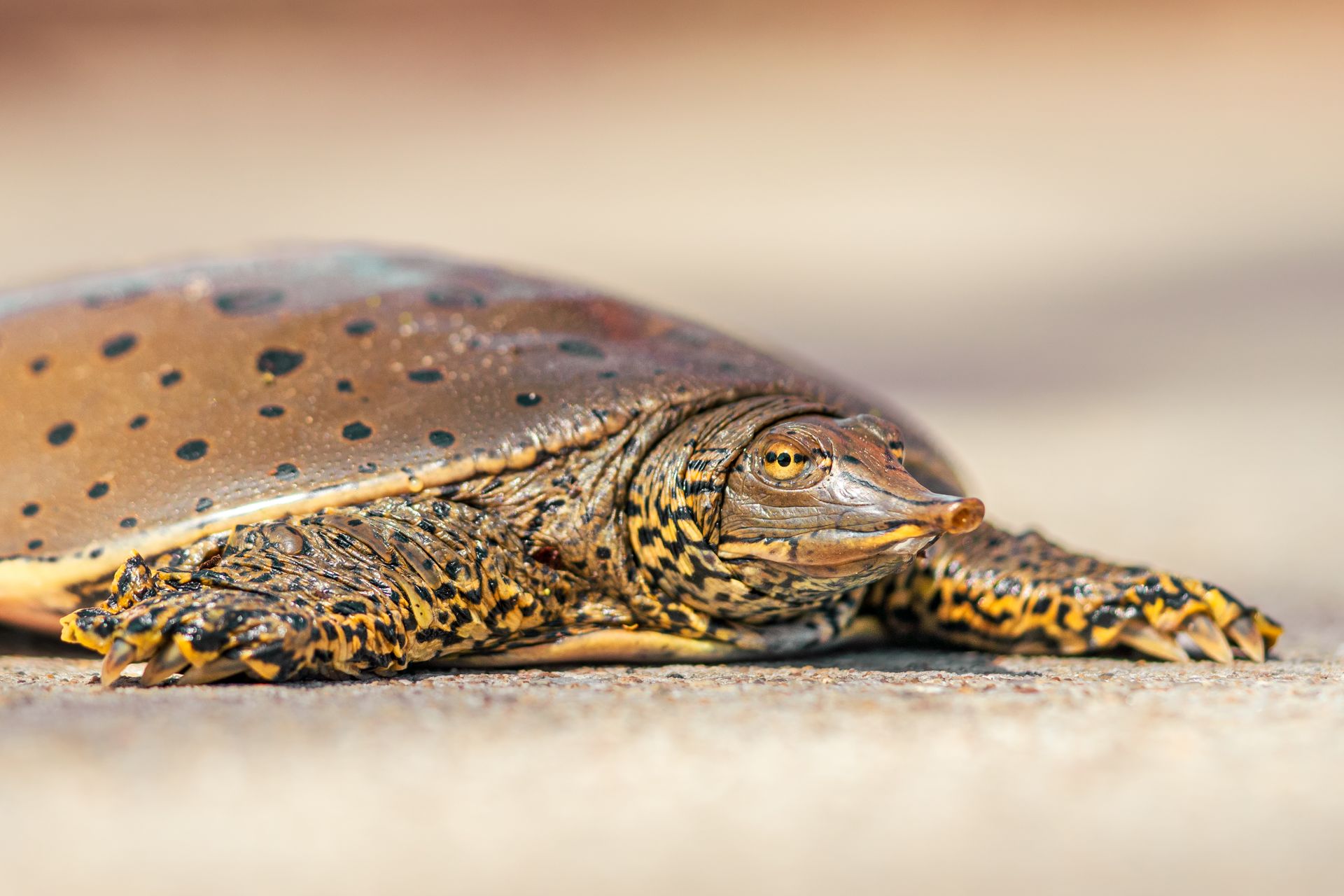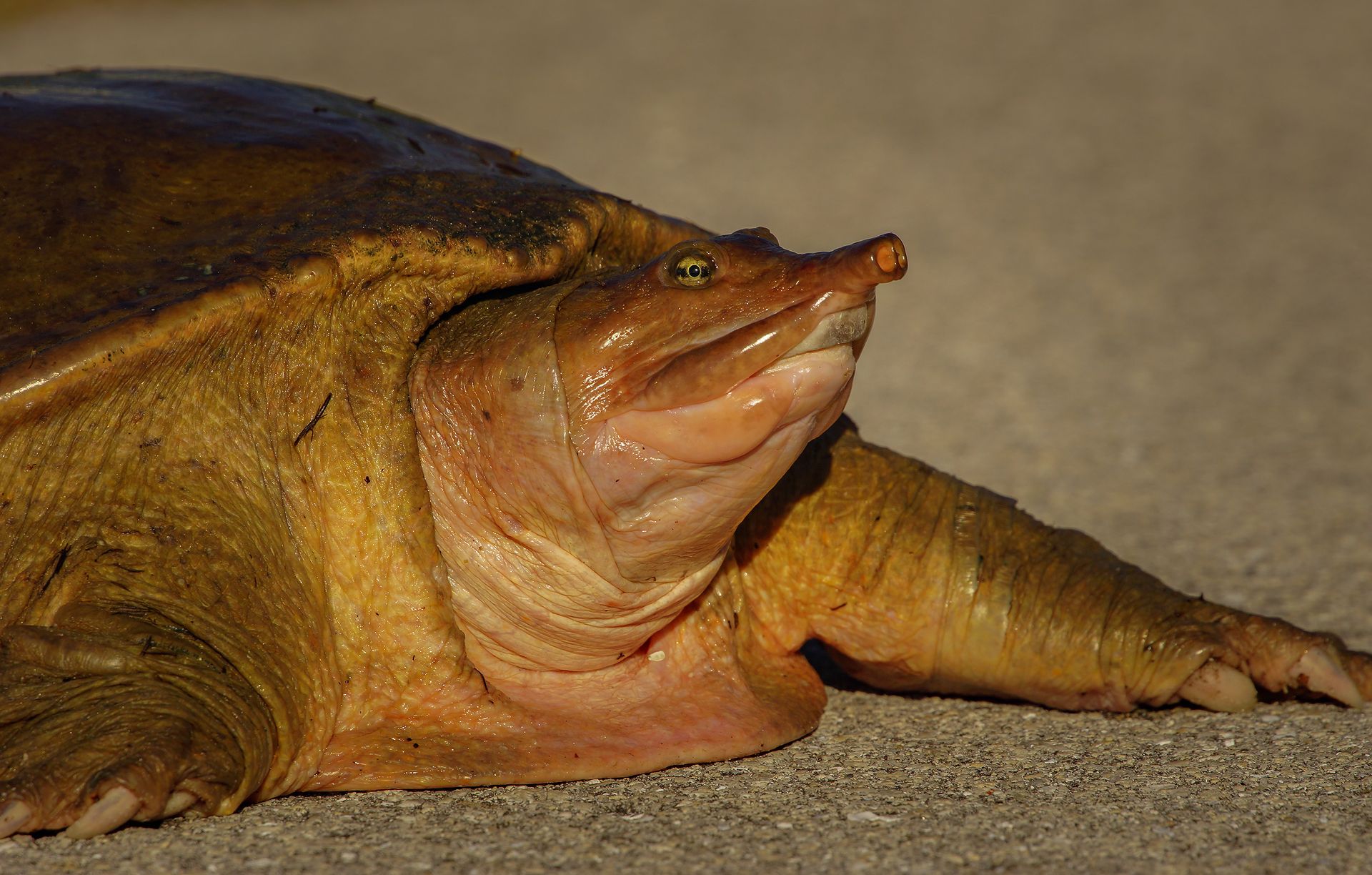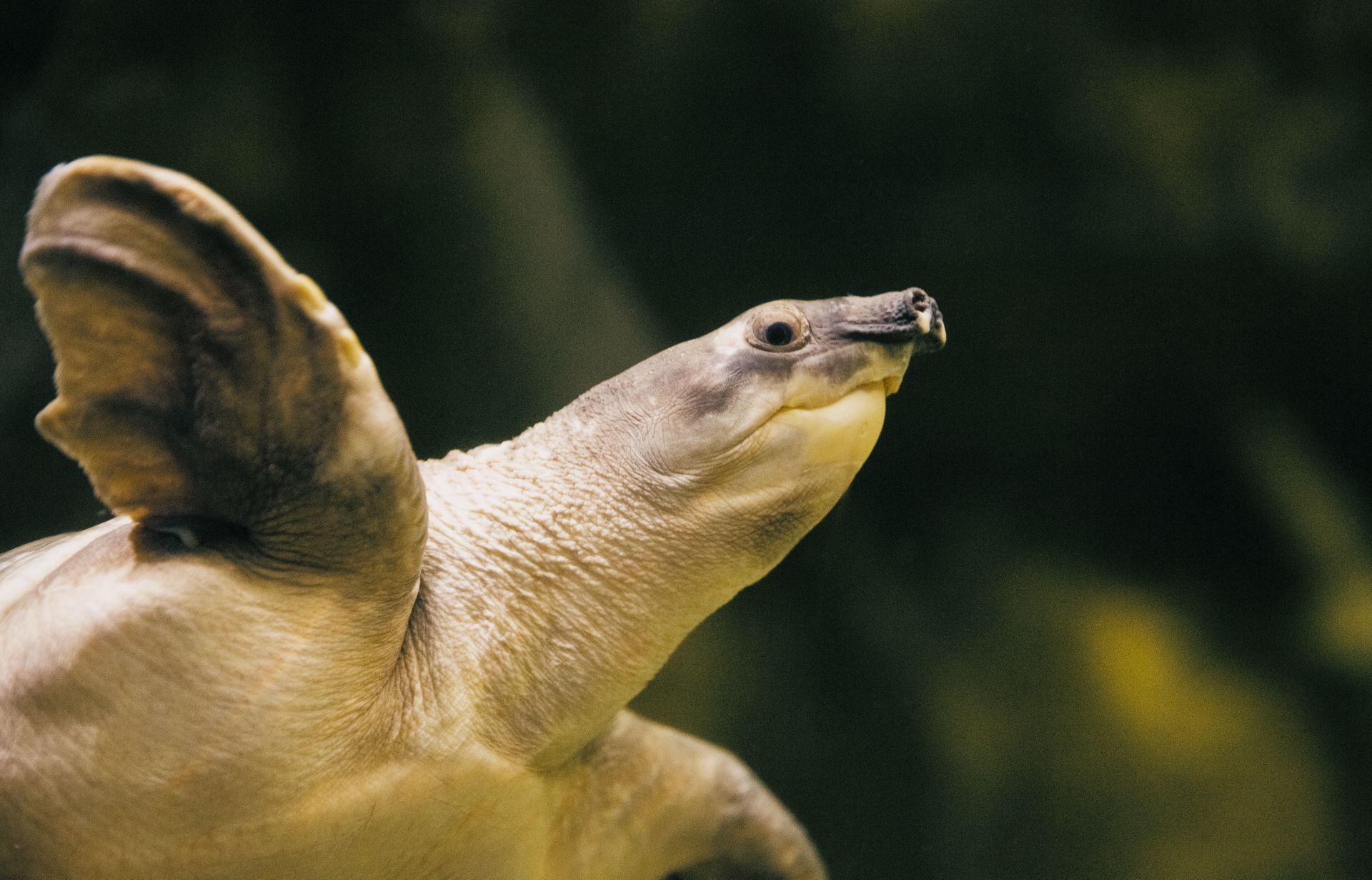
The Ganges Softshell Turtle is a unique and fascinating creature. It's found in the wild in the Ganges River and its tributaries in India.
These turtles have a distinctive soft, leathery shell that's more like a skin than a traditional shell. It's a remarkable adaptation that helps them navigate the river's shallow waters and sandy riverbeds.
Unfortunately, the Ganges Softshell Turtle is listed as Critically Endangered on the IUCN Red List.
Worth a look: Common Snapping Turtle Shell
Description
The Ganges softshell turtle is identified by its unique carapace and plastron structure.
There are eight pairs of costal plates, with the last pair well developed and in contact throughout on the median line. Two neurals are found between the first pair of costals.
The plates are coarsely pitted and vermiculate, giving the turtle a distinctive appearance.
In young turtles, the dorsal skin has longitudinal ridges of small tubercles.
The head is moderate in size, with a snout that's about as long as the diameter of the orbit.
The interorbital region is narrower than the nasal fossa in adult turtles.
The postorbital arch is one third to one half the greatest diameter of the orbit.
The mandible has a sharp ridge on its inner edge, which sends off a short perpendicular process at the symphysis.
The diameter of the mandible at the symphysis does not exceed the diameter of the orbit.
The turtle's coloration is olive above, with a black longitudinal streak on the head intersected by two or three inverted-V shaped black streaks.
The lower parts are yellowish.
The length of the dorsal disk is 2 feet.
Discover more: Black Buck Antelope
Conservation
The Indian softshell turtle is classified as endangered due to habitat loss, hunting, and trade for food and traditional medicine.
Habitat destruction, primarily caused by dam construction, sand mining, and deforestation, has led to a significant decline in their population.
Their nesting sites and riverine habitats are being destroyed, making it harder for them to survive.
Discover more: Common Snapping Turtle Habitat
The Government of India has taken steps to conserve the Indian softshell turtle, banning the hunting and trade of all species of turtles and tortoises under the Wildlife Protection Act of 1972.
The Forest Department of various states in India is working to conserve these turtles, and the Madras Crocodile Bank Trust has set up a breeding and conservation program in collaboration with the Tamil Nadu Forest Department.
This program aims to increase the population of Indian softshell turtles by breeding them in captivity and releasing them back into the wild.
Threats to Indian Turtles
The Indian softshell turtle is facing numerous threats to its survival. Poaching for the illegal wildlife trade is a major concern, with nearly 7.4% of the world's 25 most threatened turtles found in India.
The demand for turtle meat and eggs for traditional medicines is also a significant issue. Many people believe that turtle shells possess medicinal properties, but there is no scientific or medical proof to support this claim.
In some states, like Bihar, West Bengal, Chhattisgarh, and Uttar Pradesh, turtle meat is widely sold in local markets, contributing to overconsumption. The Indian Softshell turtle falls under Schedule I of the Wildlife (Protection) Act, 1972, making poaching or possession of any protected wildlife species a criminal offense.
These turtles are often hunted illegally, with their meat sold in markets and their shells used to make items like masks for tourists. Habitat loss is another major threat, with new dams and drainage works changing the rivers where these turtles live.
Here are some of the main threats to the Indian softshell turtle:
- Illegal hunting
- Habitat loss
- Human activities like fishing and farming near the rivers
Protecting these amazing creatures means protecting their river homes and stopping illegal hunting.
Habitat and Distribution
The Ganges softshell turtle can be found in the river systems of Ganges, Brahmaputra, Mahanadi, and Godavari. They inhabit slow-moving rivers.
They prefer shallow, muddy or sandy bottoms, where they can bury themselves in the mud to escape predators and regulate their body temperature. This adaptation helps them survive in their environment.
In some places, like the temple ponds of Odisha, people consider them sacred and protect them.
Know the Turtle
The Ganges Softshell Turtle is a massive creature, with one individual weighing nearly 25 kilograms, as seen in a rescue case in May 2022.
Rescues like this one highlight the importance of conservation efforts, where Wildlife SOS helped stabilize the turtle's health with intensive veterinary care and medication.
These turtles can be found in areas where they're at risk of being poached or trafficked, as suspected in the 2019 case where a 30-kg Softshell turtle was found on a road in Agra.
With the help of organizations like Wildlife SOS and its anti-poaching unit "Forest Watch", we can work together to protect these incredible animals and their habitats.
If this caught your attention, see: Fish and Wildlife Western Pond Turtle
Featured Images: pexels.com