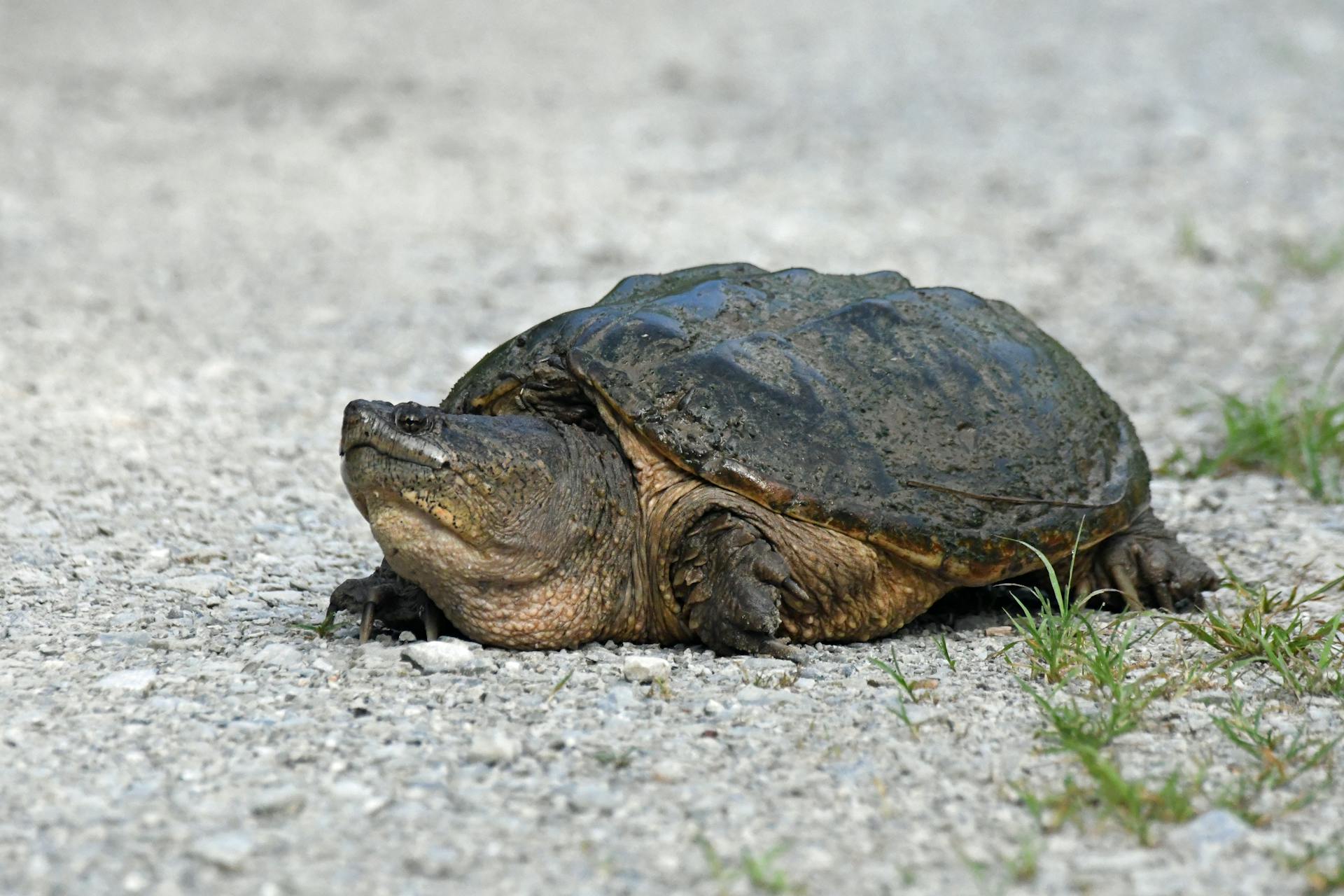
Common snapping turtles are found in freshwater habitats across North America, including rivers, lakes, and wetlands. They prefer areas with still or slow-moving water and a soft, muddy bottom.
These turtles are well adapted to their environment, with webbed feet and a strong tail that helps them swim and maneuver in the water. Their broad, flat heads and powerful jaws also make them well-suited for life in the water.
In the wild, snapping turtles can live for up to 40 years, which is remarkable considering their slow growth rate. This is likely due to their ability to survive in a variety of habitats and their tolerance for cold temperatures, which allows them to thrive in areas with limited food resources.
Their long lifespan also means that snapping turtles can take a long time to mature, with some individuals taking up to 20 years to reach reproductive age.
Worth a look: Eastern Water Dragon Habitat
Species Information
The common snapping turtle is a large freshwater turtle species that can be found in North America.
They can grow up to 19 inches in length and weigh up to 35 pounds.
Common snapping turtles have a distinctive shell that is brown or black in color and has yellow stripes on the head and neck.
They are herbivores and carnivores, feeding on aquatic plants, insects, crustaceans, and small animals.
In the wild, common snapping turtles can live up to 40 years.
They are listed as a species of least concern by the IUCN Red List.
Habitat and Distribution
Common snapping turtles can be found in a wide range of habitats, including shallow ponds, slow-moving rivers and streams, and shallow bays of lakes and rivers.
They prefer areas with slow-moving water, a soft mud bottom, and lots of aquatic vegetation, making them a common sight in fens, bogs, swamps, and marshes.
In North Dakota, snapping turtles are found statewide and prefer water bodies that are flowing or have access to flowing water.
Snapping turtles have been known to inhabit brackish environments, such as estuaries, where there is an abundance of aquatic vegetation.
They can swim in deep water, but tend to stay along the edges of a lake or water body, within 5 meters of shore and at about a 2-meter depth.
In some cases, they may be found resting or waiting for prey at the bottom of a lake or water body, partially covered by vegetation and logs.
Conservation and Threats
The common snapping turtle's habitat is under threat from various human activities.
Road mortality is a significant problem, with studies showing that decades of road mortality can cause severe population decline in urbanized wetlands.
Decades of road mortality can cause severe population decline in common snapping turtle populations present in urbanized wetlands.
A study in southwestern Ontario monitored a population near a busy roadway and found a loss of 764 individuals in only 17 years.
The population decreased from 941 individuals in 1985 to 177 individuals in 2002, highlighting the devastating impact of road mortality.
Exclusion fencing could aid in decreasing population loss by preventing turtles from crossing roads and becoming roadkill.
The lack of aquatic vegetation, stumps, logs, and other debris in the habitat could also affect the common snapping turtle population.
Harvest of Snapping Turtles for their meat is largely unregulated and may be a factor in some areas, contributing to the decline of the species.
Contaminants have been linked to population decline or abnormal development in some areas, further threatening the species.
You might enjoy: Common Snapping Turtle Species
Research and Identification
Common snapping turtles inhabit freshwater habitats, including rivers, lakes, and wetlands. They prefer areas with slow-moving water and a soft, muddy or sandy bottom.
These turtles are often found in areas with plenty of vegetation, such as aquatic plants and algae. This helps them blend in and ambush prey.
The average depth of their habitats can range from 0.5 to 3 feet, with some areas being as shallow as 0.1 feet. They're also known to inhabit areas with depths of up to 10 feet.
In the wild, common snapping turtles can be found in a variety of aquatic environments, including swamps, marshes, and bayous.
Biology and Behaviour
Common snapping turtles are primarily solitary animals, only coming together during mating season.
They have a unique mating ritual, where the male will grasp the female's head with his jaws, a behavior that can last for several hours.
In the wild, snapping turtles can live up to 40 years, making them a long-lived species.
Their diet consists mainly of aquatic plants, fish, and crustaceans, which they hunt using their powerful jaws and sharp beak-like snout.
Snapping turtles are also skilled diggers, using their strong claws and powerful legs to excavate burrows in the riverbanks and lakebeds.
They are known to be territorial, with individuals often defending their burrows and surrounding areas from other snapping turtles.
Featured Images: pexels.com