The eastern wild turkey is a fascinating bird, and understanding its behavior, habitat, and conservation status is crucial for its survival. They are found in a variety of habitats, including deciduous and mixed forests, as well as agricultural areas.
These birds are ground-dwelling, meaning they spend most of their time on the ground, and are known for their impressive courtship displays. Males will often gobble loudly to attract females during mating season.
In terms of habitat, eastern wild turkeys require a mix of open areas for foraging and dense cover for shelter. They are particularly fond of areas with oak, pine, and maple trees, which provide a bounty of acorns and other nuts.
Eastern wild turkeys are also known for their strong social bonds, often living in small groups of up to several dozen birds.
Recommended read: Eastern Hognose Snake Habitat
Physical Characteristics
Eastern wild turkeys are the largest members of the order Galliformes, with males ranging between 11-24 pounds and 39-49 inches in length.
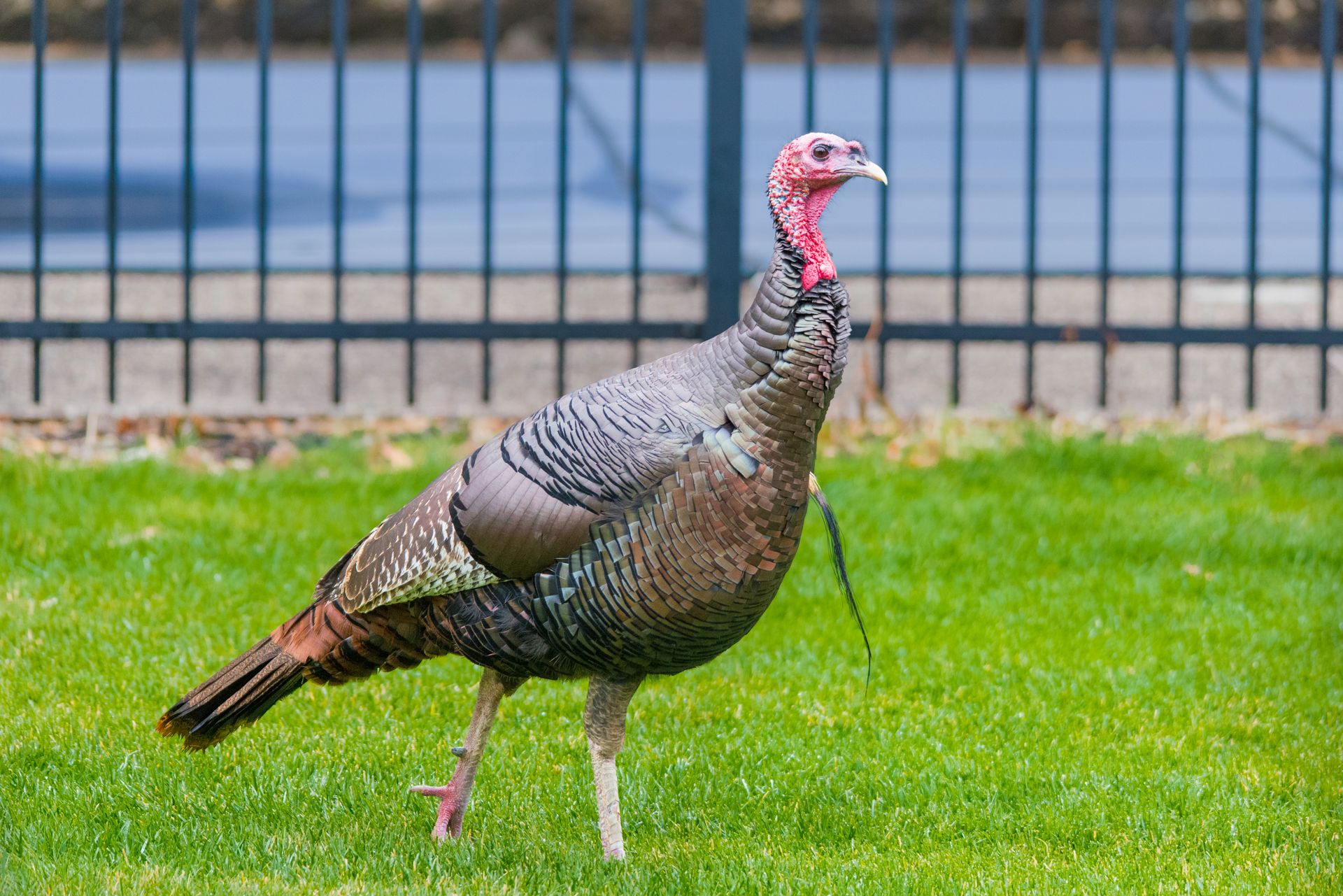
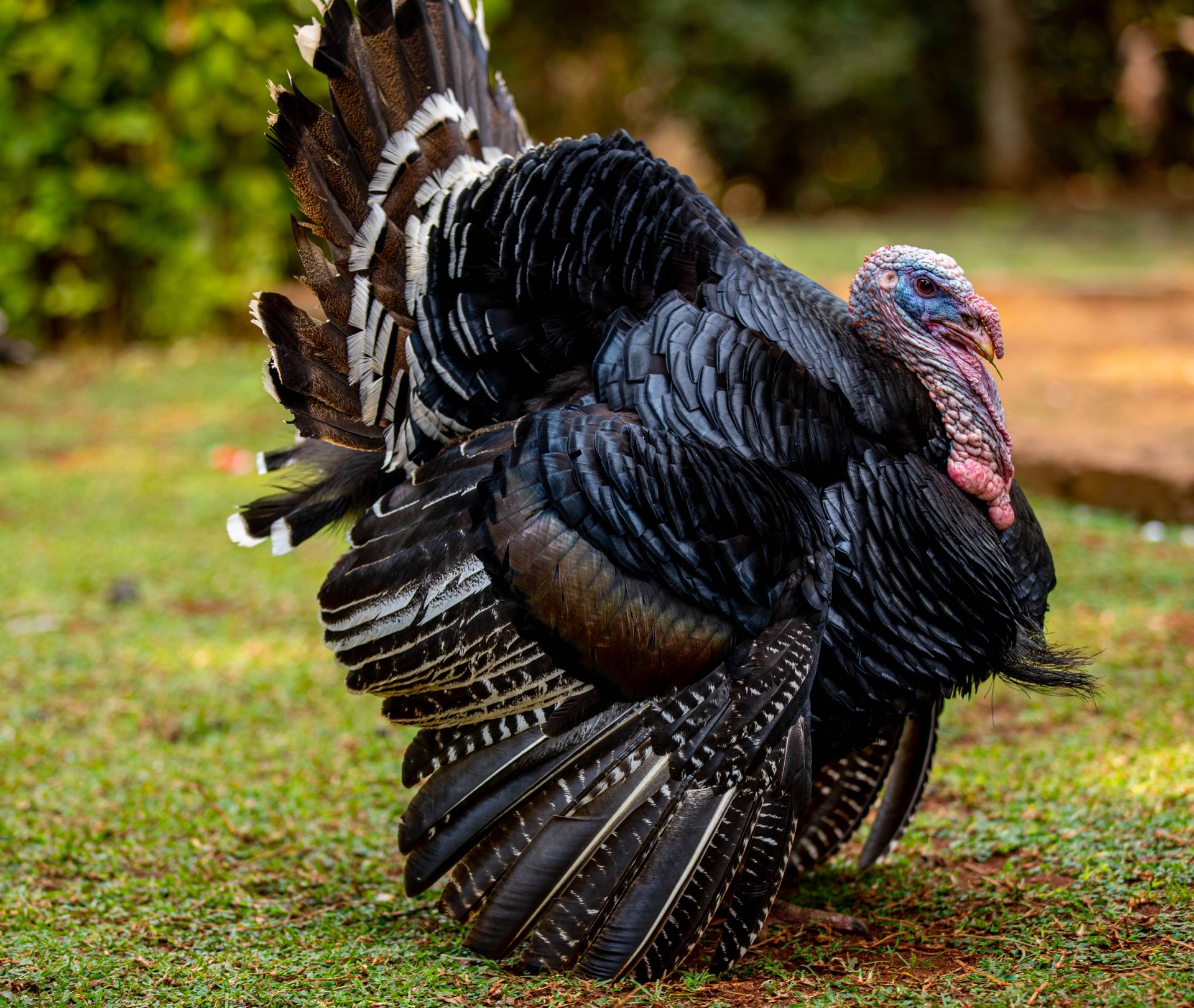
Males have dark iridescent plumage, bare heads, and necks with blue and pink streaks. Their fan-shaped tails are tipped with chestnut, and they have black-barred flight feathers.
The contour feathers of males are black-tipped, giving the birds an overall blackish color from a distance. Up close, they show iridescent copper, bronze, red, green, and gold hues.
Female wild turkeys have buff-tipped body feathers, making them appear more brownish in the distance, and their hues are muted.
Both males and females have sparsely feathered heads with bare legs and feet that are pink to red in color.
Male turkeys have a distinctive beard, a cluster of long follicles in the center of their chest that can be an inch to 10 inches long. This beard does not molt and becomes visible when the turkey is 6-7 months old.
Hens may occasionally have beards, although this is uncommon and produces much shorter beards than males.
Males also have spurs on the lower third of their leg that start off small and rounded, but become pointed and about 2 inches long with time.
Female turkeys, on the other hand, have small and blunted spurs.
Males weigh 17-21 pounds and attain a height of 40 inches, while females weigh 8-11 pounds and are 30 inches tall.
Wild turkeys have long, thick legs, large toes for walking and scratching, and a relatively short bill.
Wild Turkey Behavior
Eastern wild turkeys are polygamous, with one tom mating with several hens.
A tom's mating process is a complex affair, involving gobbling, strutting, and drumming to attract his hens.
Turkeys are social birds and live in flocks, but after mating, hens become more solitary and eventually leave the flock to lay their eggs.
A hen lays roughly one egg a day, sitting for about an hour after laying each of her first five eggs, with incubation time increasing with each subsequent egg.
Once a hen's clutch of 10-12 eggs is complete, she will incubate continuously, day and night, leaving the nest only for brief feeding recesses.
Explore further: Eastern Wild Turkey Hen
Wild Turkey Breeding Behavior
Turkeys are polygamous, which means one tom mates with several hens.
A tom tries to gather and defend a harem of hens, and the mating process is a long and complex affair.
The male gobbles, struts, and drums while displaying for his hens, and once a hen finally capitulates, breeding takes place.
The tom then moves on to another potential mate, leaving the hen to start the process over.
After mating, the hen becomes more solitary and eventually leaves the flock to lay a single egg.
She covers the egg with leaves and duff and returns to the flock or moves off on her own to feed.
The process is repeated as she lays roughly one egg a day, sitting for about an hour after laying each of their first five eggs.
Incubation time gradually increases with the laying of each subsequent egg.
Once her clutch of 10-12 eggs is complete, she will incubate continuously, day and night, leaving the nest only for brief feeding recesses.
Wild Turkey
Wild turkeys are fascinating birds, and understanding their behavior can be a real treat. Plant material makes up as much as 85 percent of an adult turkey's diet.
They tend to eat a lot of herbaceous vegetation and hard and soft mast, which is a big change from their insect-rich diet as young poults. Young turkeys rely heavily on insects to fuel their rapid growth.
Recommended read: Eastern Gray Squirrel Diet
As they mature, their diet gradually shifts from insects to succulent plants, and by late summer, both young and mature birds are eating a lot of seeds, nuts, and berries. I've seen this change in diet firsthand, and it's amazing how quickly their eating habits adapt.
Turkeys are polygamous, which means one tom mates with several hens, and the mating process is quite complex. A tom will try to gather and defend a harem of hens, and the male will gobble, strut, and drum to display for his hens.
After mating, the hen will gradually become more solitary and eventually leave the flock to lay a single egg, which she'll cover with leaves and duff. She'll then return to the flock or move off on her own to feed.
A hen will lay roughly one egg a day, sitting for about an hour after laying each of their first five eggs, and then incubation time will gradually increase with the laying of each subsequent egg. Once her clutch of 10-12 eggs is complete, she'll incubate continuously, day and night, leaving the nest only for brief feeding recesses.
Check this out: Eastern American Toad Diet
Habitat and Diet
Eastern wild turkeys require a diverse habitat with a mix of forested areas and open grasslands to meet their needs. This habitat diversity is essential for their survival.
They need open grasslands for turkey courtship and to provide seeds and insects for poults. If the forest gets too dense, their main defense, sight, is compromised and they will no longer use it.
Prescribed burning and forest thinning are necessary to maintain a forest landscape with reasonable visibility up to 60 yards and good understory growth. This allows wild turkeys to utilize the forested areas effectively.
Their diet consists of about 36% grasses, 29% insects, 19% mast, and 16% forbs. In east Texas, water is not a limiting factor, and they obtain water from standing sources like creeks and ponds, as well as metabolic water through their diet.
In late summer, their diets shift from succulent greens to hard and soft mast: seeds, nuts, and berries. This shift is essential for their survival during the changing seasons.
If this caught your attention, see: Eastern Grey Squirrel Habitat
Conservation and Management
The eastern wild turkey's population was once declining significantly, with minimal hope for rebound, but thanks to conservation efforts, they now thrive in 38 states and four Canadian provinces.
By 1942, there were less than 100 eastern wild turkeys remaining in Texas, but through conservation efforts, their population has made a remarkable recovery.
Prescribed burning, forest thinning, and grazing can improve the nesting and brood-rearing habitats of eastern wild turkeys, making them more favorable for the species.
Trap-and-transfer, active habitat management, harvest regulations, law enforcement, and educational materials have all played a crucial role in the eastern wild turkey's recovery.
Increased wild turkey numbers can be attributed to many factors, including trap-and-transfer, research, and habitat management.
NWTF has played a key role in funding critical research used by wild turkey managers to better understand wild turkey biology, habitat use, and how to capture and relocate wild turkeys.
Appropriate fall and spring hunting season structures, law enforcement, and data collection are also essential for the long-term sustainability of eastern wild turkey populations.
The National Wild Turkey Federation Technical Committee offers recommendations for research, biological, and technical needs, and shares information cooperatively to ensure more informed management-action decisions.
Take a look at this: Wildlife Conservation
Predation and Threats
Eastern wild turkeys face numerous threats in the wild, and one of the most significant is predation. Half of all nests are lost to predation or abandonment.
American crows and raccoons are two of the most common nest predators, preying on vulnerable poults. Snakes, feral pigs, opossums, and great-horned owls are also known to feed on eastern wild turkeys.
Poults are especially susceptible to predation in the first few weeks of life when they still roost on the ground. This is a critical period, as they're also vulnerable to starvation, birth defects, and inclement weather.
Less than 50% of poults survive to be one month old in east Texas, highlighting the challenges they face in their early lives.
Discover more: Eastern Wild Turkey Poults
Species Information
The eastern wild turkey is a fascinating bird species. They are native to eastern North America, with a range that includes parts of Canada, the northeastern United States, and the southeastern United States.
These birds are known for their distinctive gobbling call, which is a loud, raspy sound that can be heard during the breeding season. They are also excellent foragers, using their strong legs and sharp eyesight to search for food on the ground and in trees.
Eastern wild turkeys are social birds that live in groups, called flocks, which are typically made up of several females and their young, along with one or more males.
Expand your knowledge: Wild Birds Trust
Mating and Nesting
Mating and nesting behaviors are crucial for the survival of wild turkeys. Gobblers attract a hen's attention by gobbling and strutting.
A hen will signal her interest by lying close to the ground in front of the male, prompting him to begin copulation. This behavior is a key part of the mating process.
The breeding season typically occurs from March to June, with hens starting to nest mid-April to mid-June. During this time, they focus on building and maintaining their nests.
Hens choose nesting sites in native bunchgrasses and forbs that provide adequate screening cover, usually between 20 and 26 inches tall. This helps protect the nest from predators.
In forested habitats, dense shrubs and young trees offer the necessary screening cover for nesting sites. Nests are carefully scratched out and form a shallow depression or bowl shape.
Hens lay one egg per day, resulting in an average total of 10 eggs. This is a remarkable feat, showcasing the dedication of these amazing birds.
Open herbaceous areas are essential for broods, providing a rich source of invertebrates like grasshoppers, beetles, and spiders. This is crucial for the young turkeys' growth and development.
Species Significance
Wild turkeys are widely hunted for both food and sport, with the hunting season in South Carolina extending from March 15 or April 1 to May 1.
In 1997, a total of 13,984 turkeys were harvested in the state, a significant increase from the 132 individuals taken in 1970.
The wild turkey is not considered an endangered species, thanks to successful re-stocking and management practices.
However, the species was almost extinct throughout its range around 1900 due to hunting and habitat loss.
A live-trapping and transplanting program was carried out from 1951 to 1958 to replenish turkey populations in the piedmont and mountain portions of South Carolina.
In 1975, a program was initiated to restore turkey populations in the coastal plain, with restoration sites selected based on location and habitat characteristics.
Each restoration site was stocked with about 5 gobblers and 10 hens, which helped to establish healthy turkey populations in the state.
Today, wild turkeys occupy all 46 counties in South Carolina, thanks to the establishment of re-stocking programs and habitat improvement.
Explore further: Wild Dogs in North Carolina
Frequently Asked Questions
How many states in the US have eastern wild turkeys?
Eastern wild turkeys can be found in a total of 38 states across the US. They have a wide distribution, spanning across the eastern part of the country.
What are eastern wild turkey males called?
Eastern wild turkey males are called gobblers, typically weighing 18-22 pounds and having a 5-foot wingspan.
Featured Images: pexels.com