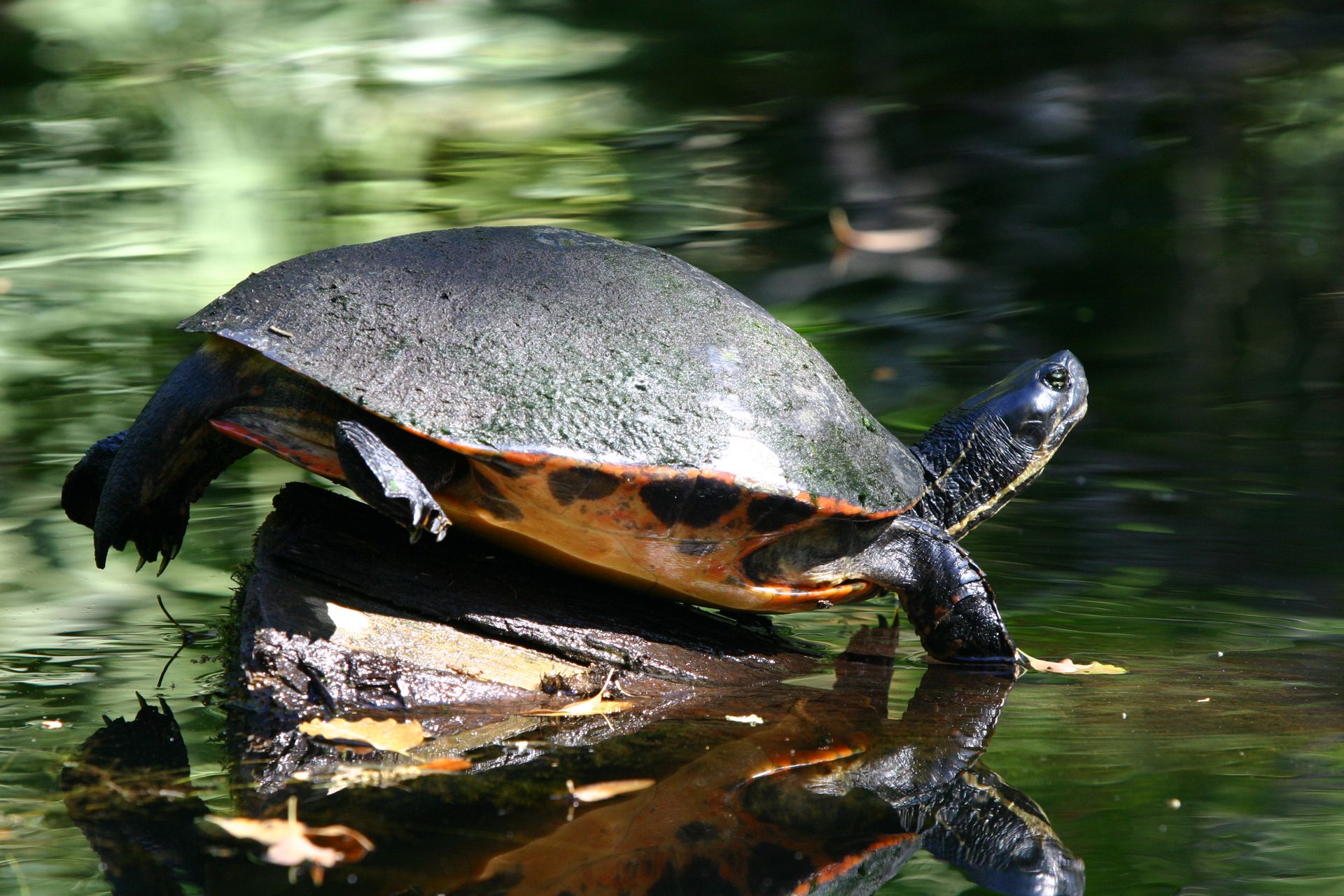
The eastern diamondback terrapin is a species of turtle that's native to the southeastern United States.
They're found in brackish and saltwater environments, such as marshes, estuaries, and mangrove swamps.
These terrapins are relatively large, with adults reaching up to 12 inches in length and weighing up to 10 pounds.
They have a distinctive diamond-shaped marking on their shell, which is a key identifier of the species.
Physical Characteristics
The eastern diamondback terrapin is a unique and fascinating creature, and understanding its physical characteristics is a great place to start.
The diamondback terrapin's shell is its most distinctive feature, with a diamond-like pattern on top that varies greatly from one individual to another. No two terrapins look alike.
The shell is usually wider at the back than in the front, and from above it appears wedge-shaped.
The shell coloring can vary from brown to grey, and its body color can be grey, brown, yellow, or white. All have a unique pattern of wiggly, black markings or spots on their body and head.
Readers also liked: Eastern Gray Squirrel Population Distribution Pattern
Male diamondback terrapins grow to a carapace length of approximately 13 cm (5 in), while females grow to an average carapace length of around 19 cm (7+1⁄2 in).
The largest female on record was just over 23 cm (9 in) in carapace length.
Male diamondback terrapins weigh 300 g (11 oz) on average, while females weigh around 500 g (18 oz).
Here's a comparison of the average lengths of male and female diamondback terrapins:
Habitat and Distribution
Eastern diamondback terrapins can be found in the coastal habitats of the Atlantic and Gulf Coasts of the United States.
They live in a very narrow strip of coastal habitats, spanning from Cape Cod, Massachusetts to the southern tip of Florida and around the Gulf Coast to Texas.
In most of their range, terrapins inhabit Spartina marshes that are flooded at high tide, but in Florida, they also live in mangrove swamps.
Terrapins can survive in both freshwater and full-strength ocean water, but adults prefer intermediate salinities.
You might enjoy: Eastern Screech Owl Florida
They tend to live quite close to shore, unlike sea turtles, which wander far out to sea.
A population of terrapins on Bermuda has been determined to be self-established rather than introduced by humans.
Terrapins often live in the same areas for most or all of their lives, and do not make long-distance migrations.
In the winter, terrapins may become less active and bury themselves in the muddy substrate under water, beneath undercut banks or in soft sand or mud on banks of rivers, creeks or marshes.
Individual terrapins rarely explore other tidal creeks or travel outside tidal creeks, typically only doing so for breeding purposes.
If this caught your attention, see: Where Does the Western Diamondback Rattlesnake Live
Behavior and Life Cycle
Eastern diamondback terrapins are active during daylight hours for most of the year. They can be found basking in open or densely vegetated areas, submerged in muddy substrates, foraging on land or water, and hiding under vegetation to protect themselves from predators or the elements.
Maturity in males is reached in 2-3 years at around 115 mm in length. It takes longer for females, with a maturity age of 6-7 years at a length of around 170 mm.
In the wild, eastern diamondback terrapins typically live for about 25 years. They have been known to live for up to 40 years in captivity.
Behavior
Diamondback terrapins are active during daylight hours for most of the year. They can be found basking in open or densely vegetated areas, submerged in muddy substrates, foraging on land or water, and hiding under vegetation to protect themselves from predators or the elements.
In Florida, males reach maturity between two and three years of age, while females take a bit longer and reach maturity between four and five years of age.
Terrapins have been known to live for up to 40 years in captivity, and scientists estimate that they typically live for about 25 years in the wild.
Courtship occurs in the spring, between March and May, and nesting usually takes place during the day in sparsely vegetative sandy areas above the high tide line.
Life Cycle
Diamondback terrapins have a unique life cycle that's worth exploring. Adult terrapins mate in the early spring, and clutches of 4-22 eggs are laid in sand dunes in the early summer.
The eggs hatch in late summer or early fall, marking the beginning of a long journey to maturity. It takes a while for the young terrapins to grow into adults, but it's a crucial part of their life cycle.
Males reach maturity in 2-3 years, typically around 115 mm (4 1/2 in) in length. Females, on the other hand, take a bit longer, reaching maturity in 6-7 years.
Terrapins in Class
More than 40 schools across Maryland participate in the Aquarium's Terrapins in the Classroom program each year.
These schools learn about the iconic native species and its habitat by caring for a baby diamondback terrapin through the school year.
Students in the program release their turtle on Poplar Island in the spring after learning about the species.
Data collected by students contributes to the ongoing conservation and scientific study of the diamondback terrapin species.
The National Aquarium offers this hands-on educational experience to foster a connection with Maryland's diamondback terrapins.
Here's an interesting read: Diamondback Terrapin Florida
Conservation and Threats
The eastern diamondback terrapin is a vulnerable species due to its decreasing population numbers in most of its range. The IUCN has classified it as Vulnerable.
Habitat loss is a major threat to the species, with over 75% of the salt marshes where terrapins lived having been destroyed or altered. This is largely due to land development and human impacts along the Atlantic coast.
Terrapins are often caught and drowned in crab traps, which can result in male-biased populations and local population declines. Terrapin-excluding devices are available to retrofit crab traps, but they are not widely used.
Some states, such as New Jersey, Delaware, and Maryland, have laws requiring the use of these devices to reduce terrapin bycatch. However, the pet trade remains a significant threat, with terrapins being harvested for their colorful appearance and friendly disposition.
Here are some of the main threats to the eastern diamondback terrapin:
- Habitat loss: Climate change and other habitat loss and conversion are the drivers behind most threats for diamondback terrapins.
- Predation: Predators such as wild hogs, raccoons, and rats prey on terrapins at all life stages.
- Road mortality: Females often cross roads in search of suitable nesting areas and can be struck by cars.
- Boat strikes: Accidental collision with boats can injure and kill terrapins.
- Crab traps: Accidental drownings in blue crab traps occurs when adults enter the traps in search of food and cannot escape.
- Harvest for the pet trade: Terrapins are susceptible to unsustainable wild take for the pet trade.
Conservation Status
The Diamondback Terrapin is listed as Vulnerable by the IUCN due to declining population numbers in most of its range.
Limited protection exists for terrapins on a state-by-state level, with the species listed as Endangered in Rhode Island and Threatened in Massachusetts.
The Diamondback Terrapin Working Group addresses regional protection issues.
The Lacey Act provides national protection, although it's not comprehensive.
International protection is scarce.
Terrapin populations have been severely depleted by land development and other human impacts along the Atlantic coast.
This has led to a significant decline in terrapin numbers throughout its historic range, which stretches from Massachusetts to Texas.
Threats
Diamondback terrapins face a multitude of threats that put their populations at risk. Habitat loss is a major concern, with climate change and other human activities causing the destruction of vital nesting and foraging habitats.
The loss of these habitats has a significant impact on population stability. In fact, it's estimated that >75% of the salt marshes where terrapins lived have been destroyed or altered.
Predation is another significant threat, with predators like wild hogs, raccoons, and rats preying on terrapins at all life stages. Eggs and young terrapins are particularly vulnerable to predation.
Terrapins are also at risk from road mortality, with females often crossing roads in search of suitable nesting areas and being struck by cars. This can have a significant impact on populations, especially during the breeding season.
Accidental collisions with boats can also injure and kill terrapins. This is a significant threat, especially in areas with high boat traffic.
Crab traps can also be a source of mortality for terrapins, with adults entering the traps in search of food and often drowning. However, terrapin-excluding devices are available to retrofit crab traps, reducing the number of terrapins captured.
The pet trade is another threat, with terrapins being harvested for their colorful appearance and friendly disposition. In fact, terrapins are listed as a CITES Appendix II species, meaning that trade must be closely controlled to prevent the species from becoming threatened with extinction.
Here are some of the major threats to diamondback terrapins:
- Habitat loss: Climate change and other human activities cause the destruction of vital nesting and foraging habitats.
- Predation: Predators like wild hogs, raccoons, and rats prey on terrapins at all life stages.
- Road mortality: Females are struck by cars while crossing roads in search of suitable nesting areas.
- Boat strikes: Accidental collisions with boats can injure and kill terrapins.
- Crab traps: Adults enter the traps in search of food and often drown.
- Pet trade: Terrapins are harvested for their colorful appearance and friendly disposition.
Relationship with Humans
In Maryland, diamondback terrapins were so plentiful in the 18th century that slaves protested the excessive use of this food source as their main protein.
Demand for turtle soup in the late 19th century led to a harvest of 89,150 pounds from Chesapeake Bay in one year.
Terrapin was even offered on the dinner menu of renowned Delmonico's Restaurant in New York City as its third most expensive item, priced at $2.50 (equivalent to $75.46 in 2018).
Relationship With Humans
In Maryland, diamondback terrapins were so plentiful in the 18th century that slaves protested the excessive use of this food source as their main protein.
The demand for turtle soup was so high in the late 19th century that a harvest of 89,150 pounds was taken from Chesapeake Bay in one year.
Terrapin was even offered on the dinner menu of Delmonico's Restaurant in New York City as its third most expensive item in 1899, priced at $2.50, which is equivalent to $75.46 in 2018.
According to the FAA National Wildlife Strike Database, there were only 18 reported strikes between diamondback terrapins and civil aircraft in the US from 1990 to 2007.
Flights at John F. Kennedy Airport in New York City were delayed for up to one and a half hours in 2009 when 78 diamondback terrapins invaded one of the runways.
The Port Authority of New York and New Jersey installed a turtle barrier along runway 4L at JFK to reduce the number of terrapins on the runway, but it didn't work perfectly, as 86 terrapins still made it onto the runway in 2014.
Human activities like crab-trapping, pollution, and urban development threaten the safety of diamondback terrapins and their habitats.
Curious to learn more? Check out: Eastern Cottontail vs New England Cottontail
How You Can Help
If you see a terrapin in the road, you can help by moving it across the road in the direction it was heading, as long as you're safe from oncoming traffic.
It's essential to be aware of terrapins' presence on the coast, especially during spring and summer.
If you come across an injured diamondback terrapin, contact your local FWC Regional Office to find a list of rehabbers in your area.
You can also help by reporting suspected illegal activities, such as capturing or selling wild diamondback terrapins, to FWC Wildlife Alert.
Significance
Eastern diamondback terrapins have a unique relationship with humans, one that's deeply tied to their importance in the ecosystem. They're a symbol of the Port Royal Sound, where they spend their whole lives in the salt marsh.
Coastal eagle populations have been observed preying on terrapins, highlighting the delicate balance of power in their environment. This dynamic is a reminder of the interconnectedness of species in their ecosystem.
Terrapins are both predators and prey in small tidal creek ecosystems, making them a crucial component of the food chain.
Maryland's Terrapins Multimedia
The National Aquarium is home to Maryland's iconic diamondback terrapins, a species that's deeply connected to the state's ecosystem.
These incredible animals have a unique shell that's adapted to their environment, with a distinctive "diamondback" pattern on their carapace.
The National Aquarium is a great place to learn more about terrapins and their importance in Maryland's aquatic world.
General Information
The eastern diamondback terrapin is a unique and fascinating creature. They have distinctive diamond-shaped markings on their carapaces, which range from medium gray to nearly black.
One of the most interesting things about terrapins is their ability to survive in environments with daily tidal changes and strong currents. Their large webbed feet and muscular legs make them strong swimmers.
Terrapins have glands that help remove excess salt from their bodies. This is similar to how sea turtles function.
In the wild, terrapins are found in brackish water, which is a mix of fresh and salt water. They only come ashore to nest.
Here are some unique facts about terrapin shells:
- Each plate of the shell is made up of keratin, just like our fingernails.
- Just like human fingerprints, each plate is unique to that terrapin.
Terrapins have a fascinating mating and nesting process. Females lay two to three clutches of eggs annually, with clutch sizes ranging from 4 to 23 eggs.
Terrapins are vulnerable to overharvesting, pollution, and habitat destruction. In the late 1800s to early 1900s, turtle soup was a popular delicacy, which greatly reduced terrapin populations.
Featured Images: pexels.com