
The Eastern Timber Wolf is a fascinating creature, and understanding its biology, ecology, and endangered status is crucial for conservation efforts. They are a highly adaptable species, capable of surviving in a variety of habitats, from forests to tundras.
Their diet consists mainly of small mammals, such as beavers and rabbits, but they will also scavenge for carrion if the opportunity arises. They are apex predators, playing a vital role in maintaining the balance of their ecosystems.
Eastern Timber Wolves are highly social animals, often living in packs of up to 15 individuals. These packs are typically led by a dominant male and female, who work together to hunt and protect their territory.
Their population numbers have been declining drastically over the years, primarily due to habitat loss and human persecution.
Taxonomy and Genetics
The taxonomy of the eastern timber wolf has been a topic of debate for a long time. The first published name of a taxon belonging to the genus Canis from North America is Canis lycaon, published by Johann Schreber in 1775.
Suggestion: Northwestern Wolves
It was initially thought to be a distinct species, but later reclassified as a subspecies of gray wolf. Edward Goldman made this reclassification, likely based on its physical characteristics.
In 2005, W. Christopher Wozencraft listed the eastern wolf as a gray wolf subspecies in the third edition of Mammal Species of the World. This classification was based on morphology in three studies, which likely looked at the wolf's physical features.
The American Society of Mammalogists considered the eastern wolf as its own species, Canis lycaon, in 2021. This change in classification suggests that the eastern wolf may be more unique than previously thought.
Physical Characteristics and Behavior
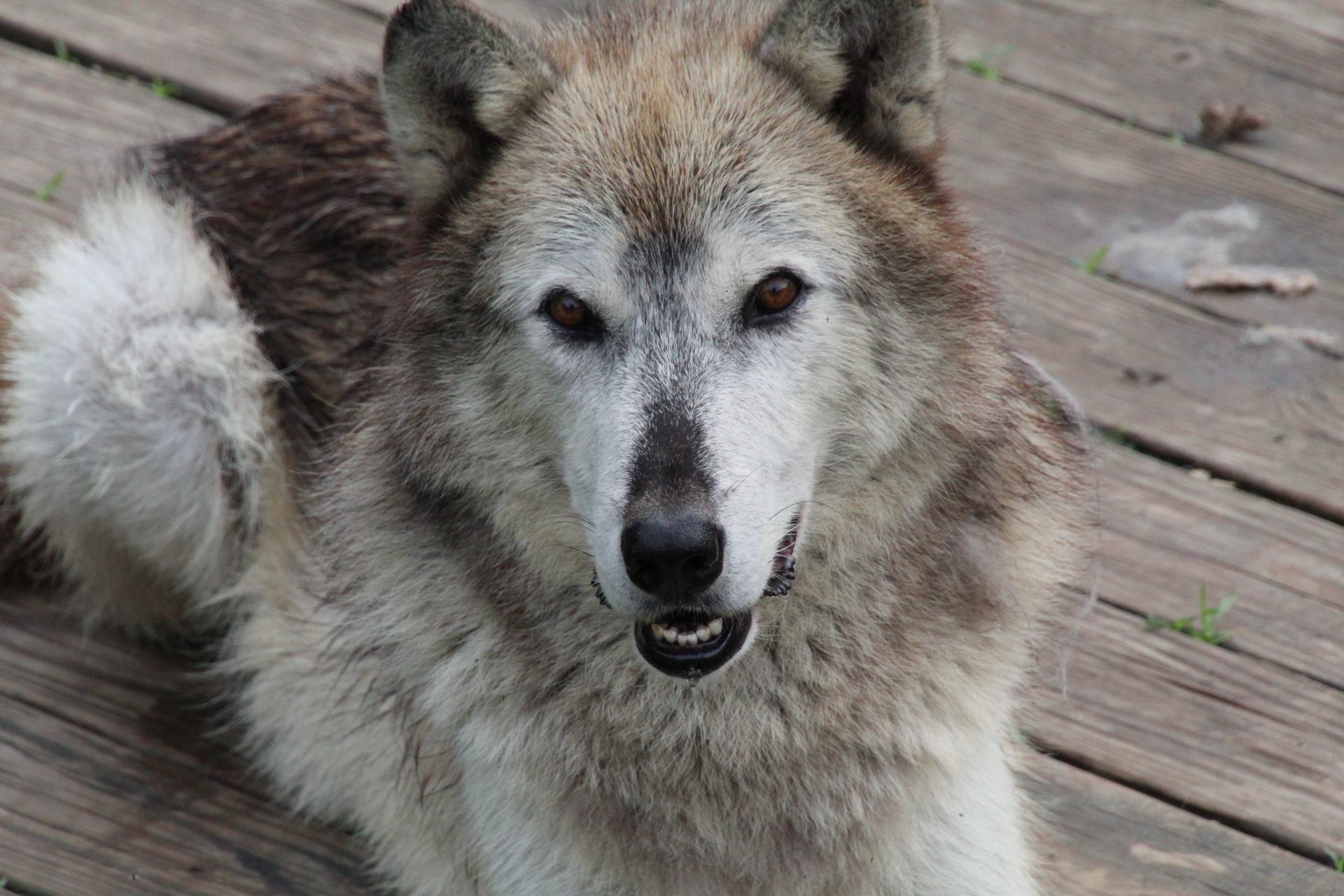
The eastern timber wolf is a unique animal with some distinct physical characteristics. Its fur is typically a grizzled grayish-brown coloration, mixed with cinnamon, with rufous or creamy flanks and chest, and a mix of black and gray on the nape, shoulder, and tail region.
Eastern wolves are intermediate in size between coyotes and gray wolves, with females weighing around 23.9 kilograms (53 lb) on average and males weighing 30.3 kilograms (67 lb).
Their average lifespan is 3-4 years, with a maximum of 15 years, which is similar to that of gray wolves.
Intriguing read: Wolves in Great Britain
Description
The eastern wolf's fur is typically a grizzled grayish-brown coloration, mixed with cinnamon.
Their flanks and chest are rufous or creamy, while the nape, shoulder, and tail region are a mix of black and gray.
Unlike gray wolves, eastern wolves rarely produce melanistic individuals.
The first documented all-black eastern wolf was found to have been an eastern wolf–gray wolf hybrid.
Eastern wolves are intermediate in size between coyotes and gray wolves, with females weighing 23.9 kilograms (53 lb) on average.
Males average 30.3 kilograms (67 lb) in weight.
Their average lifespan is 3–4 years, with a maximum of 15 years.
Additional reading: Repopulation of Wolves in California
Ecology and Behaviour
The eastern wolf's diet consists mainly of small to medium-sized prey items like white-tailed deer and beavers.
In contrast to the gray wolf, the eastern wolf doesn't have the ability to effectively hunt large ungulates like caribou, elk, moose, and bison.
Packs of eastern wolves have been known to forage for blueberries in Voyageurs National Park during the months of July and August when the berries are in season.
This behavior is quite unique, as you wouldn't typically associate carnivores with snacking on berries!
Eastern wolf packs are generally solitary, with only lone wolves occasionally entering other packs' territories.
The average territory size of an eastern wolf pack ranges from 118 to 185 km, or about 46 to 71 square miles.
Young eastern wolves tend to disperse from their packs at a relatively early age of 15 weeks.
Howling
Howling is a distinctive form of vocalization that can be quite loud and intense. Wolves howl to communicate with each other over long distances.
A howl can last anywhere from 10 to 40 seconds. This prolonged vocalization allows the pack to convey important information.
In the wild, wolves typically howl at dawn and dusk, which are the times of day when they are most active.
Distribution and Habitat
The eastern timber wolf has a relatively limited range, primarily inhabiting the Great Lakes region in southeastern Canada. They can be found in central and eastern Ontario, as well as southwestern Quebec north of the St. Lawrence River.
In particular, these wolves are concentrated in Algonquin Provincial Park and other nearby protected areas, such as Killarney, Kawartha Highlands, and Queen Elizabeth II Wildlands Provincial Parks.
Their range extends into parts of the northeastern United States, including Minnesota, Wisconsin, and Michigan, where they inhabit deciduous and mixed forests. These forests provide them with ample cover and prey.
In Ontario, eastern wolves can be found in the southern areas of northeastern and northwestern regions, as far west as the Lake of the Woods near the border with Manitoba.
History and Conservation
The eastern timber wolf has a precarious conservation status, listed as "Special Concern" under Canada's federal Species at Risk Act and "Threatened" under Ontario's provincial Endangered Species Act.
Their populations face numerous threats, including habitat loss, human encroachment, vehicle collisions, and persecution due to livestock predation.
History, Hybridization, Conservation
The history of conservation efforts is a long and complex one, with roots dating back to the late 19th century.
In the United States, the first national park was established in 1872, with Yellowstone National Park being set aside to preserve its natural wonders.
The concept of hybridization has been around for centuries, with early plant breeders experimenting with different species to create new and desirable traits.
In the early 20th century, conservation efforts began to take off, with the establishment of the National Park Service in 1916.
The Endangered Species Act of 1973 marked a significant turning point in conservation efforts, recognizing the importance of protecting threatened and endangered species.
Conservation is a global effort, with international agreements like the Convention on International Trade in Endangered Species of Wild Fauna and Flora (CITES) playing a crucial role in protecting species across borders.
Conservation Status
The eastern wolf's conservation status is precarious, listed as "Special Concern" under Canada's federal Species at Risk Act and "Threatened" under Ontario's provincial Endangered Species Act.
Habitat loss, human encroachment, vehicle collisions, and persecution due to livestock predation all pose significant threats to their populations.
Their genetic integrity is also under threat from hybridization with grey wolves and coyotes, making conservation efforts even more challenging.
Ongoing research aims to better understand the eastern wolf's taxonomy, genetic makeup, and ecological role to inform effective management strategies and ensure their long-term survival.
Diet and Social Structure
As we explore the fascinating world of eastern timber wolves, it's interesting to consider how their diet affects their social structure.
In the wild, eastern timber wolves primarily feed on large ungulates, such as white-tailed deer and moose, which require a coordinated hunting effort.
Their diet is also influenced by the availability of food in their territory, which can impact their social dynamics and pack size.
A single wolf can eat up to 20 pounds of meat in a single sitting, highlighting the importance of successful hunting in their social structure.
For more insights, see: What Does the Eastern Gray Squirrel Eat
Diet and Prey
Eastern wolves are carnivorous, primarily feeding on white-tailed deer, their main prey. Their diet consists mainly of meat.
They also consume smaller mammals such as beavers, rabbits, and rodents. These smaller mammals are an important part of their diet.
Eastern wolves are known to be opportunistic feeders, which means they'll eat what's available. This can sometimes include carrion, or the flesh of dead animals.
Occasionally, their diet may also include livestock, which can lead to conflicts with humans. This is a problem that can arise when their natural hunting habits intersect with human interests.
Broaden your view: Eastern American Toad Diet
Social Structure
Eastern wolves live in packs with a dominant breeding pair, who are the alpha male and female, and their offspring from multiple years. These packs can range in size from 3 to 12 individuals.
Pack sizes are determined by the availability of food and territory. Eastern wolves are highly territorial, which means they fiercely protect their territory and resources.
They communicate through a combination of vocalizations, body language, and scent marking. This complex communication system helps them maintain their social hierarchy and cooperate as a pack.
Reproduction and Lifespan
Eastern timber wolves have a unique reproductive strategy. The alpha pair in a pack is the primary breeding pair, typically mating in February.
Their gestation period is relatively short, lasting around 63 days. This allows them to have multiple litters in a year, increasing their chances of survival.
Eastern wolves give birth to a litter of 4 to 6 pups, which is a significant number considering their average lifespan in the wild. They reach sexual maturity at around two years of age, which is relatively quick compared to other canines.
The entire pack helps care for the young, with older siblings playing a crucial role in their upbringing. This social behavior is essential for the survival of the pack and the pups.
Eastern wolves have an average lifespan of 6 to 8 years in the wild, which is a relatively short lifespan compared to other mammals.
Additional reading: How Long Does a Eastern Gray Squirrel Live
Ma'iingan and Endangered Status
The Ma'iingan, also known as the eastern wolf, is listed as a "Special Concern" under Canada's federal Species at Risk Act and "Threatened" under Ontario's provincial Endangered Species Act.
Human activity poses the greatest threat to the Ma'iingan, and they came close to being extinct in the United States in the early 1900s.
Their populations face threats from habitat loss, human encroachment, vehicle collisions, and persecution due to livestock predation, which reduces their habitat to only 3 percent of their original range in the United States.
You might like: Eastern Gray Squirrel Habitat
Ma'iingan
Ma'iingan is a critically endangered species, with only a few individuals remaining in the wild.
The Ma'iingan, also known as the Eastern Wolf, is a subspecies of wolf that was once widespread in North America.
Their population has been declining due to habitat loss and fragmentation, as well as hybridization with domestic dogs and other wolf species.
Conservation efforts are underway to protect the remaining Ma'iingan population and their habitat, but more work is needed to ensure their survival.
The Ma'iingan is a vital part of its ecosystem, playing a key role in maintaining the balance of nature in the region.
Endangered?
The eastern wolf's endangered status is a pressing concern. Their populations face threats from habitat loss, human encroachment, vehicle collisions, and persecution due to livestock predation.
In Canada, the eastern wolf is listed as "Special Concern" under the federal Species at Risk Act. This designation highlights the need for conservation efforts to protect their populations.
Human activity is the greatest threat to the eastern wolf, having brought them close to extinction in the early 1900s. Today, they survive in only 3 percent of their original habitat in the United States.
Hybridization with grey wolves and coyotes poses a significant challenge to the eastern wolf's genetic integrity and conservation. This highlights the importance of ongoing research to better understand their taxonomy, genetic makeup, and ecological role.
Frequently Asked Questions
How aggressive are timber wolves?
Timber wolves are generally not aggressive towards people, but they can pose a threat in rare instances. Understanding their behavior is crucial to coexisting with these wild animals.
Featured Images: pexels.com