The eastern Pacific green turtle is an incredible species that's been fascinating scientists and conservationists for years. They're listed as Endangered on the IUCN Red List due to habitat loss, entanglement in fishing nets, and egg poaching.
Their nesting sites are primarily located on the coasts of Mexico, Costa Rica, and Panama, where they face threats from coastal development and human disturbance.
These turtles migrate long distances to reach their breeding grounds, with some individuals traveling over 1,000 miles.
Green Turtle Basics
The Eastern Pacific green sea turtle is a remarkable creature, and understanding its basics is essential to appreciating its beauty and importance.
These turtles can weigh anywhere from 300 to 350 pounds and reach lengths of 3 feet.
Their diet consists mainly of seagrasses and algae, which they feed on almost exclusively as adults.
One of the most fascinating aspects of the Eastern Pacific green sea turtle is its behavior, particularly when it comes to reproduction. Females return to the same beaches where they were born to lay eggs, a process that occurs every 2-4 summers.
Here are some key facts about the Eastern Pacific green sea turtle:
Research and Conservation
The Eastern Pacific is home to some of the most dynamic marine ecosystems and unique sea turtles, with the smallest leatherbacks and a singular morph of the green turtle being two examples.
The oceanographic conditions that promote sea turtle activity also lead to massive fishing efforts, causing declines in several turtle populations.
The book "Sea Turtles of the Eastern Pacific" describes the history of this exploitation and recent conservation initiatives, offering a comprehensive view of the region's remarkable ecosystems and the people involved in research and conservation efforts.
Acoustic Telemetry
Acoustic telemetry was used to monitor green turtle movement in San Diego Bay.
Active tracking was conducted from a 17-ft Boston Whaler 170 Montauk boat, equipped with an omnidirectional hydrophone, a directional hydrophone, and an ultrasonic receiver.
Tagged turtles were equipped with an ultrasonic transmitter attached to their rearmost lateral scute using fiberglass mesh and resin.
Each transmitter had a unique combination of frequency, pulse burst, and pulse burst interval.
Submersible ultrasonic receivers were used for passive tracking, allowing for near-constant monitoring of turtle movement.
Data were collected actively via grid surveys and passively via SUR stations, each representing different spatial and temporal scales.
A 500-m latitude/longitude grid map of San Diego Bay was used for boat-based surveys of tagged turtles.
SUR stations were deployed throughout San Diego Bay, predominantly in South Bay adjacent to the South Bay Power Plant.
Take a look at this: Turtles in South America
Research and Conservation Advances
Sea turtles are a vital part of the world's oceans, serving as a connection between human action and ecosystem health.
The East Pacific Ocean is home to some of the most unique sea turtle species, including the smallest leatherbacks and a singular morph of the green turtle.
Only now are we beginning to understand how these varieties have evolved due to the distinctive oceanographic conditions in the region.
Massive artisanal and industrial fishing efforts, combined with illegal harvesting of eggs and turtles, have led to declines of several turtle populations in the East Pacific.
Conservation initiatives and scientific research are underway to address these challenges and protect the sea turtles.
The book "Sea Turtles of the Eastern Pacific" provides an in-depth view of these efforts, including recent research and conservation initiatives in the region.
The book offers six compelling stories of conservation success, highlighting the work of people involved in research and conservation efforts in one of the most remarkable regions of our planet.
Diet and Nutrition
As adults, eastern pacific green turtles are vegetarian and prefer to eat sea grasses, sea weeds, and algae.
Their diet is quite different from their younger selves, who are omnivorous and enjoy snacking on jellyfish, snails, crabs, and shrimp.
A unique characteristic of all sea turtles, including the eastern pacific green turtle, is that they lack teeth, which is a common trait among all sea turtle species.
This lack of teeth doesn't stop them from playing a vital role in ocean ecosystems, affecting the diversity and function of ocean habitats by what they eat.
For more insights, see: What Do Leatherback Sea Turtles Eat
Behavior and Navigation
Eastern Pacific green turtles are incredibly skilled navigators, able to travel vast distances across the ocean to reach their breeding grounds. They have been tracked traveling from Japan to Baja, a distance of 13,000 km (8,000 miles), and some individuals have even crossed the entire Pacific Ocean in search of jellyfish.
One of the most impressive navigation feats of eastern Pacific green turtles is their ability to return to the same beach where they were born to nest. While some theories suggest they can detect the earth's magnetic field, others believe they imprint the unique qualities of their natal beach, including smell, low-frequency sound, and magnetic fields, during their early life stages.
In fact, younger female turtles may even follow older, experienced nesting turtles from their feeding grounds to the breeding site, making their migration routes a social and learned behavior.
Turtles' Ideal Temperature
Sea turtles are sensitive to ambient temperature and seek to occupy warmer waters, typically in the tropical and temperate zones and ideally over 20ºC.
They can't internally maintain their body temperature, so they absorb heat from their surroundings. This is why they're often found in warmer waters.
If exposed to temperatures below 10ºC, sea turtles may develop a condition called cold-stunned, a kind of hypothermia, if not treated.
Here's a breakdown of the ideal temperature range for sea turtles:
Leatherback turtles, however, are an exception. They can be found in very cold waters, thanks to their black carapace acting as a good insulator and their large layer of body fat (blubber) under their skin.
Turtle Detections and Conditions
Turtle detections and associated thermal conditions were studied before and after the SBPP decommissioning.
The study found that turtles were detected exclusively in the South Bay region of SDB, specifically in and around the SBPP intake channel, effluent area, and adjacent eelgrass beds.
Average water temperatures in and around the SBPP were warmer before the SBPP closure than after operations ceased.
Turtles were detected in areas with significantly warmer water temperatures than where they were not detected, both before and after the SBPP closure.
The mean water temperature where turtles were detected before SBPP closure was 18.0 °C, with a range of 14.5–25.6 °C.
In contrast, the mean water temperature where turtles were not detected before SBPP closure was 17.4 °C, with a similar range of 11.3–29.1 °C.
After SBPP closure, the mean water temperature at turtle detections was 17.0 °C, with a range of 12.5–22.4 °C.
The mean water temperature at locations where turtles were not detected after SBPP closure was 15.9 °C, with a range of 11.54–21.86 °C.
A unique perspective: Eastern Water Dragon Habitat
Sea Turtles' Navigation Ability
Sea turtles are incredibly skilled navigators, and their ability to find their way back to their birthplace to nest is truly remarkable. Some sea turtles may return to the exact beach where they were born to nest, a phenomenon known as natal homing.
However, not all sea turtles nest on their birthplace. Many will choose a different beach in the same region where they were born. Scientists are still trying to figure out how sea turtles navigate back to their birthplace, but a few theories have emerged.
One theory suggests that sea turtles can detect the earth's magnetic field and use it to determine their latitude and longitude. This ability would allow them to navigate virtually anywhere. Early experiments have shown that sea turtles can detect magnetic fields, but it's still unclear if they actually use this ability to navigate.
Another theory proposes that hatchlings imprint the unique qualities of their natal beach while still in the nest and/or during their trip from the nest to the sea. This imprinting could include smells, sounds, magnetic fields, seasonal offshore currents, and even celestial cues.
Some scientists believe that younger female turtles follow older, experienced nesting turtles from their feeding grounds to the breeding site. This would explain how they learn the route to their birthplace.
Here are some examples of sea turtles' incredible navigation abilities:
- Leatherback turtles can travel 16,000 km or more each year, crossing entire oceans in search of food.
- Loggerheads have been tracked traveling from Japan to Baja, a distance of 13,000 km.
- The longest recorded green turtle migration was 3,979 km from Chagos to Somalia.
These remarkable feats of navigation are a testament to the incredible abilities of sea turtles.
Why Do Turtles Shore Up?
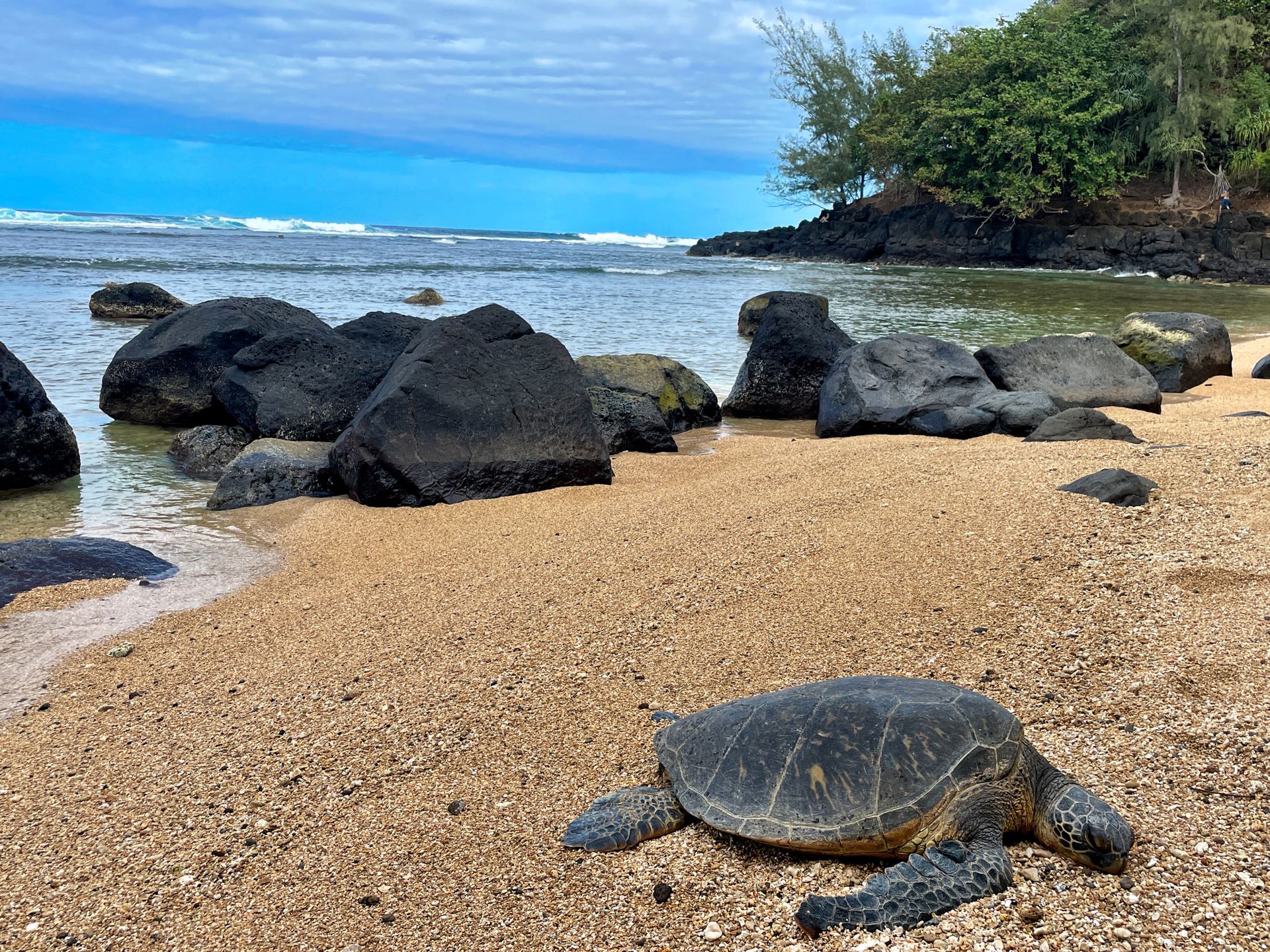
Sea turtles have a unique behavior of coming ashore, and it's not just the females who do it. In some colder waters, both males and females can be found basking in the sun on the beach.
This basking behavior is linked to thermoregulation, which means regulating their body temperature. Sea turtles are poikilothermic, meaning they can't internally maintain their body temperature, so they absorb heat from the surrounding environment to stay warm.
In fact, basking can help them warm their internal temperatures by up to 3ºC! This is especially important for green turtles in the Galapagos, Hawaiian, and Wellesley archipelagos.
Some researchers speculate that basking may aid immune function, predator avoidance, digestion, egg development, and even prevent unwanted courtship.
How Long Can They Hold Their Breath?
Sea turtles can hold their breath for quite a while, depending on their activity level.
If they're sleeping, they can stay underwater for several hours. In cold water during winter, they can even hold their breath for up to 7 hours.
During routine activity, they can hold their breath for 45 minutes to one hour.
On the other hand, a stressed turtle, like one entangled in a ghost net, quickly uses up oxygen and may drown within minutes.
How to Avoid Predators
As an adult eastern pacific green turtle, you've got a hard shell that's your best defense against predators. This shell provides a shield from attacks, making it harder for predators to get a good grip.
You'll still need to be cautious, especially when encountering sharks and killer whales, which are your main predators. Shark avoidance is a tricky business, and most of what we know is based on observing how you behave around these predators.
Synchronized, mass hatching is a clever strategy to avoid predators at the hatchling stage. This way, you're not an easy target for crabs, sea birds, and mammals on the beach.
U-shaped dives might function as both resting dives and predator avoidance. This could be a clever way to stay safe while still getting some rest.
If an attack is imminent, you've got a clever trick up your sleeve - turning your shell to the shark's mouth as it approaches. This prevents the shark from biting your flippers or soft tissues, and you can swim fast in the opposite direction to get away.
Recommended read: Western Pond Turtle Shell
Here are some of your predator avoidance strategies at a glance:
- Synchronized, mass hatching to avoid predators at the hatchling stage
- U-shaped dives for predator avoidance and resting
- Slow approach to the surface to scan for predators before surfacing
- Turning your shell to the shark's mouth to prevent biting
- Swimming fast in the opposite direction to escape predators
General Information
The Eastern Pacific green turtle is a magnificent creature.
They can grow up to 3.5 feet in length and weigh up to 700 pounds.
These turtles have a heart rate of about 30 beats per minute, which is much slower than humans.
They can live up to 80 years in the wild.
Featured Images: pexels.com