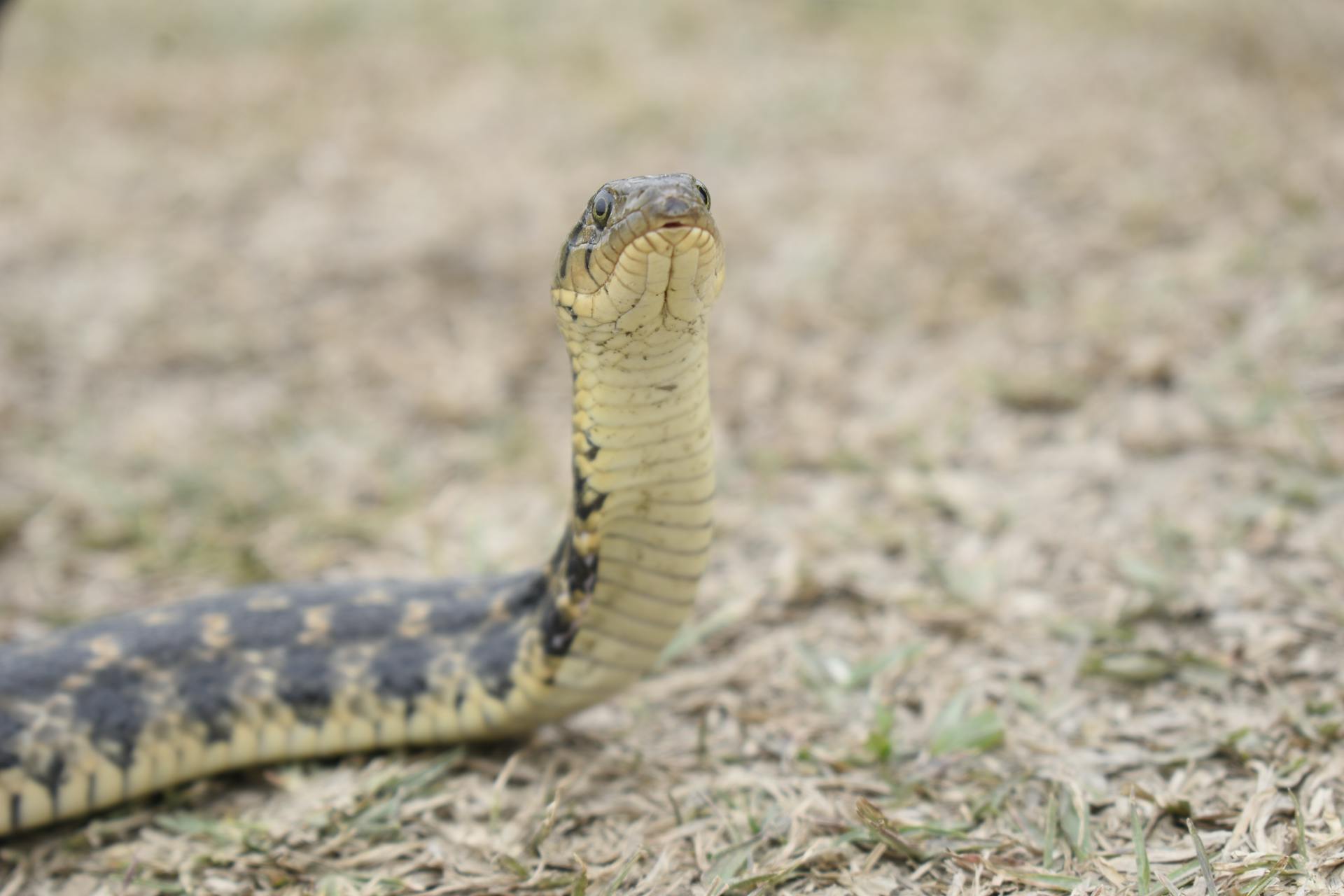
The Eastern Hognose Snake, also known as Heterodon platirhinos, is a species of snake found in the eastern and central regions of North America.
They are a relatively small species, typically growing to an average length of 18-24 inches.
Their distinctive upturned snout, or "hump", is a characteristic feature that sets them apart from other snakes.
Hognose snakes are non-venomous and feed on small animals, such as earthworms, leeches, and insects.
Their burrowing behavior allows them to thrive in a variety of habitats, including forests, grasslands, and wetlands.
Unfortunately, the Eastern Hognose Snake is listed as a species of special concern due to habitat loss and fragmentation, as well as the introduction of invasive species.
Geographic and Habitat Information
The eastern hognose snake (Heterodon platirhinos) has a wide geographic range, spanning from the central United States to the east coast. They can be found in about thirty states in the United States and southern Ontario, Canada.
In the northern parts of their range, they inhabit areas such as southern Ontario, southern New Hampshire, Minnesota, Wisconsin, and Massachusetts. Going west, they can be found in Texas and Kansas, while the southern part of their range extends into southern Florida.
Eastern hognose snakes prefer dry conditions with loose soil for burrowing purposes, making upland sandy pine-forests, old-fields, and forest edges their ideal habitat. They also inhabit barrier beach and dune ecosystems, where abundant prey is available.
Their home range size averages about 40 hectares, and their habitats include southeastern and midwestern woodlands, tall-grassland prairies, and grassy or cultivated fields along woodland edges. They tend to increase their habitat range with the presence of grass and leaf litter.
Here are some specific habitat features where eastern hognose snakes can be found:
- temperate
- terrestrial
- savanna or grassland
- forest
- agricultural
- riparian
Their maximum reported elevation is 830m, with an average elevation of 330m. They are often found in areas with dry, sandy, or mixed sandy soils, and can occasionally be found near small bodies of water.
Physical and Behavioral Characteristics
The eastern hognose snake, Heterodon platirhinos, has a unique physical appearance. They have thick bodies, wide heads, and a slightly upturned and pointed snout.
Adult eastern hognose snakes can grow up to 105cm in length, with females being larger than males. Their coloration varies greatly, ranging from light brown to solid dark gray or black.
One interesting fact about eastern hognose snakes is that their coloration changes as they mature. Juveniles have a pinkish coloration with dark brown to black blotches, while adults have a wide range of colors and patterns.
Here are some key physical characteristics of eastern hognose snakes:
- Length: 45-105cm (17.72-41.34in)
- Average length: 60cm (23.62in)
- Number of dorsal scale rows: 23-25
- Ventral scales: 126-138 (males), 138-130 (females)
- Subcaudal scales: 51 (males), 39 (females)
- Caudal scales: 37-60
Characteristics
The eastern hog-nosed snake is a unique species with some fascinating characteristics. They have thick bodies and wide heads, with a slightly upturned and pointed snout.
Their coloration is highly variable, ranging from light brown to dark gray or black, with some individuals having a pinkish coloration with dark brown to black blotches as juveniles. As adults, they can have a wide range of colors, including red, tan, grayish green, yellowish, and even solid dark gray or black.
You might enjoy: Black Snakes in North America
One of the most distinctive features of the eastern hog-nosed snake is its ability to flatten out its neck during a defensive display, similar to a cobra's hood. This is a remarkable adaptation that helps the snake protect itself from predators.
These snakes are ectothermic, meaning they regulate their body temperature using external sources, such as the sun or a warm rock. They also exhibit bilateral symmetry, meaning their bodies are divided into left and right halves that are mirror images of each other.
Eastern hog-nosed snakes can grow to varying lengths, with a range of 45 to 105 cm (17.72 to 41.34 in) and an average length of 60 cm (23.62 in). Females are larger than males, with an average of 138 ventral scales and 39 subcaudal scales compared to males' 126 ventral scales and 51 subcaudal scales.
Here are some key physical characteristics of the eastern hog-nosed snake:
Overall, the eastern hog-nosed snake is a remarkable species with a range of fascinating characteristics that set it apart from other snakes.
Defensive Behavior
The eastern hognose snake's defensive behavior is quite unique. It will flatten its neck and raise its head off the ground, much like a cobra, to deter predators.
This threat display is often accompanied by hissing and striking with its mouth closed, a behavior known as "bluffing." The snake will even attempt to deliver a high-speed head-butt to its attacker.
If its threat display doesn't work, an eastern hognose snake will roll onto its back and play dead, a behavior that's often observed in water habitats.
Etymology and Biology
The eastern hognose snake's name is derived from Greek words, with "Heterodon" meaning "different tooth" and "platirhinos" meaning "broad or flat snout". This refers to the snake's distinctive upturned snout, used for digging in sandy soils.
The eastern hognose snake breeds in the spring, late summer, or autumn, with females typically laying between 28 to 35 eggs in burrows in sandy soil. The eggs hatch after about two months, and the young are approximately 20 centimetres in length at birth.
In Ontario, eastern hognose snakes reach maturity after four or five years, but in warmer climates, they may do so in as little as two years.
Description and Etymology
The name Heterodon platirhinos is quite a mouthful, isn't it? It's derived from the Greek words heteros meaning "different" and odon meaning "tooth".
The species name platirhinos is a combination of the Greek words platys meaning "broad or flat" and rhinos meaning "snout". This refers to the snake's distinctive upturned snout, which is used for digging in sandy soils.
This species of snake is described as being quite stout-bodied, with an average adult length of 71 cm (28 in) including the tail. Females are larger than males.
The color pattern of Heterodon platirhinos is extremely variable, with a range of colors including red, green, orange, brown, gray to black, or any combination thereof depending on locality.
For your interest: Girdled Armadillo Lizard Real Name
Biology
The eastern hog-nosed snake breeds in the spring, late summer, or autumn. Females typically lay between 28 to 35 eggs in burrows in sandy soil, which the snake excavates with its upturned snout.
The eggs hatch after about two months, and the young are approximately 20 centimetres in length at birth. This species may also deposit eggs in rotting logs or under rocks or leaves.
In Ontario, eastern hog-nosed snakes reach maturity after four or five years, but in warmer climates may do so in as little as two years. Individuals can live up to seven years in the wild.
Eastern hog-nosed snakes hibernate underground below the frost line, often in burrows that they excavate in sandy soil. This species is not known to overwinter communally.
The eastern hog-nosed snake uses very mild venom to immobilize its prey. Its venom is not dangerous to humans.
A unique perspective: Western Diamondback Rattlesnake Venom
Conservation and Captivity
The eastern hognose snake is a fascinating species, but it's also facing some challenges in the wild. They are listed as Least Concern on the IUCN Red List, but their populations are declining in some areas due to habitat loss and fragmentation, road mortality, and intentional killing.
In captivity, hognose snakes can live for 10-15 years and require suitable substrate depth to retain their natural instinct to burrow. They are also toad specialists, which can make feeding them a bit tricky.
To entice hognose snakes to eat, hobbyists often scent their food with toad or lizard scent. This can be a useful trick for snake keepers, but it's essential to remember that hognose snakes are solitary animals and should be kept individually unless it's for intentional breeding.
- Habitat loss and fragmentation are significant threats to eastern hognose snake populations.
- Road mortality and intentional killing also contribute to their decline.
- Eastern hognose snakes are often mistaken for pygmy rattlesnakes and killed due to this mistaken identity.
Current Status and Protection Status
The eastern hog-nosed snake is currently listed as Threatened under both the Ontario Endangered Species Act, 2007 and the federal Species at Risk Act.
In the United States, its status varies by state, with four out of five northeastern states where it occurs having listed conservation status.
The species has also been designated as a Specially Protected Reptile under the Ontario Fish and Wildlife Conservation Act.
It's worth noting that the International Union for Conservation of Nature lists the global status of the eastern hog-nosed snake as Least Concern.
Here are some key conservation status listings for the eastern hog-nosed snake:
- Ontario Endangered Species Act, 2007: Threatened
- Federal Species at Risk Act: Threatened
- Ontario Fish and Wildlife Conservation Act: Specially Protected Reptile
- IUCN Red List: Least Concern
Captivity
The hognose snake is an intermediate level reptile to keep and lives between 10-15 years in captivity.
Mice and rats are the typical food sources for most snakes in captivity, but hognose snakes can be tricky to feed, especially when it comes to frozen thawed mice.
Scenting the food with toad or lizard is a trick used by hobbyists to entice the snake to eat.
Being a solitary species, hognose snakes are best kept individually, unless it's for intentional breeding.
Due to their burrowing nature, hognose snakes require suitable substrate depth to retain this natural instinct.
Reproduction and Diet
Eastern hognose snakes are polygynandrous, meaning both males and females have multiple mates in a single mating period. They follow scent trails to find mates, with males traveling farther than females.
Males will copulate with females for up to three days, with the female storing the male's sperm until the following spring if a second breeding period occurs. The gestation period for females is typically between 40-50 days, resulting in 10-30 eggs being laid from early June to late July.
Female eastern hognose snakes typically lay eggs beneath rocks and bury them 10-15 centimeters deep into sandy soils, with the eggs weighing 3-12 grams. The incubation period depends on the nest temperature and ambient temperature, with the higher the temperature, the shorter the incubation period.
Here are some key reproductive features of eastern hognose snakes:
- Breeding interval: Eastern hognose snake females breed once yearly
- Breeding season: April to July
- Range number of offspring: 4 to 69
- Average number of offspring: 25
- Range gestation period: 40 to 50 days
- Average time to independence: 0 days
- Average age at sexual or reproductive maturity (female): 21 months
- Range age at sexual or reproductive maturity (male): 18 to 24 months
- Average age at sexual or reproductive maturity (male): 26 months
Reproduction
Eastern hognose snakes are polygynandrous, meaning both males and females have multiple mates during a single mating period. They follow scent trails to find each other, much like they follow prey scent trails.
Males tend to travel farther in search of mates, while females stay near optimal egg-laying areas that maximize hatching success. These areas are typically between 23-26 degrees Celsius and have high sunlight exposure.
Females lay 10-30 eggs from early June to late July, and clutch size is positively correlated with their snout-vent length (SVL). Eggs are often laid beneath rocks and buried 10-15 centimeters deep into sandy soils.
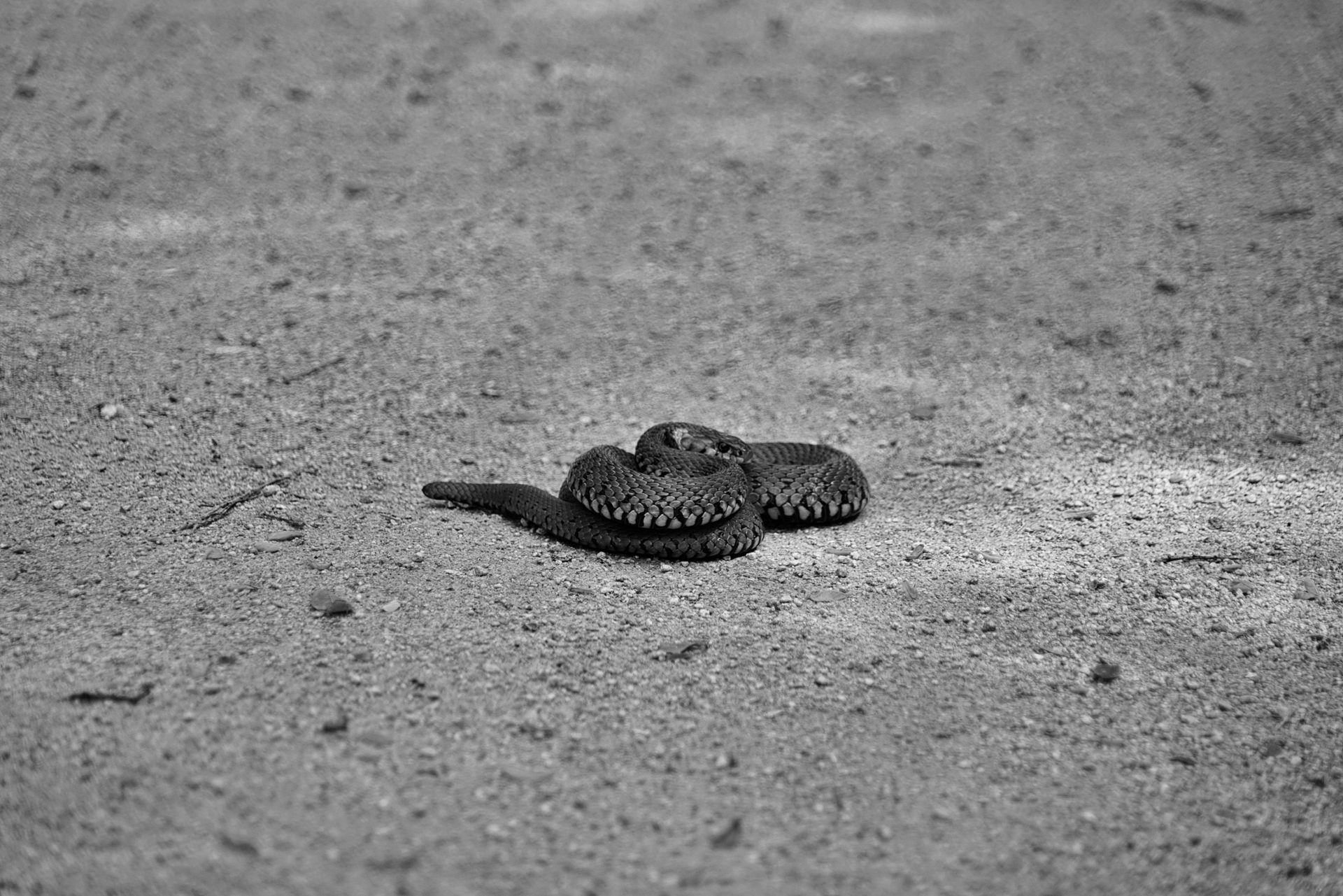
The gestation period for female eastern hognose snakes is typically 40-50 days, and they usually hatch during August and September. Hatchlings can range from 10-20 centimeters long and grow as fast as two centimeters per month.
Here's a breakdown of the reproductive features of eastern hognose snakes:
- Key Reproductive Features:
- iteroparous
- seasonal breeding
- sexual
- oviparous
- sperm-storing
Female eastern hognose snakes incubate their eggs for 39-65 days (average 56 days), depending on the nest temperature and ambient temperature. The higher the temperature, the shorter the incubation period.
Feeding and Diet
Eastern Hognose Snakes have a specialized diet in the wild, primarily consisting of amphibians like toads.
They can be transitioned to a diet of frozen-thawed rodents in captivity, which are more accessible and nutritionally balanced.
Feeding should occur every 7-10 days for adults, with younger snakes requiring more frequent meals.
General Information
The Eastern Hognose Snake is a fascinating creature.
This snake is "Polk County's Most Wanted—Animal" according to Conserving Carolina and botanist/ecologist David Campbell.
The Eastern Hognose Snake is a species that needs our help in locating it.
What Is a Hognose Snake?
Hognose snakes are a type of non-venomous snake that can grow up to 46 inches in length.
They're easily recognizable by their distinctive upturned snouts, which they use to dig for prey in sandy soil and other habitats.
Eastern Hognose Snakes come in a variety of colors, including orange, dark brown, and solid black, with darker blotches on some individuals.
Their coloration helps them blend in with their surroundings, making them expert hunters.
These snakes are found in the eastern half of the United States, from southern Florida to central New England, and some regions of southern Canada.
You can spot them in woodlands with sandy soil, fields, farmland, and coastal areas.
Eastern Hognose Snakes are active during the day and are often seen on roads in the spring and fall.
Their diet consists of frogs, salamanders, small mammals, birds, and invertebrates, but toads are their favorite food source.
They have large teeth in the back of their mouths, called rear fangs, which they use to puncture inflated toads before swallowing them.
These snakes are experts at feigning death when threatened, often displaying a convincing show of "agony" to deter intruders.
See what others are reading: Southern Alligator Lizard
Have You Seen Hognose Snake?
The Eastern Hognose Snake is a species that needs our help in being located. It's the "Polk County's Most Wanted—Animal" this month, according to Conserving Carolina and botanist/ecologist David Campbell.
This snake is a bit of a mystery, and we're counting on your help to find one. It's a joint effort to expand our knowledge and understanding of the flora and fauna of Polk County.
The Eastern Hognose Snake is a specific species, known as Heterodon platirhinos.
Eastern Hognose Snake
The Eastern Hognose Snake is a thick-bodied, non-venomous snake that reaches about 46 inches in length.
These snakes are easily distinguished by their upturned snouts, which they use to dig for prey in woodlands with sandy soil, fields, farmland, and coastal areas.
Eastern Hognose Snakes are found in the eastern half of the United States, from southern Florida north to central New England, the Great Lakes Region, and some regions of southern Canada.
Explore further: Southern Flying Squirrel
They are active during the day and are often seen on roads in the spring and fall, usually when they're out hunting for food.
Their diet consists of frogs, salamanders, small mammals, birds, and invertebrates, but toads are their favorite food source due to their strong toxins that predators avoid.
Eastern Hognose Snakes have a unique defense mechanism where they suck in air, spread their skin around their neck and head, hiss, and lunge, pretending to strike, and if that doesn't work, they'll feign death by coming to rest upside down with their mouth open and tongue out.
Snake Details
The eastern hognose snake has a unique appearance, with a flat, upturned snout that's perfect for digging.
Their scales are usually a mottled brown or gray color, helping them blend in with their surroundings.
These snakes are relatively small, typically growing to an average length of 20-30 inches.
They have a distinctive pattern of dark spots or blotches on their back, which can vary in intensity and distribution.
The eastern hognose snake is a nocturnal animal, meaning it's most active at night.
They are skilled burrowers, using their powerful front legs and sharp claws to dig complex networks of tunnels.
Eastern hognose snakes are carnivores, feeding on a variety of small animals including insects, amphibians, and lizards.
Their diet consists mainly of earthworms, which they hunt using their keen sense of smell.
In the wild, eastern hognose snakes are typically found in a variety of habitats, including forests, grasslands, and wetlands.
They are often found near water sources, such as ponds or streams, where they can hunt for fish and other aquatic prey.
Frequently Asked Questions
How venomous is an eastern hognose snake?
Eastern Hog-nosed Snakes have a mild venom, but it's not potent enough to cause significant harm to humans or pets. Bites from these snakes are extremely rare, making them a relatively non-threatening species.
How rare are eastern hognose snakes?
Eastern hognose snakes are not endangered, but their populations are declining due to habitat loss from development in their sandy habitats. They hold a conservation status of special concern in New York State.
Are baby eastern hognose snakes poisonous?
Eastern Hog-nosed Snakes, including babies, have a mild venom that helps them catch prey, but it's not strong enough to harm people or pets. Bites from these snakes are extremely rare, making them a non-threatening species.
What happens if you get bit by a eastern hognose snake?
If you get bitten by an eastern hognose snake, you may experience symptoms like swelling, redness, pain, and nausea at the bite site, as well as other systemic issues. If bitten, seek medical attention immediately to receive proper treatment and prevent potential complications.
Featured Images: pexels.com