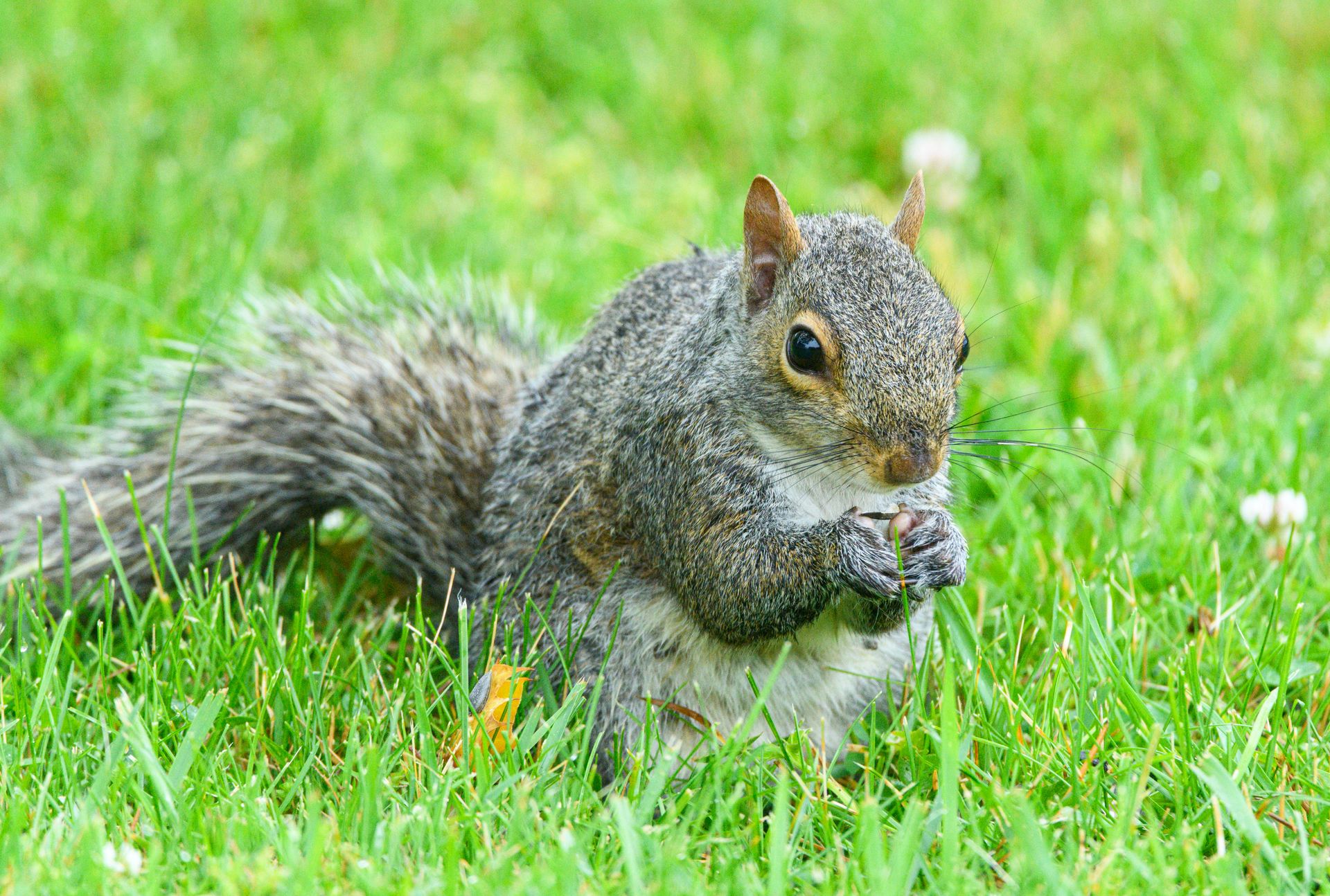
The eastern gray squirrel is a fascinating creature, and I'm excited to share some fun facts about these bushy-tailed critters. They're native to North America, specifically in the eastern and central regions.
Eastern gray squirrels are incredibly agile, able to leap up to 20 feet in a single bound. Their impressive jumping ability allows them to navigate tree canopies with ease.
These squirrels are known for their intelligence and resourcefulness. They've been observed using tools, such as sticks, to obtain food and solve problems.
One of the most interesting characteristics of eastern gray squirrels is their ability to adapt to different environments. They can thrive in both urban and natural settings, making them a common sight in cities and forests alike.
Recommended read: Do Squirrels Attack Dogs
Habitat and Behavior
Eastern gray squirrels are highly adaptable and can thrive in a variety of environments, from rural to urban areas.
They are common in woodlots and are regulated by the availability of suitable habitat and abundance of mast, or tree nuts. In areas with an abundance of food, their populations can explode.
These squirrels are incredibly active, with most of their activity taking place during the day, particularly in the afternoon and at dawn. They are busy animals that work throughout the year.
Their spatial memory is impressive, as they need to remember the location of their caches, which can number in the thousands per season. They use landmarks to help them retrieve their hidden food.
Eastern gray squirrels have a keen sense of smell, allowing them to detect their caches from just a few centimeters away. This is crucial for their survival.
Despite their adaptability, they still require a secure place to rest and hide from predators, which is why they often use tree cavities or nests constructed of leaves.
For your interest: Birds Attack Squirrels
Reproduction and Lifespan
Eastern gray squirrels have two breeding seasons in a year, one from December to February and another from May to late June. The female squirrels typically don't breed in their first year of birth.
The males are very promiscuous and can breed with multiple partners. They have a gestation period of about 44 days, during which the female produces 2 to 6 young, which are naked and pink at birth.
In the wild, the maximum lifespan of an eastern gray squirrel is 12.5 years, but in captivity, they can live up to 20 years.
Reproduction
Eastern gray squirrels have two breeding seasons in a year, one from December to February and another from May to late June.
Female squirrels are not capable of breeding in their first year of birth, which means they have to wait a whole year before they can start having babies.
The males, on the other hand, are very promiscuous and indulge in a lot of breeding activity.
The gestation period for Eastern gray squirrels is about 44 days.
After giving birth, the female squirrels typically have between 2 to 6 young, which are born naked and pink.
Readers also liked: Were the Tsavo Lions Male or Female

The young squirrels have larger heads and feet compared to their body size at birth, and their eyes are closed.
In the wild, gray squirrels can live up to 12.5 years, which is a pretty impressive lifespan for a small animal.
While in captivity, they can live for up to 20 years, which is even more remarkable.
On a similar theme: How Long Do American Bald Eagles Live
Long Lifespan
Grey squirrels have a remarkable lifespan, living up to 12 years in the wild and 20 years in captivity.
Their lifespan is significantly longer than that of chipmunks, which typically live for three to eight years.
Squirrels are able to thrive in various environments, from urban areas to forests, due to their adaptability and resilience.
In Toronto, the grey squirrel is the most populous species, with the black squirrel being the second most common variety.
This adaptability is likely a key factor in their long lifespan, allowing them to adjust to changing conditions and find food sources.
You might enjoy: Eastern Gray Kangaroo
Adaptations and Description
The eastern gray squirrel is a remarkable creature with some amazing adaptations and physical characteristics.
Its fur is predominantly gray and black, with a white underside and a bushy tail that's about 22 to 25 cm long. The tail is also quite versatile, serving as a rudder for balance, a warm winter coat, and even a distraction to predators.
Eastern gray squirrels are diurnal, meaning they're active during the day, and they have sharp claws that help them climb trees and grasp things. They're also excellent jumpers, using their tails as a rudder to help them navigate long distances.
Their fur changes color with the seasons, turning tawnier in summer and grayer in winter, with a distinctive salt and pepper combination of gray and black guard hairs. In some cases, their fur can even appear reddish or yellowish-gray.
These squirrels have distinctive footprints, with round prints about an inch long and hind prints that are 2.5 inches long. They're also quite agile, able to scamper up trees with ease.
One of the most interesting things about eastern gray squirrels is their ability to confuse predators, such as rattlesnakes, by increasing the temperature of their tails and wagging them furiously. This is thought to be a way of making the squirrel appear more threatening than it actually is.
For your interest: How Long Do Galapagos Tortoises Live
Frequently Asked Questions
Are Eastern GREY squirrels smart?
Eastern grey squirrels possess impressive problem-solving abilities, rivaling those of some primates. Their intelligence is evident in their ability to outsmart obstacles, like bird feeders.
Featured Images: pexels.com