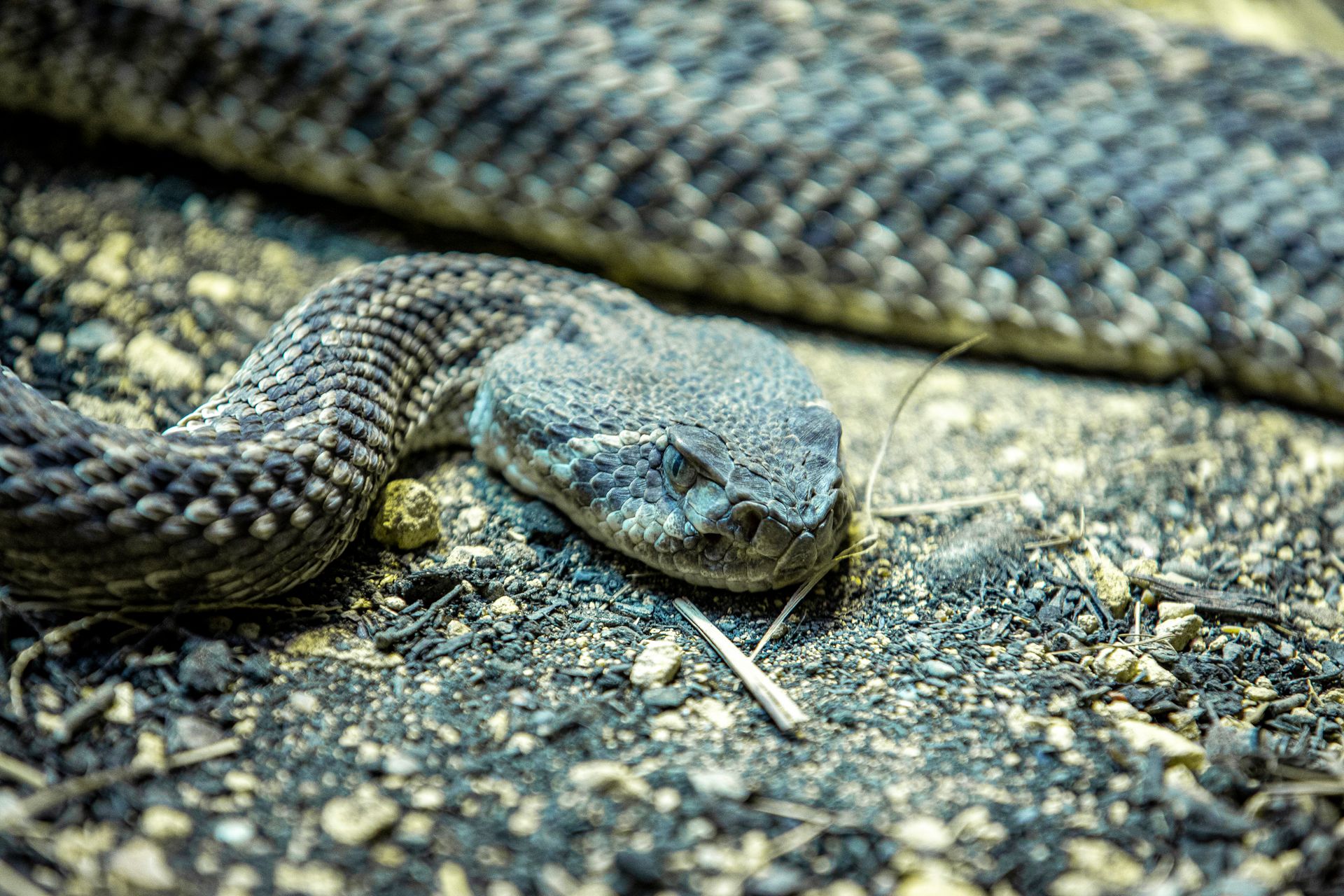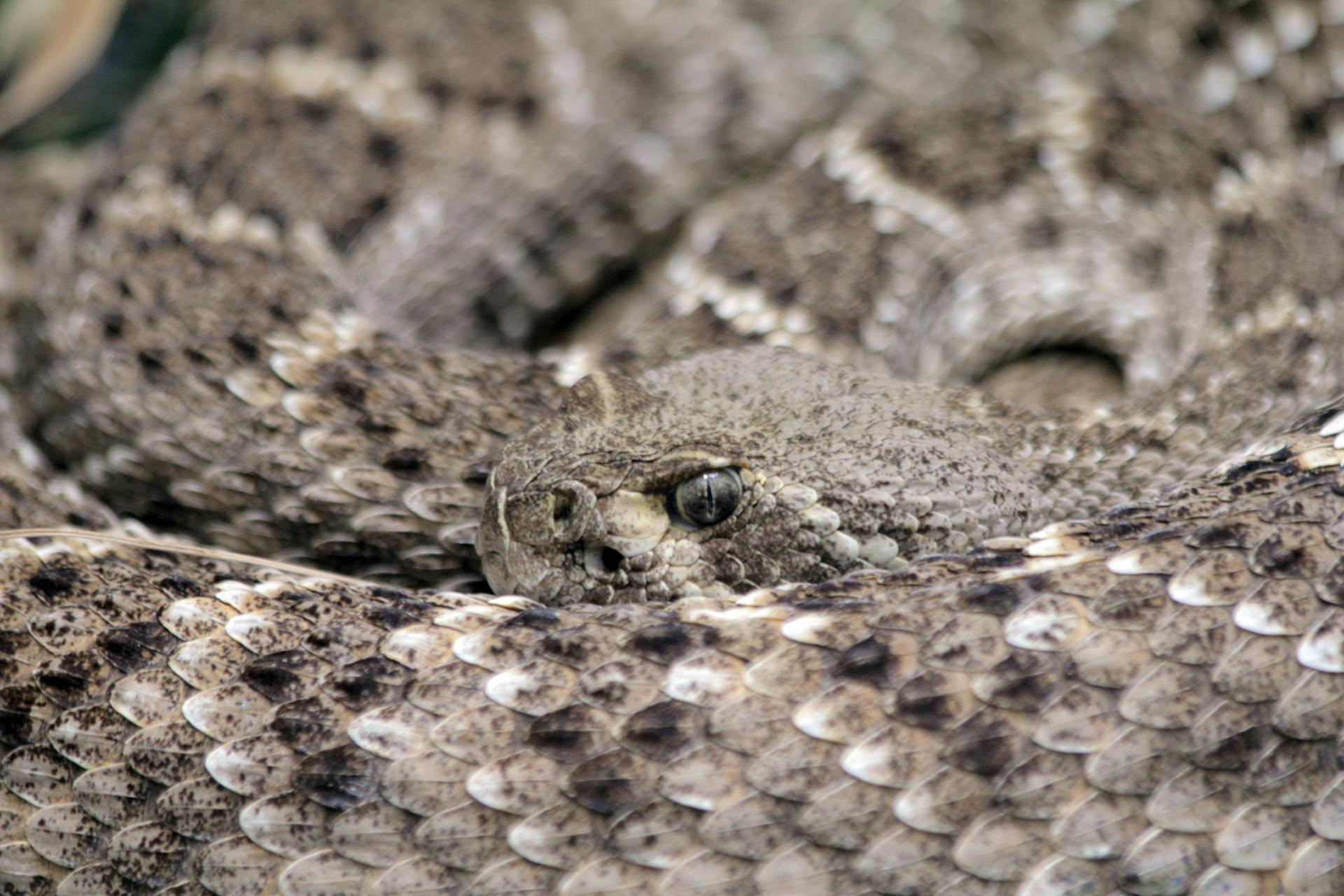
The eastern diamondback rattlesnake is a venomous snake found in Florida, and it's essential to know how to identify it. These snakes have a distinctive rattle on their tail.
They can grow up to 8 feet in length, making them one of the largest venomous snakes in the United States. Their diamond-shaped markings on their back are a key identifier.
Eastern diamondback rattlesnakes are generally found in dry, sandy areas with scrub vegetation. They are solitary animals and only come together to mate.
In Florida, they are most commonly found in the central and southern regions of the state. Their venom is highly toxic and can cause serious harm to humans.
See what others are reading: Florida Snakes List
Physical Characteristics
The eastern diamondback rattlesnake is a formidable creature, and its physical characteristics are just as impressive. Adults can reach over 8 feet long and weigh up to 15 pounds, making them a force to be reckoned with.
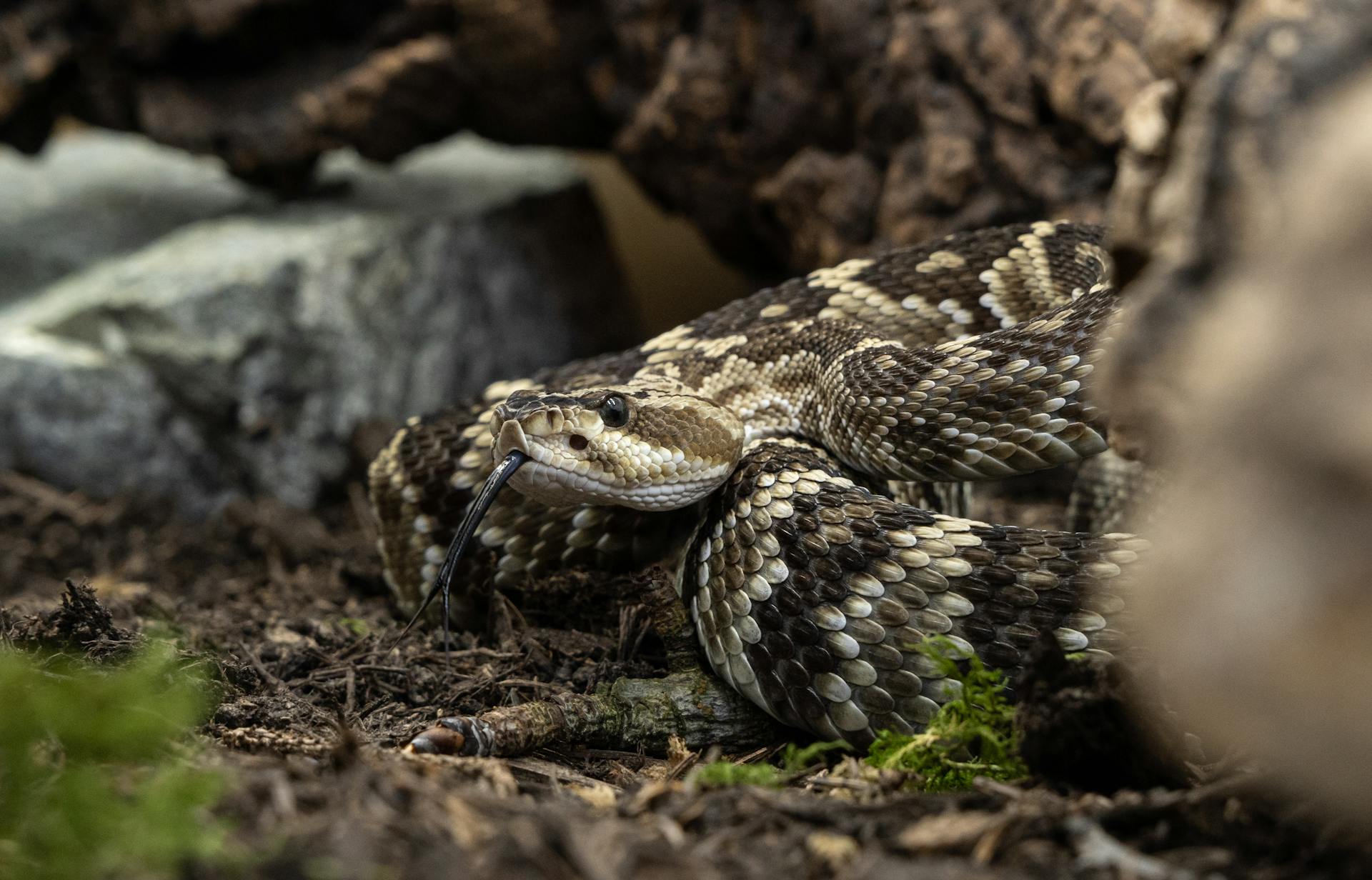
The eastern diamondback's color is quite striking, ranging from yellowish to black, with pronounced dark brown or black diamonds running the length of its back. These diamonds are outlined with lighter coloring, giving the snake a unique appearance.
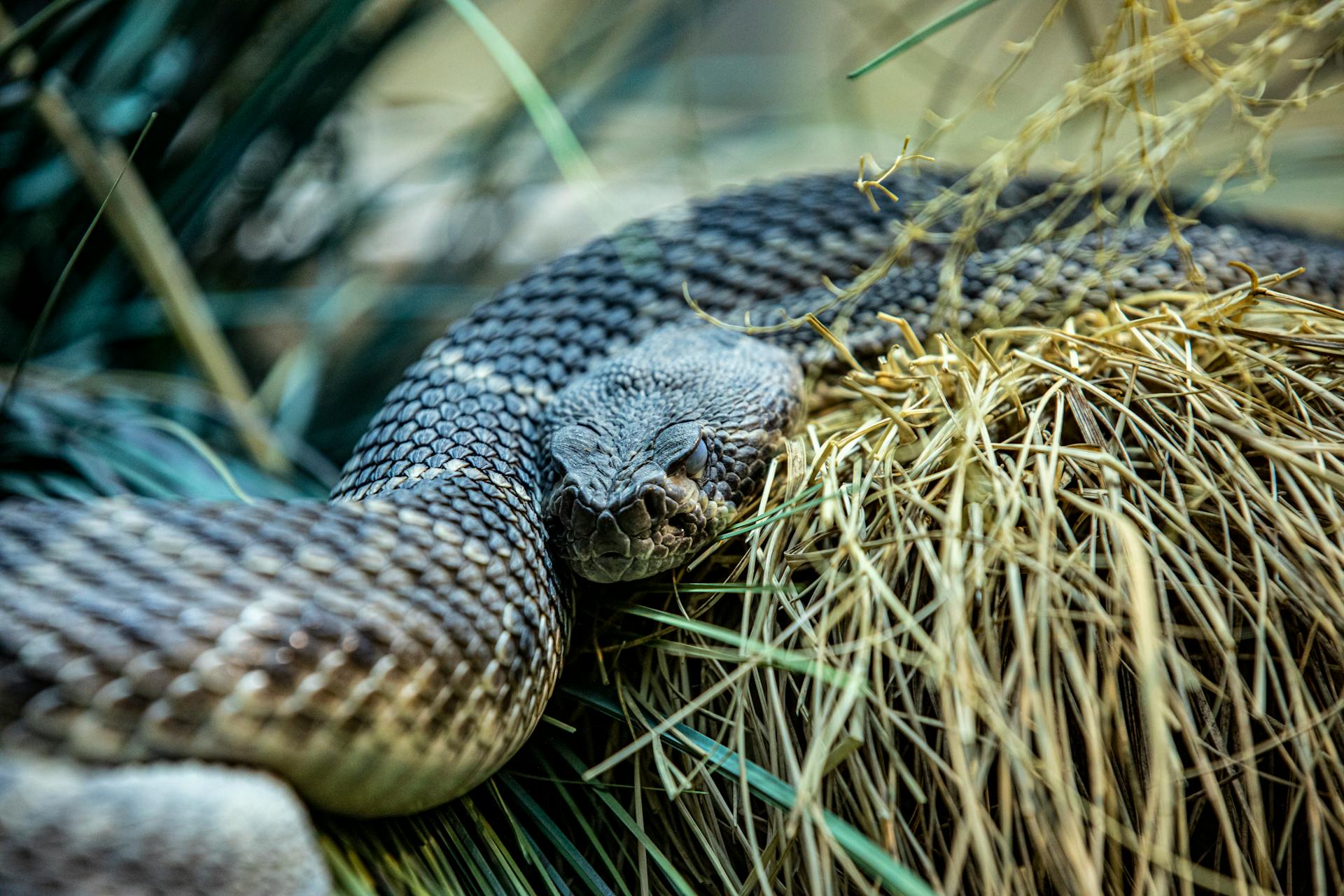
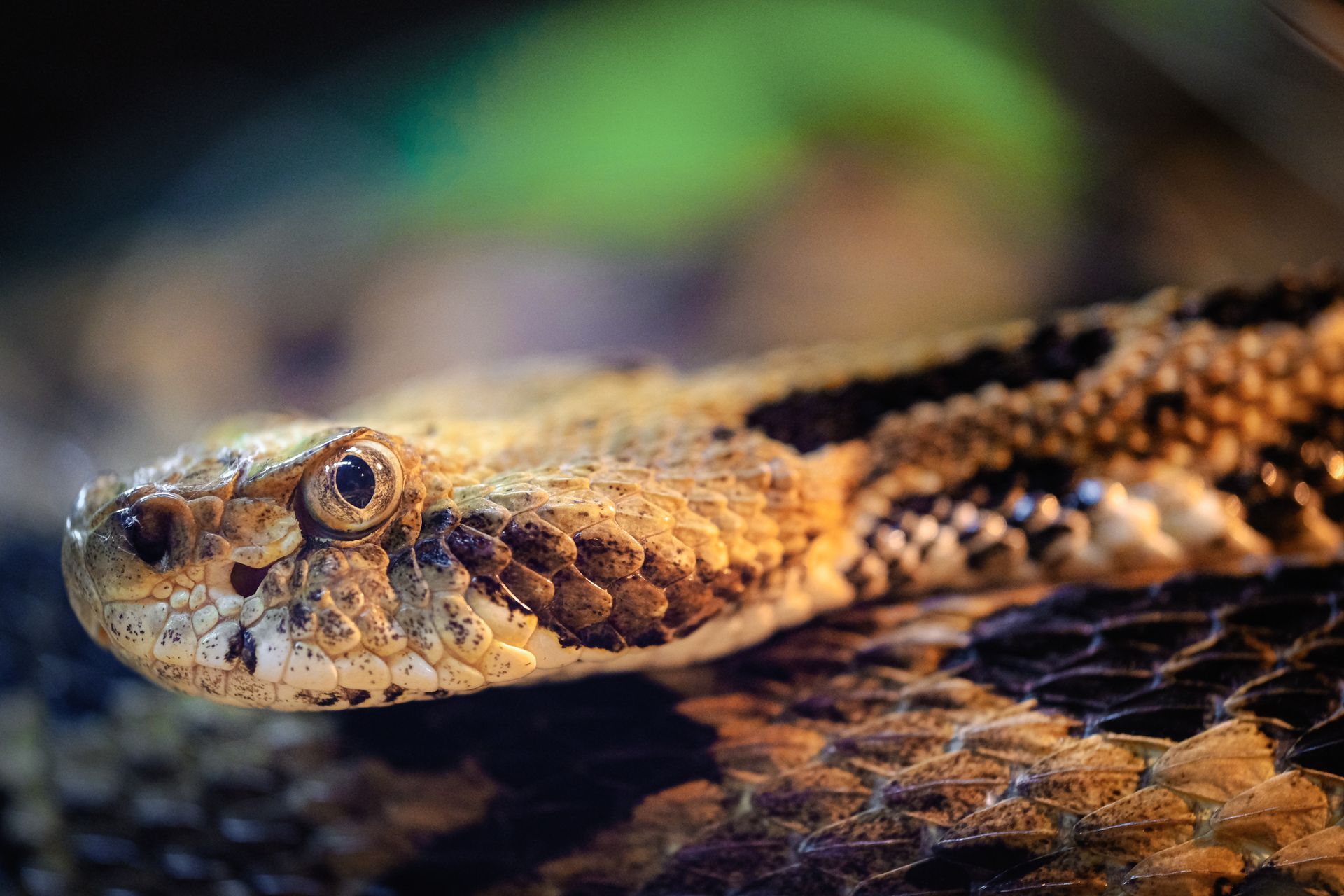
Its head is triangular, distinct from the neck, and features horns or supraocular scales above the eyes. Heat-sensing facial pits are also present, allowing the snake to detect warm-blooded prey.
The eastern diamondback's rattle is a distinctive feature, producing a loud, buzzing sound made of interlocked hollow segments at the end of its tail. This rattle adds 1-2 new segments each time the snake sheds its skin.
Juvenile eastern diamondback rattlesnakes are much smaller, averaging 14 to 22 inches in length and weighing 4 to 7 ounces. They have a more grayish color with diamond-shaped dorsal blotches and a well-defined black and white banded pattern on their tail.
Newborn eastern diamondback rattlesnakes have a small button-like pre-rattle at the end of their tail that makes a faint buzzing sound when vibrated. This pre-rattle is a precursor to the full rattle that develops as the snake matures.
Here's a comparison of the eastern diamondback's size with other Florida species:
The eastern diamondback's larger size, distinctive diamond-shaped dorsal blotches, and triangular head make it easily distinguishable from other rattlesnake species in Florida.
Habitat and Behavior
Eastern diamondback rattlesnakes can be found in a variety of habitats, including pine flatwoods, longleaf pine and turkey oak hammocks, sand pine scrub areas, and coastal barrier islands.
These habitats provide the perfect combination of dry, sunny openings and wooded wetlands for the snakes to forage for prey. They often seek refuge in palmetto thickets and gopher tortoise burrows.
In central Florida, the warm and humid climate provides ideal conditions for these snakes, with average annual temperatures ranging from the mid 60s°F to the mid 70s°F. The region receives abundant rainfall, supporting dense forests and swamps.
Eastern diamondbacks are diurnal sit-and-wait predators that lay in a tight coil for hours at a time waiting on prey. They typically sit-and-wait in shaded areas, like in the underbrush.
The snakes can be found scattered through the underbrush of open abandoned fields, palmetto flat lands, pine woods, and other brush-filled or grassy areas. They stay mainly around travel game trails and other areas where they can find high concentrations of food.
Here are some key behaviors and characteristics of eastern diamondback rattlesnakes:
- Terrestrial Biomes: savanna or grassland, forest
- Range elevation: 0 to 500 m
- Key Behaviors: terricolous, diurnal, motile, sedentary, hibernation, solitary, territorial
- Range territory size: 0.180 to 0.843 km^2
Juvenile Rattlesnake
Juvenile Rattlesnakes are a wonder to behold. Newborn Eastern Diamondback Rattlesnakes average 14 to 22 inches in length and weigh 4 to 7 ounces.
These little snakes have a distinctive appearance, with diamond-shaped dorsal blotches that are more grayish in color than their adult counterparts. The tail has a well-defined black and white banded pattern.
A key feature of juvenile Eastern Diamondback Rattlesnakes is the small button-like pre-rattle at the end of their tail, which makes a faint buzzing sound when vibrated.
Here are some key characteristics of juvenile Eastern Diamondback Rattlesnakes:
Juvenile Eastern Diamondback Rattlesnakes are quite different from their adult counterparts, but still have some key features that distinguish them from other rattlesnake species in Florida.
Ideal Habitat
Eastern diamondbacks are found in a variety of habitats, including pine flatwoods, longleaf pine and turkey oak hammocks, sand pine scrub areas, and coastal barrier islands.
These habitats contain palmetto thickets and gopher tortoise burrows, which provide the snakes with refuge and shelter.
The warm, humid climate of central Florida is ideal for eastern diamondbacks, with average annual temperatures ranging from the mid 60s°F (18°C) in northern counties to the mid 70s°F (24°C) in southern areas.
Hot summers see highs in the 90s°F (30s°C), while the region receives abundant rainfall of 40-60 inches (1000 to 1500 mm) per year, supporting dense forests and swamps.
Eastern diamondbacks prefer dry, sunny openings, such as palmetto flatwoods, pine forests, scrublands, and coastal dunes, along with wooded wetlands for foraging.
Here are some key characteristics of eastern diamondback habitats:
- Temperate regions
- Savanna or grassland, forest
- Range elevation: 0 to 500 m (0.00 to 1640.42 ft)
Behavior
Eastern diamondback rattlesnakes are not social creatures and prefer to live alone, except when they have young. They don't inhabit the same holes except when females are raising their babies.
These snakes are diurnal, which means they're most active during the day, and they're sit-and-wait predators that lay in a tight coil for hours at a time waiting on prey. They typically sit-and-wait in shaded areas, like in the underbrush.
Eastern diamondbacks are solitary animals and only interact directly in mating season. During this time, males will engage in a "combat dance" to establish territories, which can last up to two hours.
These snakes are also territorial, with females defending their territories and males fighting for rights. Their territories can overlap, but they usually only interact directly in mating season.
Here are some key behaviors of eastern diamondback rattlesnakes:
- Terrestrial
- Diurnal
- Motile
- Sedentary
- Hibernation
- Solitary
- Terrestrial
Their territory size can range from 0.180 to 0.843 km^2.
Diet and Lifespan
The eastern diamondback rattlesnake in Florida has a fascinating diet that plays a role in its lifespan.
In the wild, they primarily feed on small mammals like rodents and rabbits, which they can consume in a single meal.
Their diet is also a key factor in their growth rate, with young snakes growing up to 3 feet in just one year.
A diet rich in protein helps them grow at a rapid pace, allowing them to reach maturity in just 3-5 years.
If this caught your attention, see: Eastern American Toad Diet
Diet and Feeding
Eastern diamondbacks are skilled hunters, preying on a wide variety of small animals. They ambush their prey from camouflaged positions, making them formidable predators.
Their diet consists of small mammals, including squirrels, rats, mice, rabbits, moles, shrews, and many others. These make up their most important food source.
Birds are also on the menu, with quail, grouse, and songbirds being attracted to the ground for seeds. Amphibians, such as frogs, toads, and salamanders, are another source of food.
Other reptiles, like snakes, small alligators, and lizards, are also preyed upon. In addition, invertebrates like large centipedes, caterpillars, and beetle larvae provide moisture and nutrients.
Neonates and juveniles eat smaller prey, such as reptiles, amphibians, rodents, and invertebrates. Adults, on the other hand, take larger warm-blooded prey.
After striking, Eastern diamondbacks release and track the scent trail of envenomated prey, which soon dies. This unique hunting strategy allows them to efficiently catch their prey.
Here's a breakdown of their diet:
- Small mammals: Squirrels, rats, mice, rabbits, moles, shrews, etc.
- Birds: Quail, grouse, songbirds attracted to ground scratching for seeds.
- Amphibians: Frogs, toads, salamanders.
- Other reptiles: Snakes, small alligators, lizards.
- Invertebrates: Large centipedes, caterpillars and beetle larvae provide moisture.
Reproduction and Lifespan
Eastern diamondbacks are remarkable creatures, and their reproductive habits are just as fascinating as their lifespan. They sexually mature between 2 to 4 years of age.
Males engage in ritual combat dances during the breeding season from April to June, which is a pretty intense way to find a mate. After mating, females give birth to 5-21 live young about 5-6 months later from August to October.
Young eastern diamondbacks are independent immediately after birth, which is impressive considering they're born blind and helpless. They shed their skin frequently as juveniles when growing, which is a natural process that helps them grow and develop.
Adult eastern diamondbacks shed 2-4 times per year, which is a common occurrence for many snakes. Their average lifespan in the wild is around 10 years, which is a remarkable feat considering their habitat and predators.
A fresh viewpoint: How Long Does a Eastern Gray Squirrel Live
Safety and Prevention
To minimize the risk of conflict with eastern diamondback rattlesnakes, learn how to identify them and make noise while hiking through brush.
Wearing snake-proof leg wear and boots in snake country can also help prevent encounters. Always give snakes a wide berth if encountered and allow them to retreat.
Keeping vegetation short around homes and yards can help reduce the likelihood of snakes hiding under woodpiles and debris. Remove any woodpiles and debris that can provide hiding spots.
Installing snake-deterrent fencing can also help keep snakes away from your property. Keep pets from roaming unsupervised to prevent them from accidentally disturbing a snake.
Most bites occur when a rattlesnake is accidentally stepped on or feels cornered, so it's essential to stay calm and back away slowly if you encounter one.
Rattlesnakes can lose their tails, so be sure to look at your surroundings and not just listen for their warning sounds. They can be found in dry areas, including pine forests and golf courses.
Eastern diamondbacks are also adept at climbing and swimming, so be mindful of your surroundings even near rivers or in forests.
For your interest: Eastern Ribbon Snake
Risk and Conservation
The eastern diamondback rattlesnake is listed as "Least Concern" by the IUCN Red List, but it's not entirely out of the woods. They hold no special status under the US Endangered Species Act, and they're not protected by CITES either.
In some states, they're considered endangered or a species of special concern. For example, they're endangered in North Carolina and may be extinct in Louisiana. It's a mixed bag, and it's not just a matter of their numbers declining - it's also about their habitat and how humans interact with them.
They're on the decline due to habitat loss and human interactions, which is a big concern. No additional conservation actions are in place for this species, which means we need to take action to protect them.
Here's a summary of their conservation status:
- IUCN Red List: Least Concern
- US Federal List: No special status
- CITES: No special status
- State of Michigan List: No special status
It's worth noting that they have some protection in certain areas, like Florida and Georgia, where laws prevent the gassing of gopher tortoise holes. But it's not enough to ensure their survival.
Specific Regions
Eastern diamondback rattlesnakes are found throughout Florida, including every county. They can also be found on many nearshore islands, including the Florida Keys and several islands in the Gulf of Mexico.
The largest rattlesnake in the world, eastern diamondbacks can grow up to 8 feet in length. They thrive in the warm, humid environment of central Florida.
You can find eastern diamondbacks in sandy pinewoods, scrub, palmetto flatwoods, and swamps throughout central Florida. This is their ideal habitat.
These snakes are found in the Coastal Plain of the southeastern United States, stretching from eastern Louisiana east along the coast through Florida, and as far north as southern North Carolina.
Here's a breakdown of the biogeographic region where eastern diamondbacks are found:
- Biogeographic Regions
- nearctic
Comparison and Trivia
The eastern diamondback rattlesnake is a formidable creature, but let's put its size into perspective: it can grow up to 7 feet in length, making it one of the longest venomous snakes in the world.
In Florida, these snakes are found in a variety of habitats, including pine flatwoods, scrub, and dry prairies. They're highly adaptable and can thrive in different environments.
Their distinctive rattle is a warning sign to potential predators, and it's not just a loud noise - it's also a warning to humans to stay away. A single rattlesnake can produce up to 20 shakes per second.
These snakes are also expert hunters, using their heat-sensing pits to locate warm-blooded prey like small mammals and birds. They're stealthy and patient, making them a formidable predator.
In Florida, the eastern diamondback rattlesnake is listed as a threatened species, due in part to habitat loss and fragmentation. Conservation efforts are underway to protect their habitats and reduce human-snake conflicts.
Frequently Asked Questions
What is the largest size of an eastern diamondback?
The maximum length of an eastern diamondback can reach up to 8 feet. Individuals can grow even longer, with some recorded lengths exceeding 7 feet.
What is the largest venomous snake in the United States?
The eastern diamondback rattlesnake is the largest venomous snake in the United States, reaching lengths of up to 8 feet. Native to North America, it's a species worth learning more about.
Featured Images: pexels.com