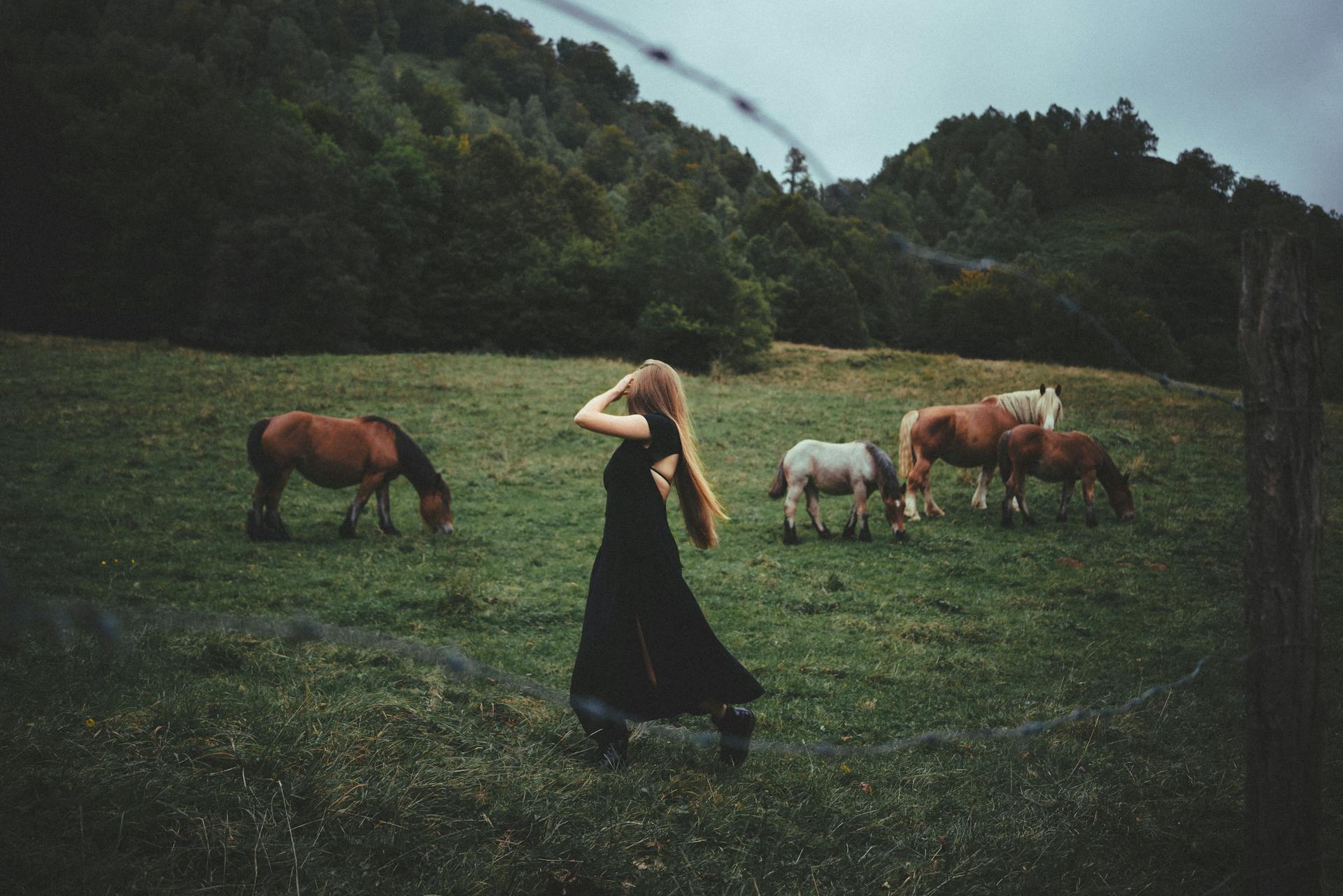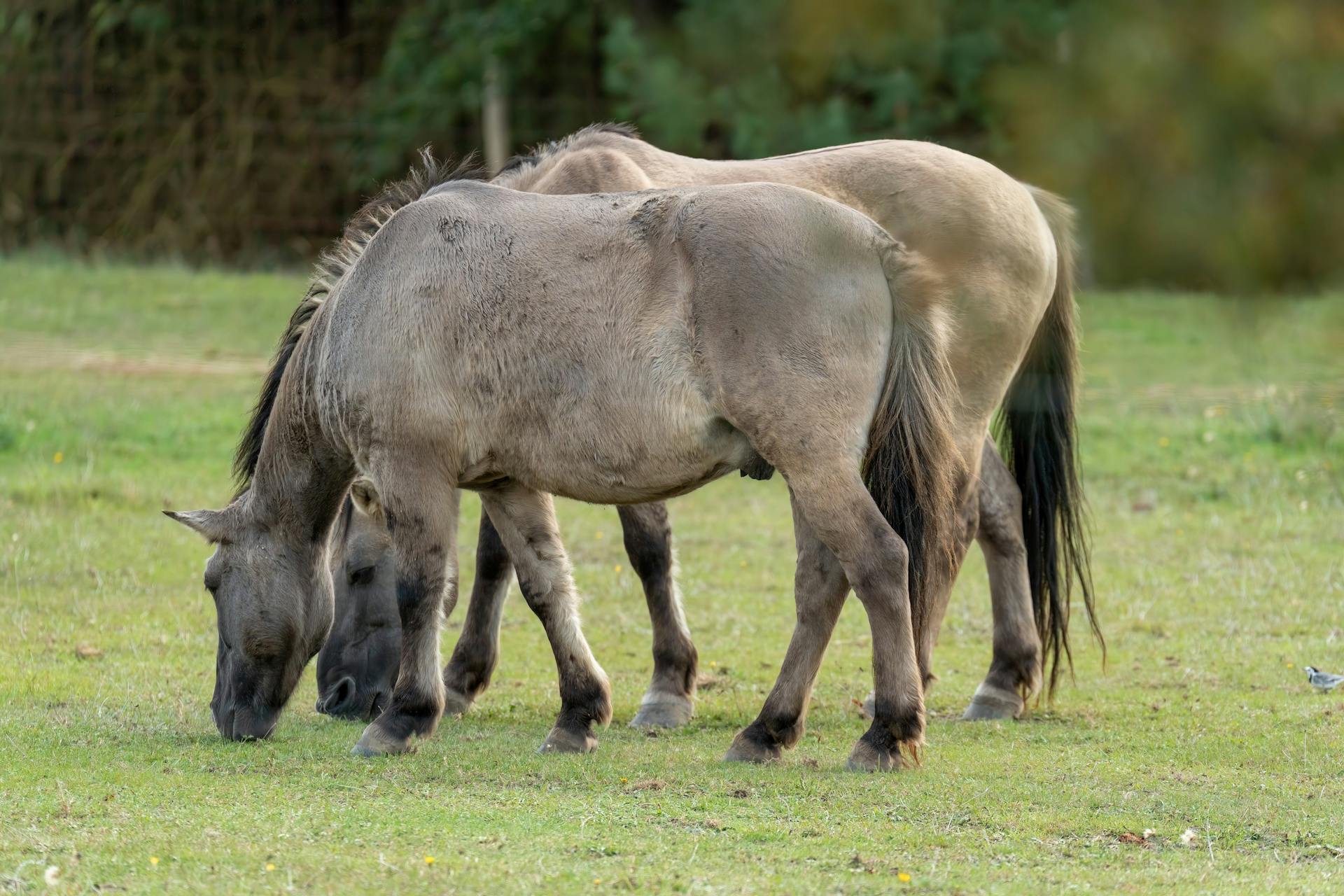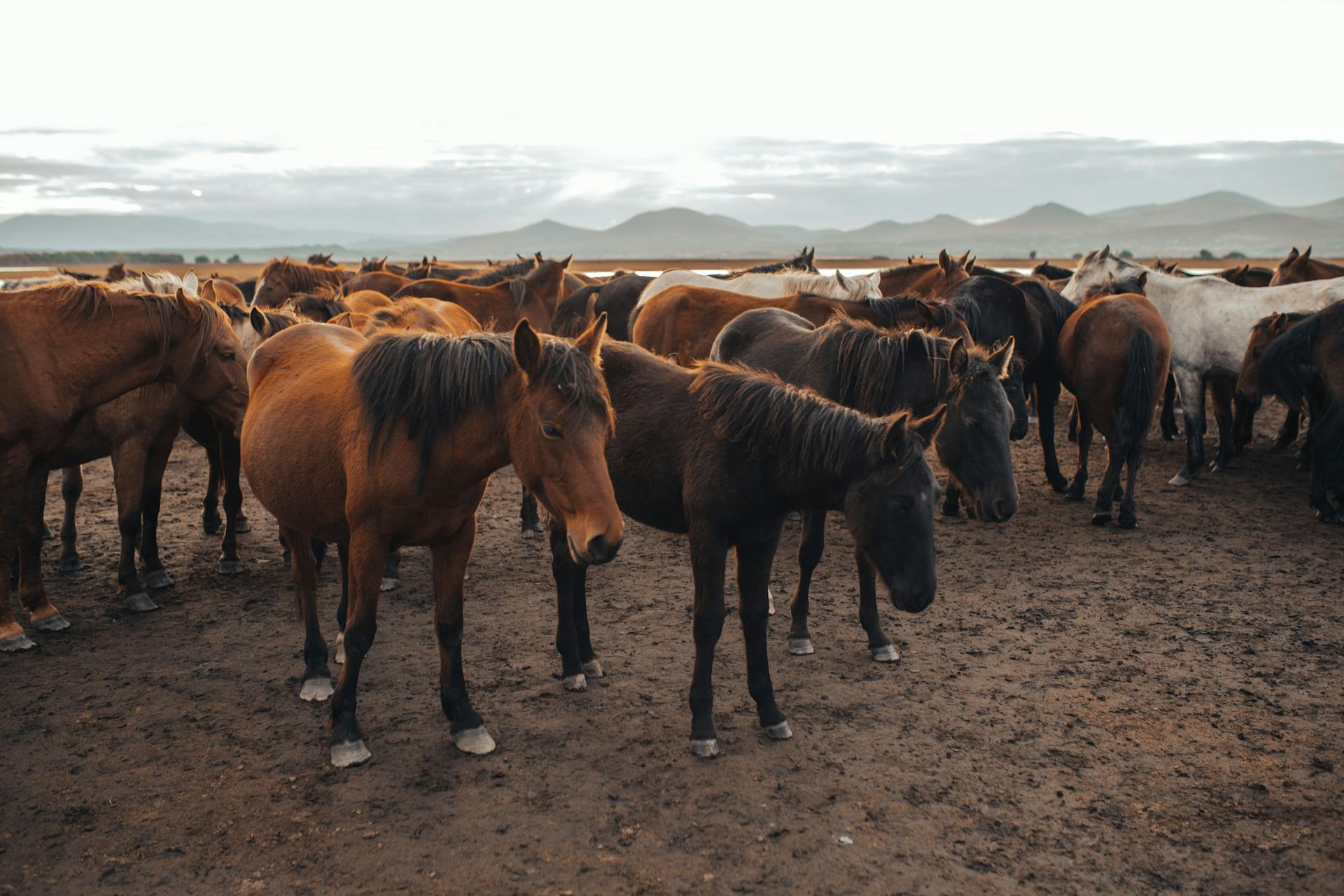
Wild horses have been roaming the American landscape for centuries, with estimates suggesting there are around 70,000 to 80,000 feral horses in the US.
These horses are primarily found in the western states, with the majority residing in Nevada, California, Oregon, and Wyoming.
Some of the most notable populations can be found in the following locations: the Virginia Range in Nevada, the Calico Mountains in California, and the Saddle Mountains in Washington.
The Bureau of Land Management (BLM) is responsible for managing and protecting these wild horse populations, working to maintain a balance between the horses' needs and those of other land users.
History and Origins
Horses evolved in North America, but became extinct between 8,000 and 10,000 years ago.
There are multiple theories for this extinction, including climate change and the arrival of humans.
The horse returned to the Americas with Christopher Columbus in 1493, and also arrived on the mainland with Cortés in 1519.
These horses were mostly Iberian horses, now described as "Spanish type", and became an important part of Native American culture.
The horse population expanded rapidly, and additional European settlers brought a variety of horse types to the Americas.
From all sources, some animals eventually escaped human control and became feral.
The Spanish Conquistadors were among the first to reintroduce horses to North America after a long absence of native horse species.
These horses adapted to the new environment and eventually spread across the continent.
Some horses were turned loose by their owners, some escaped, and still others survived shipwrecks that deposited them on American shores.
Modern studies have identified a few modern herds, including the Sulphur Springs herd, the Cerbat herd, the Pryor Mountains herd, and the Kiger herd, as retaining the original phenotype of horses brought to the New World by the Spanish.
Curious to learn more? Check out: Are Horses Native to the United States
United States and Distribution
In the United States, you can find free-roaming herds on some of the barrier islands along the East Coast, including Chincoteague Ponies, Banker horses, and Cumberland Island horses. These herds are managed by the National Park Service with assistance from various organizations.
Their populations are held stable through the use of contraception and removal and adoption. This is a deliberate effort to maintain a healthy balance between the horses and their environment.
Free-roaming horses can be found in saltwater marshes, on sandbars along the East Coast, and in the drought-prone American West. They compete with ranch animals for land, legal protection, water, and food in these areas.
Here's a list of some of the notable free-roaming horse herds in the United States:
- Chincoteague Ponies
- Banker horses
- Cumberland Island horses
- Placitas Herd (New Mexico)
- Virginia Range Herd (Nevada)
- Sheldon Herd (Nevada)
- Theodore Roosevelt National Park Herd (North Dakota)
- Salt River Herd (Arizona)
- Herds on Indian Reservations such as those on the Pyramid Lake Paiute, the Uintah and Ouray Ute and the Ute Mountain Ute Reservations.
US Distribution
The US Distribution of Wild Horses is a fascinating topic. Wild horses in the United States live in saltwater marshes, on sandbars along the East Coast, and in the drought-prone American West.
These horses compete with ranch animals for land, legal protection, water, and food. The geography of wild horses across the United States is as diverse as this species' history.
In the West, many herds are confined to Herd Management Areas (HMAs) that are managed by government agencies like the Bureau of Land Management (BLM). There are 177 HMAs across 10 Western states where horses are found.
If this caught your attention, see: Horse Management
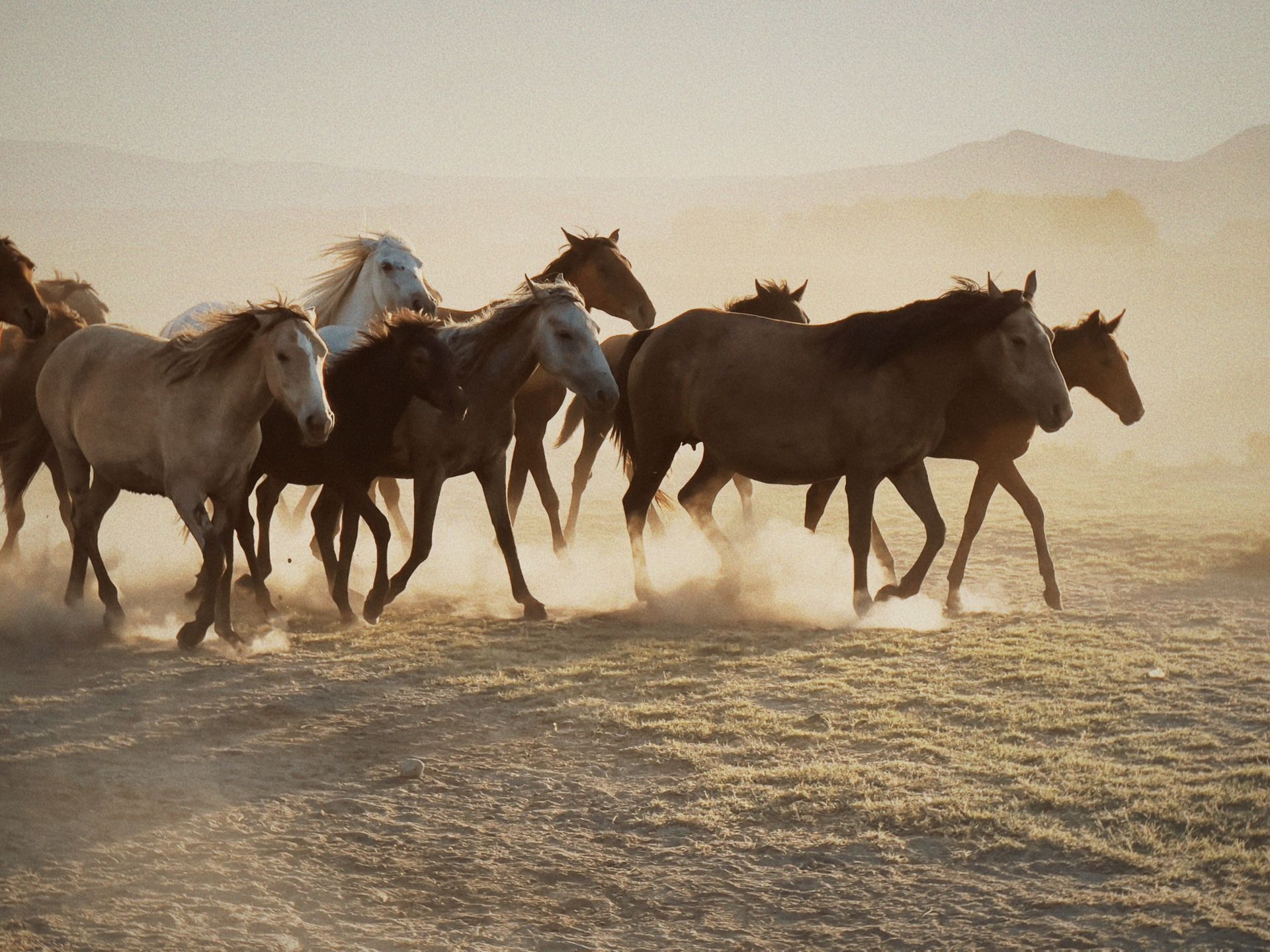
These areas are also managed for use by ranchers for grazing livestock, for public recreation, for hunting, and other uses that diminish the space and resources many wild horse herds need to thrive. The horses in these areas are competing with ranch animals for limited resources.
Here's a breakdown of the number of feral horses and burros by state:
On the East Coast, free-roaming herds can be found on some of the barrier islands, including Chincoteague Ponies, Banker horses, and Cumberland Island horses.
Outer Banks NC
The Outer Banks in North Carolina is home to a unique and fascinating population of wild horses. These horses, known as Colonial Spanish Mustangs, are the official state horse of North Carolina.
Each of the three horse populations in this area has around 100 stallions, mares, and foals. These horses can be found on Corolla Island, Shackleford Banks, and Ocracoke Island.
Visiting Shackleford Banks is a coveted destination, but it requires a 3-hour boat ride to access. This makes it a bit of a challenge for some visitors.
The Corolla Wild Horse Fund and the Foundation for Shackleford Horses are two organizations working to preserve these bands of feral horses.
Expand your knowledge: Sable Island Ponies
Western US Herds and Management
The Western US is home to several free-roaming horse herds, including the Placitas Herd in New Mexico and the Virginia Range Herd in Nevada. These herds are not protected by the Wild and Free-Roaming Horses and Burros Act, which only applies to unclaimed horses on lands managed by the BLM and USFS.
Some of these herds are thriving, while others are facing management dilemmas. For example, the Ute Mountain Ute Reservation is considering multiple options to manage their growing herd, including roundups, adoption, sterilization, sales, and even hunting. The Navajo Reservation's herd has also multiplied, prompting the tribe to explore similar options.
The management of feral horses in the US is a complex issue, with federal agencies like the BLM and USFWS working to balance the needs of these animals with ecological considerations and competition with ranchers. Despite the challenges, there are many individuals and organizations working to preserve the wild horse herds in the Western US.
These herds are an important part of the Western US's cultural and ecological heritage, and it's essential to find a balance that allows them to thrive while also addressing the needs of other species and human communities.
Western US Herds
The Western US is home to many free-roaming horse herds, some of which are managed by the Bureau of Land Management (BLM) and the US Forest Service (USFS). The Wild Free-Roaming Horses and Burros Act applies only to unclaimed horses on BLM and USFS lands.
The Placitas Herd in New Mexico is one such herd. Other notable herds include the Virginia Range Herd in Nevada, the Sheldon Herd in Nevada, and the Theodore Roosevelt National Park Herd in North Dakota. These herds are not managed by the BLM or USFS.
Some herds, like those on the Pyramid Lake Paiute, Uintah and Ouray Ute, and Ute Mountain Ute Reservations, are managed by the tribes themselves. However, the Ute Mountain Reservation herd is causing a management dilemma for Mesa Verde National Park.
Here are some of the notable free-roaming horse herds in the Western US:
- Placitas Herd (New Mexico)
- Virginia Range Herd (Nevada)
- Sheldon Herd (Nevada)
- Theodore Roosevelt National Park Herd (North Dakota)
- Salt River Herd (Arizona)
- Herds on Indian Reservations such as those on the Pyramid Lake Paiute, the Uintah and Ouray Ute and the Ute Mountain Ute Reservations
These herds face challenges related to their environments, human pressures, and climate change, which threaten their survival.
Feral Animal Management
Feral Animal Management is a complex issue in the Western US, where horses are largely considered feral by many state and federal agencies. These agencies, including the Bureau of Land Management (BLM), US Fish and Wildfire Service (USFWS), and the National Park Service, have implemented population control and habitat management policies to balance ecological considerations with cultural and economic concerns.
Feral horses have adapted to difficult environments, making them genetically resistant to many diseases that impact domesticated stocks. This is a result of their physiological and genetic differences from domesticated horses.
In an attempt to manage feral horse populations, federal agencies have implemented population control measures, which can be contentious. Many people, however, see feral horses as a valuable and iconic part of the Western US landscape.
Feral horses contain more genetic diversity than modern domesticated horses do, a result of their genetic remnants from ancient species.
Consider reading: United States Service Dogs
Conservation and Status
Wild horses in the United States are not considered an endangered species, as they are feral populations descended from domestic animals.
More than 70,000 free-ranging mustangs currently roam the U.S. According to the America's Mustang program.
Their population declined dramatically in the 20th century, from around 2 million in 1900 to just 17,300 in 1971, before being protected on public lands under the Wild Free-Roaming Horses and Burros Act.
The U.S. Bureau of Land Management controls mustang and burro numbers on public lands by capturing, holding, and offering them for adoption.
Debate and Controversy
The debate surrounding wild horses in the United States is complex and contentious. Many scientists, including those at BLM, argue that the land simply cannot support the growing number of free-ranging horses.
The distinction between "wild" and "feral" horses is crucial to this debate. Feral horses, like those descended from domestic horses brought to the continent by Europeans in the 16th century, are not native to the area and don't co-evolve with the ecosystem.
Activists argue that roundups are inhumane, breaking up families and traumatizing individuals. They believe that fertility control programs could have prevented these tragedies.
Expand your knowledge: What Are Feral Horses
Scientists point out that horses aren't a native species, and their presence can disrupt the delicate balance of the ecosystem. This is especially concerning in areas with worsening droughts and warming temperatures.
The National Wild Horse and Burro Advisory Board, a group of scientists that advises BLM, suggests that ecological-based decisions should be the priority. This means considering the impact of horses on the environment and finding ways to mitigate it.
Many activists, however, believe that BLM unfairly targets horses and should instead focus on reducing the number of livestock grazing public lands.
Data and Statistics
There are 82,384 wild horses and burros in the Western United States. This number includes 64,604 wild horses.
The Bureau of Land Management (BLM) manages 177 Herd Management Areas (HMAs) across 10 Western states where horses are found. These areas are also used by ranchers for grazing livestock, public recreation, hunting, and other purposes.
Many of these HMAs are located in states with large populations of wild horses, such as Nevada. More than half of the feral horses in the Western United States are found in Nevada, with an estimated 41,853 horses.
Here's a breakdown of the number of wild horses and burros by state:
Characteristics and Ancestry
Wild horses in the United States are a fascinating topic, and understanding their characteristics and ancestry is key to appreciating their unique place in the country's ecosystem.
Feral horses are descended from domesticated horses brought to the Americas by Spanish conquistadors in the 16th century.
Wild horses can be found in various regions, including the Great Basin, the Great Plains, and the Southwest.
They are known for their striking appearance, with a mix of breeds and coat colors, including bay, brown, and palomino.
Their average lifespan is around 25 years, although some have been known to live up to 30 years in the wild.
Wild horses are social animals, often living in small herds led by a dominant mare.
These herds can range in size from 5 to 20 horses, with some larger herds found in areas with abundant food and water.
Their ancestors were primarily Spanish Mustangs and other breeds brought to the Americas by early European settlers.
Wild horses have adapted to their environments over time, developing unique characteristics such as their ability to survive in harsh desert conditions.
Their ancestry is a testament to the resilience and adaptability of these incredible animals.
Check this out: List of Most Popular Dog Breeds in the United States
Frequently Asked Questions
Can you legally catch a wild horse?
No, it is not legal to catch a wild horse, as they are protected from capture by the Wild Free-Roaming Horses and Burros Act of 1971.
Featured Images: pexels.com