As a pet owner, it can be devastating to receive a cancer diagnosis for your furry friend. Fortunately, veterinary oncology services offer a range of treatment options to help manage and even cure pet cancer.
Veterinary oncologists, who are specialized veterinarians with training in cancer treatment, use various methods to diagnose and treat pet cancer, including surgery, chemotherapy, and radiation therapy.
From surgery to manage tumors and remove cancerous tissue, to chemotherapy to kill cancer cells, veterinary oncologists work with pet owners to create a personalized treatment plan that addresses the unique needs of their pet.
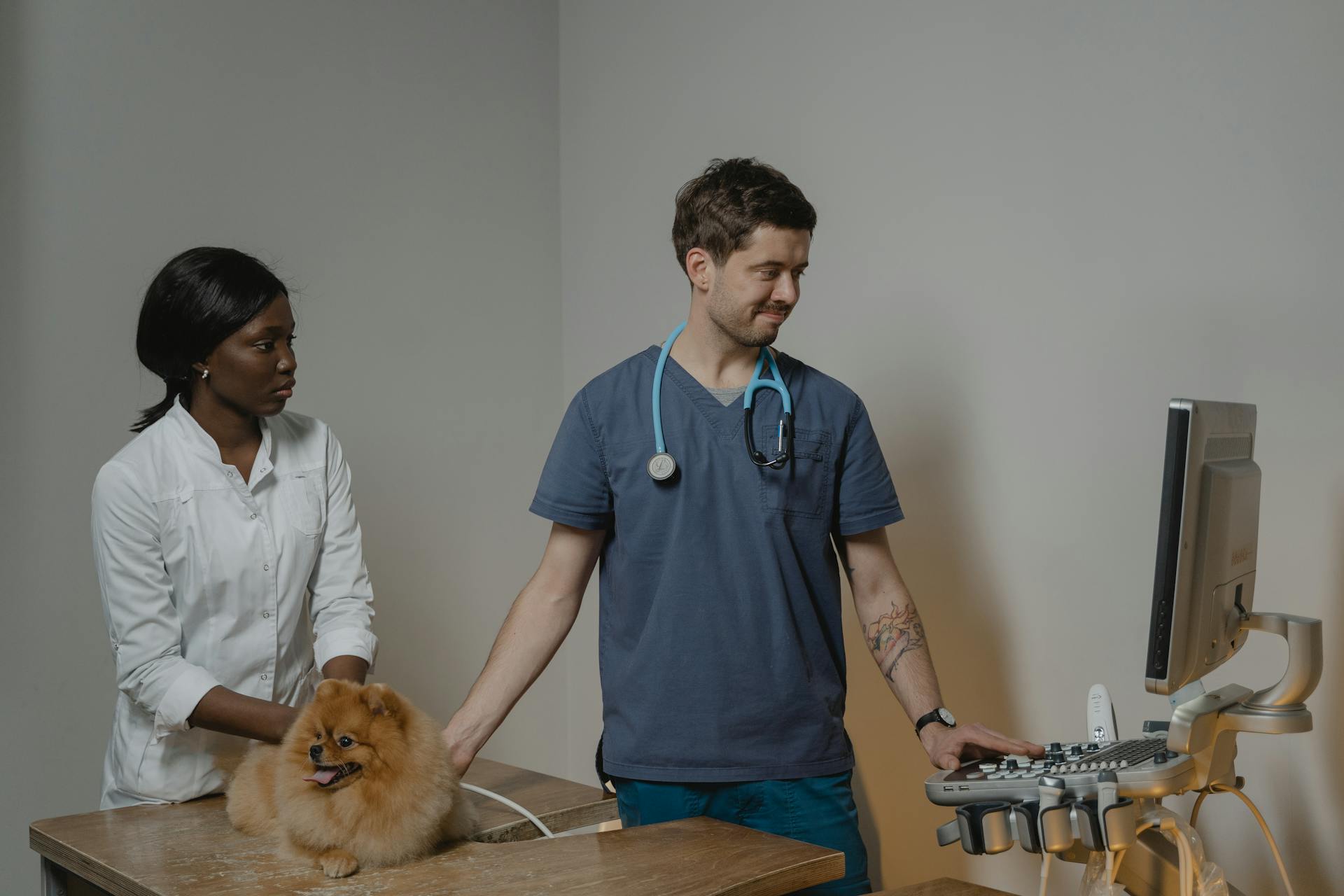
Accurate diagnosis is key, and veterinary oncologists use advanced imaging techniques, such as MRI and CT scans, to identify the type and extent of the cancer.
Explore further: Veterinary Surgery Technician
Common Types of Cancer in Pets
Cancer can affect any part of a pet's body. There are many different types of cancer, and they can be quite common in pets.
Some of the most common types of cancer in dogs include skin cancer, which tends to occur on areas of the body that are exposed to the sun.
Lymphoma, a type of cancer that affects the immune system, is also common in dogs. It can occur in the lymph nodes, spleen, or other parts of the immune system.
Other common types of cancer in pets include mast cell tumors, which can occur in the skin or internal organs, and osteosarcoma, a type of bone cancer that is often seen in larger breeds of dogs.
Discover more: Mammary Gland Cancer in Dogs
Lymphoma (Lymphosarcoma)
Lymphoma (Lymphosarcoma) is a common form of cancer in dogs that causes enlargement of multiple lymph nodes.
These lymph nodes can often be felt along the jaw, in front of the shoulders, in the armpits and groin area, and behind the "knee" area of dogs.
The diagnosis of lymphoma is usually straightforward and involves a fine needle aspirate to confirm the disease.
A sample is taken from one of the enlarged lymph nodes, spread onto a microscope slide, and examined by a pathologist for confirmation.
While lymphoma is rarely cured, it can be effectively treated with a regimen of four different medications: prednisone, cyclophosphamide, vincristine, and doxorubicin.
The medical oncology team will provide a variety of diagnostic and treatment options to find one that best suits you and your dog.
Explore further: Feline Mediastinal Lymphoma
Bone Tumors (Osteosarcoma)
Bone Tumors (Osteosarcoma) are a common type of cancer in pets, especially large to giant breed dogs.
These tumors usually arise within one of the limbs, and warning signs include lameness and swelling at the site of the cancer.
A diagnosis of osteosarcoma is confirmed through X-rays of the affected bone, followed by a fine needle aspirate of the tumor, and sometimes a biopsy.
Chest X-rays or a CT scan of the chest are also recommended to check for cancer spread to the lungs, as osteosarcoma tends to do early in the disease.
Treatment options for osteosarcoma include amputation followed by chemotherapy, but in some cases, a "limb sparing" surgery or radiation therapy may be viable alternatives.
While osteosarcoma is almost always a fatal disease, veterinarians can work with pet owners to control the cancer and improve the pet's quality of life for as long as possible.
The oncology team will discuss all treatment options with you, including limb removal, limb sparing surgery, and radiation therapy.
- Amputation followed by chemotherapy
- Limb sparing surgery
- Radiation therapy
Mast Cell Tumors
Mast Cell Tumors are a common type of cancer that affects dogs.
They most commonly arise on or just below the skin, although they can occasionally arise inside the chest or abdominal cavities.
A persistent swelling on or under the skin is a warning sign of a mast cell tumor.
These tumors are usually not painful.
Diagnosis is usually achieved by taking a sample from the swelling using a small needle (fine needle aspirate).
The sample is then examined by a pathologist for confirmation of the disease.
Treatment typically involves surgery to remove the tumor.
Our pathologists will examine the removed tissue and evaluate a number of tumor cell characteristics to determine the next best steps.
Based on their findings, there may be no additional treatment recommendations, or our oncology team may discuss radiation therapy and/or a drug called Palladia or chemotherapy with vinblastine and prednisone.
The good news about mast cell tumors is that there are many patients who can be cured of this disease.
For another approach, see: Canine Cancer Treatment
While a cure is not possible for every dog with mast cell cancer, there are a range of treatment options that can help prolong survival while maintaining a great quality of life.
Here are some common characteristics of mast cell tumors:
- Usually not painful
- Diagnosed by fine needle aspirate
- Treatment typically involves surgery
- May require additional treatment options such as radiation therapy and/or Palladia or chemotherapy
Nasal Tumors
Nasal Tumors are a type of cancer that can affect dogs, causing symptoms like blood dripping from one side of the nose, sneezing, facial disfigurement, or protrusion of an eyeball.
A CT scan is usually recommended to determine why a dog is experiencing these symptoms, as it can identify mass lesions that may be present.
Blood dripping from one side of the nose is a warning sign of nasal cancer in dogs.
To get a tissue diagnosis, a biopsy should be performed if a mass lesion is identified on the CT scan.
Radiation therapy is the most commonly recommended treatment option for dogs with nasal tumors.
Surgery is not recommended for dogs with nasal tumors unless it's combined with radiation therapy, because it's not possible to completely remove all of the tumor cells from the nasal cavity.
Medical or chemotherapy may be an additional option, depending on the type of cancer and its likelihood of responding.
While it's not possible to cure most nasal tumors, treatment can temporarily resolve clinical signs, improve a dog's quality of life, and prolong survival.
Warning Signs and Detection
If you notice any of the following signs in your pet, it's essential to take them to the vet right away. Lumps on the body or lymph nodes, limping, behavior change or lethargy, unexplained weight loss, decreased appetite, vomiting and/or diarrhea, and increased thirst and urination are all common warning signs of cancer in pets.
Some of these signs can be subtle, so it's crucial to be aware of any changes in your pet's behavior or physical condition. Persistent vomiting, diarrhea, and dramatic weight change are all red flags that require immediate attention.
A sudden change in your pet's energy levels or appetite can also be a sign of cancer. If you notice your pet is acting lethargic or has a decreased interest in food, it's time to take them to the vet.
Here are some key warning signs of cancer in pets:
- Masses, especially those that grow quickly, feel firm, or are changing in appearance (becoming bruised or ulcerated)
- Persistent vomiting
- Diarrhea
- Dramatic weight change
- Sudden lameness or swelling of the leg
- Blood coming from the mouth or nose, especially if accompanied by foul odor
- Swelling of the abdomen, especially if accompanied by decreased energy or pale gums
- Major changes in appetite and energy beyond normal age-related changes
Remember, early detection is key to treating cancer in pets effectively. By being aware of these warning signs and taking prompt action, you can help your pet receive the best possible care and improve their chances of recovery.
Treatment and Care
At VRCC's pet oncology department, you'll find board-certified veterinary oncologists committed to providing comprehensive cancer diagnostic and treatment options for your pet.
Working closely with other specialists and your primary care veterinarian, they'll ensure your pet receives the best possible care. After reviewing your pet's medical history and diagnosis, they'll sit down with you to discuss the disease, staging, treatment options, and prognosis.
Surgery is often an essential part of cancer management, and experienced surgeons are available on-site to manage your pet's cancer.
Veterinary cancer treatment protocols are designed to improve both the quantity and quality of life for your pet. Most patients can continue to participate in all the same activities they did before the diagnosis, and can lead their normal lifestyle.
Pet Care & Treatment in Denver
At VRCC's pet oncology department in Denver, you'll find a team of board-certified veterinary oncologists who are committed to providing the best possible care for your pet.
We have experienced surgeons on-site who work to manage your pet's cancer, often combining treatments such as chemotherapy, radiation therapy, and surgery to achieve the best results.
Most patients continue to participate in all the same activities they did before the diagnosis, and can continue to lead their normal lifestyle after cancer therapy.
Less than 5% of chemotherapy patients will need to be hospitalized due to chemotherapy side effects, making it a relatively safe and manageable process.
Our goal is to make the chemotherapy visits to Pieper Veterinary as pleasant and positive an experience as possible, with mild side effects that can be managed at home.
After reviewing your pet's medical history and diagnosis, we'll sit down with you to discuss the disease, staging, treatment options, and prognosis, working closely with other specialists and your primary care veterinarian.
We're dedicated to providing comprehensive cancer diagnostic and treatment options, ensuring your pet receives the best possible care.
Immunotherapies
Immunotherapies are a powerful tool in the fight against cancer. They harness the body's immune system to fight disease, and Penn Vet's Nicola Mason is working with Penn Medicine to further develop these treatments that are already showing promise in both canine and human patients.
Immunotherapy is being used to treat various types of cancer in pets, and it's an exciting area of research. Faculty and clinicians at Penn Vet are actively engaged in groundbreaking research in cancer care, including developing an immunotherapeutic treatment for canine osteosarcoma.
This innovative approach has led to promising results, with some of the faculty's research being used in human clinical trials. By using the body's immune system to fight cancer, immunotherapies offer a new hope for pets and people alike.
Immunotherapies are often used in combination with other treatments, such as chemotherapy, radiation therapy, and surgery. At UW Veterinary Care, the small animal oncology specialists work together to determine the best options for each patient, bringing together the best cancer expertise and most effective treatments.
Take a look at this: General Practice Veterinary Care
Our Team and Services
Our team of veterinary oncologists is comprised of experienced professionals who are dedicated to providing the best possible care for your pet. We have a diverse range of experts, including Ruthanne Chun, Xuan Pan, MacKenzie Pellin, and David Vail, who are all board-certified in veterinary oncology.
Each member of our team brings their own unique expertise and perspective to the table, ensuring that your pet receives comprehensive and personalized care. Our team includes Clinical Professor Ruthanne Chun, Assistant Professor Xuan Pan, and Professor David Vail, among others.
We understand that every pet is different, and that's why we take the time to get to know you and your pet. We'll work closely with you to understand your pet's needs and develop a treatment plan that's tailored to their specific situation.
Our team includes a range of specialists, including veterinary oncologists, radiologists, and radiation oncologists. Some of our team members include Lisa Forrest, Michelle Turek, and Nathaniel Van Asselt.
We're committed to providing you with the information and support you need to make informed decisions about your pet's care. We'll take the time to explain your pet's diagnosis, treatment options, and prognosis, so you can feel confident in the care we're providing.
Our team is dedicated to staying up-to-date with the latest advances in veterinary oncology. We participate in clinical studies and stay current with the latest research, so we can provide the most effective and compassionate care for your pet.
Here are some of the veterinarians who make up our team:
- Ruthanne Chun, DVM, DACVIM (Oncology), Clinical Professor
- Xuan Pan, VMD, PhD, DACVIM (Oncology), Assistant Professor
- MacKenzie Pellin, DVM, DACVIM (Oncology), DACVR (Radiation Oncology)
- David Vail, DVM, MS, DACVIM (Oncology), Professor
- Lisa Forrest, VMD, DACVR (Radiology, Radiation Oncology), Professor
- Michelle Turek, DVM, DACVIM (Oncology), DACVR (Radiation Oncology), Clinical Assistant Professor
- Nathaniel Van Asselt, DVM, DACVR (Radiation Oncology)
- Ann Marie Picone, DVM
- Rachel McMahon, DVM
- Han-Yun Cheng, DVM, MVM
- Kirsten Andersson, DVM
- Christen Montesanto, DVM
Research and Technology
Faculty at Penn Vet are leading the way in cancer care research, developing innovative treatments like immunotherapeutic treatments for canine osteosarcoma.
These groundbreaking approaches are not only benefiting dogs but also informing human clinical trials, showing the potential for cross-species breakthroughs in cancer treatment.
David Holt at Penn Vet has partnered with Penn Medicine to improve detection of surgical margins, a crucial step in removing soft tissue sarcomas, using a technique that involves dye and special imaging equipment.
Imaging Systems
Imaging Systems are crucial in both veterinary and human surgical oncology. David Holt, a veterinarian at Penn Vet, has partnered with Penn Medicine to improve cancer detection.
A technique using dye and special imaging equipment is being offered to Ryan Hospital patients. This surgery is vital for ensuring the entire tumor is resected.
This technique is a significant advancement in cancer treatment. It allows for more accurate detection of surgical margins during surgery.
A fresh viewpoint: Canine Cancer Detection
Research in Care
Penn Vet is a leader in innovative approaches to treating cancer, with faculty and clinicians actively engaged in groundbreaking research in cancer care.
Faculty at Penn Vet are developing an immunotherapeutic treatment for canine osteosarcoma, a type of bone cancer in dogs.
This research is not limited to animals, as some of the faculty's results are now being used in human clinical trials.
Penn Vet is also a member of the Comparative Oncology Trials Consortium (COTC), which provides access to new cancer drugs in the early stages of testing.
The COTC is an active network of twenty academic comparative oncology centers, centrally managed by the NIH-NCI-Center for Cancer Research’s Comparative Oncology Program.
The goal of this effort is to design and execute clinical trials in dogs with cancer to assess novel therapies and inform the development path of these agents for future use in human cancer patients.
Client Experience
The client experience at a veterinary oncology practice can make all the difference in a pet owner's journey. Dr. DeRegis and her team are clearly dedicated to providing top-notch care and compassion.
Their staff is described as "excellent", "amazing", and "caring", with many clients expressing their trust and confidence in their abilities. Dr. DeRegis is praised for her expertise and wonderful bedside manner.
The oncology team goes above and beyond to demonstrate care and compassion, with one client saying they "love" the team and feel very comfortable with their pet's care. The front desk staff is also welcoming and supportive.
A fresh viewpoint: The Client of a Veterinary Practice Is the
A client's experience was described as "pleasant and stress-free", with Dr. DeRegis explaining everything and answering all questions. The staff is also patient and supportive during emotional times.
The chemotherapy staff is particularly notable, giving pets love and attention on chemo days and making them excited to visit the office.
Frequently Asked Questions
How much do veterinary oncologists make in the US?
Veterinary oncologists in the US can earn an estimated $288,357 per year, with a median salary of $177,143. Discover the factors that influence their compensation and learn more about this rewarding career.
Featured Images: pexels.com